
A bit of an obsession with Diane Arbus

Identical Twins, Roselle, New Jersey, 1967. © Estate of Diane Arbus

I seem to have developed a bit of an obsession with Diane Arbus of late. I think it started when I read about the exhibition: Diane Arbus. In the beginning at the Met Breuer. Of course I’d seen some of her more famous pictures (the twins; the boy with the hand grenade; etc.) but I didn’t really know much about her. I felt like reading something about photography so I browsed around on Amazon.com and came up with this: Diane Arbus: Portrait of a Photographer and bought the Kindle version. I don’t usually buy electronic versions of photography books because I like to see the photographs in their full glory. However, the reviews of this book indicated that there were no Arbus photographs in it because the author hadn’t been able to obtain rights to use them. So I figured I wasn’t losing much by getting the e-book. It was an interesting (and long – coming in at over 700 pages) read, but I missed not having the photographs.

So I thought I’d get a book with Arbus photographs and bought: Diane Arbus: An Aperture Monograph: Fortieth-Anniversary Edition . This book is virtually the opposite to the Lubow book in that it’s almost all photographs and virtually no text. What little text there is is mostly in the form of Arbus’s words taken from interviews and recorded lessons. She apparently didn’t like to teach (doing it mostly for the money it brought in) and doesn’t seem to have been particularly good at it. It’s more a series of disjointed thoughts than anything else. The pictures are impressive though.

Finally I found a number of articles on the internet, the most interesting of which was: Freak Show by Susan Sontag. Where Lubow is largely postitive towards Arbus’s work Sontag is much more negative saying at one point:

The ambiguity of Diane Arbus’s work is that she seems to have enrolled in one of art photography’s most visible enterprises—concentrating on victims, the unfortunate, the dispossessed—but without the compassionate purpose that such a project is expected to serve.

.

After all of this what do I think about Arbus? Her reputation certainly doesn’t come from her photographic technique. The exposure isn’t always right. Composition seems to be off. Her fans are effusive about her ability to bring out the “inner person”. In “Looking at Photographs” John Szarkowski says of her:

With rare exceptions, Arbus made photographs only of people. The force of these portraits may be a measure of the degree to which the subject and the photographer agreed to risk trust and acceptance of each other. She was interested in them for what they were most specifically: not representatives of philosophical postitions or life styles of physiological types, but as unique mysteries. Her subjects surely perceived this, and revealed themselves without reserve, confident that they were not being used as conscripts to serve an exterior issue. They were also doubtless interested in her. At times it may have been unclear which was the mariner and which the wedding guest.

While this may be true for many of the “freak” pictures I don’t believe this is the case with many of her pictures of “normal” people. As described in the Lubow book she often used techniques (making people wait; making them hold poses for very long periods of time; making the sessions excessively long etc.) designed to frustrate and annoy. The famous picture of the boy with the hand grenade may serve as an example. The contact sheet containing this picture is available on the internet. It contains 12 photographs, 11 of which show the boy. In ten of these he looks like a perfectly normal child. Arbus chose to use the twelfth picture where he looks like a psychopath. Did she capture his inner personality (Lubow interviewed the child for his book and he certainly doesn’t seem to have become a psychopath) or did she “cherry pick” a picture where he finally showed his frustration for a fleeting second?

So I’m not entirely sure where I stand regarding Diane Arbus. While I have some concerns and doubts I still find myself fascinated by her work and I’m not entirely sure why. Maybe it will become clearer over time?

I will probably make a trip into the city to see the above exhibition though.
A small gripe

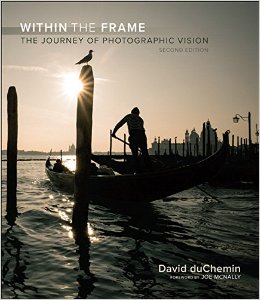
We took three of our grandchildren to the movies today. I didn’t especially want to see the movie (Pete’s Dragon) so I went off to Barnes and Noble to wait until they’d finished. While there I started reading “Within the Frame: The Journey of Photographic Vision” by David Duchemin. I’m a fan of Mr. Duchemin’s and I have a few of his books. I like the way he focuses on vision rather than on technique. However, in reading his introduction I came across this paragraph:

This is a book about the passionate photography of people, places, and cultures. It’s a book about chasing your vision and telling your stories as clearly and passionately as possible with compelling photography. It’s a book for everyone who’s wanted to shoot images of the places and people they love, whether or not they ever go around the world to do it.

Mr.Duchemin lives in Victoria, British Columbia and he does include a few (very few) pictures from there (particularly Vancouver) but most of them are from further afield: India; Kenya; Italy; Nepal; Ethiopia; Tunisia; Vietnam; Cuba; Thailand; Egypt; Ecuador. Apparently Mr. Duchemin likes to shoot: “places and people” he loves in exotic locales. Pity. Most people to not get travel to the extent that he does and it would have been nice to see a fe pictures of places that that did not require going “AROUND THE WORLD TO DO IT”. I would have enjoyed seeing some pictures along the lines of: “I took this one walking back from the pub”. Or “I was sitting in my backyard when…”. Possibly such mundane locales do not appeal to Mr. Duchemin.

As usual though I did enjoy the remainder of the book – or at least those portions I had time to read.

Donkey and Foal

In a recent post: Soul/Creativity on his Photos and Stuff blog, Andrew Molitor provides the following quote (which he attributes to Ansel Adams):

The final image you achieve will, to quote Alfred Stieglitz, reveal what you saw and felt. If it were not for this element of felt, the term creative photography would have no meaning.

For many years I had difficulty with the first part of this quote: revealing what I saw. My failure to do this almost led me to abandon photography. I didn’t develop or print my own film so my options were limited. This changed (although it took me a while to realize it) with the advent of digital photography and now, with a little help from Lightroom and even less from Photoshop I’m able to get an image, which is much closer to what I thought I would get when I pressed the shutter button.

The second part of the quote suggests that I should also try to reveal what I felt when I took the picture. I hadn’t thought much about this aspect. My first reaction was to think that I didn’t really feel much at all. But then it occurred to me that I’m not, I hope, some kind of psychopath who doesn’t feel anything at all. I must be feeling something. I just have to try harder to articulate what it is.

Unfortunately, I often look back on old photographs and rework them. This particular picture was taken in 2013 so my memory of what I felt at the time is a bit vague. I imagine, however, that it was something along the lines of “Aw how cute! The little one is trying to hide behind the other one”. Ok, maybe not the deepest, or most thought provoking feeling, but that’s probably it.

Another Freeman Patterson book: Photographing the World Around You

I already have one book by Freeman Patterson: Photography and the art of seeing. I enjoyed reading it so when I came across this one for sale (used) for a very reasonable price I decided to get it. Where my initial purchase focused very much on developing photographic vision this one focuses more on elements of design. It’s based on actual workshops conducted by Mr. Freeman who attempts to create a workshop in a book – not always successfully I felt. You just can’t create the feel of a workshop: the interaction with the faciliators; the interaction between the participants; the social aspects etc. in a linear print presentation.

The first sections explain the basic building blocks of visual design and how to put them together into a coherent whole. They were somewhat interesting, but I’d read similar material before and so didn’t find a lot that was new.

I enjoyed the third section on “Evaluating your Photographs”, which was really Mr. Freeman trying to explain how to do this by evaluating some of his own photographs. I didn’t always agree with the points he was trying to make.

The next section is on “Assignments”. Once again it’s Mr. Freeman discussing some assignments that he had set for himself in the following areas: people; natural things; human constructions and manufacturer things. It’s really about the importance of setting yourself assignments and not just randomly shooting.

The final (very short) section is about “Making an Album”. This, too, is carried over from Mr. Freeman’s workshops. It seems that on the final afternoon of each workshop the participants show their ten favorite photographs. Here it seems to be just another opportunity for Mr. Freeman to present some of his photographs – in this case eight rather than the ten the workshop would demand.

As with the earlier book I learned a few things; picked up a few ideas and enjoyed some of his anecdotes. However, I’m not sure that I learned enough to justify the purchase. Had I paid full price I would probably have been disappointed.

I also discovered that I don’t actually like his photographs all that much. They’re competent enough, but they don’t really engage me much emotionally. I don’t feel the desire to look at them over and over again the way I would with a Weston; a Strand; a Cartier-Bresson etc. I felt that I could, and have, made photographs similar to many of his. Maybe that’s the point: follow my advice and almost anyone, even you, can make pictures of a certain quality. That may be true, but for me at least I want to get past this point and make pictures that say something; that people want to look at. And I’m finding it extremely difficult to do so. I’m not sure that this book helps me much.

Haven’t been getting out much lately

I wasn’t able to get out much to take pictures this July.

First, we had an unusually large volume of visitors. It started with a visit from our younger daughter, who was in NY on business. She wasn’t able to come out and visit, so we went into the city to have lunch with her at the Oyster Bar in Grand Central Terminal. Then two old friends came to stay over the weekend. They had both suffered losses in 2015: one the death of a husband, and the other a death of a child. It was great to have them with us. We took them to see a production of “As you like it” at the Hudson Valley Shakespeare Festival at Boscobel. This was followed by a quick visit from one of our sons-in-law (the husband of our younger daughter). He frequently comes to NY on business so we see him quite a lot. After him our older daughter and her family (husband and three grandchildren) came to stay (from Amman, Jordan). The month ended with a visit from one of my wife’s former colleagues and a friend of hers. The weather was bad, but the rain managed to hold out long enough for us to visit nearby Chuang Yen Monastery (above), to sit down on the dock for a while, and to have dessert on the patio.

Second, the weather has (at least from my perspective) been terrible. It was very hot (high 90sF/low 100sF) and extremely humid for some time. This is my least favorite weather. Eventually it cooled down, but then turned stormy. We’ve just had a very wet weekend (6+ inches of rain). Even when there were breaks I didn’t feel like walking around taking pictures.

Third, somewhere along the line I developed a stiff neck (a little painful, but not excessively so); and a painful left foot (probably from being on my feet cleaning the house for 12 hours followed by four hours cooking the next day. Finally, I woke up this morning with a runny nose, sneezes, and a sore throat. My wife has had these symptoms for about a week so I guess I got it from her. Shouldn’t complain though. I can’t remember when I last had a cold.

The weather is supposed to improve tomorrow and remain good for most of the following week. If my cold doesn’t get significantly worse I hope to be able to get out with a camera. I’m looking forward to it.