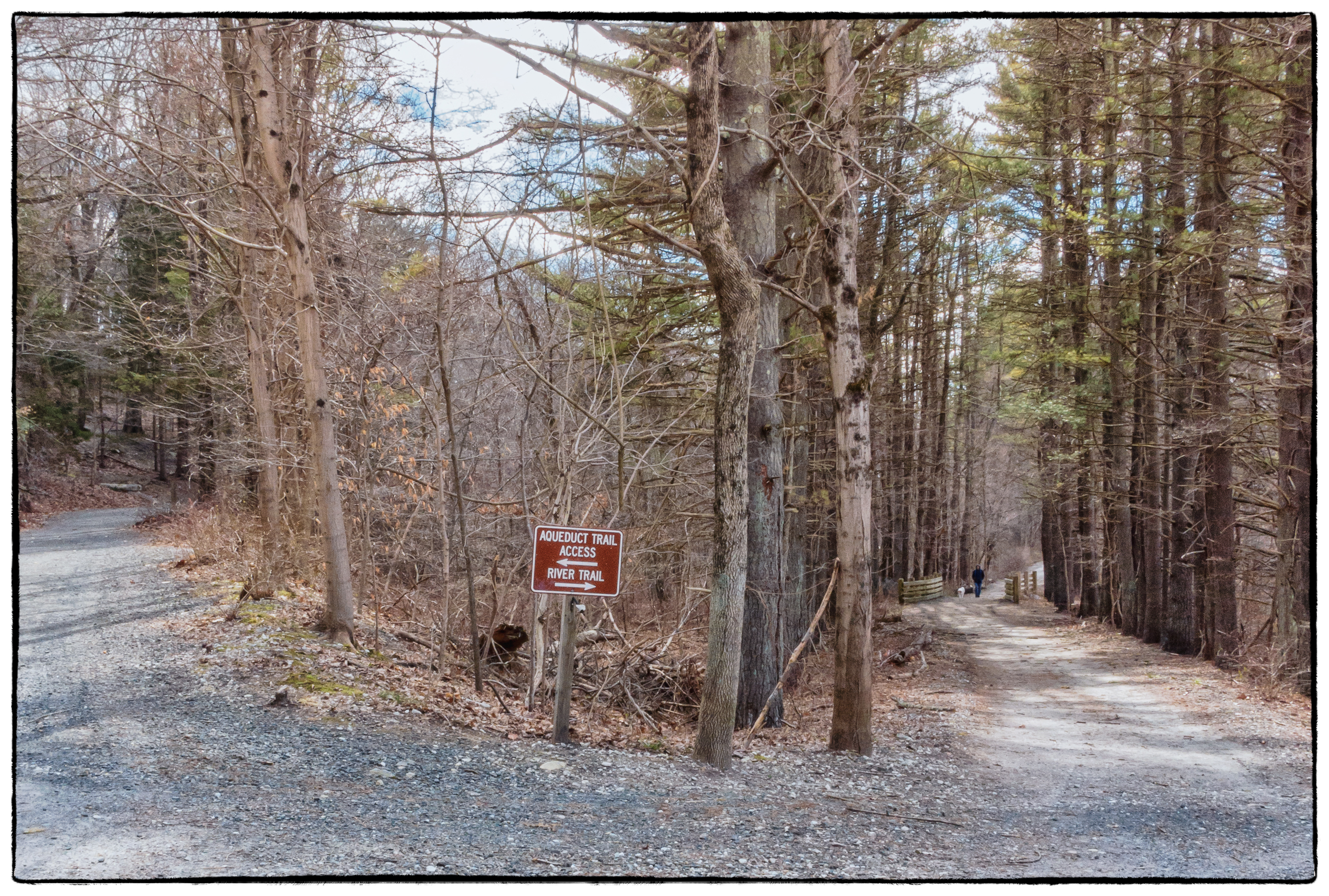
Croton Gorge – A fork in the road

Or perhaps more accurately a fork in the trail. This was taken just after a series of cold, gloomy, wet days. I was getting tired of walking the dog around the lake, but couldn’t think of anywhere else that wouldn’t be extremely muddy.

My wife remarked: “Why don’t you go to Croton”. She probably meant “Croton Landing”, which is a flat, paved stretch along the banks of the Hudson. She prefers this type of environment for walking rather than the undulating, rocky, root bound trails that I favor. It was a windy day and I thought that a walk along the Hudson might be just a bit too windy. However, “Croton” was not such a bad idea so I went to “Croton Gorge” instead. Starting off down the trails I soon came to this fork.

Robert Frost’s famous poem came to mind:

Two roads diverged in a yellow wood,
And sorry I could not travel both
And be one traveler, long I stood
And looked down one as far as I could
To where it bent in the undergrowth;

Then took the other, as just as fair,
And having perhaps the better claim,
Because it was grassy and wanted wear;
Though as for that the passing there
Had worn them really about the same,

And both that morning equally lay
In leaves no step had trodden black.
Oh, I kept the first for another day!
Yet knowing how way leads on to way,
I doubted if I should ever come back.

I shall be telling this with a sigh
Somewhere ages and ages hence:
Two roads diverged in a wood, and I—
I took the one less traveled by,
And that has made all the difference.

Robert Frost: The Road Not Taken

Another sage (Yogi Berra) is reputed to have said: “When you come to a fork in the road, take it”.

Yet another wag noted “Two roads diverged in a wood, and I—I took the one less traveled by, and now I don’t know where the f@*k I am.”

I took the trail to the right and it took me to an old building overlooking the Croton River, and (since I didn’t continue along the “River Trail”) eventually back to the “Aqueduct Trail” and the Croton Dam.

Pipilotti Rist: Pixel Forest 1

Last November we went to see an exhibition at the New Museum in New York City. It was by Swiss Artist Pilotti Risk and I must admit that I’ve never seen anything quite like it. It spanned several floors and the Museum’s website describes it as follows:

Over the past thirty years, Rist (b. 1962) has achieved international renown as a pioneer of video art and multimedia installations. Her mesmerizing works envelop viewers in sensual, vibrantly colored kaleidoscopic projections that fuse the natural world with the technological sublime. Referring to her art as a “glorification of the wonder of evolution,” Rist maintains a deep sense of curiosity that pervades her explorations of physical and psychological experiences. Her works bring viewers into unexpected, all-consuming encounters with the textures, forms, and functions of the living universe around us.

Occupying the three main floors of the Museum, “Pipilotti Rist: Pixel Forest” is the most comprehensive presentation of Rist’s work in New York to date. It includes work spanning the artist’s entire career, from her early single-channel videos of the 1980s, which explore the representation of the female body in popular culture, to her recent expansive video installations, which transform architectural spaces into massive dreamlike environments enhanced by hypnotic musical scores. Featuring a new installation created specifically for this presentation, the exhibition also reveals connections between the development of Rist’s art and the evolution of contemporary technologies. Ranging from the television monitor to the cinema screen, and from the intimacy of the smartphone to the communal experience of immersive images and soundscapes, this survey charts the ways in which Rist’s work fuses the biological with the electronic in the ecstasy of communication.

Pipilotti Rist was born in Grabs in the Rhine Valley, Switzerland, and currently lives and works in Zurich. She studied graphic design, illustration, and photography at the University of Applied Arts in Vienna and audiovisual communications and video at the Basel School of Design. Solo exhibitions of her work have been presented internationally at venues including Kunsthaus Zürich (2016); Kunsthalle Krems, Austria (2015); Times Museum, Guangzhou, China (2013); Leeum, Samsung Museum of Art, Seoul, South Korea (2012); Fondazione Nicola Trussardi, Milan (2011); the Hayward Gallery, London (2011); the Wexner Center for the Arts, Columbus, OH (2011); Museum Boijmans Van Beuningen, Rotterdam, the Netherlands (2009); the Museum of Modern Art, New York (2008); Centre Georges Pompidou, Paris (2007); and the Contemporary Arts Museum Houston, TX (2006); among many others. Rist was awarded the Zurich Festival Prize (2013), the Harper’s Bazaar Art China Prize (2012), and the Joan Miró Prize (2009).

The picture was taken on the first floor we encountered. It was actually a lot darker than it appears in the photograph.

Did I like the exhibition? Yes, I believe I did. Unfortunately, it closed in January, 2017

On the streets of NY

I don’t do much street photography. It usually involves people and I have something of aversion to taking pictures of people I don’t know. Once in a while I’ll give it a try though, just to see what kind of results I can get. This was taken somewhere (I don’t remember exactly where) on the east side of Manhattan. I do recall that I was using a Sony NEX 5n with a Canon 50mm f1.4 in Leica thread mount. Since I had no autofocus and I can’t focus manually quickly I’d pre-focused on the grid in the middle of the road and waited for someone to come by. For once I managed to get the focus about right. All in all I quite like it, but I don’t see me spending lots of time on this genre.

Woman in a big hat

Even though it was taken back in June 2012 I can clearly remember taking this picture. We were going with some friends to an antique car show on the grounds of Maryknoll in Ossining, NY but first we went to eat in a great Peruvian restaurant (I think it was Actuario) in Portchester, NY. There were tables outside, but we decided to eat indoors. As we were leaving I spotted this colorful woman sitting outside. A lot of things caught my attention: the bright colors (magentas, pinks, blues); the large hat; the big sunglasses; the dangling colorful earrings. She was accompanied by a rather cute, small white poodle adorned with ribbons that matched the color of the woman’s sweater. Quite a sight! I asked her if I could take some pictures and she agreed.

Angel in Ossining

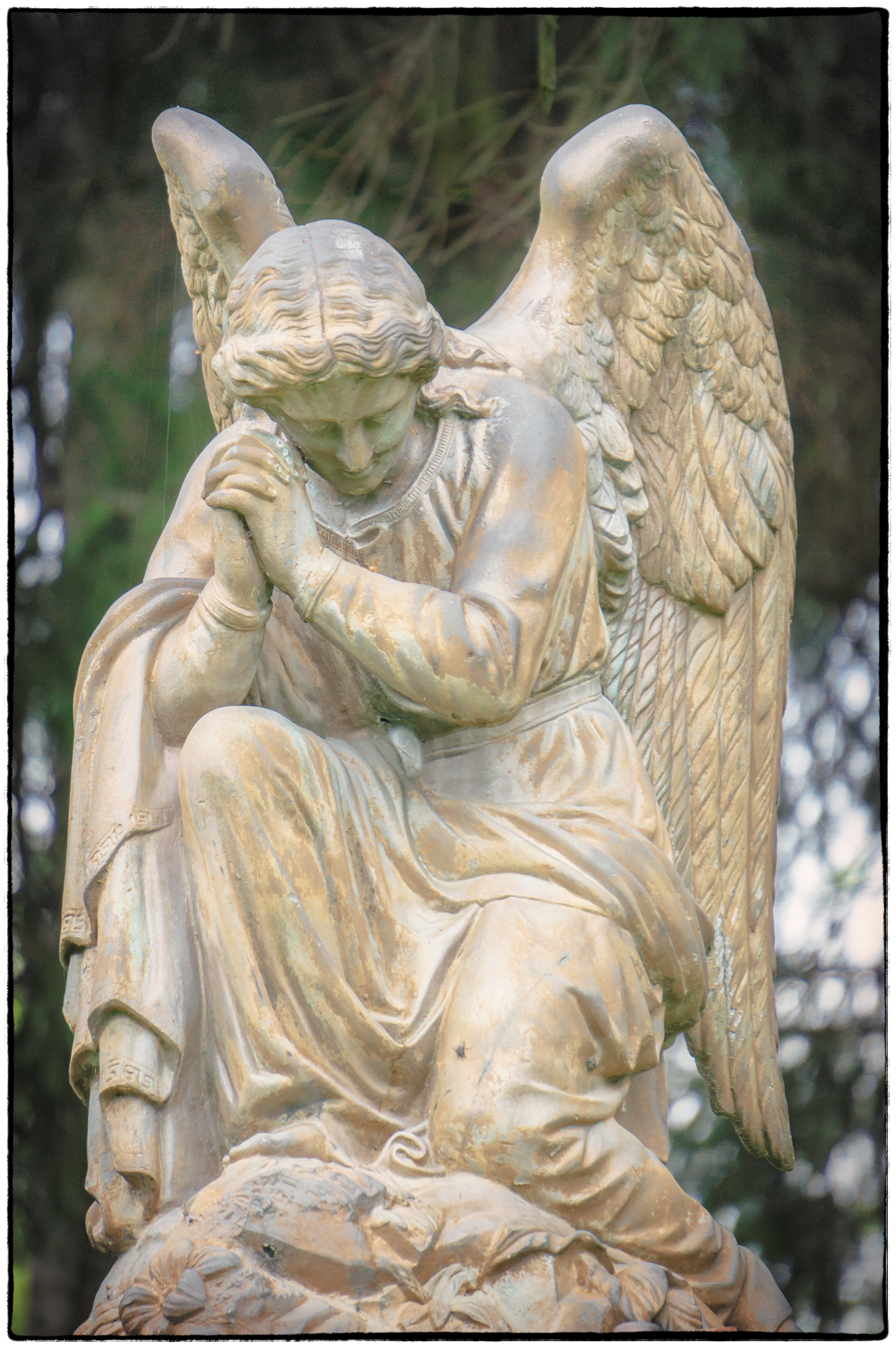
This is one of two Civil War memorials in Ossining. The other one is more visible (it’s on the corner of Pleasantville Road and Brookville Ave) and I’d seen it on numerous occasions, but this one is “hidden” in a small park near Route 9. The Field Guide to US Public Monuments and Memorials describes it as follows:

The monument remembers soldiers of Ossining, New York, who died fighting in the Civil War. Those killed were men, both privates and officers, most from the 17th U.S. Volunteer Regiment and the 6th U.S. Heavy Artillery. At the memorial’s highest point, an angel in full-length gown displaying wings is down on one knee with head bowed and hands folded, mourning and honoring those who perished in the fighting. Kneeling Angel is one of two Civil War remembrances in Ossining. The angel, surmounted on a pedestal of granite and marble, is cast in “white bronze.” This description partly obscures the detail that this material is not actually bronze (an alloy of copper and brass); but rather, it is comprised of copper, tin and zinc. The pedestal design presents in three sections. Its lowest is its base; in an older picture from the Westchester County Historical Society, the stone base seems a well polished, variegated marble. The pedestal’s second and third sections, following Scharf, are comprised of “two massive blocks of granite….” The lower contains inscriptions and plaques with the names of the war dead; two bronze, profile bust-view relief plaques, evidently painted brown, on the north-facing panel that of Lincoln and on the south-facing, a uniformed Civil War soldier. The upper pedestal section displays bunting, flags, cannon and drums. These three sections are capped by the kneeling angel. Neither artist nor maker(s) appear to be known. While the monument’s design and sculptural program are multi-dimensional and far-reaching, the work’s general deteriorated condition seems to suppress further impression-making.

After the close of the Civil War – Scharf states “shortly after,” Hernandez puts it at “1870,” a Ladies’ Monument Association emerged in the town of Sing Sing (now Ossining), formed by women seeking to erect a monument to remember and honor the men who had died in the conflict. (The year 1870, then, is the assumed Start of the monument’s creation process.) By 1872 the group had raised enough money to put the monument’s cornerstone in place, which it did on July 4, 1872. In order to continue to the next development stage, the Ladies Association and local Civil War veterans combined forces and created the Monumental Dramatic Association. This group put on entertainments, plays, which allowed them to raise further funds so they could complete the monument; they did so, in spite of difficulties, and on May 30, 1879, the monument was dedicated. The dedicatory ceremony was witnessed by a large group of townsfolk and others – veterans under the Grand Army of the Republic banner as well as local militia units, state and local officials and many civic, fraternal and religious organizations.

The monument is situated in Nelson Park, near the cross of Washington Avenue with U.S. 9 (also known as the Albany Post Road or, locally, South Highland Avenue). Originally, the Kneeling Angel was placed at the junction of Church and Main Streets, in the downtown area of Ossining. The monument was relocated in April, 1884 to the old Park School grounds, and later, when a new Park School required building, in 1939, the monument was situated across Edward Street to Nelson Park. In Nelson, it was placed initially in its “lower” part. Today, the memorial, along with other monument works, graces its eastern sloping edge.