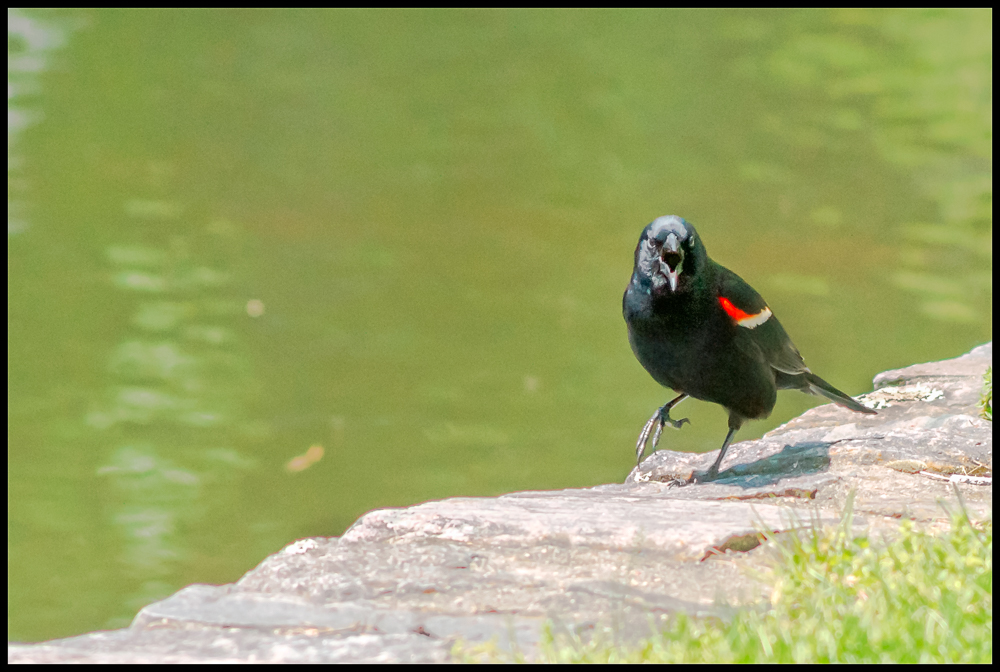
Another attempt at bird photography. This time a Red Winged Blackbird seen at Law Park in Briarcliff Manor.
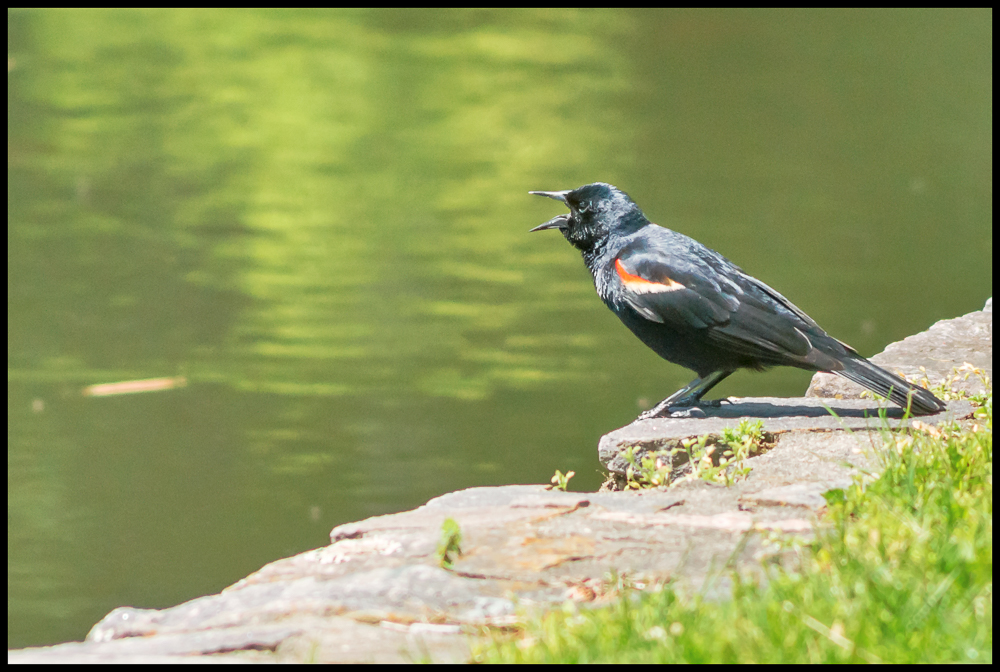
Taken with a Sony Alpha 500 and Minolta Maxxum 100-200mm f4.5
Photographs and thoughts on photography and camera collecting

Another attempt at bird photography. This time a Red Winged Blackbird seen at Law Park in Briarcliff Manor.
Taken with a Sony Alpha 500 and Minolta Maxxum 100-200mm f4.5
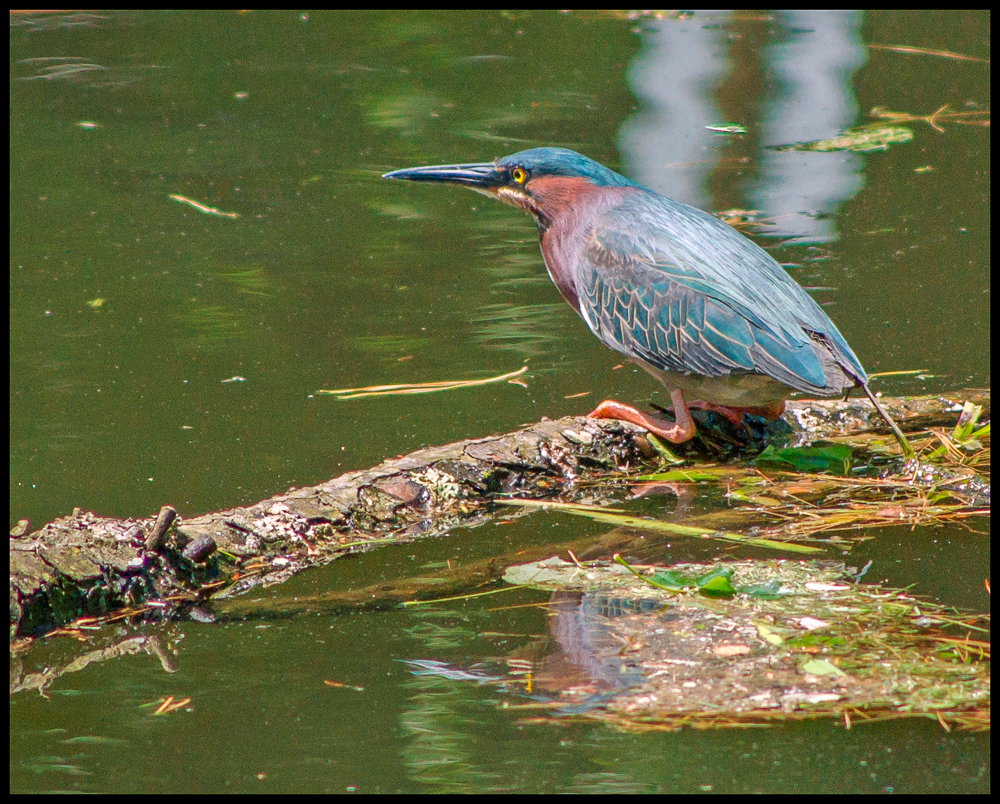
A couple of days ago I posted some pictures of a green heron fishing for tadpoles (See:Attempts at bird photography part II: Fishing for Tadpoles).
While I very much like those pictures and the way they show the bird in the act of catching a tadpole I feel they don’t altogether do the bird’s plumage justice. In the post I described it as: “somewhat brightly colored in a dull sort of way”. I take that statement back. In the right light it has lovely, colorful plumage.
Taken with a Sony A500 and Minolta Maxxum 100-200mm f4.5.
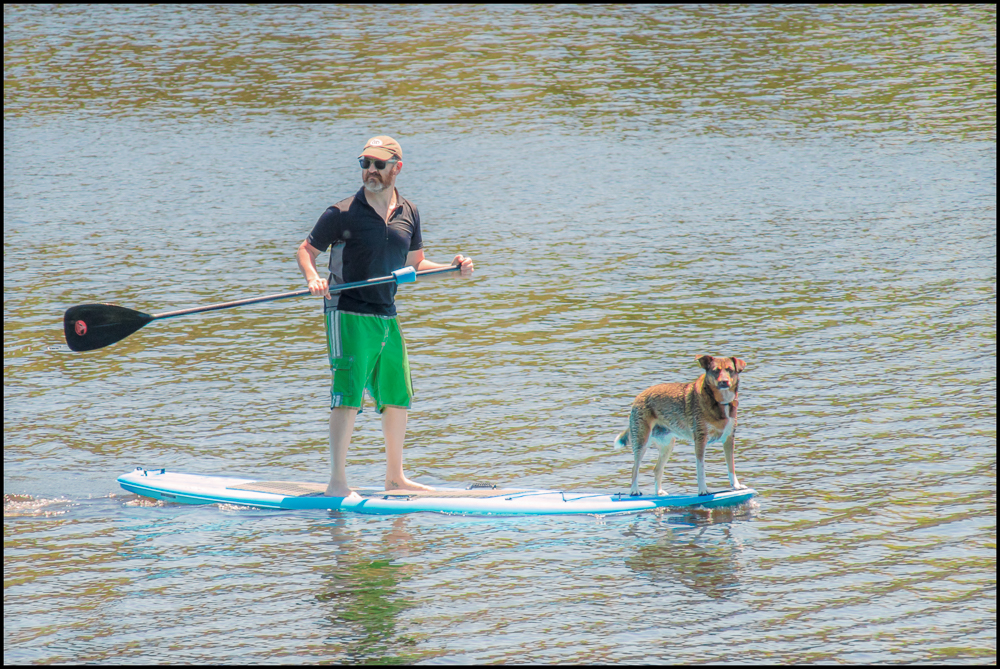
I had just finished the preceding post when I heard my wife shouting from the garden: “H come and look at this. You’ve got to take a picture”. Since I always do as I’m told I grabbed a camera and dashed into the the garden to do her bidding.
Not a stunning picture but I’m sure the grandkids will like it. They’re obsessed with dogs and it’s not everyday that you see one on a paddleboard on a lake.
Taken with a Sony A77II and Sigma 400mm f5.6.

My second attempt at bird photography took me to the pond in Law Park, Briarcliff Manor where we’ve lived for the past 20 years. I’ve seen and photographed great blue heron, cormorants, and egrets there before usually in the distance, with inadequate lenses which then required me to crop drastically (with subsequent lack of quality) to make anything visible. That was why I wanted the 400mm lens. (See:A birthday present).
Unfortunately, I didn’t have the 400mm lens with me. I’d left it with my Sony A77II up at our lake house. Instead I used an older Sony A500 and Minolta Maxxum 100-200mm f4.5 lens that I’d left in our house in Briarcliff Manor. Luckily the bird allowed me to get fairly close.
It’s a green heron. It’s quite small (about 1.5 feet) and somewhat brightly colored in a dull sort of way. Actually there were three of them vying for possession of the small branch in the middle of the pond. Eventually the largest of the three took possession and held it for the remainder of the time I was there. Apparently green herons are one of the few species of bird known to use tools. In particular, they commonly use bread crusts, insects, or other items as bait. The bait is dropped onto the surface of a body of water in order to lure fish. When a fish takes the bait, the green heron will then grab and eat the fish. When green herons catch large frogs, they will drown before before swallowing whole.
I’d already taken a number of pictures of it when I suspected that it was getting ready for action. It sort of crouched, looking intently into the water and then uncoiled: the body tilted, the neck extended to an incredible length and in a flash it was into the water and then back out again with a tadpole in its beak. Actually if you closely at the last picture you see that rather than grabbing the the tadpole it has speared it. I had thought that it would dive into the water (e.g. the way a kingfisher or a cormorant might) but it didn’t. It’s legs never left the branch.
Incredible! I was so excited to get this.


In a recent post (See: A Birthday Present) I mentioned that I wanted “have a go” at bird photography. I also noted that to this end my wife bought me a 400mm lens for my birthday. This same post showed my first test shots in our garden – regrettably no birds.
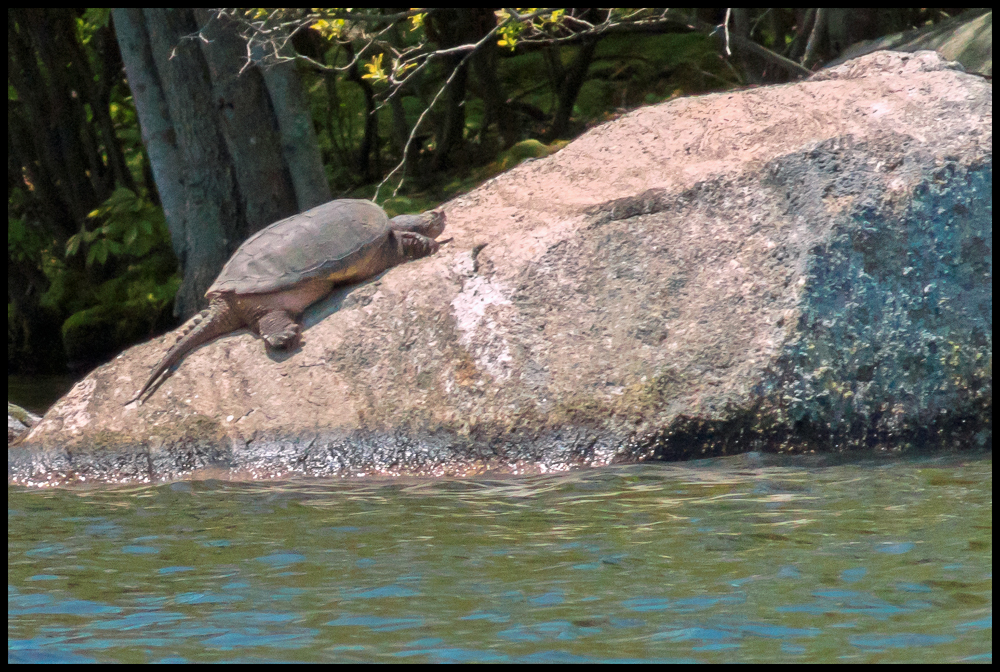
So I went out the other day to try to find some birds. Our lake has five small beaches. I visited all of them – no birds. I did find some turtles though.
I was returning home when I remembered there was one place I hadn’t tried. Ironically it’s the closest to our house – less than a five minute walk. A small stream meanders under a small wooden bridge and down to the lake. Maybe I’d find something there. And, indeed, as I walked down I heard a “quack, quack” sound. Promising. Then I spotted a goose. Finally a bird! I took a couple of pictures and then moved on. A few steps on I realized that the goose wasn’t moving. I took a closer look and it wasn’t moving because it wasn’t a real goose. It was some kind of decoy. Curses – foiled again!
Choking back my disappointment I started to trudge back home. Then it occurred to me – if the goose wasn’t real then what was making the “quack quack” sound? In any case even if the goose had been real it would have been going “honk honk” rather than “quack quack”. Back I went and sure enough hidden under the leaves of an overhanging tree was a flotilla of five ducks.
I expected them to be mallards because that’s what you usually find around us. There was a female mallard, but a couple of the others I’d never seen before. When I got home I did some “googling” and consulted with some more knowledgeable friends. We concluded that it wasn’t a wild duck at all. Rather it was a mix of domestic breeds. I thought that the body coloration looked like that of a Buff Orpington and the head like that of a crested duck. The presence of the female mallard may indicate there’s some of that breed in the mix. Apparently mallards will mate with any duck that moves.
Above a large snapping turtle on an island in the middle of the lake. If seen one (maybe the same one) in the same location before. Possibly this is it’s domain. It’s big and they have a very powerful bite (that can take off a finger) so I’m not going to contest it.
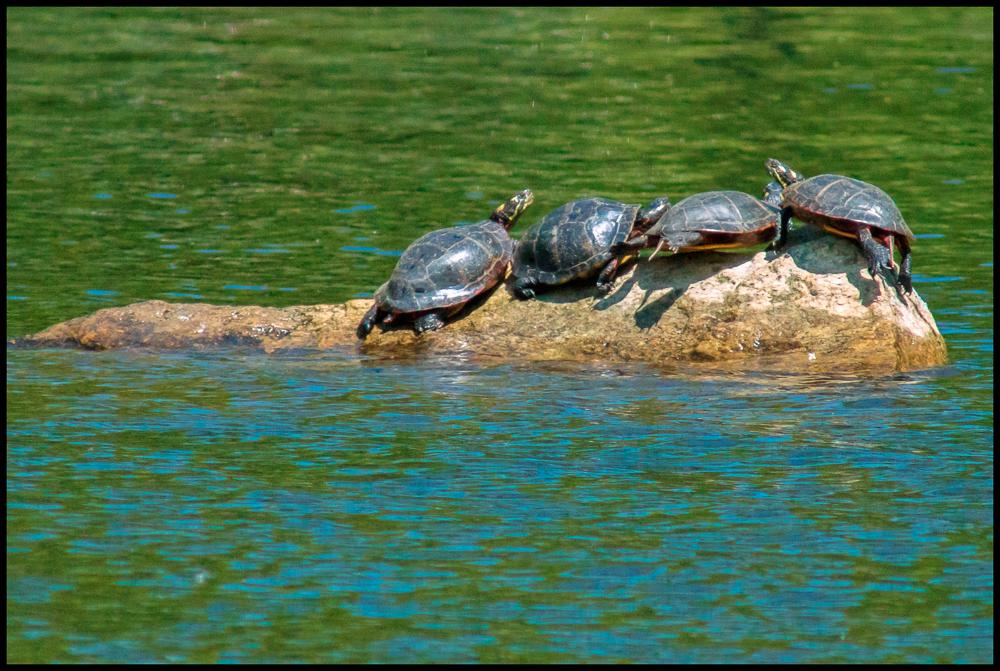
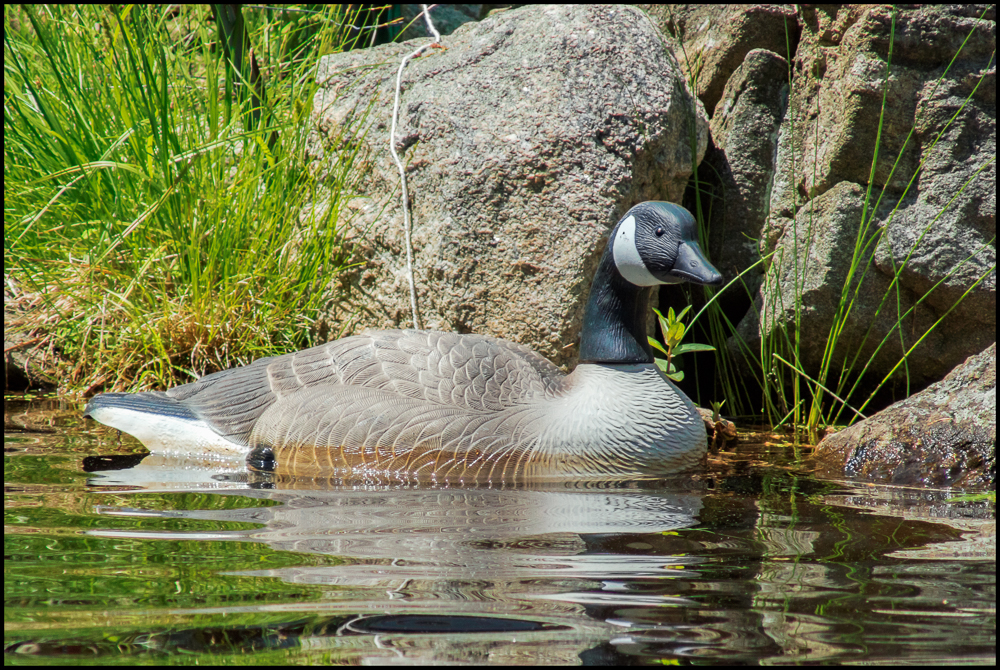
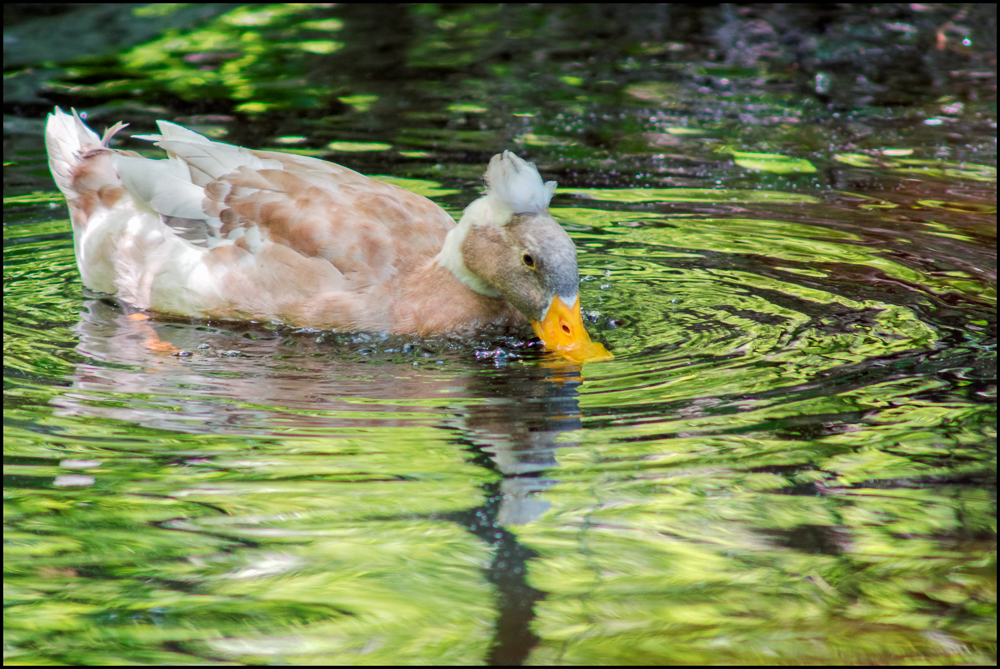
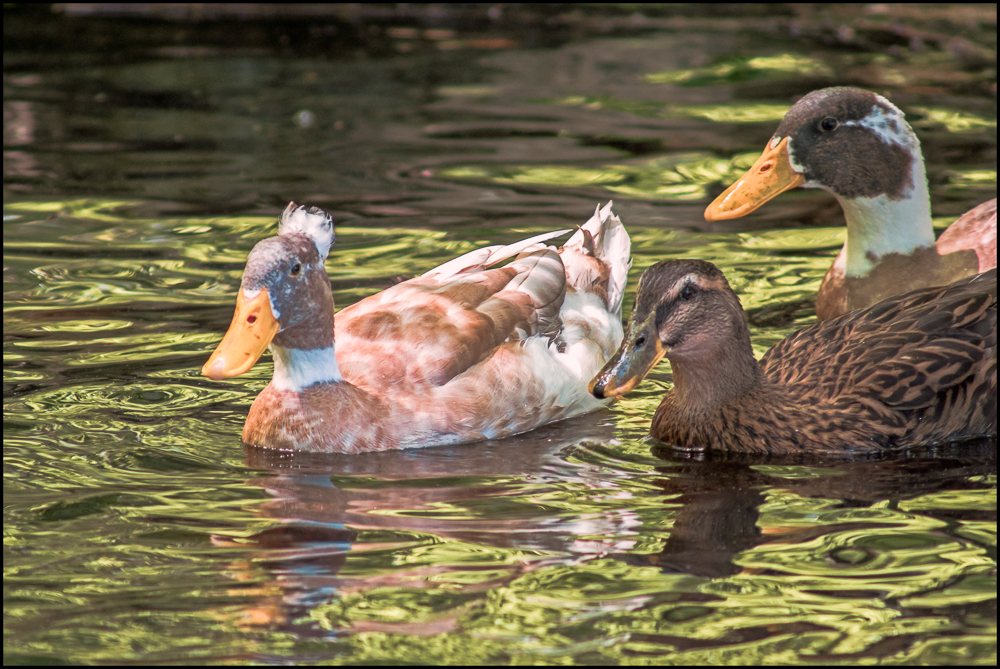
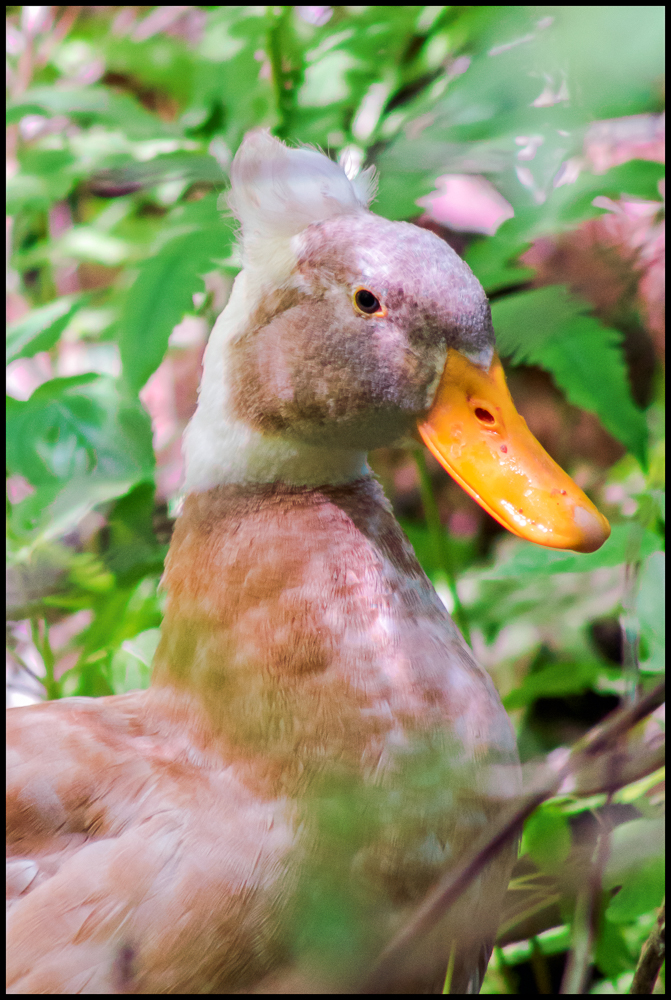
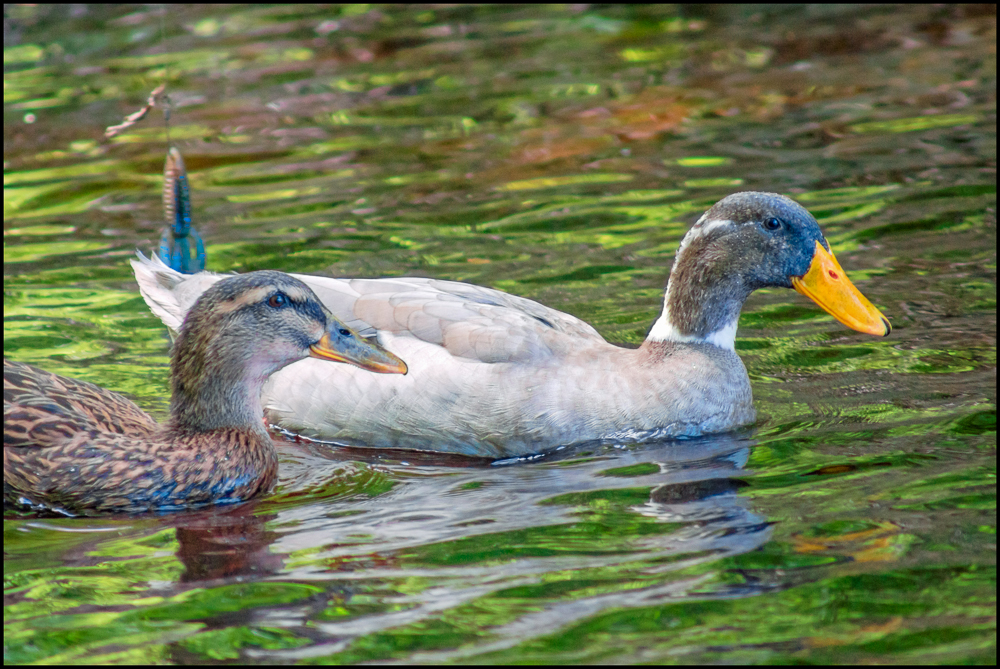
Taken with a Sony A77II and Sigma 400mm f5.6