Another Spider

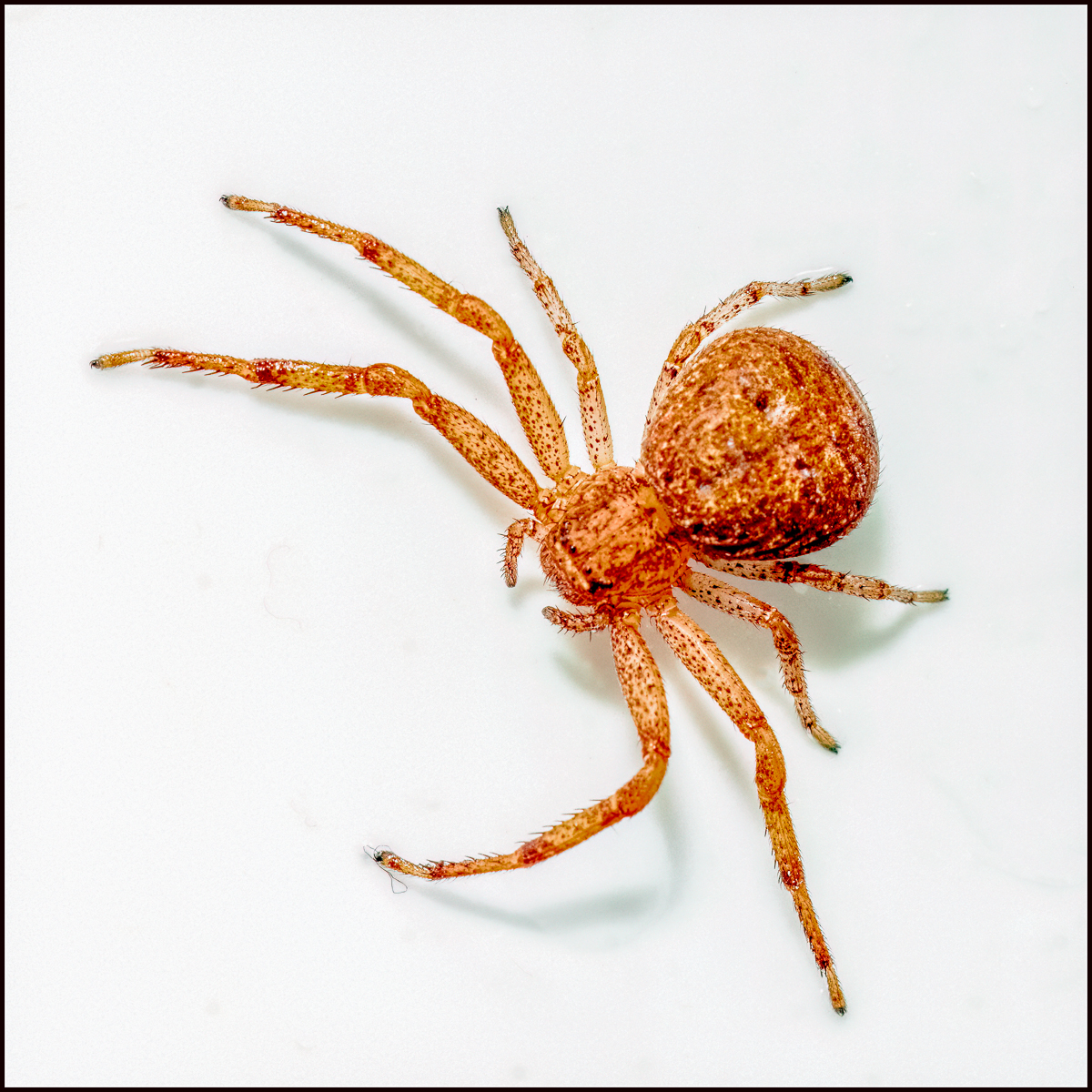
I came across this little beast last weekend. At first I was a little concerned. I thought it was a brown recluse, which would have been a concern because along with the black widows it’s the only seriously venomous spider in the US. I was once bitten by a spider, which produced a painful, necrotic sore that took some time to heal. At the time my wife had been visiting South Africa quite a bit, and I thought that she had perhaps brought back a poisonous spider in her luggage (I found a picture of a South African spider that looked very much like the one that had bitten me). I have since begun to wonder if it might not have a been a brown recluse.

However, on further consideration I no longer think the spider above is a brown recluse. It doesn’t seem to have the typical brown recluse markings on the dorsal side of its cephalothorax: a black line coming from it that looks like a violin with the neck of the violin pointing to the rear of the spider, resulting in the nicknames fiddleback spider, brown fiddler, or violin spider. And the eyes don’t look right for a brown recluse. Also the abdomen of a brown recluse looks longer, almost tubular where this one has a more globe like abdomen.

I don’t really know what it is. Maybe a common house spider? Or some kind of orb weaver?

Taken with a Sony A77II and Minolta 50mm f2.8 Macro lens

A Watery Landscape

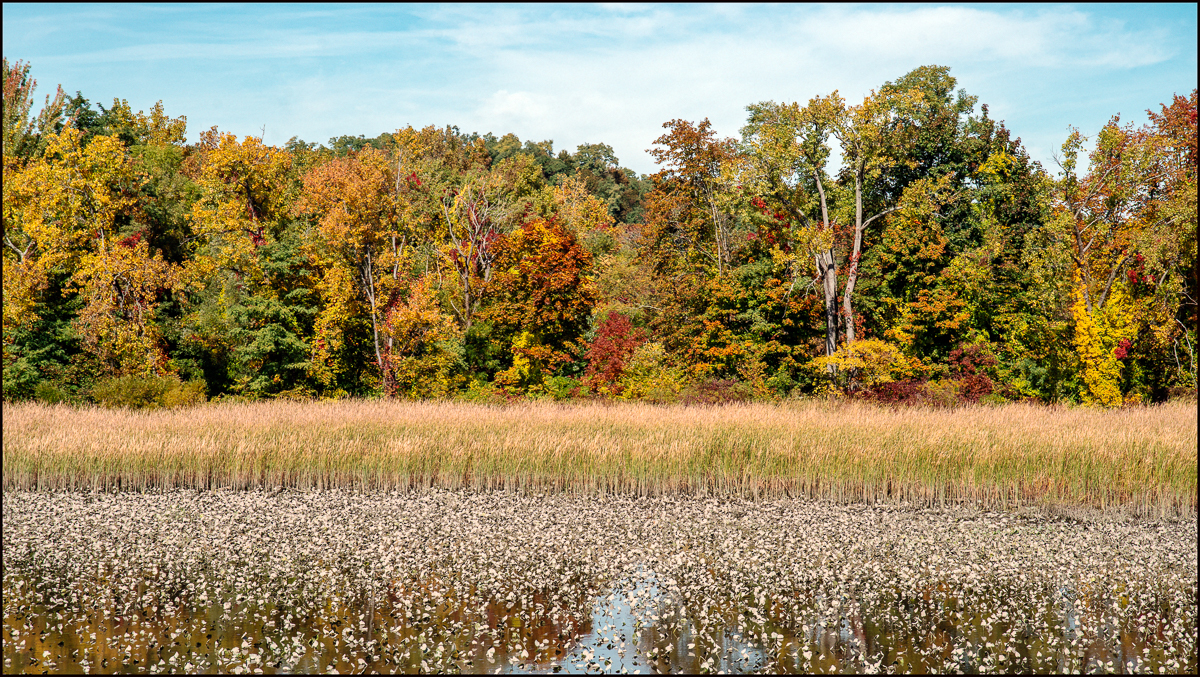
Along Esopus Creek, “…a 65.4-mile-long (105.3 km) tributary of the Hudson River that drains the east-central Catskill Mountains in the U.S. state of New York. From its source at Winnisook Lake on the slopes of Slide Mountain, the Catskills’ highest peak, it flows across Ulster County to the Hudson at Saugerties. Many tributaries extend its watershed into neighboring Greene County and a small portion of Delaware County. Midway along its length, it is impounded at Olive Bridge to create Ashokan Reservoir, the first of several built in the Catskills as part of New York City’s water supply system. Its own flow is supplemented 13 miles (21 km) above the reservoir by the Shandaken Tunnel, which carries water from the city’s Schoharie Reservoir into the creek.

The creek, originally known by the Native Americans in the area as Atkarkaton or Atkankarten and by Dutch settlers as the “Esopus Kill”, takes its name from the Esopus tribe of the Lenape, who were living around the lower Esopus when the Dutch first explored and settled the Hudson Valley in the early 17th century. The creek’s wide valley made it an ideal trading route for the Esopus and other Lenape who harvested the beaver pelts the European traders desired. Later, under the English, it became the beginning point for contentious land claims in the mountains. After independence, the Esopus corridor became the main route into the Catskills, first by road then later by the Ulster and Delaware Railroad, for forest-product industries like logging, tanning and charcoal making. Those industries declined in the late 19th century, shortly before the creation of the Forest Preserve and the Catskill Park made the region more attractive for resorts and recreation, particularly trout fishing. The renewed Esopus also attracted the attention of fast-growing New York City, which was able to acquire land and build the reservoir and tunnel after overcoming local political opposition.

The reservoir divides the creek into an upper stretch, mostly a wild mountain stream, and a lower stretch closer to the Hudson that gradually becomes more estuarine. Above the reservoir, its water quality is closely monitored, not only for its role in the city’s water supply but to preserve its local economic importance as a recreational resource. As the upper Esopus is one of the most productive trout streams in the Northeast, fly fishermen come in great numbers to take trout from its relatively accessible banks. Canoeists and kayakers have been drawn to its whitewater, which has also spawned a busy local tubing industry in the summer months. The lower Esopus is mainly an aesthetic and ecological resource, although the estuary at Saugerties is a popular bass fishery.

The Esopus’s role in the state and regional economy has led to a concentrated effort to protect and manage it, particularly on the upper stretch. The interests of the various stakeholders have not always converged, particularly where it concerns the city’s management of its water needs. Turbidity created by discharges from the Shandaken Tunnel after a 1996 flood led to a successful lawsuit against the city and a state regulation; downstream of the reservoir the city has been criticized for contributing to flooding problems by releasing too much water during heavy rainstorms since Hurricane Irene in 2011. Boaters and anglers have also clashed, and invasive species are beginning to enter the upper creek as well.” (Wikipedia).

Taken with a Sony A7IV and Rokinon AF 24-70 f2.8 FE

A School of Fish

While walking in my local park, Law Memorial Park I noticed this rather impressive school of fish swarming in the pond (Do fish swarm? flock?).

“Located in the heart of the Village on Pleasantville Road, this seven (7) acre park was gifted to the Village by its first family, Mr.& Mrs. Walter Law. The Village Pool complex is the park’s biggest attraction, featuring a 120′ x 75′ main pool and a 30′ diameter circular wading pool. A new two-story Bathhouse/Pavilion was completed in 2001 in conjunction with a major rehabilitation project. The park also offers four tennis courts with lights for evening play; three clay courts and one year-round all-weather court. Adjacent to the tennis courts is a playground that includes swings and play structures for children 2-5 and 5-12 years old. Two (2) platform tennis courts are located just north of the park and the Village Library/Community Center can be found on the Park’s eastern edge.” (Briarcliff Manor Village website)

Taken with a Nikon D800 and Nikon AF Nikkor 28-80 f3.3-5.6

Briarcliff Table Water Bottle

This bottle is part of the Briarcliff Manor-Scarborough Historical Society Collection.

Briarcliff Farms was a farm established in 1890 by Walter William Law in Briarcliff Manor, a village in Westchester County, New York. One of several enterprises established by Law at the turn of the 20th century, the farm was known for its milk, butter, and cream and also produced other dairy products, American Beauty roses, bottled water, and print media. At its height, the farm was one of the largest dairy operations in the Northeastern United States, operating about 8,000 acres (10 sq mi) with over 1,000 Jersey cattle. In 1907, the farm moved to Pine Plains in New York’s Dutchess County, and it was purchased by New York banker Oakleigh Thorne in 1918, who developed it into an Aberdeen Angus cattle farm. After Thorne’s death in 1948, the farm changed hands several times; in 1968 it became Stockbriar Farm, a beef feeding operation. Stockbriar sold the farmland to its current owners in 1979.

The farm combined a practical American business model with the concept of a European country seat or manor, with cows being milked constantly, and with milk promptly chilled and bottled within five minutes, and shipped to stores in New York City each night. The farm was progressive, with sterile conditions, numerous employee benefits, good living conditions for livestock, and regular veterinary inspections to maintain a healthy herd. The farm also made use of tenant farming, established working blacksmith, wheelwright, and harness shops on-site, was located around Walter Law’s manor house, and constructed numerous buildings in the Tudor Revival architectural style.

Briarcliff Farms was the original location for the School of Practical Agriculture and Horticulture, established by the New York State Committee for the Promotion of Agriculture in conjunction with Walter Law. The school’s purpose was to teach students in farming, gardening, poultry-keeping, and other agriculture-related skills. The school moved to a farm near Poughkeepsie in 1903, and the school building was run as a hotel for two years until it became Miss Knox’s School. After the building burned down in 1912, Miss Knox’s School was relocated several times; since 1954, the Knox School has been located in St. James, New York.

The Briarcliff Table Water Company sold its products in New York City, Lakewood, New Jersey and the Westchester municipalities of Yonkers, Tarrytown, White Plains, and Ossining. The company owned 250-foot-deep (76 m) wells.(Wikipedia)

Taken with a Sony A7IV and Samyang 45mm f1.8