
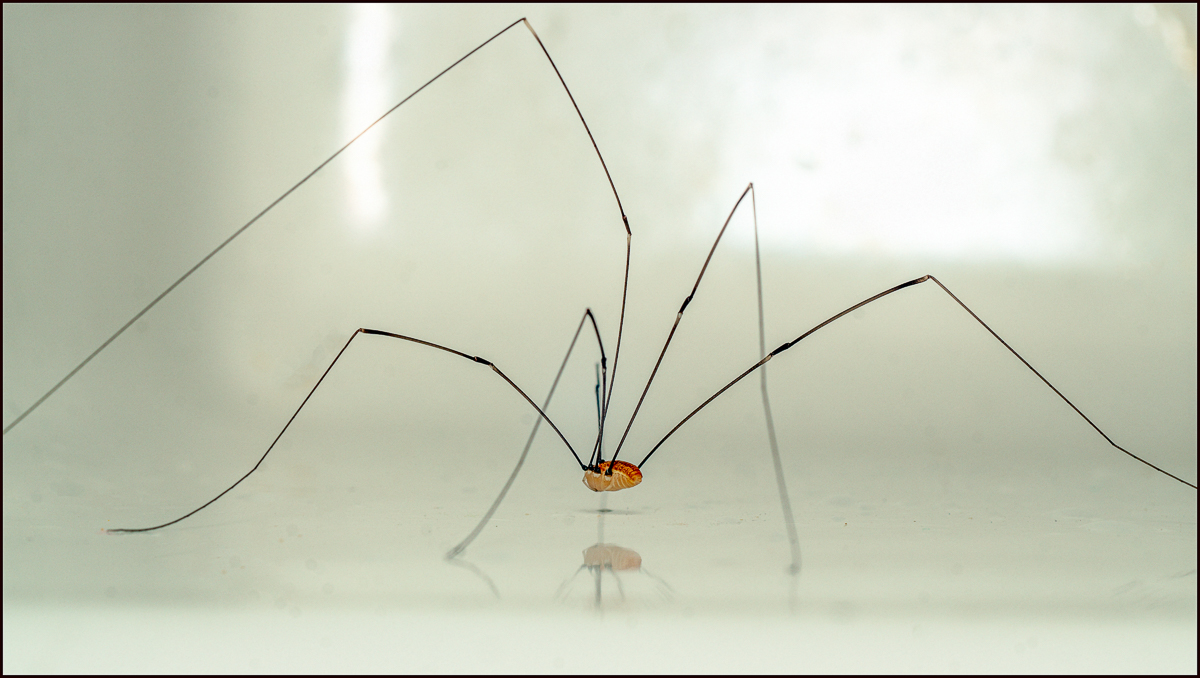
Another spider. Or is it?

I came across this in my kitchen sink. A spider I thought, but then I looked more closely and noticed that it only had six legs. So some other kind of insect then. However, when I looked more closely I realized that it was supposed to have eight legs, but had apparently lost two of them. OK so it was a spider after all. I was wrong again. It is an arachnid, but not a spider. So what is it? It turns out that it’s something called a Harvestman and it’s more closely related to ticks, mites and scorpions than it is to spiders. How can you tell the difference? Well, spider bodies have two segments: a combined head/thorax and an abdomen. Harvestmen have a single body. Spiders also usually have eight eyes where Harvestmen only have two. Scientists have identified over 6,000 species of Harvestmen and estimate that there are probably over 10,000. They’ve also been around for a very long time: specimens have been found encased in amber that is over four hundred million years old, so I suppose they’re doing something right. This one had a leg-span (if such a word exists) of over three inches, but the body was only about 1/8 inch. Some people call them ‘daddy longlegs’, but that’s confusing as at least three different species are often called ‘daddy longlegs’: Harvestmen, Crane Flies (which are winged insects), and Cellar Spiders (true spiders).
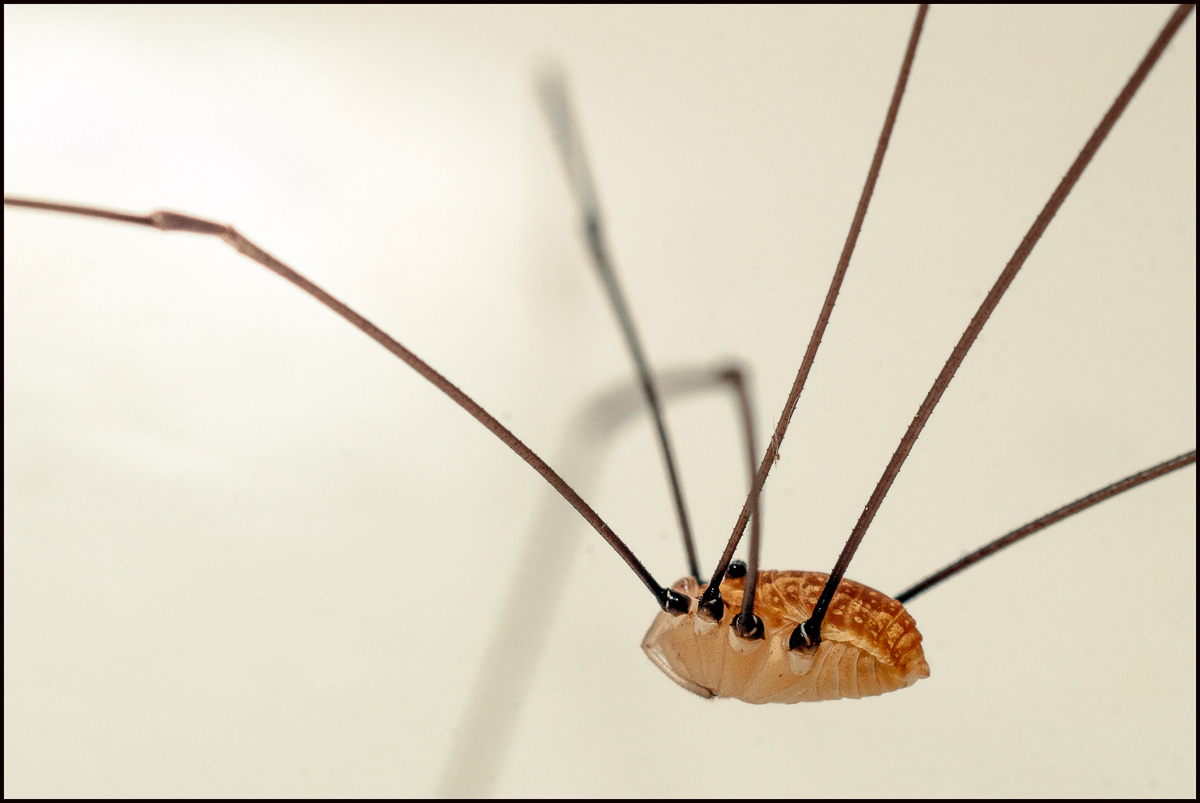
Taken with a Sony A77II and Minolta 50mm f2.8 Macro lens

Interesting presentation by Stephen Shore

Interesting, if rather long (1 hour and 15 minutes) presentation by Stephen Shore.

In case anyone reading this doesn’t know who Mr. Shore is, Wikipedia describes him as follows:

Stephen Shore (born October 8, 1947) is an American photographer known for his images of banal scenes and objects, and for his pioneering use of color in art photography. His books include Uncommon Places (1982) and American Surfaces (1999), photographs that he took on cross-country road trips in the 1970s.

In 1975 Shore received a Guggenheim Fellowship. In 1971, he was the first living photographer to be exhibited at the Metropolitan Museum of Art in New York City, where he had a solo show of black and white photographs. He was selected to participate in the influential group exhibition “New Topographics: Photographs of a Man-Altered Landscape”, at the International Museum of Photography at the George Eastman House (Rochester, New York), in 1975-1976.

In 1976 he had a solo exhibition of color photographs at the Museum of Modern Art. In 2010 he received an Honorary Fellowship from the Royal Photographic Society.

A couple of cars – snap!

Anyone reading this who may remember me during my time in Geneva, Switzerland may recall that the car above was my car, seen here with my late wife, Eirah in front of our house in Cologny. I loved that car, but unfortunately couldn’t bring it to NY when I moved. Fast forward 20 plus years or so. I was walking around in my village, Briarcliff Manor, NY when I came across the second car. It’s for sale too.

The first picture was taken with a long forgotten film camera, the second with an Iphone SE II.

A visit to Dia Beacon – Artists I don’t care for, or don’t understand – Robert Smithson

I first visited Dia in April 2014. When I came across these installations/displays I initially thought that they were unfinished i.e. that someone was in the process of building an installation. My tastes in art have evolved a lot since then but I still have problems understanding why a pile of broken glass, a pile of sand, a pile of cement and a couple of mirrors are important art. Clearly I still have a way to go. Having said that I do rather like some of his large scale exterior works such as Spiral Jetty and Broken Circle/Spiral Hill.

Wikipedia describes Robert Smithson as follows:

Robert Smithson (January 2, 1938 – July 20, 1973) was an American artist known for sculpture and land art who often used drawing and photography in relation to the spatial arts. His work has been internationally exhibited in galleries and museums and is held in public collections. He was one of the founders of the land art movement whose best known work is the Spiral Jetty (1970).

For (lots) more information see here.

Taken with a Sony A7IV and Samyang 45mm f1.8