
A Canada goose lands on the water in Tarrytown, NY as three of its siblings watch.
Taken with a Sony A6000 and some kind of manual focus lens. I forget which one.
Photographs and thoughts on photography and camera collecting

A Canada goose lands on the water in Tarrytown, NY as three of its siblings watch.
Taken with a Sony A6000 and some kind of manual focus lens. I forget which one.

The park has several public attractions including a miniature aircraft airport (note: I’ve never come across this), boat launch, tent and RV camping, cabin rental, cross-country skiing, fishing, group picnicking, hiking and walking trails, a museum, nature study, pavilions, a playground, swimming, and a beach. In the 1800s the Underhill family owned the land that is now Croton Point Park. Grapes, watermelons, and apples were grown. A brickyard was also on the property. A few buildings built with these bricks are still standing at Croton Point. The park is also home to several historic sites such as a set of wine cellars from an old manor.
A substantial portion of the land on which the park is situated today was the site of a landfill, which was operated by the Westchester County government from 1927 to 1986. The landfill has since been capped off and restored to green space. A 1931 map shows the landfill area as marsh.


For related posts see here. For more information see: Tales from Croton Point by Sarah Gibbs Underhill. Notice the name: Underhill. It was Robert Underhill (her great-great-great-great-grandfather.) who first bought the property in 1804.
Taken with an Olympus OM-D EM-10 and Panasonic Lumix G Vario 14-42 f3.5-4.6 II

Back in February I posted about my newly acquired Micro Fourth Thirds (MFT) camera: a second hand Panasonic Lumix GF-1. In that post (see A new (used) camera: Panasonic Lumix GF-1 ) I extolled the virtues of this camera and talked about how much I loved it. However, anyone reading this blog will have noticed that I’m now using a different MFT camera: an Olympus OM-D E-M10. If I liked the GF-1 so much how is it that I’m now no longer using it as much?
Well, I still love the form factor of the GF-1: how small and light both the body and the lenses are. And I still like it that you can use MFT lenses on both Panasonic and Olympus bodies. However, as I used it more and more I realized that I was missing some of the features that I had become accustomed to on some of my other camera bodies. These included:
1. Wireless. I have found it convenient to connect a camera to my iphone so as to be able to quickly transfer photographs that I don’t want to edit and to quickly upload them to social media. I missed this on the GF-1.
2. Image Stabilization. As I get older my hands as not as steady as they once were. Image Stabilization helps.
3. Tilting Screen. I often want to get down low to take a shot. The GF-1 does not make this easy. As the screen is fixed I pretty much have to lie down to take the shot. I can usually get down, but my aging body finds it hard to get up again. A tilting screen allows me to just bend over to get the picture.
4. Electronic Viewfinder. The GF-1 does not have a built in electronic viewfinder. It does have an auxiliary viewfinder (which I have), but the resolution is quite low and my aging eyes need all the help they can get.
5. Higher maximum ISO. The GF-1’s maximum ISO is only 3,200. I would have liked something higher.
6. Higher resolution LCD. The LCD on the GF-1 is only 460K
7 Focus Peaking with manual lenses. I was used to this from my Sony cameras and although the GF-1 has focus magnification it lacks focus peaking.
So I did some research and eventually found what I felt was a good deal on an Olympus OM-D E-M10. For a more detailed review see here.
The OM-D meets all of the above criteria and has a few more additional advantages: Live composite mode; touch screen; higher resolution sensor (16mp vs 12mp); more focus points (81 vs 23); 8fps continues shooting vs 3; timelapse recording; better video; smartphone remote.
And, of course, it’s pretty much the same size and weight as the GF-1 and I can still use the same lenses.
So far I’m pleased with my purchase.
Taken with a Sony A6000 and Canon 50mm f1.4 LTM (I think).
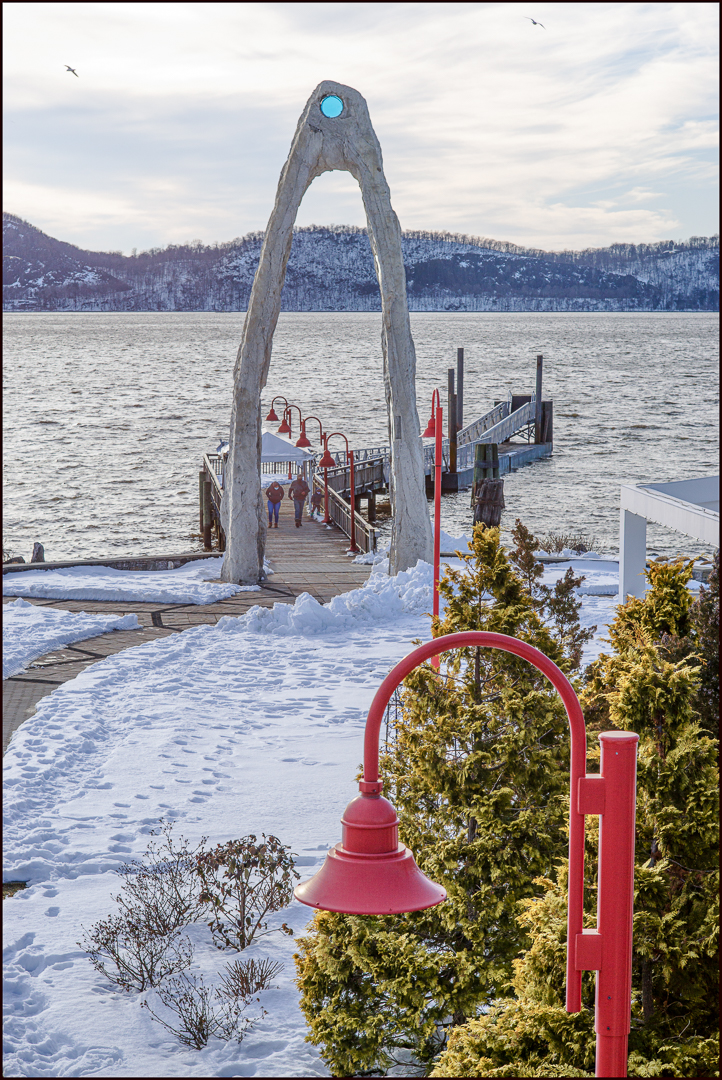
I’ve taken pictures of these structures before, but never from this angle. I was walking down the overpass from the Ossining Station when I noticed this interesting perspective on the ferry terminal.
The Haverstraw–Ossining Ferry is a passenger ferry which connects Haverstraw, New York with Ossining, New York over the Haverstraw Bay and Hudson River. The ferry operates during rush hours on weekdays only, primarily transporting commuters from the west side of the river to the Ossining Metro-North Railroad station on the east side, where they can transfer to Metro-North Railroad trains headed to Grand Central Terminal in New York City, or Croton-Harmon and Poughkeepsie, via its Hudson Line. Connections are also available at Ossining to the Bee-Line Bus System’s 13 and 19 routes. The Ossining terminal is at a pier adjacent to the west side of the station, and the Haverstraw terminal is at a pier on the eastern end of Dr. Girling Drive.
The Weehawken, New Jersey-based NY Waterway ferry company has been operating the ferry under contract from the Metropolitan Transportation Authority (along with the Newburgh-Beacon Ferry upstream) since its incarnation on September 5, 2000.
The fare is $4.25 per person ($2.00 for seniors and children 6 to 11 years old) and can either be purchased at the ticket booth at Haverstraw dock, or paid in cash only on board. The trip across the river takes approximately 15 minutes. The ferry operates at 20% of its full capacity on each trip, with 550 passengers per day as of 2009.
The ferry currently uses a 78.5-foot (23.9 m) high speed catamaran built by Allen Marine Inc. capable of carrying up to 149 passengers. The Admiral Richard E. Bennis (maiden voyage on October 29, 2003), is named after the late Coast Guard captain who directed the waterborne evacuation of Manhattan after the September 11, 2001 attacks. NY Waterway vessels Bayonne, Congressman Robert A. Roe, Jersey City, and Governor Thomas H. Kean (which are all similar to the Admiral Richard E. Bennis) also operate the ferry on occasions when the Admiral Richard E. Bennis is not available for use. On January 15, 2009, the Admiral Richard E. Bennis was among the many ships that helped evacuate stranded passengers of US Airways Flight 1549 on the Hudson River between New Jersey and Midtown Manhattan. Due to ice conditions on Haverstraw Bay which prompted NY Waterway to suspend service on the ferry that day, it was one of the vessels readily available for use at NY Waterway’s main storage facility near the incident in Weehawken. (Wikipedia)
The sculpture is called “Take me to the River” by sculptor Peter Lundberg (See: A Walk Around Ossining. Take me to the River).
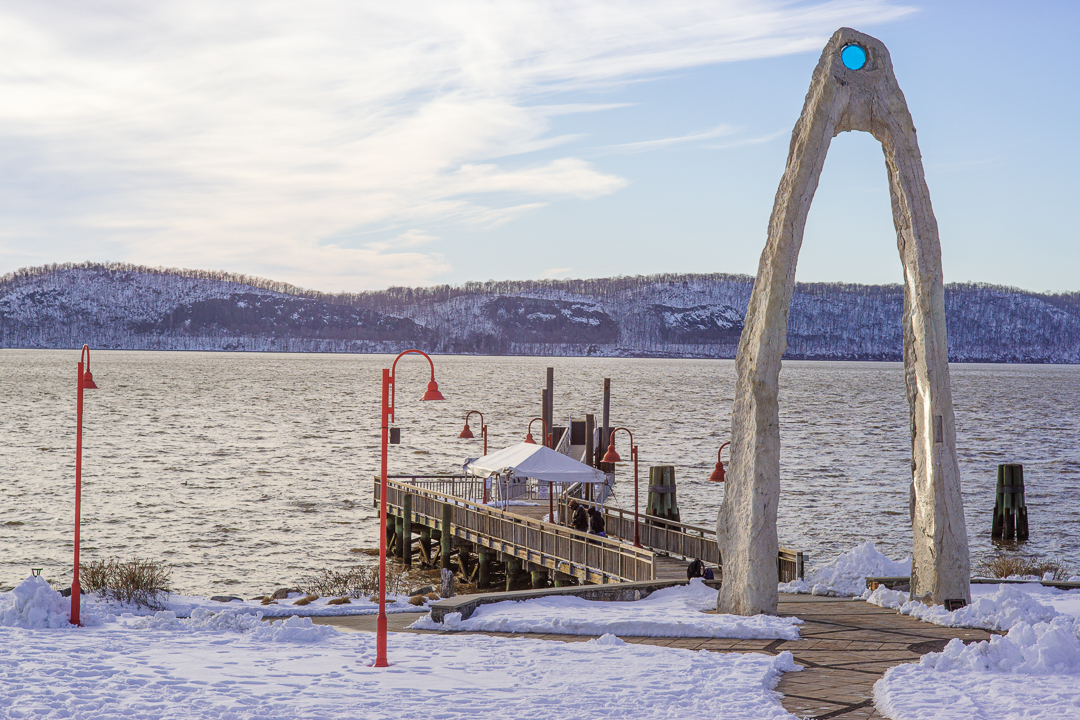
Taken with a Sony A6000 and Canon 50mm f1.4 LTM.
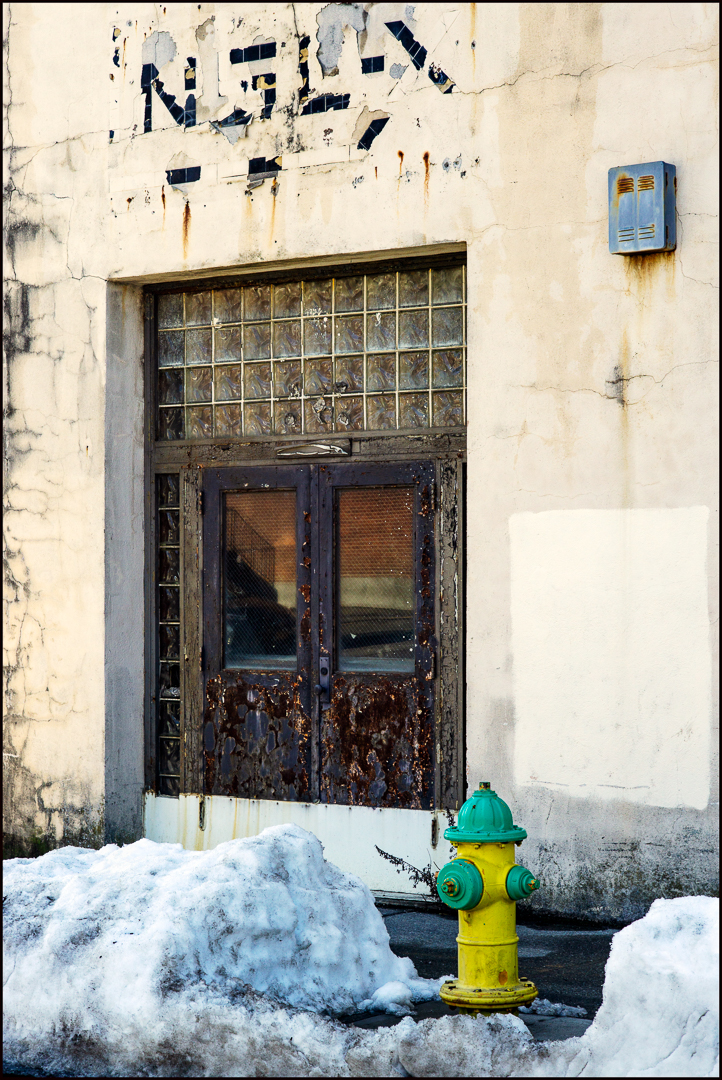
Interesting building at 81 N. Water Street. Lots of rust and crumbling masonry. There’s some lettering on the facade, but I can’t quite make out what it says. It seems to have been empty for a while. So far I haven’t been able to find any additional information.
Taken with a Sony A6000 and Canon 50mm f1.4 LTM.