Stuart’s farm – Overview

I friend had recommended Stuart’s Farm as a great place to get plants. We’d had a stretch of bad weather, which suddenly turned better so on a glorious, sunny day off we went.

According to its website:

Stuart’s Fruit Farm is a family-operated farm since 1828 located in Westchester County, New York. It is about an hour away from New York City. The farm began as cattle farm and evolved to an agricultural farm.

Depending on your seasonal needs; visit us in the spring to buy a varied selection of flowers and vegetable plants, the autumn for apple picking, peach picking and visiting the pumpkin patch, and in the winter for Christmas trees.

Visiting Stuart’s Fruit Farm in the autumn is an exceptional time of the year. Aside from the perfect apple picking with an array of apples take a hayride around the orchard and visit the farm stand to buy fresh produce and the bakery for delicious apple cider donuts and homemade pies baked daily. Finally, before heading home have a picnic with your family to enjoy the beautiful fall foliage.

It is, indeed, a lovely place – old weathered gas pumps; the inevitable red barn; lots of brightly colored tractors; and of course the vegetables and flowers (some of which we took home).

Unfortunately, the bakery was not open, which was a pity as I was a bit ‘peckish’.

Taken with a Sony RX-100 M3.
Pictures at an exhibition – RFK Funeral Train. The People’s View

This was the fourth and final exhibition I visited. According to the Center’s website:

On June 8, 1968, thousands of people lined the train tracks from New York to Washington, DC, paying their last respects and expressing bewilderment and sorrow at the assassination of Robert F. Kennedy. Photographer Paul Fusco documented the funeral train’s journey and his images have become emblematic of the loss of idealism during a period of political upheaval in the United States. Dutch visual artist, photographer, and filmmaker Rein Jelle Terpstra has been tracking down the bystanders’ views of this day. He has collected more than two hundred images, including snapshots and home movies of the train. In RFK Funeral Train: The People’s View, Terpstra combines a multiscreen video projection that stitches together this collection of vernacular photographs and audio and video remembrances of these mourners with prints by Fusco. Through this project, Terpstra adds a new chapter to a collective memory that is slowly disappearing. This exhibition is organized by Erin Barnett, Director of Exhibitions and Collections.

An interesting concept, but once again I didn’t spend much time on it – although I did sit through the entire multiscreen video presentation.

The exhibition runs until September 2, 2018.

Taken with a Sony RX-100 M3.

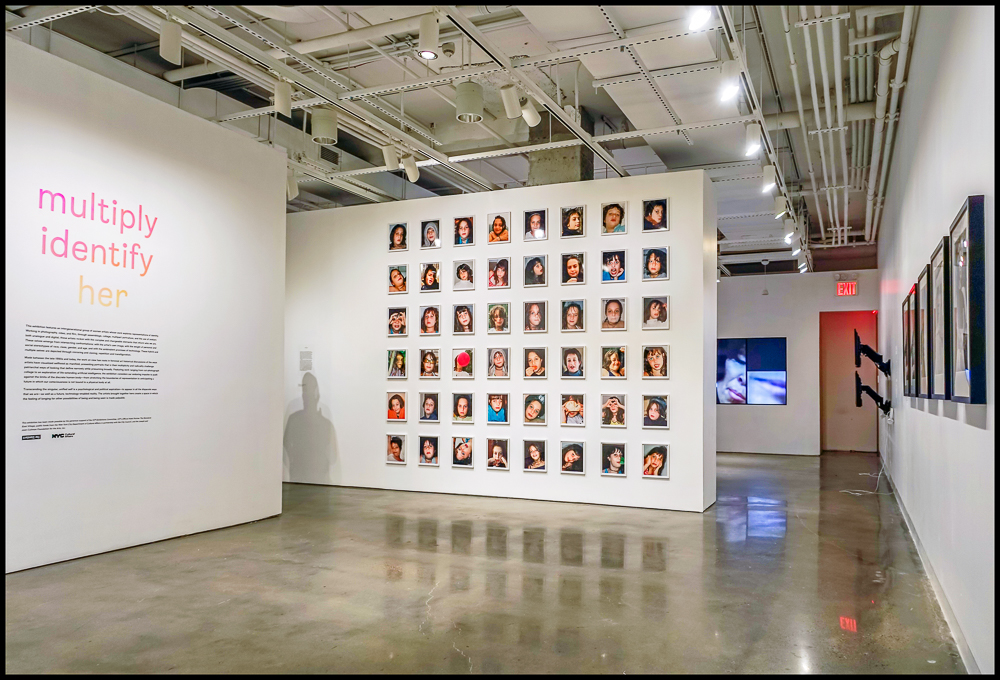
Pictures at an exhibition – Multiply, Identify, Her

According to the Center’s website:

This exhibition features an intergenerational group of women artists whose work explores representations of identity. Working in photography, video, and film, through assemblage, collage, multipart portraiture, and the use of avatars both analogue and digital, these artists reckon with the complex and changeable elements that inform who we are. These selves emerge from intersecting confrontations: with the artist’s own image, with the weight of personal and social stereotypes of race, class, gender, and age, and with the ambivalent promises of technology. These hybrid and multiple selves are depicted through mirroring and cloning, repetition and transfiguration.

Made between the late 1990s and today, the work on view has roots in feminist art historical discussions of the ways artists have visualized selfhood as manifold, presenting portraits that in their multiplicity and radicality challenge patriarchal ways of looking that define narrowly while presuming broadly. Featuring work ranging from cut-photograph collage to an exploration of life-extending artificial intelligence, the exhibition considers our enduring impulse to push against the limits of the discrete human body—from stretching the boundaries of representation to anticipating a future in which our consciousness is not bound to a physical body at all.

Transcending the singular, unified self is a psychological and political aspiration—to appear in all the disparate ways that we are—as well as a future, technology-enabled reality. The artists brought together here create a space in which the feeling of longing for other possibilities of being and being seen is made palpable.

– Marina Chao, Curator

The exhibition features the work of Mickalene Thomas; Geta Brătescu; Wangechi Mutu; Lorna Simpson and Barbara Hammer.

I’m afraid this exhibition didn’t really appeal to me – maybe just a bit to avant-garde for my tastes (for example a series of photographs seemed to portray a nude figure with internal organs overlaid and titled “What You Are Not Supposed to Look At”. So I didn’t spend a lot of time there. Maybe I should have? Maybe I would have understood more?

Taken with a Sony RX-100 M3.

Pictures at an exhibition – Pittsburgh 1950, Elliott Erwitt

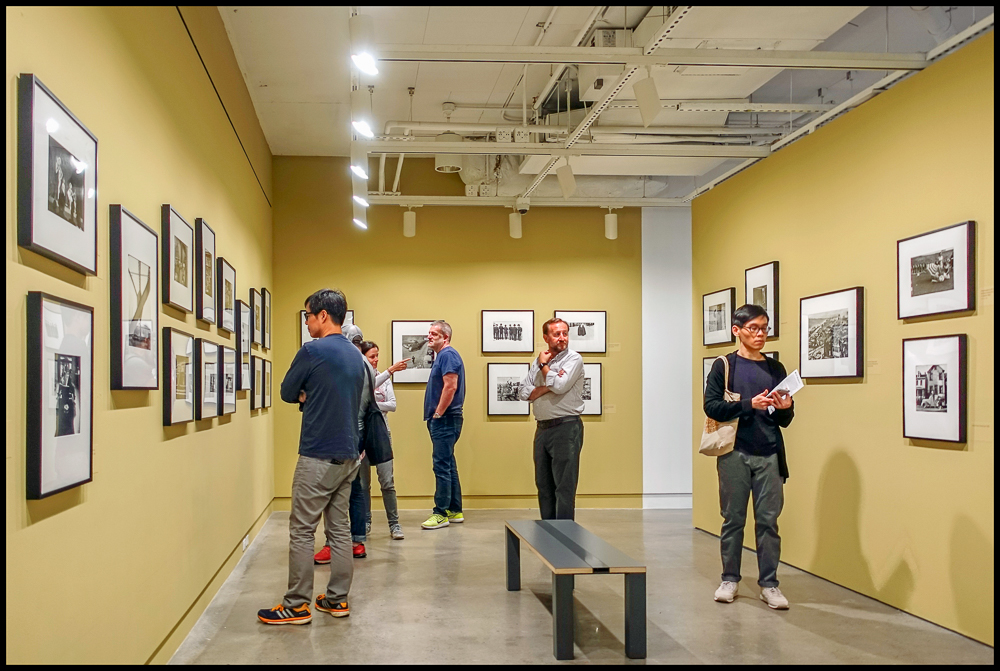
The second exhibit I visited was “Pittsburgh 1950” and the work of Elliott Erwitt. According to the Center’s website:

In 1950 Elliott Erwitt, then just twenty-two years old, set out to capture Pittsburgh’s transformation from an industrial city into a modern metropolis. Commissioned by Roy Stryker, the mastermind behind the large-scale documentary photography projects launched by the US government during the Great Depression, Erwitt shot hundreds of frames. His images recorded the city’s communities against the backdrop of urban change, highlighting his quiet observations with the playful wit that has defined his style for over five decades. After only four months, Erwitt was drafted into the army and sent to Germany, leaving his negatives behind in Stryker’s Pittsburgh Photographic Library. The negatives remained at the Pennsylvania Department of the Carnegie Library of Pittsburgh for decades. This exhibition, organized by Assistant Curator Claartje van Dijk in association with the photographer, will present these images in the United States for the first time.

This exhibition is right next to “The Decisive Moment” – so close in fact that I didn’t immediately realize that I was no longer seeing works by Cartier-Bresson. I’m something of a fan of Erwitt too (particularly for the humor he brings to his work), but seeing it right next to Cartier-Bresson I couldn’t help be feel it was a step down. I did try to bear in mind, however, that this is very early Erwitt (he was only 22 at the time where Cartier-Bresson was 44 when “The Decisive Moment” was published) and I’m such a fan of Cartier-Bresson that, to me, almost anything would suffer by comparison.

The exhibition runs until September 2, 2018.

For more on the story behind these pictures see the video below: “What Were You Thinking?” with Legendary Magnum Photographer Elliott Erwitt

Taken with a Sony RX-100 M3.