Warning: the last picture is rather gruesome. If you have a sensitive nature you might want to avoid it.
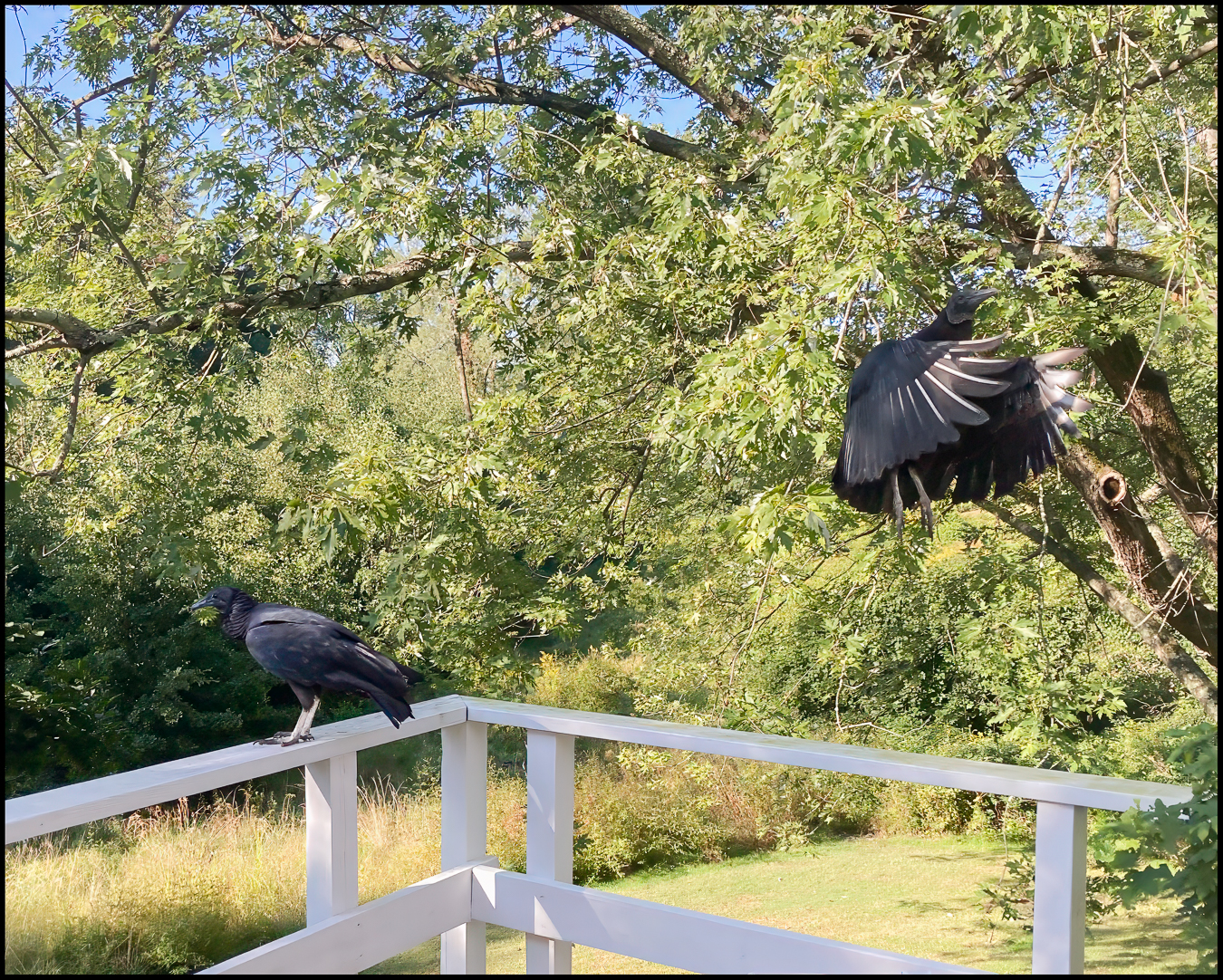
Almost two weeks ago I was reading in my bedroom when heard the sound of something running around on the roof above me. I thought – maybe squirrels? I’ve heard them before and didn’t think much of it. However, as time went on the sound continued and seemed rather loud for squirrels so I went out onto the balcony outside my room to see if I could find out what was going on.
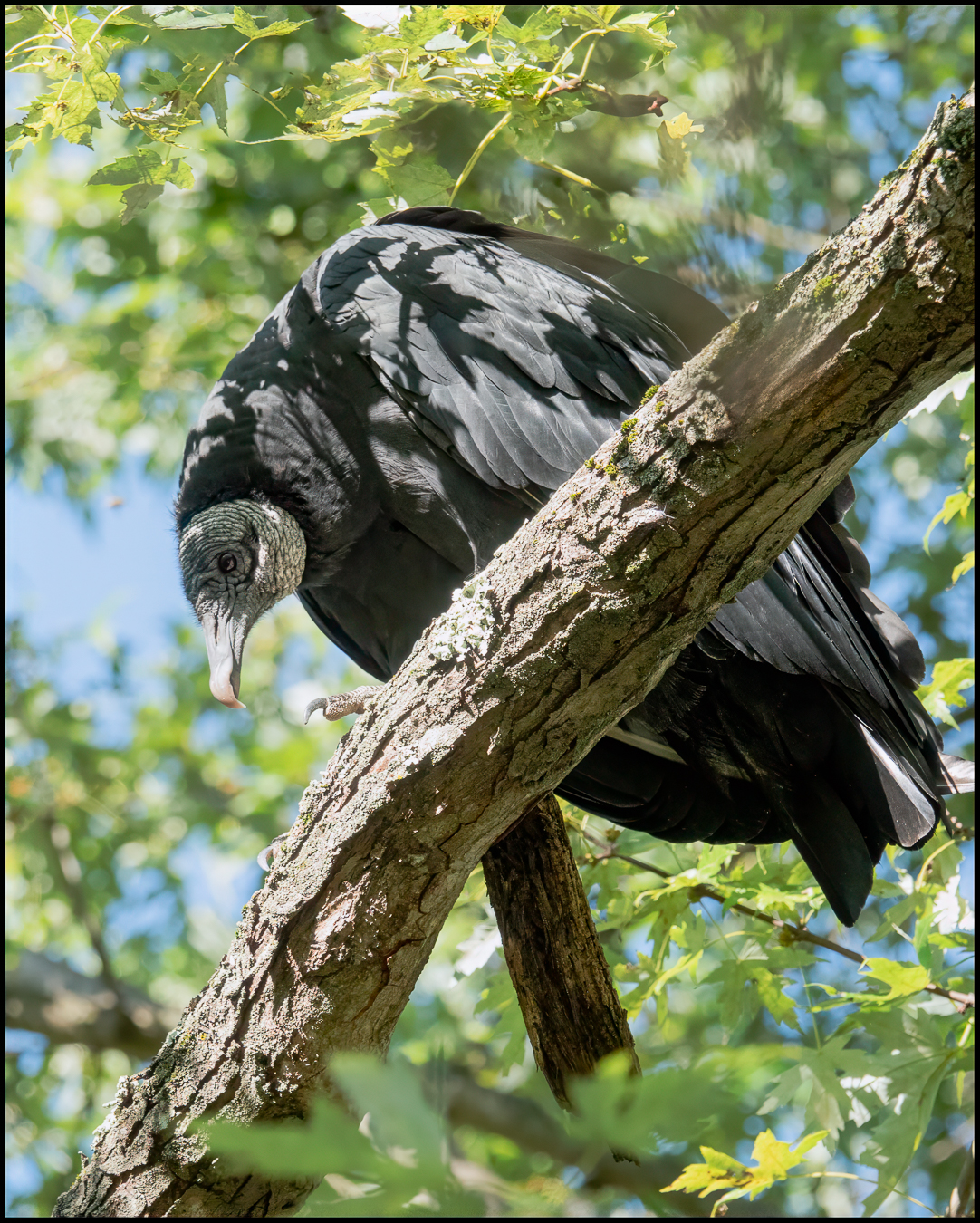
This is what I found:
It’s a vulture. We have two types of vultures in the Hudson Valley:
Turkey Vultures. Turkey Vultures are large dark birds with long, broad wings. Bigger than other raptors except eagles and condors, they have long “fingers” at their wingtips and long tails that extend past their toe tips in flight. When soaring, Turkey Vultures hold their wings slightly raised, making a ‘V’ when seen head-on. They’re smaller than an eagle; larger than a Red-tailed Hawk – about the size of a goose. They appear black from a distance but up close are dark brown with a featherless red head and pale bill. While most of their body and forewing are dark, the undersides of the flight feathers (along the trailing edge and wingtips) are paler, giving a two-toned appearance. The Turkey Vulture uses its sense of smell to locate carrion. The part of its brain responsible for processing smells is particularly large, compared to other birds. Its heightened ability to detect odors — it can detect just a few parts per trillion — allows it to find dead animals below a forest canopy. The Turkey Vulture maintains stability and lift at low altitudes by holding its wings up in a slight dihedral (V-shape) and teetering from side to side while flying. It flies low to the ground to pick up the scent of dead animals.
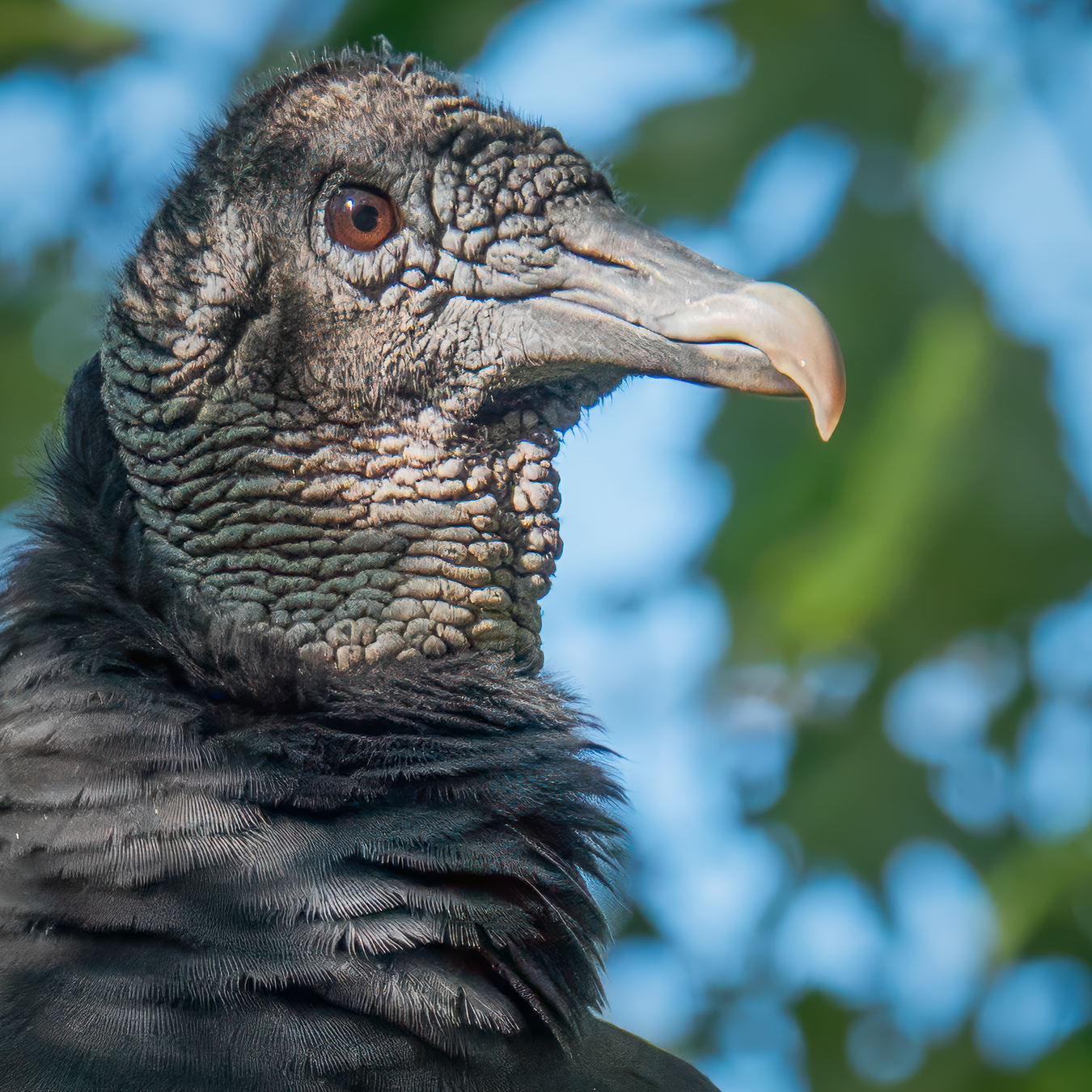
Black Vultures. Black Vultures are relatively new to this area. They are smaller than Turkey Vultures and more aggressive. Where the Turkey vulture has a bare red head, black vultures have a grey, or black head. They don’t have as good a sense of smell as the Turkey vulture so to find food they follow the Turkey vultures around.
These were Black vultures, and there were five of them. At first, I was a little concerned for my cat, but after some more research I discovered that Black vultures (like other vultures) are primarily carrion eaters. Turkey vultures eat only carrion whereas the more aggressive Black vultures have been known to go after newborn or sick (but still living) animals. However, they won’t go after a healthy, full-grown cat. It’s too dangerous. They might get seriously hurt and a badly injured vulture wouldn’t last long. In any case, after seeing my cat in action I’d fancy her chances. She’s a Maine Coon and fairly large. She also has extremely fast reflexes and very sharp claws.
After a while they all flew off, and I spotted them on a nearby dead tree. Eventually, they disappeared entirely leaving me with a mystery: why were they bouncing about on my roof in the first place?. At first, I thought that maybe one of them had taken a small, dead animal up onto the roof and the others had followed.
But I was wrong about that. Eventually, I figured out why they were there. I was sitting on the balcony eating lunch when I looked into the meadow in front of my house and noticed something I hadn’t seen before. It was some distance away and at first glance it looked like a fallen branch, but it couldn’t be as there were no trees nearby. I had a camera with a long telephoto lens in my bedroom, so I took a closer look. It was a dead deer! Of course, I had to go down and take a closer look. I also took a couple of pictures, one of which is below.
Since then almost two weeks have passed, and the vultures have not returned. I guess they must have had their fill.
First picture taken with an iPhone SE II, others with a Taken with a Sony RX10 IV