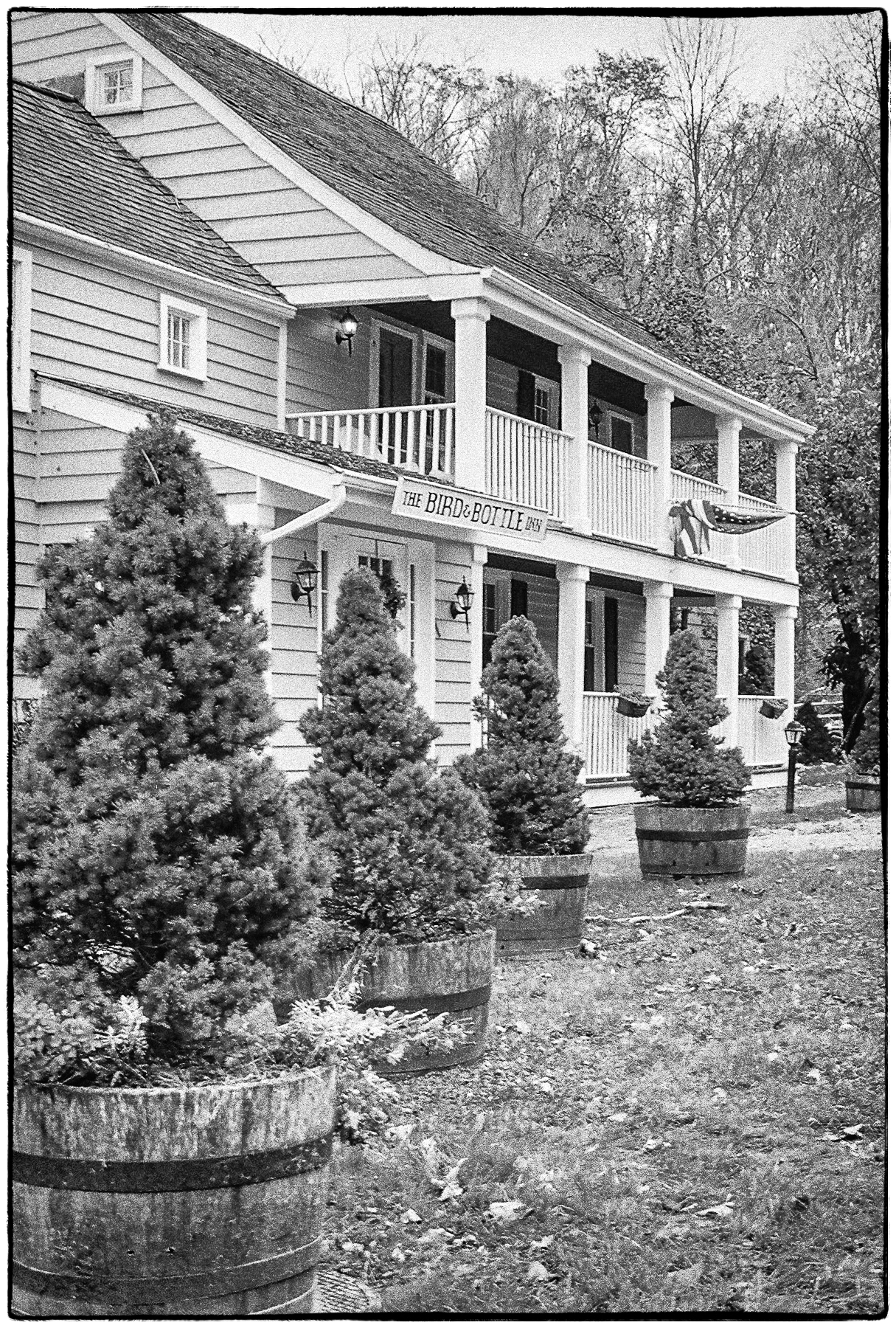
The Bird and Bottle Inn, Garrison, NY

According to “Historic Houses of the Hudson Valley” by Harold Donaldson Eberlein and Cortlandt Van Dyke Hubbard:

Lying just to the east of the Albany Post Road, at Indian Brook between Garrison-on-Hudson and Cold Spring, the Bird and Bottle began life about 1761 – perhaps a few years earlier – as Warren’s Tavern. When the Post Road was little more than a horse trail, John Warren’s tavern was a welcome sight to weary travellers of pre-Revolutionary days. As travel increased on this first highway through Putnam (then Dutchess) County – it had been much improved since its horse trail beginnings – Warren’s Tavern became a famous stopping place. Somewhat later, stagecoaches between Albany and New York regularly changed horses there, while passengers and drivers often stayed the night. In 1776 the inn passed to Absalom Nelson, at his marriage to Esther Warren, and thenceforth was known as Nelson’s Tavern. Its success continued under Absalom Nelson, and during the post-Revolutionary period it attained its greatest renown. The building of the Highland Turnpike (now the Albany Post Road – U.S. Route 9), which ran parallel to the old Post Road and ended at Nelson’s Tavern, greatly increased highway traffic between New York and Albany, and Nelson’s Tavern became one of the best known and esteemed ordinaries in that part of the Sate.

With the increase of boat travel on the Hudson and, finally, the coming of the railroad, life at Nelson’s Tavern gradually waned. At last, custom had so dwindled that the inn ceased to be a place of public entertainment and for a long time was a private dwelling. It so contined until 1939, when George W. Perkins of Cold Spring, wishing to preserve for Putnam County one of its historic buildings, bought it with the intent to restore it and have it again conducted as an ordinary, and in a manner worthy of its traditions.

Of course as is often the case with old houses, it’s reputed to be haunted. In this case by Emily Warren Roebling – daughter-in-law of John A. Roebling and wife of Washington A. Roebling, both of George Washington Bridge Fame. According to Hudson Valley Hallowe’en:

Emily has always made a great impression on the people of Cold Spring and her spirit lives on there. In 1969, Larry Evans, the director of the Bird and Bottle Inn explained that one of the upstairs rooms was to be known as the Emily Warren room and noted that Emily visited her grandparents there often. The Putnam County Historical Society displayed some of her personal belongings at the Foundry School Museum as a tribute to her importance to the village.

Today the inn is owned by Elaine Margolies. She is a charming woman and gracious hostess who has great respect and pride for the inn’s history. Emily has become part of her family. Guests and employees have sensed the presence of a woman in the inn. Some guests have even taken unique photos that could explain the unexplained. Elaine shared the most amazing photo (see image 7 in the photo gallery) taken in the dining room . I saw it as a ghostly image of a woman in old-fashion clothing. I have to believe it is Emily returning to her family home. There have also been reportings of a woman humming in the hall. Emily seems to be a little particular about how her room is arranged. At times the curtains and the chair in her room will be arranged as if someone wanted to peer out the window to enjoy the lovely view.

The information in the last paragraph seems dated and a notation on the Hudson Valley Hallowe’en site says: “The Bird and Bottle Inn is Closed and Up For Sale 7/15/2013”. I recently passed by and without going inside I definitely got the impression that it was open again. Their Facebook page indicates that this is the case.

Taken in November, 2011 with a Kodak Retina IIc.
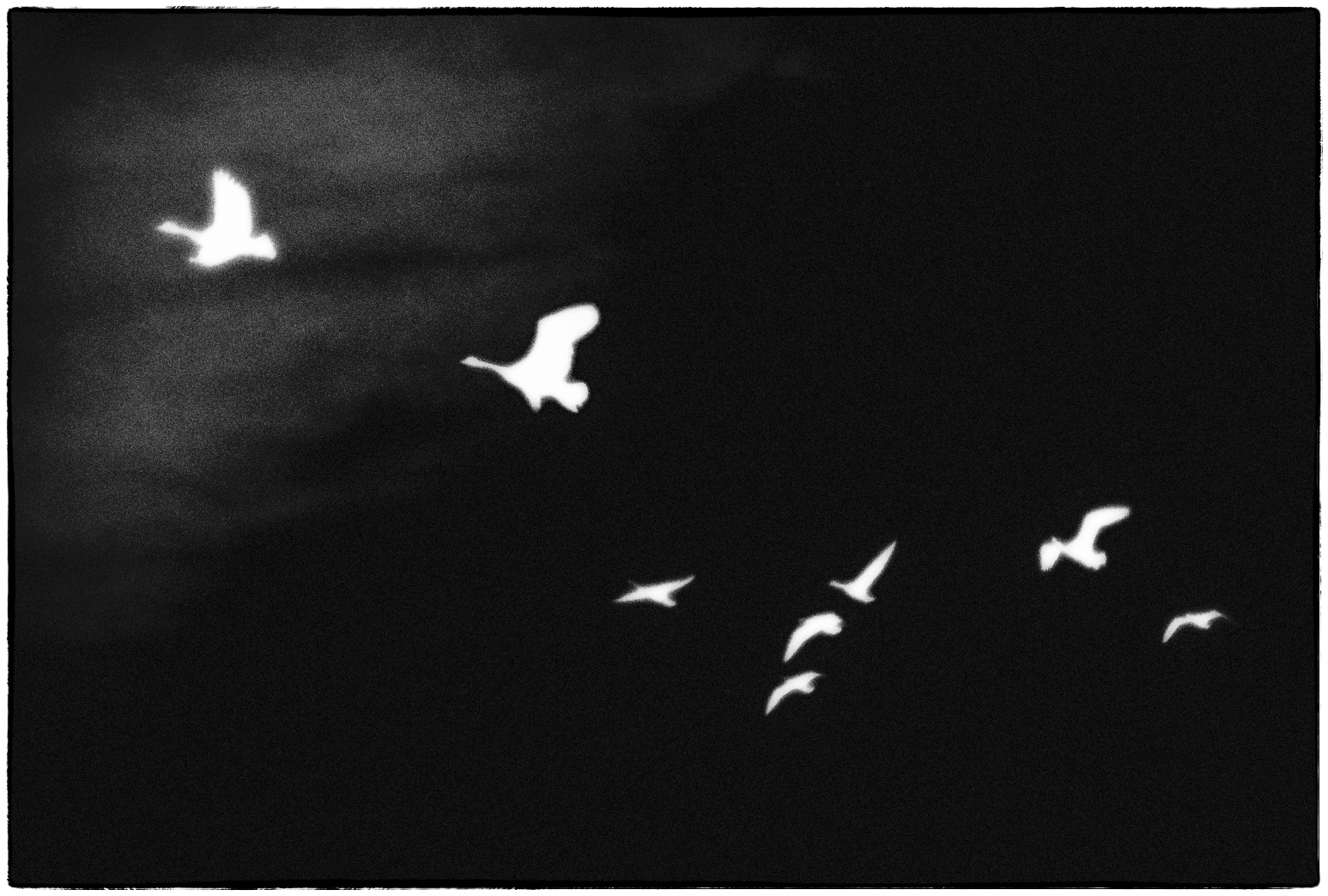
Geese on the Wing

In the previous post (Why It Does Not Have to be In Focus: Modern Photography Explained) I mentioned that I find it hard to to break rules and explore boundaries. So I thought I’d try something a little different. This started out as fairly low resolution scan of a film photograph taken with a Kodak Retina IIc. I was standing in Charles Point Pier Park near Peekskill when I spotted some geese flying overhead. I quickly snapped the shot without thinking about exposure and/or focus. The result was a rather blurry photograph of the geese with the tops of a few lamp posts intruding.

First I blurred it some more and adjusted the cropping mostly to remove the lamp posts. Then I converted it to black and white, applied a few filters (including one which gave a negative look) and voilà this is what came out. It’s kind of abstract looking. It reminds me a tiny bit of Les Oiseaux by Matisse. I very much doubt that this is great art, but it was something different for me to do and I enjoyed the process.

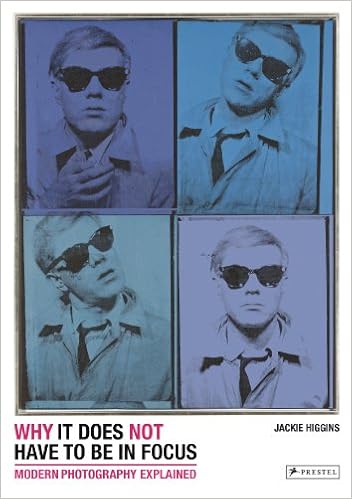
Why It Does Not Have to be In Focus: Modern Photography Explained

Why it does not have to be in focus. Source: Amazon.com

I suppose this book’s subtitle should really be “Modern art using a camera as a tool”. I’m strangely fascinated by this book. I bought it some time ago and I find that I often pick it up and browse throught it. If you’re looking for a book on photographic technique then this book isn’t for you. It doesn’t talk about ISO, shutter speeds, f-stops, rule of thirds or any of the other things commonly found it photography “how to” books. Instead about 100 images are organized according to the following categories: portraits/smile; document/snap; still lifes/frieze; narrative/action; landscapes/look; and abstracts/dissolve. Each picture is from a different photographer and for each one the author: “Describes the artist’s approach, process and technique; Locates the image in its historic and artistic context;…provides additional incremental information; and lists examples of similar images by the same photographer. Quotations (both attributed and unattributed) are also scattered throughout the book.

To give a flavor of what the book’s about I’ll provide a few examples of the photographs provided:

Second Beauty Composite by Nancy Burson, 1982. A single face which is actually a composite of five famous female movie stars: Jane Fonda; Jacqueline Bisset, Diane Keaton, Brook Shields and Meryl Streep. As the book says “This face belongs to non one; it has never existed”.

Untitled [Cowboy] by Richard Price, 1989. Re-photographed ‘Marlborough Man’ photograph blown up to gallery size. Has become known as “appropriation art”. This was the first photograph to sell for more than $1 million.

Poll by John Demand, 2001. Looks like a real office, but is actually an elaborately constructed set made of card, which is then photographed subsequently destroyed.

Strip by Jemima Stehli, 1999. A series of pictures of a woman (the photographer I think) with her back to the camera. She takes off her clothing in front of a man (a different man in each picture) who sits on a chair holding a remote shutter release and who presumably decides when to take the picture.

99 Cent by Andreas Gursky, 1999. A huge 81 1/2 by 132 1/4 inch picture of the shelves in .99 store.

Damage/Drown/Canal, 168 hours, June 2003 by Catherine Yass, 2005. According to the book “Yass photographed the canal on her large-format(4×5 inch) camera. Returning to where she exposed the image, she tied a large print to the edge of the canal and floated it in water for one week”.

I think I like this book so much because it encourages you to break rules and explore boundaries – something which I find very hard to do, and probably the reason why my photographs are so conventional. It would never have occurred to me to even try to do any of these things. I guess I keep hoping that if I go back to the book often enough something will rub off. It hasn’t so far, but who knows…

This book certainly won’t teach you photographic technique, but it will hopefully give you lots of ideas.

A comment on one of my pictures

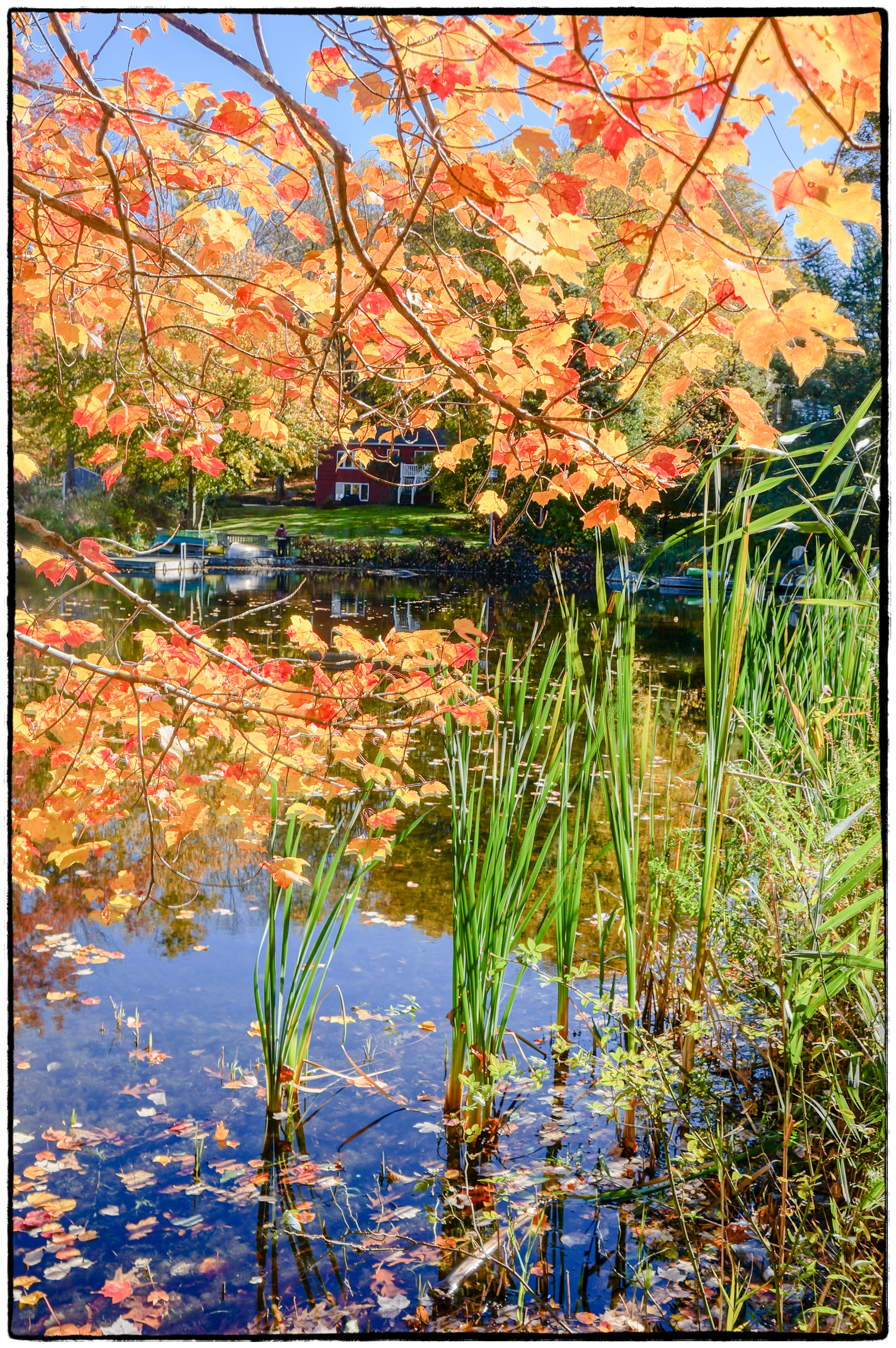
My wife recently posted one of my pictures (the one above) to Facebook. One of her friend’s commented: “Beautiful!! … Eirah, tell Howard that when he gets tired of his camera or makes an upgrade I’ll be happy to take it off his hands.” I know that she meant well, but I have a couple of problems with this comment.

First, I don’t really think that this picture is all that “beautiful”. I’ve never displayed it anywhere as I don’t really like it that much. It’s mostly just a large splash of color. Many would say that a picture should say something. I’m not sure that I agree with this. After all Monet’s ‘Water Lilies’ doesn’t say much, but it’s a beautiful creation. Yes, it has color – but it also has more: lines, focal points, space, etc. This photograph doesn’t have a clear focus. The grass leads off into nowhere. The brightly colored leaves obscure what might have been a focal point (i.e. the house). If I’d gotten down lower I might have made the house more visible. Even if I had chosen the house as a focal point I shouldn’t have placed it so much in the center. The exposure around the house is also off – way too dark. So if it’s so bad, why did I take the picture? Well, “it seemed like a good idea at the time your honour”. I suspect I may seen something (I don’t know what), but then failed totally in realizing it. If I had it to do again I think I could do better, but as it is I’m just left with a splash of color.

Second, if the picture did have merit I’d like to think that the photographer would have had something to do with it. I learned a long time ago that the camera doesn’t make the picture. Yes, an expensive camera can make some photographic tasks easier, faster etc. but the overall vision has to come from the photographer. That’s where I mostly failed with this picture: I didn’t think enough about what I was trying to achieve. I’ve seen many, many mediocre to lousy pictures taken with flashy equipment. Many of mine fall into this category. I’ve also seen great pictures (not so many) taken with inexpensive gear. To me a truly great photographer (and I certainly don’t put myself in that category) can take a great picture with virtually any camera.

So much as I appreciate the kind words in the comment I can’t take them all that seriously.

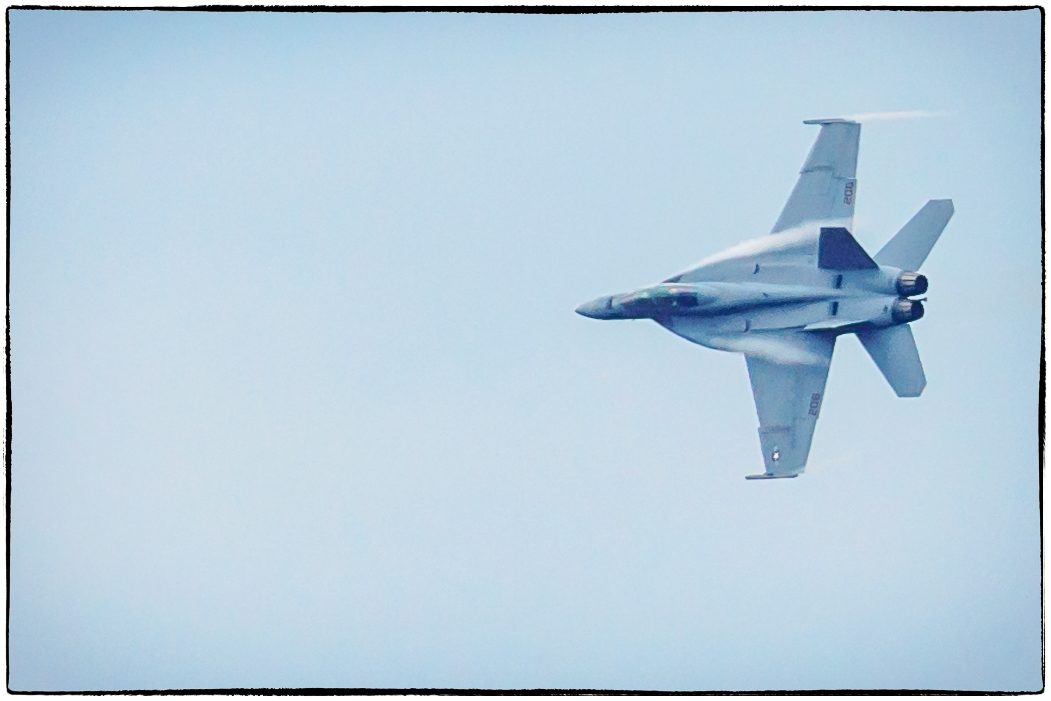
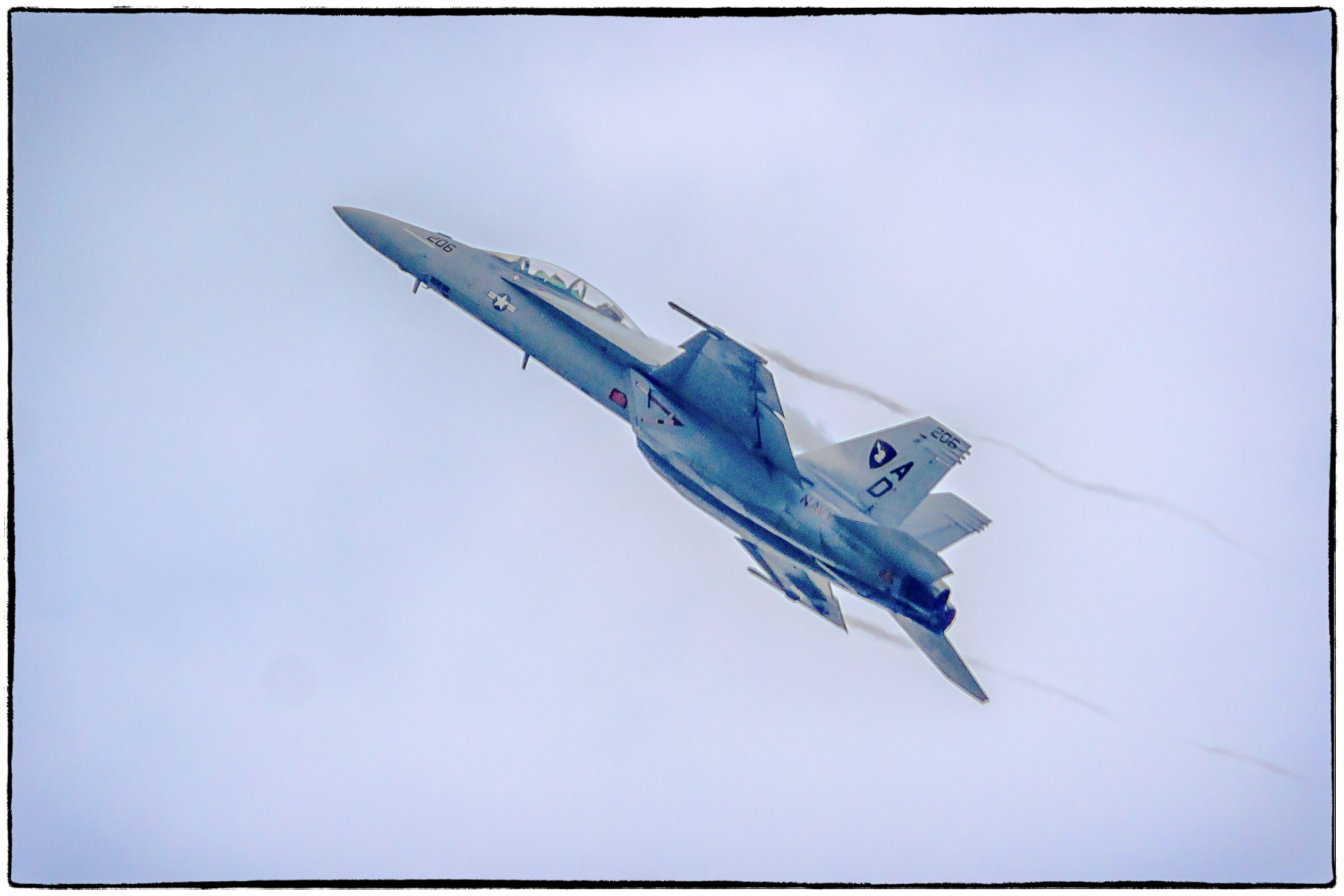
NY Air Show – US Navy F/A-18 Super Hornet

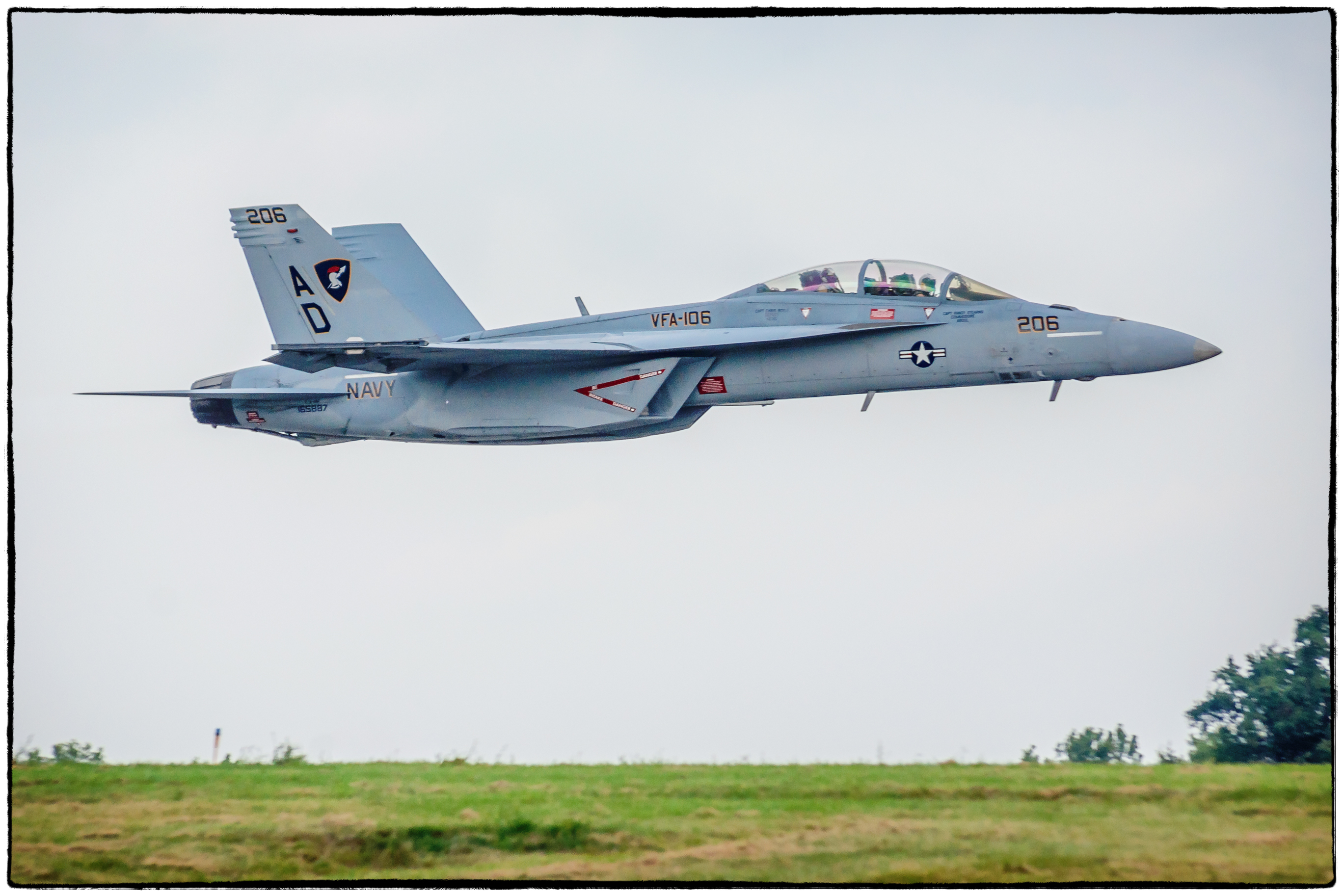
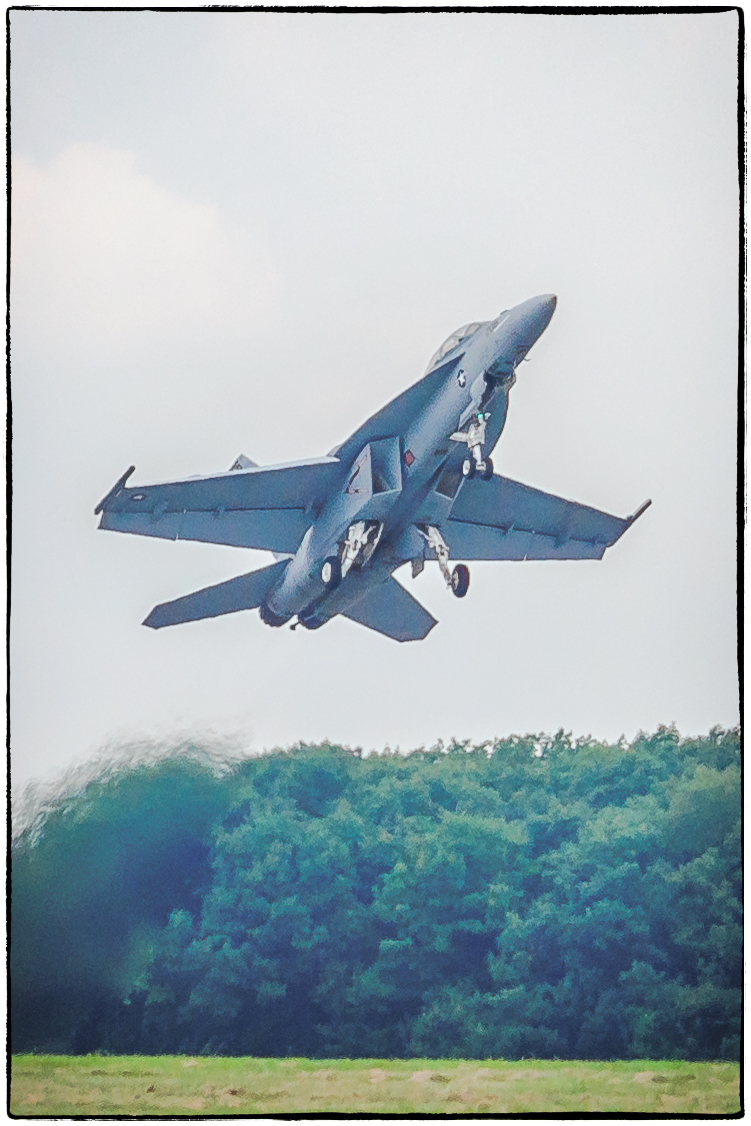
So far the airshow had been interesting but not really ‘awe-inspiring’. That was now about the change as the US Navy F/A-18 started to roll down the runway. The NY Air Show website describes the F/A-18 as follows:

The Boeing F/A-18F Super Hornet is a twin-engine fighter aircraft based on the original McDonnell Douglas F-18 Hornet also known as the “Legacy Hornet.” The Super Hornet is a larger and more advanced version of the legacy hornet. The Super Hornet has an internal 20 mm rotary cannon and can carry air-to-air missiles and air-to-surface weapons. The Super Hornet entered service with the United States Navy in 1999, replacing the Grumman F-14 Tomcat, which was retired in 2006.

The Super Hornet is largely a new aircraft and is about 20% larger in size than the legacy Hornet. The Super Hornet carries 33% more internal fuel, increasing mission range by 41% and endurance by 50% over the Legacy Hornet. The Super Hornet’s radar cross-section was reduced greatly making it harder to detect by enemy radar. The design of the engine inlets reduces the aircraft’s frontal radar cross-section. The alignment of the leading edges of the engine inlets is designed to scatter radiation to the sides. Fixed fanlike reflecting structures in the inlet tunnel divert radar energy away from the rotating fan blades.

As I mentioned in an earlier post I hadn’t been to an airshow since I was a child and I’d never seen such fast and powerful aircraft “in the flesh” as it were. It was really something.

Taking Off.

High Speed Turn.

Climbing.