Collecting Photography

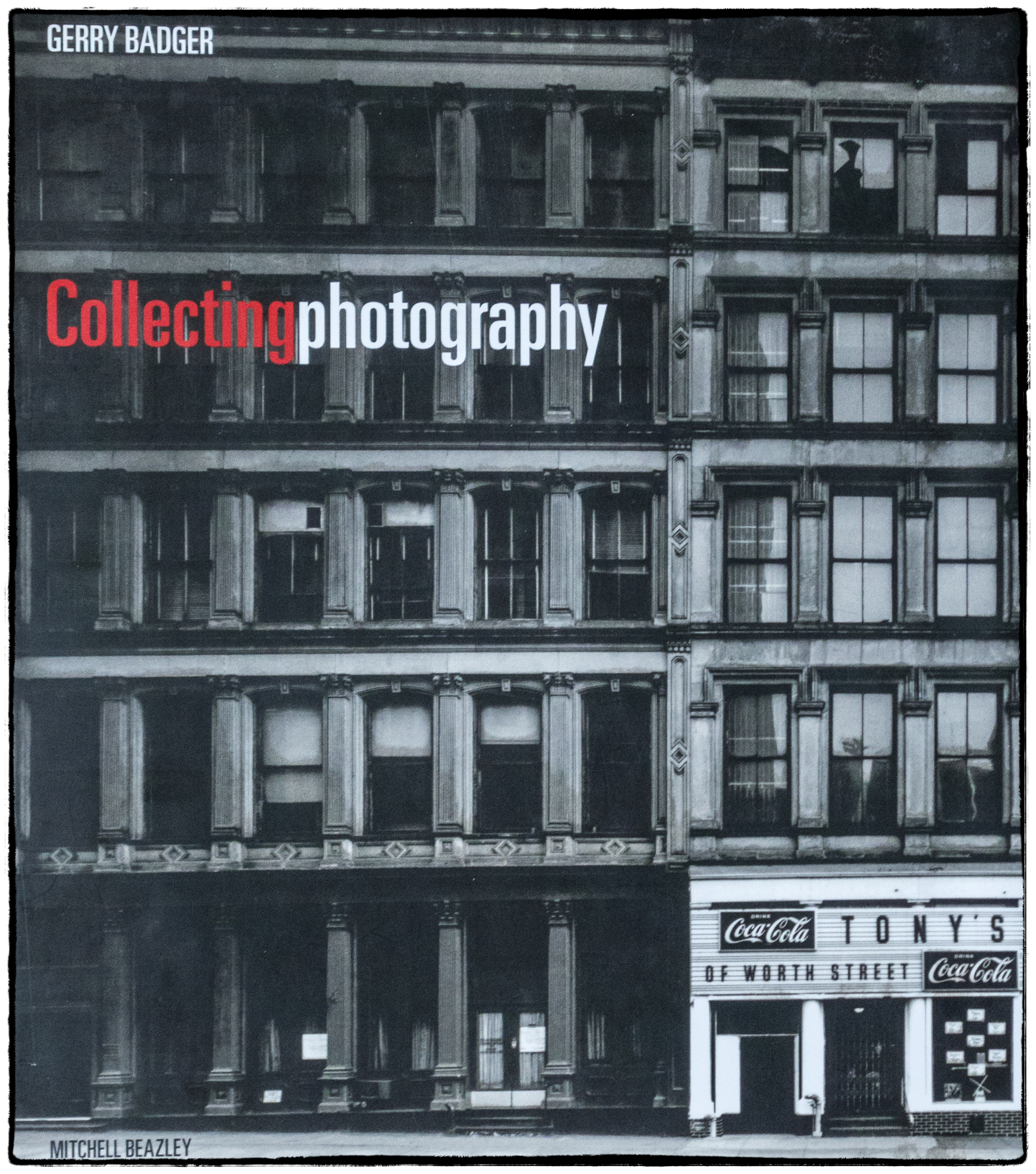
I’ve been thinking of starting collection of photographs for a while, but I didn’t really know where to start. So I picked up this book: Collecting Photography by Gerry Badger, second hand – cost about $8.00. It’s a nice hardback book in pretty good condition and I found it very useful.

The book is divided into two parts: the first part contains the introduction and five chapters dealing with the following topics:

The Art of Photography – deals with photography as an art form and discusses which photographs can be considered to be art, and which not as a guide to deciding which photographs might be worthy of collection. It ultimately concludes with the statement: “For even the most experienced professionals, an emotional response is a more accurate guide than a purely intellectual one, though one’s considered intellectual response is also important. But first of all, look for pictures that hit you in the gut, that ‘go against the grain’, because that is where the art of photography most properly resides.”

Building a Collection – Suggests several areas for collecting e.g. by subject; genre; process; school or historical period; quality; photographer or any combination of the above. Also covers collecting as an investment and concludes with the following guidelines (particularly for investors): Buy the best you can afford; Pay particular attention to condition; Check an images provenance; Avoid restored prints; Consider subject matter; Avoid ephemeral market trends; and Take the long view.

The Photographic Print – Covers issues and problems related to prints including Original prints; Vintage Prints; Later prints; Different print editions including limited editions; Print sizes. I must admit that I hadn’t realized that there were so many issues associated with prints.

Buying and Selling Photographs. Covers different places (and issues associated with each of them) to acquire pictures: Gallery or Dealer; Auctions; From a photographer; Photofairs; The Internet; Photographic archive or library. Also covers selling photographs – apparently not likely to be as fulfilling as buying. The problem of fakes and forgeries is also discussed although it’s apparently not as big a problem as you might think.

Displaying and Caring for Photographs – very useful tips on how to take care of your collection including handling; light; heat and humidity; and chemical pollution. Also deals with issues specific to colour and digital prints and includes sections on storing photographs; restoration (don’t unless you really have to and then have a professional do it); framing and record keeping.

The second part consists of a number of appendices:

An extensive Chronology covering the history of photography.
A glossary (I found the descriptions of photographic processes to be very informative).
A lengthy (almost 30 page) listing of key photographers including, for each, their nationality; dates of birth and death; subject matter they covered; types of media they used; and estimated price ranges for their work.
A listing of galleries and dealers with contact information.
A Bibliography subdivided by subject: General histories; Photography in the 19th century; Photography in the 20th Century; Books on collecting photographs; Books on Museum Collections; Books on private and corporate photographic collections; Books on photographic books; Technical books.

The book is also lavishly illustrated with many beautiful photographs, many of which I was not familiar with. Each one has a short caption with information related to collecting. For example a full page photograph of Edward Weston’s famous pepper is captioned with “Edward Weston. Pepper No. 30, 1931. Silver Gelatin Print. Private Collection. One of the icons of modern photography, which is available printed by Weston’s son, Cole for $2,500.

I enjoyed this book a great deal, but it’s worth mentioning a couple of caveats. First the book was published in 2006 and much has no doubt changed in the field since then, although I imaging basic principles will remain the same. Second I think it’s all probably a bit much for the type of collection I might build (i.e. inexpensive photographs which catch my attention). I’m not likely (at least not at the moment) to spend thousands of dollars on a photograph and consequently some of the issues related to taking care of the collection would be overkill. Having said this, however, I know from my camera collecting that once the ‘bug’ bites you can take off in unforeseen directions.
A Disturbing Object

Not far from where I live a trail goes off into the woods. I’ve documented it before in an earlier post: Wasteland off the Lake. It’s a strange area with an abandoned trailer, concrete forms, old tires, playground equipment etc. I went through again the other day.

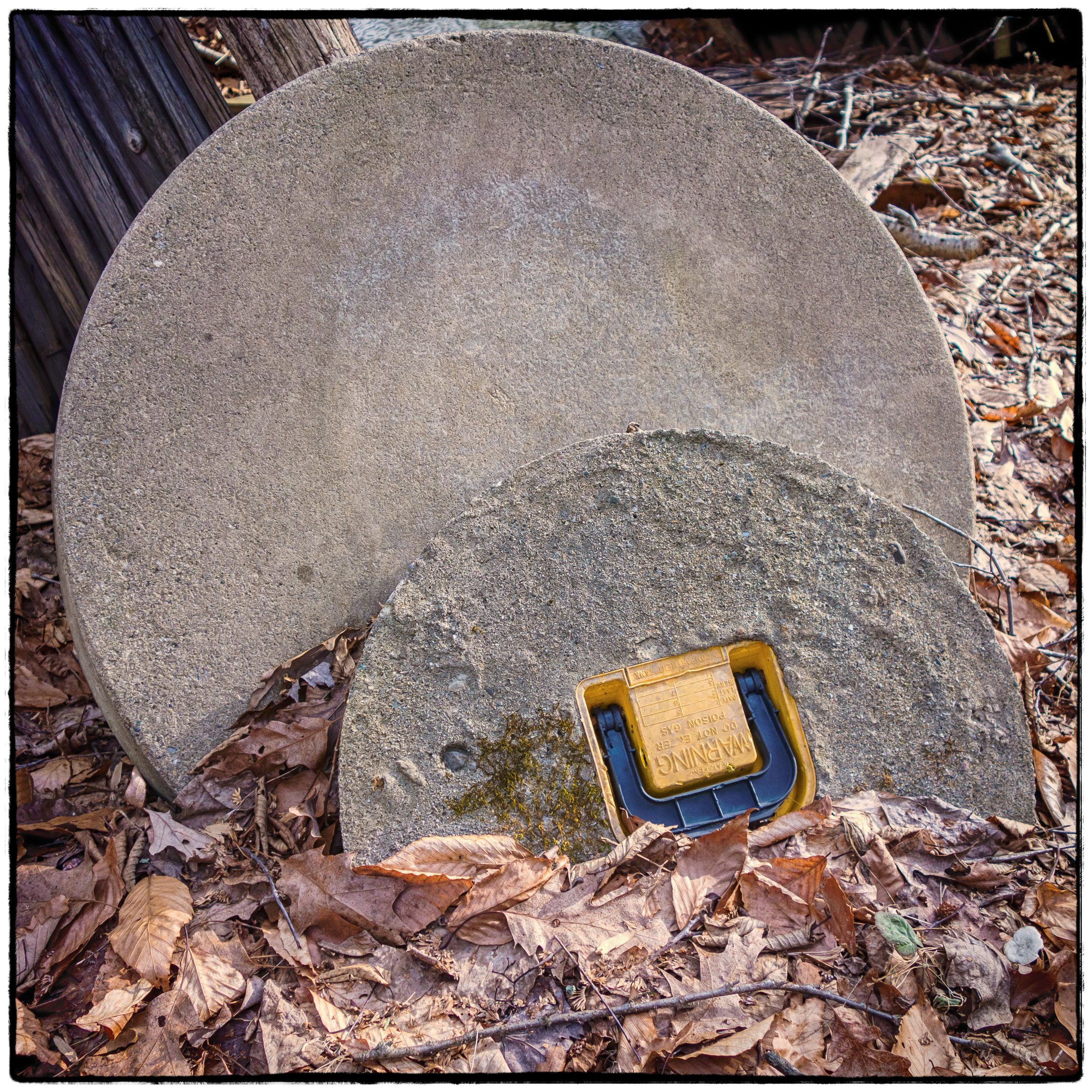
I’d noticed these circular objects before, but hadn’t looked at them closely. At first I’d thought that they were mill wheels but dismissed that thought as they seemed too small. This time I took a closer look. The first one has a handle and right by the handle a sign (in yellow in the picture). The sign reads: WARNING. DO NOT ENTER. POISON GAS.

Clearly they covered some kind of container at some point. Makes you wonder what it was they covered!

Converging Lines

I was sitting in Moonbean Cafe, one of my favorite local eateries when I noticed these lines converging towards the center of the round table where I was sitting. I also like the warmth of the wood grain inlay. It was pretty dark inside and I wanted a decent amount of depth of field so I had to use a slow shutter speed. Luckily the low angle that I wanted allowed me to lean the camera on the table surface while tilting it downwards.

It’s Your Image Do What you Like to it

Quite some years ago when I was doing my Fine Art Degree at University I was working on an image which I wasn’t quite sure about. My tutor came over and asked what was wrong. I told him that I thought people wouldn’t like one aspect of it. He looked at me and said, “It’s your image, you can do anything you like to it.” Ever since then I keep repeating those words to myself.

via It's Your Image Do What you Like to it.

Interesting article and also an interesting set of comments.

The article focuses on processing of images and whether or not certain types of processing would meet with the approval of certain types of people. My wife likes to paint from time to time and a while ago I was in Montreal and she wanted me to get her some painting supplies. I checked around and found a store close to my hotel. While I was getting her stuff I got talking to the woman in the shop. I told her that I had once tried painting, but that my attempts were almost universally ridiculed by my family even though I quite liked the result. I had painted a horse with woods in the background. I liked the way the woods came out, and most of the horse. However, I’ll be the first to admit that one of the rear legs of the horse was somewhat ‘off’. But, I thought, not bad for a first attempt. My family apparently didn’t think so and I can still hear their mocking laughter today. I never tried painting again! The woman in the store essentially said that you don’t paint for other people. You paint for yourself. I’ve taken this lesson to heart with my photography. I do it for me, not for other people and I don’t really care too much what others think. Actually that’s not entirely true. I welcome constructive criticism, especially from those whose opinions I respect because it makes my work better. I think this article is saying the same thing.

The comments, while generally agreeing with the article, take the discussion in a different direction: If a photograph is substantially enhanced through post-processing is it still a photograph. Or is it, as some of the comments suggest, “digital art”? To me it’s still a photograph. Photographers have always enhanced their photographs through post-processing even in the days of film. The pictorialist photographers did a lot to their images to make them look like paintings and even Ansel Adams manipulated (if that’s the right word. It sounds too negative.) his negatives and prints to get them to realize the vision he had when he pressed the shutter release. I probably spend more time processing an image than I do taking it. When I take a picture I have a particular result in mind. Sometimes, rarely, I get this right out of the camera. More often than not I have to ‘tweak’ it to get the result I had in mind when I took the picture. I think I soured of photography at one point because, unlike Adams, I never learned how to develop my own negatives and make my own prints. This meant that I was at the mercy of commercial labs, which generally produced results, which I could not match with the idea I had in my head of what my picture would look like. Essentially I couldn’t control the entire process. Now, in the digital world, I can – at least up to a point. I don’t often print my photographs, but when I do I have to rely on a lab. One day I’ll get a better printer, understand better how printer profiles work and be able to get prints, which match the vision I had when I pressed the shutter release. Then I’ll only have to learn how to matte and frame the prints.

I suppose that is my ultimate goal – to be able to control the entire process from pressing the shutter release to viewing a print on the wall. I didn’t realize I was such a control freak.

One final thought. If you look for a definition of photography you tend to come up with something like ‘the art or practice of taking and processing photographs’. It would be wise not to forget that the word originally meant ‘drawing with light’. Under that definition both traditional approaches and “digital art” would both be considered to be photography.