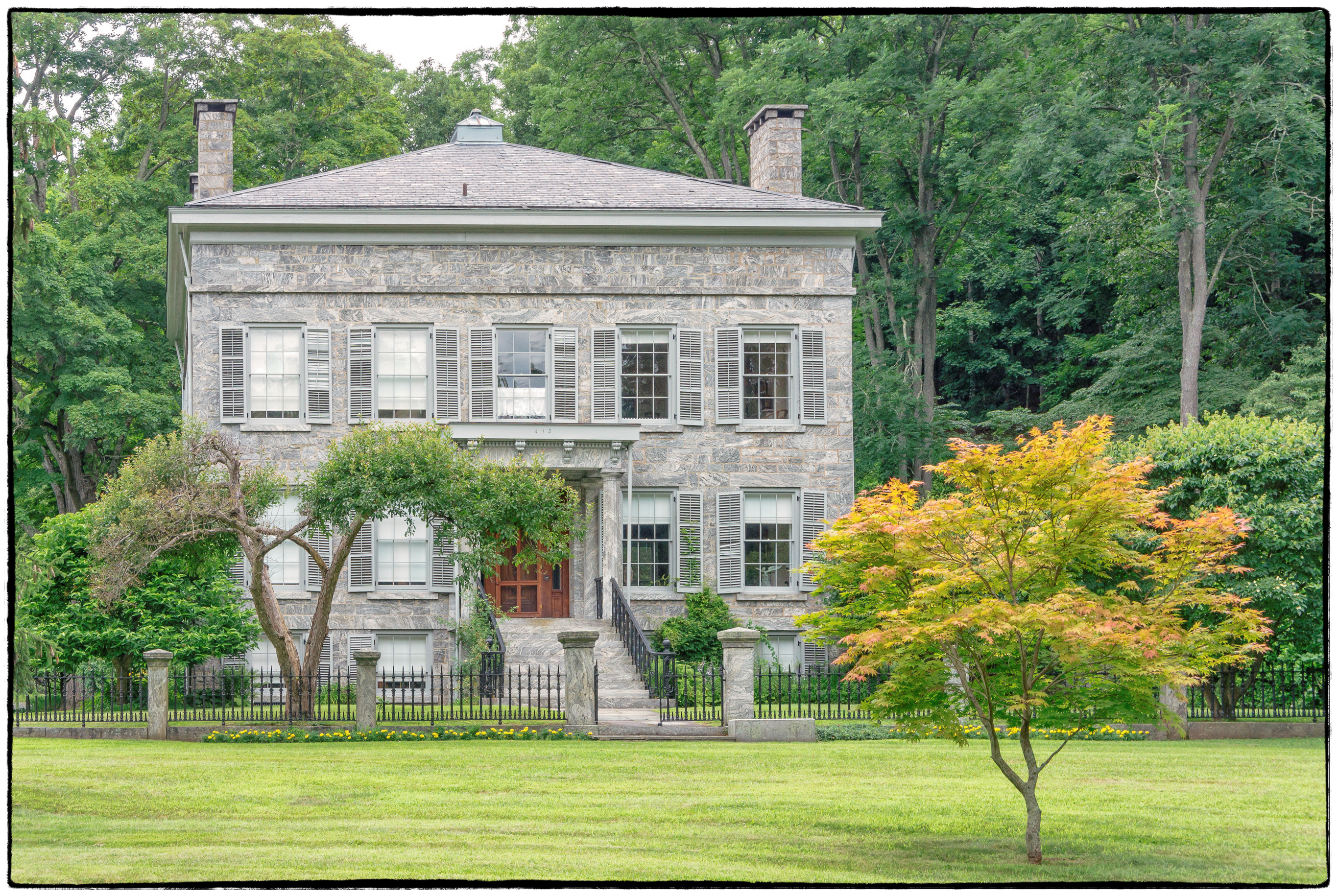
A mystery solved

Back in August, 2013 I went to North Salem and took some pictures (see: North Salem). On the way home I noticed this fine old building. At the time I wasn’t able to find any additional information and I remarked in the blog post: “I don’t know what this house is (seems to be a private residence) and I don’t even remember if it’s in North Salem. If it’s not it’s certainly close by”.

We have some friends who transferred to Thailand, and are returning in a month or so. They asked us to check out an area where they would like to rent while looking to buy a new house. That area is Somers, NY and we went yesterday. On our return I started to see what I could find out about Somers on the internet and ‘lo and behold’ I came across a picture of this house. It turns out I was right. The house in not in North Salem. It’s in Somers.

It’s the Gerard Crane House and according to Wikipedia:

The Gerard Crane House is a private home located on Somerstown Turnpike (U.S. Route 202) opposite Old Croton Falls Road in Somers, New York, United States. It is a stone house dating to the mid-19th century, built by an early circus entrepreneur in his later years.

The house itself is an unusually sophisticated late application of the Greek Revival architectural style. The interior features a high level of decoration, particularly English Renaissance-style plaster moldings on the ceilings that are not commonly found in rural Greek Revival houses. It is the center of a 25-acre (10 ha) estate that includes not only the original outbuildings but an original section of Somerstown Turnpike and one of its mileposts.

It remains largely as it was originally built. In 1985 the area was designated a historic district and listed on the National Register of Historic Places. It is the northernmost such listing in Westchester County.

Crane and his brother Thaddeus, descendants of a colonel in the Revolutionary War, moved to Somers from their hometown, nearby North Salem, in 1823. They had become active in the new business of exhibiting exotic animals, and records show that they had taken a lion to the Carolinas three years earlier. They bought land from Hachaliah Bailey, whose exhibition of Old Bet at the building now known as the Elephant Hotel is considered the beginning of the circus in America, that they would later build on.

They added to their menagerie, got partners, and exhibited as far as west as the Mississippi River. They were among the founders of an early trade organization called the Zoological Institute, which collapsed in the Panic of 1837. Crane himself was more fortunate; he served as a director, and later president of a local bank, and had just concluded four years as town supervisor at the outset of the panic.

In 1849, having married Roxana Purdy, he had the house built. Its extensive detailing and finely crafted stonework are features of a country manor house in the highest Greek Revival tradition. The English Renaissance-style molded plasterwork on the first floor ceilings, common in urban homes of this type but rare in rural variants, reflects Crane’s cosmopolitan tastes.

The next year’s census shows the Cranes at that address, with their six children and one other woman. He died in 1872. The house and estate have remained a private residence since then. Other than the barn’s gambrel roof and the conversion of the main house’s music room into a kitchen during the 1980s, there have been no significant alterations to the property.
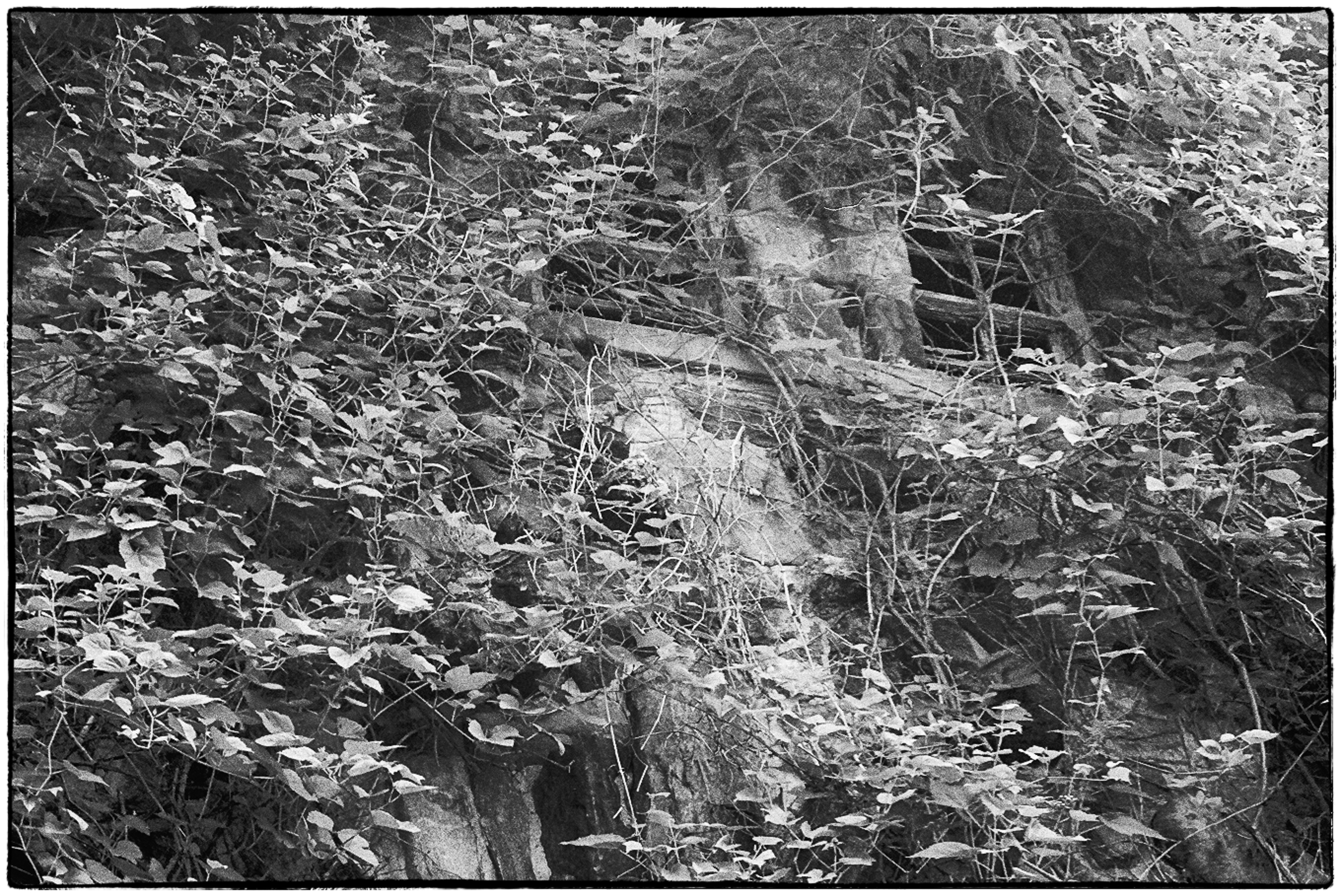
Vines on an old building

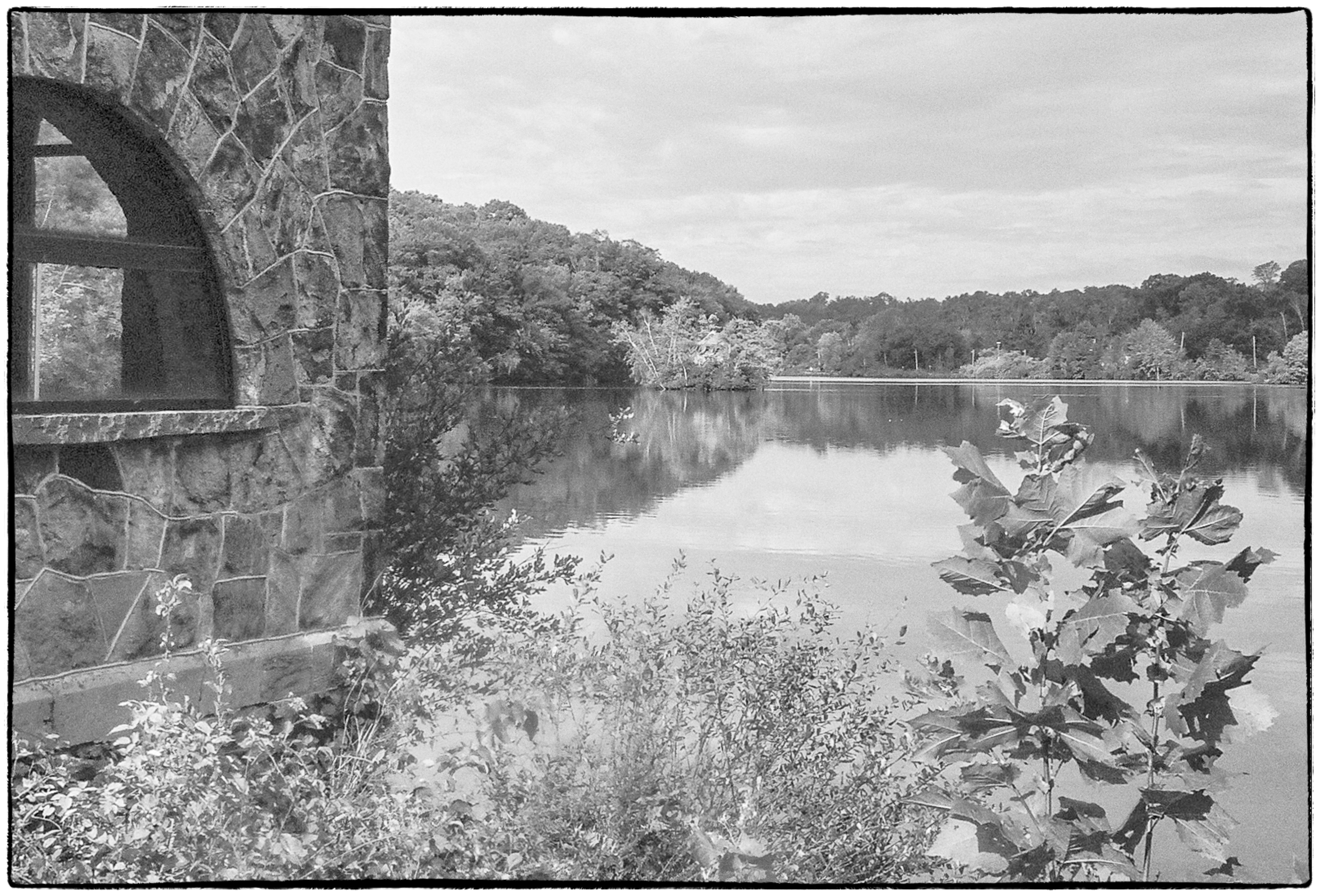
Another old film picture taken around the time I started collecting cameras. This one was taken with a Fed 2 rangefinder camera and Industar-61 lens.

It was taken at Pocantico Lake (see Old Waterworks at Pocantico Lake for a better sense of the surroundings. The picture is taken of the facade on the left of the building in the last photograph). It’s a very ‘busy’ photograph and I like the way that it’s not immediately apparent what you’re looking at. It just looks like a bunch of leaves. Gradually, however you start to see the outlines of a window and some weathered stone and you realize that there’s a building under there.

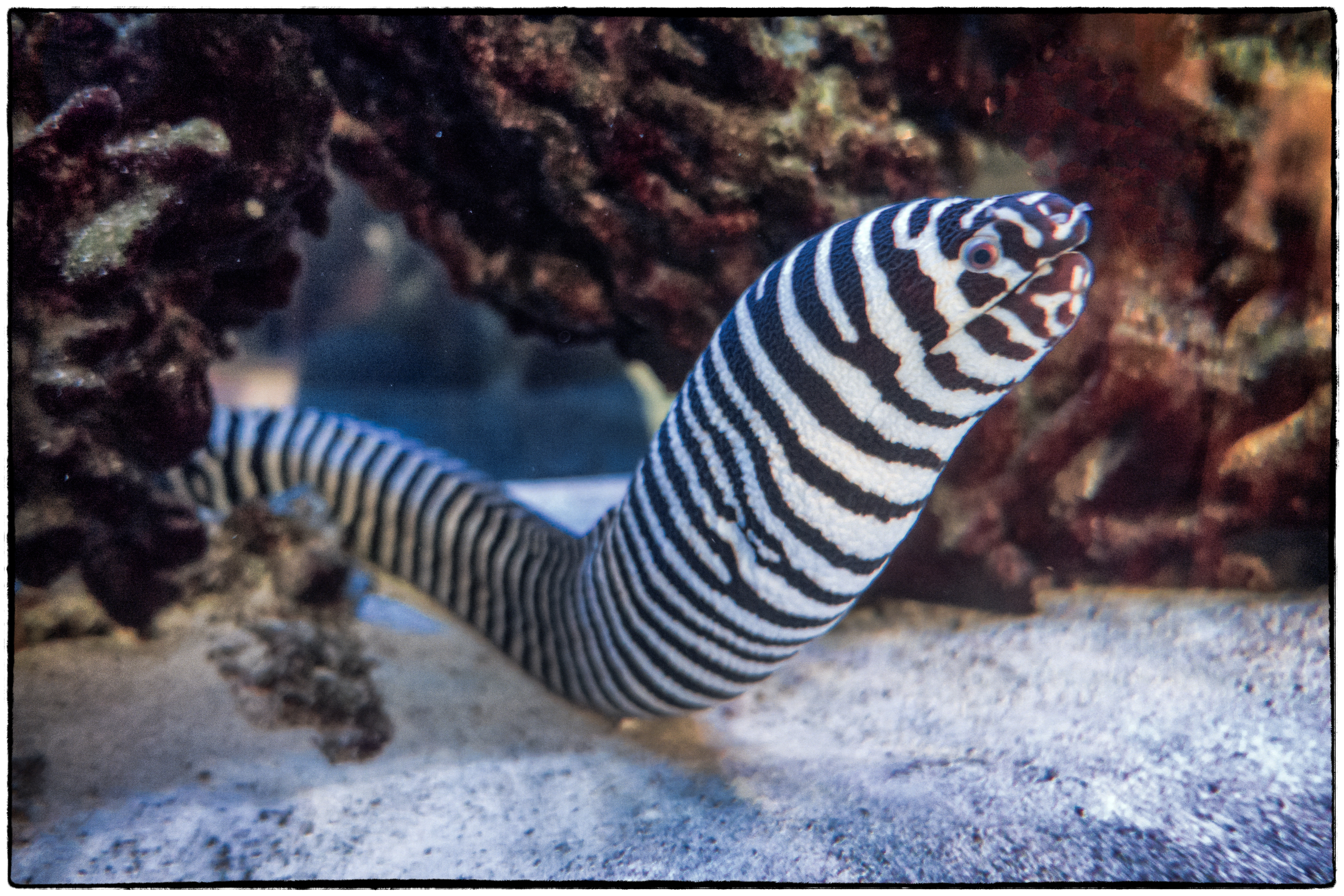
Eel

We took the dog in for his annual checkup today and while we were waiting decided to have lunch at a nearby restaurant (Wild Fusion). As we were leaving I noticed an aquarium right by the exit, and inside, along with the usual brightly colored fish, was this spectacular creature. I’d never seen anything like it before. The white bands had what must be scales, but looked almost like fur. At first it appeared to be suspicious of the camera and retreated backwards. Curiosity seemed to take over and it quickly started to move towards the camera – no doubt checking out what it was.

When I got home I browsed around a bit on the internet to see if I could find what it is. The nearest thing to it that I could find was a Zebra Moray Eel. FactZoo.com describes it as follows:

The zebra moray eel is a mid-sized species of moray eel that has become known for its black and white striped appearance. The striped eel commonly has a length of up to 4.9 feet (1.5 meters), but many specimens found are much smaller. They are found in their habitat primarily in the reefs of the Indo-Pacific region and the eastern Pacific region; including California (United States), Mexico, Columbia, the Galapagos Islands, and of course the make a handsome appearance in people’s aquariums worldwide.

The zebra moray eel has become known as a danger to humans. The truth though is, that the eels only attack in self defense, and most bites on humans are the result of mistaken identity or attempts by humans to hand feed them – don’t try it! Like all morays, its bite has a weak release mechanism and therefore its jaw must be pried off (even in death during cases of human bites). Contrary to popular belief, their bite is not poisonous naturally, but may cause infections because of the toxic bacteria-laden algae that they eat.

The zebra morays have also become known for their practice of hunting in cooperation with groupers; the only cooperative hunting that has ever been observed to go on among fish. Morays are recruited by groupers in order to use their ability to enter small crevices to flush out prey such as crustaceans, sea urchins, and mollusks; which are pretty much the only prey that zebra morays feed on. The “bounty” from these hunts is then shared between species.

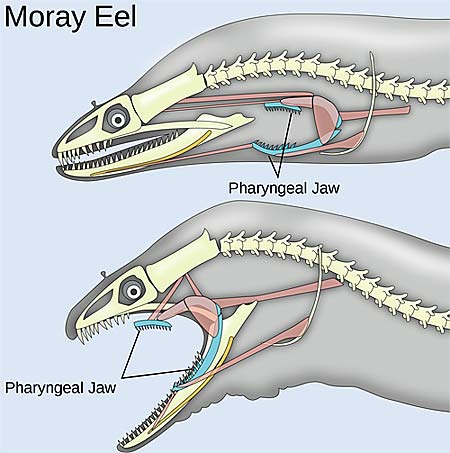
As we stated before, morays have primitive biting system, but that’s based sheerly on their first set of jaws, but they also have second set, known as pharyngeal jaws, that rest deeper in their bodies and are shot out into their main jaws when trapping prey.

Moray Eel – pharyngeal jaws

It’s not much of a picture, but after all it was dark and I was shooting through glass and water so I’m pretty much satisfied that I was at least able to capture this remarkable creature.

Tarrytown reservoir

This was taken in the early days of my camera collecting. As I recall it was taken with a Zorki 4 rangefinder camera with a Industar 61 55mm f2.8 (not the L/D version) lens. I don’t recall what film was used other than that it wasn’t Kodak Professional BW400CN. I remember this quite clearly because I hadn’t realized (it was a long time since I’d used film) that places like CVS could not process this film (which at the time I found odd as they had sold it to me). I do recall that it was ISO 400 film so it was probably either Tri-X or TMAX.

Leitz 90mm f4 Elmar LTM

When I started camera collecting I was initially focused on rangefinder cameras. I hadn’t really collected anything before, and I wasn’t sure if my interest would last. I didn’t want to spend much money (just in case) and I bought a couple of Former Soviet Union rangefinder cameras: A FED 2 and a Zorki 4. Of course these cameras use lenses (in this case a Jupiter 8 and an Industar 61) with a Leica Thread Mount (LTM).

As time went on I decided that I liked using these cameras and decided it was time to get a real Leica – A Leica IIIf. Although the FSU lenses I had worked well and produced results I liked, I thought I should have at least one actual Leitz lens. I didn’t want to pay an arm and a leg so I opted for this 90mm f4 Elmar. I was at first suspicious of the low cost (less than $100), but I was buying it from a very reputable dealer so I decided to take a chance.

A discussion thread on photo.net entitled Leica 90mm f4 Mystery suggests some reasons why these lenses are inexpensive:

I believe you are describing the 90/4 Elmar in Leica thread mount, (LTM) is that right? The Leitz code designation is ELANG. As long as there is no fungus, fog, or haze, there’s nothing wrong with it. Until 1963 these were of the four-element triplet design. Then they changed to three elements. Like most triplets (and to some extent like practically all lenses), they are sharp in the center, and perhaps less so at the edges and corners especially wide open–like the 50mm Elmar. But there are always photographers who prefer the imaging properties of one or another lens! It’s a decent lens, and a compact one. As the lens began production in 1931, early examples are probably not coated. The thin version started in 1932. They were black until the late ’40’s, when they switched to chrome. They pretty one with the band of Vulcanite was introduced in 1950. I don’t think there’s anything wrong with them. Maybe they have not been “discovered” yet!

Supply exceeds demand. Also, it’s not the sharpest of lenses, but it is a pleasant lens. The VIOOH (Imarect) finder commonly used with it provides a quite small image at the 90mm setting. You have to be careful about parallax with this lens.

I have the “…pretty one with the band of vulcanite” mentioned above, which according to How to determine the production year of a Leica lens based on the serial number was made in 1952 (coincidentally the year I was born).

I really is a lovely lens. My copy is in great shape cosmetically and it feels really well made (especially compared to my FSU lenses, which although they work well feel very “rough and ready”). It’s true that at f4 it’s a bit slow, but for the kind of pictures I take this doesn’t bother me much. Nor does the lack of sharpness. I’ve never been a believer that good photographs necessarily have to be ultra sharp.

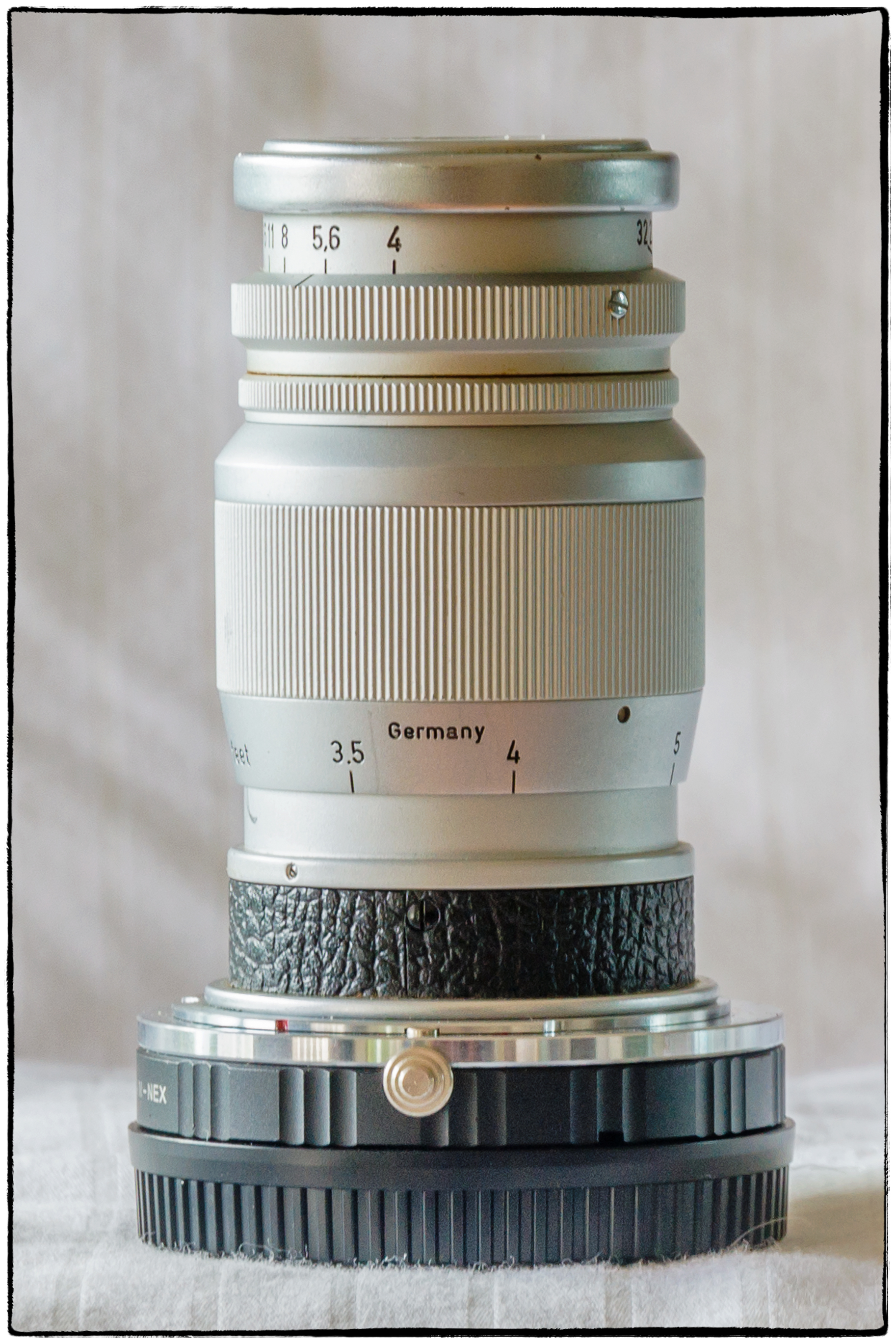
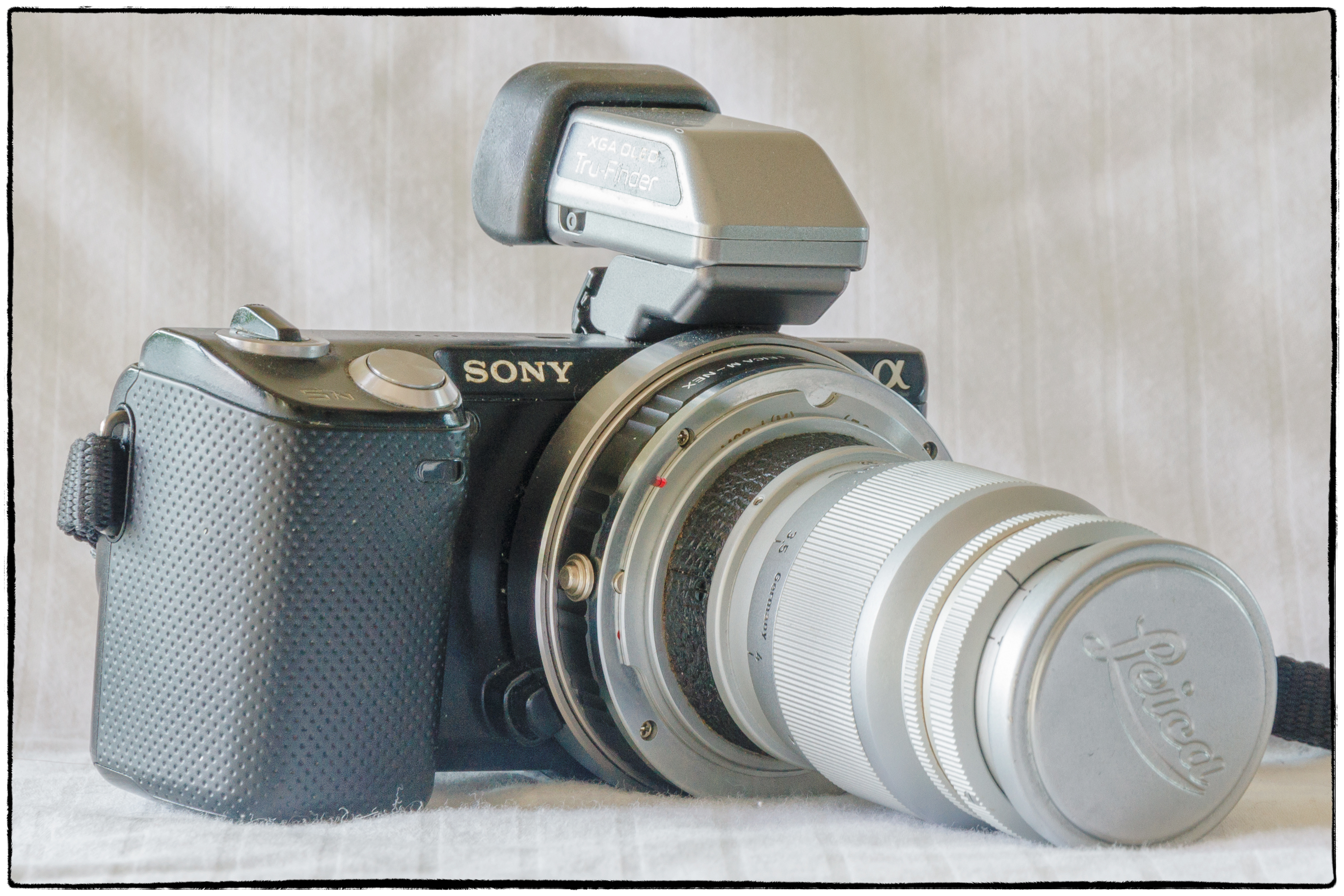
I still haven’t used it on the Leica, but I did decide to use it on my NEX 5N with an adapter – or actually with two adapters. My LTM-Sony E mount adapter doesn’t seem to work right so in this case I used an LTM-Leica M adapter and a Leica M-Sony E mount adapter), which worked perfectly. Note that in the picture above you see the lens, the adapters and a body cap. The actual lens starts at the band of vulcanite. It’s quite small and rather light. In the picture below you can see the lens on the NEX. To take this picture I removed a Minolta MD 50mm f1.4, which was not much shorter and noticeably heavier. On the NEX the lens is of course a 35mm equivalent 135mm lens.

For some pictures taken with this lens see:

Eighteen Arhats: Right Side
Eighteen Arhats: Left Side
Eighteen Arhats: My personal favorite – Mahakappina Thera (not such a great example because I missed the focus).

Leitz 90mm f4 Elmar on Sony NEX-5N