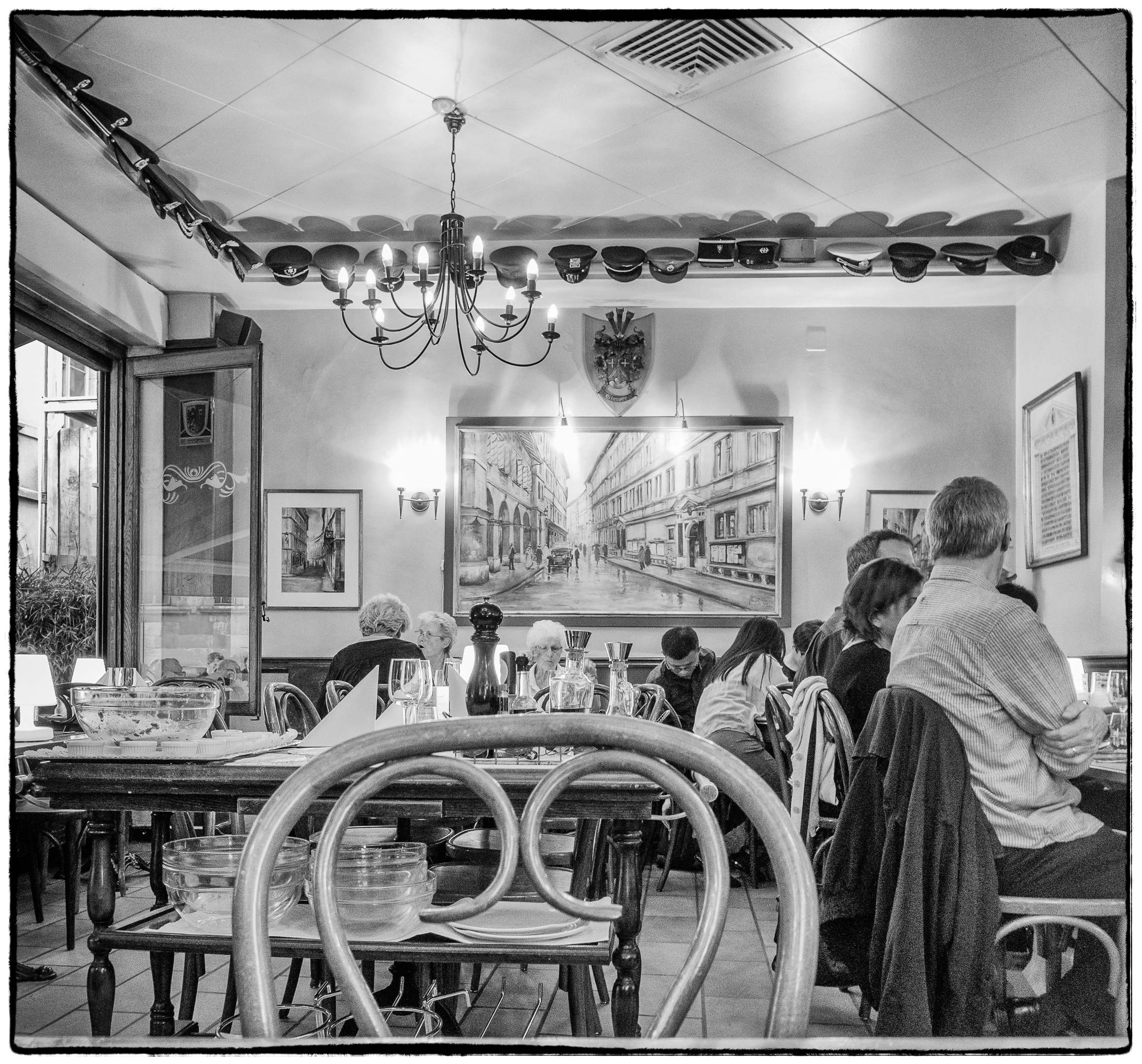
Geneva – Old Town, Fondue at the Restaurant de l’Hotel de Ville

I love cheese fondue! My preference is for the fondue at the Café du Soleil in Petit-Saconnex, near where I used to work (it was also a favorite after work watering hole for myself and my colleagues). Unfortunately, time was getting short during our visit and our daughter and her family were incredibly busy so it was starting to look as if I wouldn’t be getting to the Café du Soleil.

I didn’t want to miss my fondue though. I’d met with some friends for a drink at Brasserie du Molard and afterwards decided to walk back through the old town and back home. I was hungry and knew of a couple of places that had decent fondue. One was “Les Armures” near the old armory and the other was the “Restaurant de l’Hotel de Ville

I decided on the “Restaurant de l’Hotel de Ville”, whose website provides the following historical information (translated from the original French):

The current building was constructed in the XVIth century for Count Calandrini hence the name of this house adjoining the “Maison Tavel”. Around the year 1600, the current restaurant was the city’s guard room and soldiers in armor gathered here to eat. According to state archives, a public house was opened around 1700, and then a bar, to which was added a few frugal meals. It was only in the years 1800-30 that a brewery (making beer) came into being.
 
Nowadays, it is a Café-Restaurant-Brasserie, operated for 24 years by Mr. Jean-Yves Glauser and his family, who through their immense popularity have given a true soul to this Geneva institution, which is affectionately called the Brasserie of Father Glôzu.
 
Inevitably the restaurant is part of the Geneva’s political and international life as the Republic’s parliament is directly opposite. Encountering heads of state or other famous people in the restaurant is not uncommon. Film and theater stars mix with other customers.

I was surprised to read that the restaurant is owned by the town of Geneva.

Taken with a Sony RX100 M3.

Geneva – Old Town, Hotel-de-Ville

Although I’ve passed by the entrance to the Hotel de Ville many times I’ve never been inside. As I went by this time I noticed the the entrance was open and went in for a look. I liked the cloister like vaulted archways.

For more information see: Hotel de Ville (sorry too much to translate).

According to the Wikipedia entry on Geneva:

The Municipal Council (Conseil municipal) holds legislative power. It is made up of 80 members, with elections held every five years. The Municipal Council decrees regulations and by-laws that are executed by the Administrational Council and the administration. The delegates are selected by means of a system of Proporz with a seven percentage threshold.

The sessions of the Municipal Council are public. Unlike members of the Administrational Council, members of the Municipal Council are not politicians by profession, and they are paid a fee based on their attendance. Any resident of Geneva allowed to vote can be elected as a member of the Municipal Council. The parliament holds its meetings in the Town Hall (Hôtel de Ville), in the old city

Geneva – Old Town, Along the Rue de l’Hotel-de-Ville

The Rue de l’Hotel-de-Ville leads you up into another part of the old town, where you find the Hotel-de-Ville (Town Hall), Les Armures (the old armory), and the St. Pierre Cathedral. Above the view from outside the Hotel-de-Ville looking back in the direction of the Place du Bourg de Four.

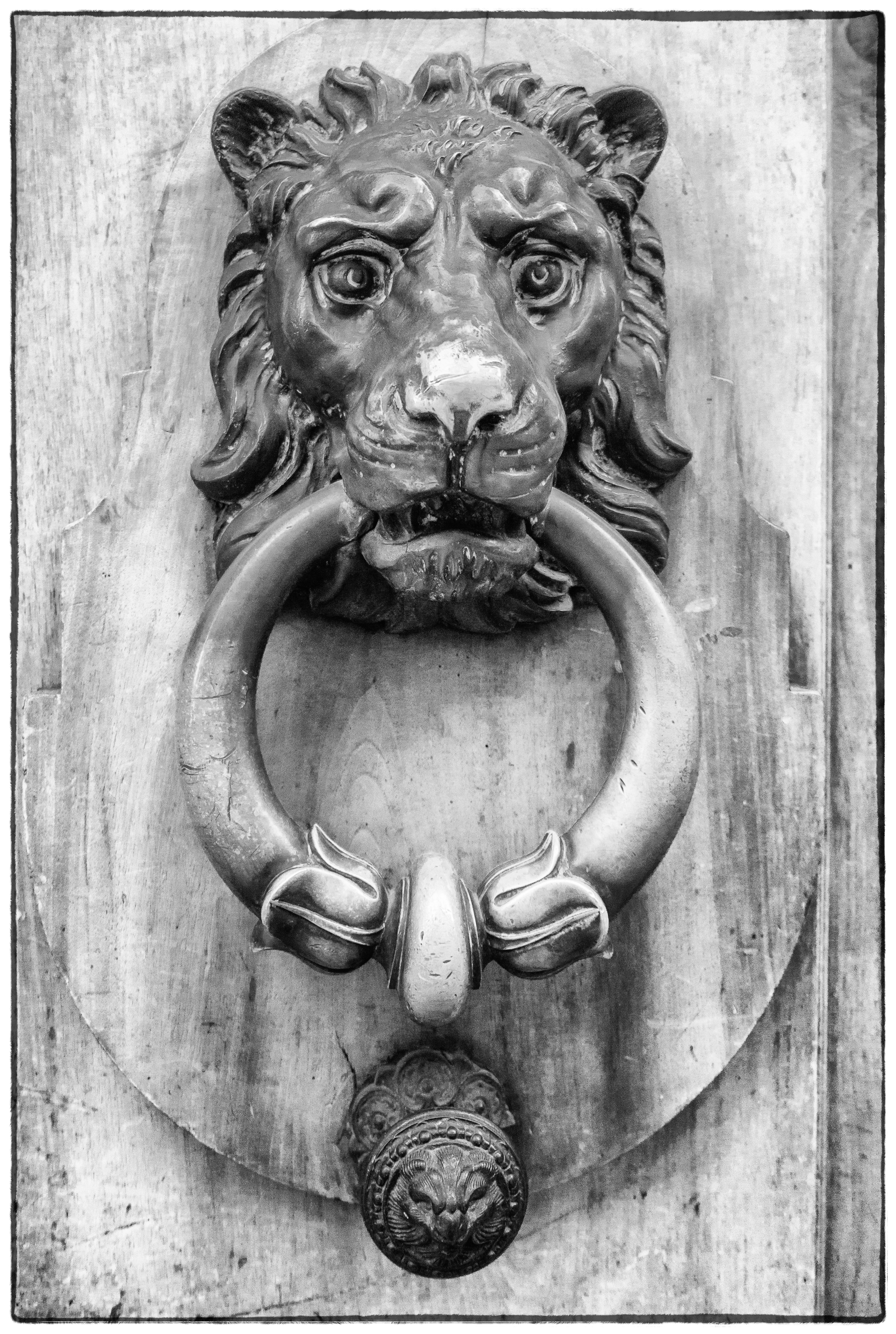
Ornate door knocker.

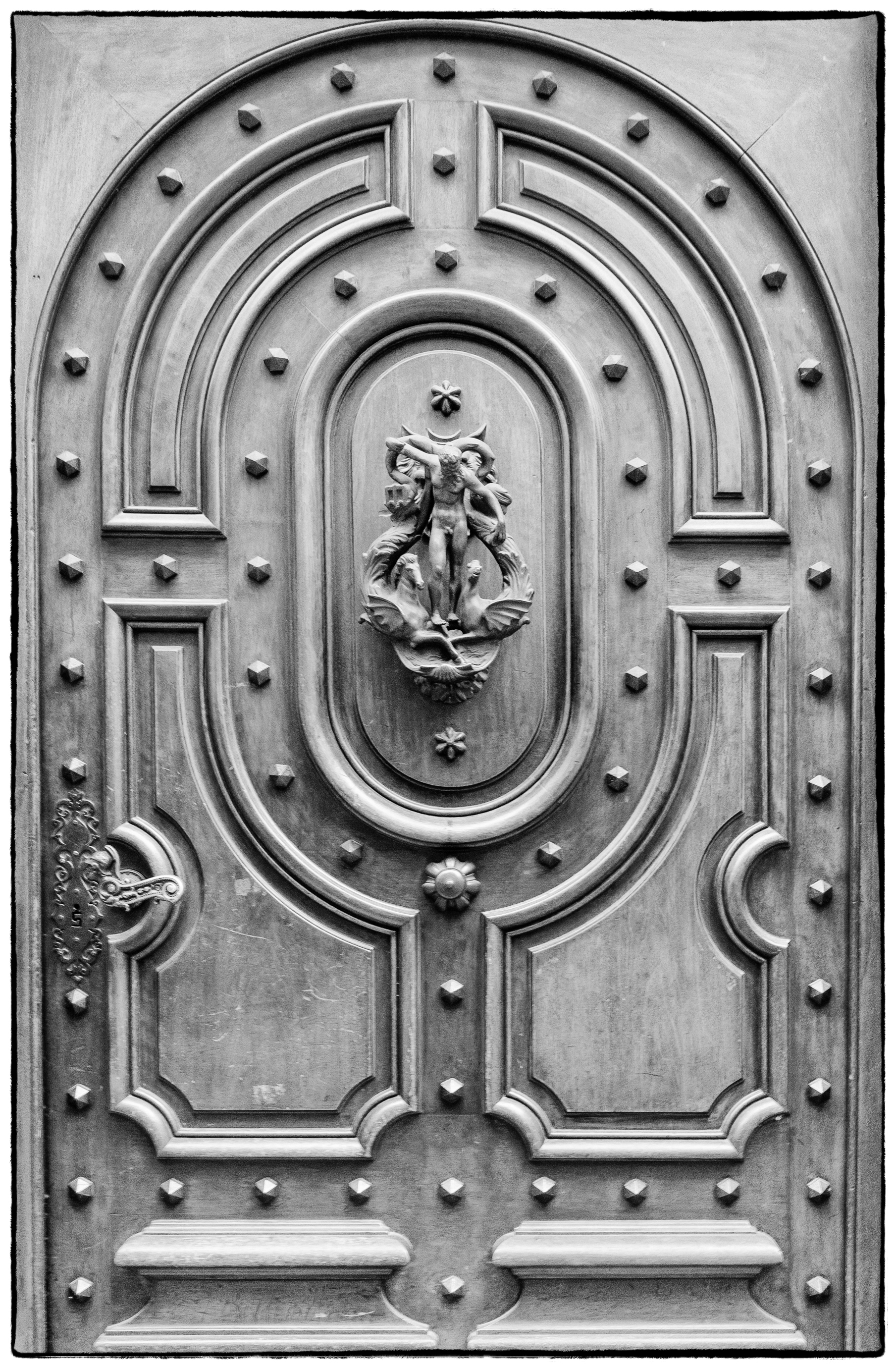
Another even more ornate door knocker on an equally door.

Double headed eagle above a doorway. I believe a symbol of the Holy Roman Empire, half of which appears on the Geneva coat of arms.

Geneva – Old Town, Clementine Statue

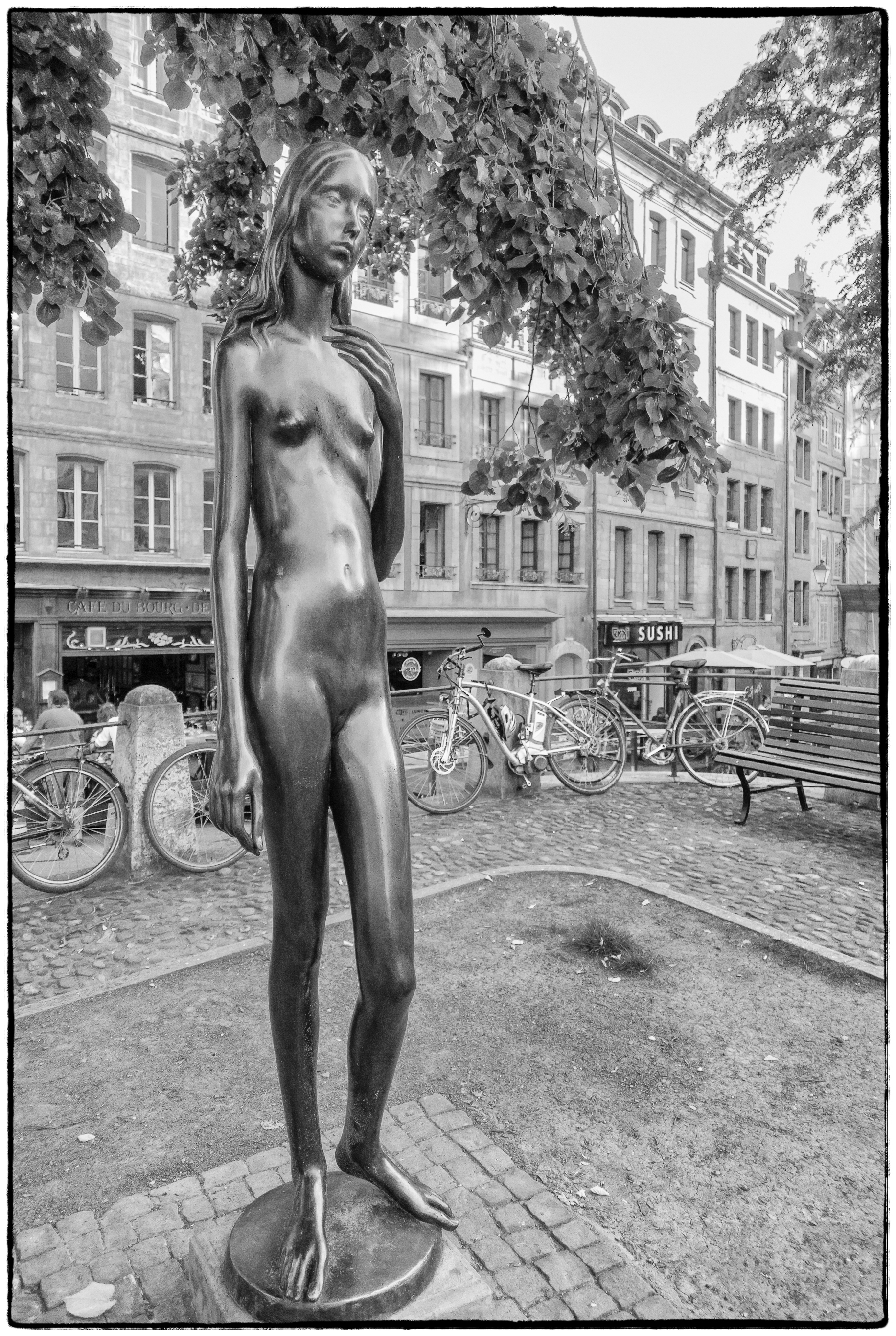
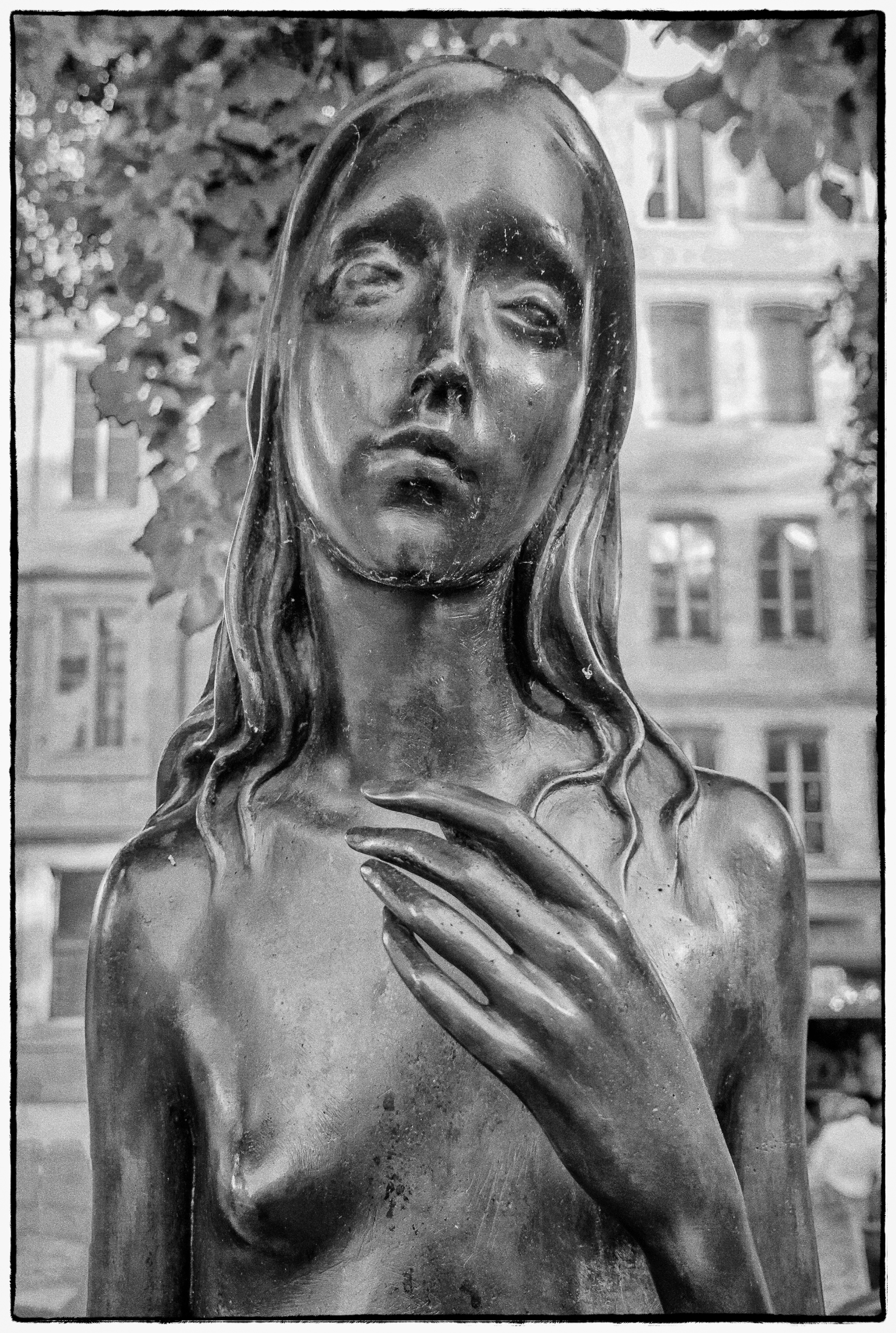
I first photographed this mesmerizing statue sometime in the mid 1990s with a film camera. I’ve even posted about it before (see Statue in the Old Town). The main difference between these two pictures and the earlier one is that in the latter the girl is holding a flower in her hand. Apparently visitors often either place flowers in the girl’s hand(s) or leave them at the base. I didn’t know at the time who had created this statue. I’ve since discovered more about its creator and his intent.

According to the Official Site of the Town of Geneva (translated from the original French):

In the heart of the old town stands a teenage girl with a thin silhouette. This bronze statue by the Swiss artist Heinz Schwarz is part of the collection of the Fonds d’art contemporain of the City of Geneva (FMAC).

The delicate young girl who stands naked on Place du Bourg-de-Four is one of the most popular Geneva statues. She was baptized Clementine by the inhabitants of the district, probably because the statue almost opposite the cafe of La Clémence.

Harmonious forms of adolescence. Adolescence is one of Heinz Schwarz’s favorite subjects. He aims to capture this transitional moment between childhood and adulthood. According to him, this is the period of age when young girls have the purest forms.

A long limbed figure somewhere between energy and weakness. The teenager, with delicate curves and natural calm, amazingly combines energy and weakness: while her body measures more than a meter eighty, it seems to threaten to collapse due to its leanness. This extreme refinement of the body, proposed in several statues of the artist, is difficult to perform technically, for it is less voluminous than statues of more classical proportions.

A statue that denounces injustice. Many have become attached to this statue, which has come to symbolize issues related to female exploitation and child maltreatment.

Factsheet
Title: Clementine
Artist: Heinz Schwarz (Arbon / Switzerland, 1920 – Satigny / Switzerland, 1994)
Date of creation: 1974 (mold), 1975 (cast iron)
Description: sculpture in public space, statue
Technique and materials: bronze
Dimensions: 183x40x40 cm

The Talking Beautiful Stuff site has this to say about the statue in a post entitled: “The adolescent tragedies of Heinz Schwarz“:

From the lake edge, take yourself up to Place Bourg de Four in the old town. Prepare to have your heart-strings pulled!

Schwarz’s “Clementine” is much more than an exquisite statue. She is a symbol of solidarity for women and girls – especially those forced into prostitution – all over the world: the reason why there are often floral tributes strewn at her feet. Clementine is overpoweringly sad and beautiful in her budding adolescence. She is unspeakably delicate and stands fully and unashamedly naked. She is quiet but her vulnerability screams out. You can only weep for her innocence that has been or is soon to be brutalised. And Schwarz has evoked all this in bronze! Genius!

I have to wait to take my photograph because an obese man – to the amusement of his tourist friends – drapes an arm around Clementine’s shoulder and fingers her right breast. Digital shutters click amid giggles. My disgust wells inside. Clementine doesn’t flinch. She’s seen and felt it all before.

It’s ironic that a statue, which has come to symbolize the fight against female exploitation can itself be exploited in such vile ways by the moron mentioned above.

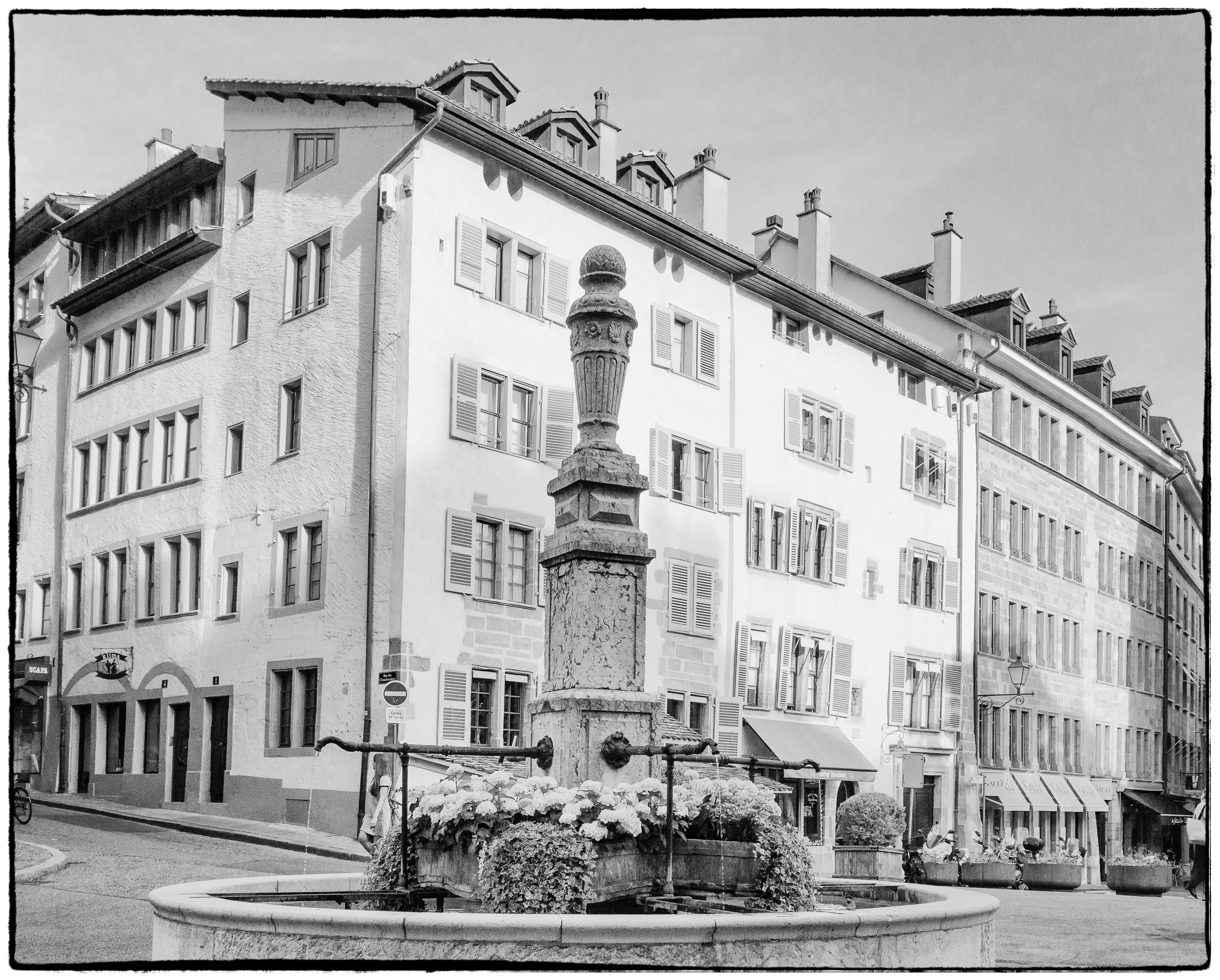
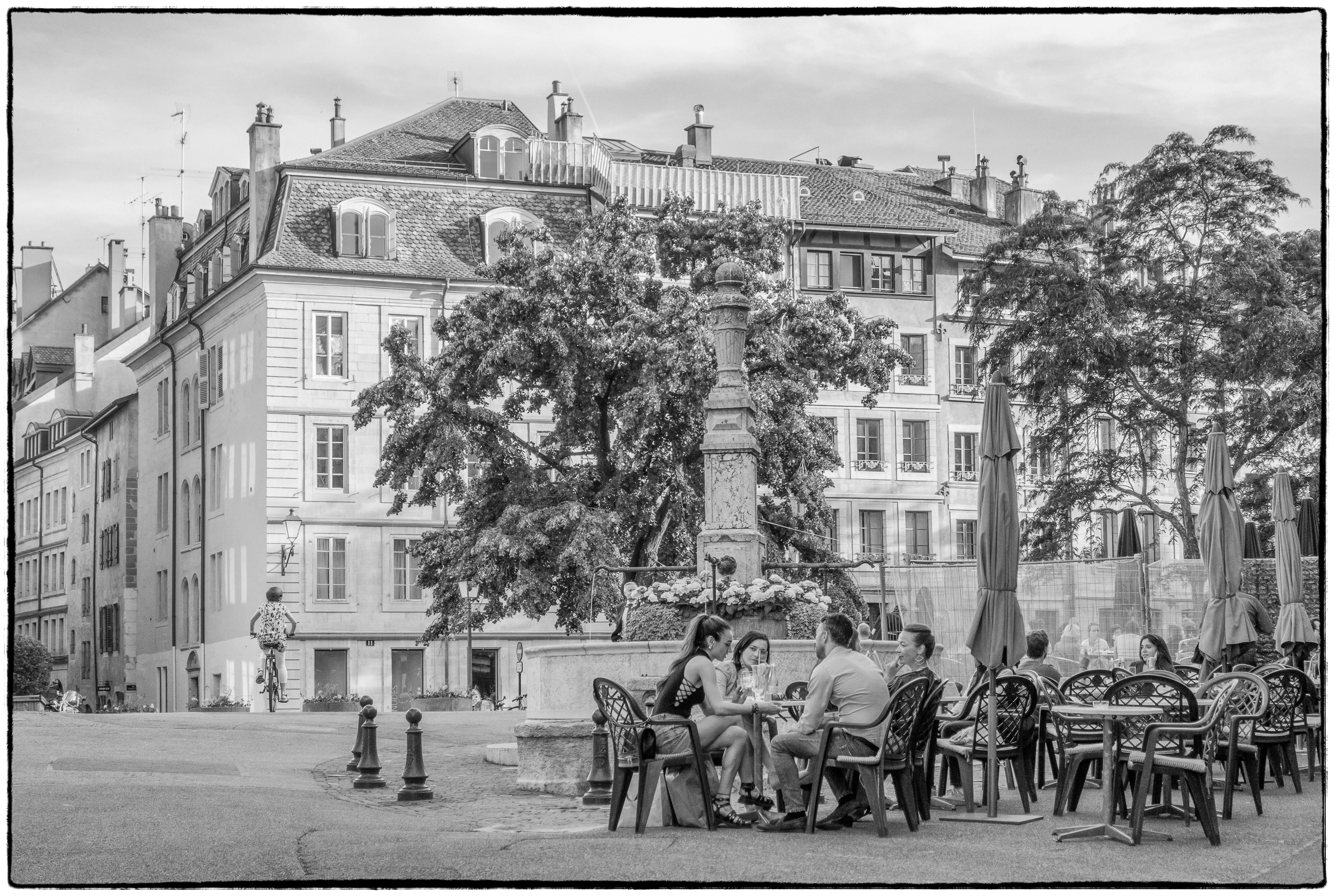
Geneva – Old Town, Place du Bourg-de-Four

One of my favorite places in Geneva. I’ve spent many pleasant hours sitting here, including during this recent visit were I met up with an old friend for a few beers at “La Clemence” mentioned below.

According to the Just Landed site:

One thing has not changed a bit in the Place du Bourg-de-Four since Roman times. It is still a center for commerce and a meeting place for the Genevois. Remnants of the ancient roads that led south to Annecy and Lyon and east to Italy and the Chablais are found buried in this deep within the square. At one time the Place served as a Roman forum and cattle market, then later a medieval town square. It also served as a safe haven for masses of Protestant refugees fleeing persecution in the 16th century.

The building of the Palais de Justice on the Place was constructed in 1707. It later sheltered the convent of the Order of St. Clare and also a hospital until 1857. In 1860, it began housing the courts of law behind its 18th century restructured frontage. This explains there are many intricate varieties of architectural styles on the Place, all blended in their display and ranging from medieval modern in their charm.

This crossroad in the heart of the Old Town is a treasure of magnificent collections of 16th century architecture, as well as handsome constructions of the 17th and 18th centuries. It is an established place of history, but with its heart beating and intent on the future. Still today, hosts of Genevois gather around the18th century flowered fountain of the Place du Bourg-de-Four. Locals gather to sit and sip cafés, take a leisurely walk, or soak up the ambiance in the busy bistrot terraces around the square.

Nightlife in the Place du Bourg-de-Four is just another example of the quintessential Genevois crossroad. Among the antiquaries’ shops, art galleries, book and tourist shops, people of all ages and backgrounds gather to meet for drinks and begin their evening in one of the many friendly cafés, bistrots, or bars. One of the best-known starting points is La Clémence with its large terrace accommodating bohemians, bourgeoisie, and the cultured elite alike. Everyone is welcome and finds their place in the Place du Bourg-de-Four.