Harley has a grooming

Harley was recently groomed. I usually let his hair grow until it starts to get warm. This year I was somewhat delayed because of difficulties arranging an appointment.

I booked online at the place we usually have him groomed, but the earliest appointment they could give me was a few weeks into the future. The day of the appointment came and before leaving I thought to check that all was well. It turned out that their computer system had failed to absorb the appointment and nothing was scheduled for that day. So another long wait to get another appointment, which was ultimately cancelled.

So I gave up on that place and tried another option: mobile grooming. I had to wait again, but not too long. Then they too cancelled. I threw a fit and they were able to find me a place. Eventually they came to the house and did the grooming.

Above before and after pictures.

Pictures taken with an Iphone 8eii

A new (to me) lens: Canon 50mm f1.4 LTM

In an earlier post (See: Struggling with Manual Focus Lenses) I mentioned that I had started using manual focus lenses again. This was one of them.

It’s a well regarded lens. According to Casualphotophile:

The Leica Thread Mount Canon 50mm f/1.4 is widely referred to as the Japanese Summilux. This is both deserved praise and a disservice. Praise because it speaks to its optical quality, and a disservice because it subtly implies that the Canon was nothing more than a Japanese copy of the German original. However, Canon’s 50mm predates Leica’s venerable lens by about two years.

Leica`s first version Summilux was made for just three years, from 1959 to 1961. Its re-engineered second version was produced in 1961 and continued until 2004. One could argue that Leica`s desire to re-engineer their 50mm f/1.4 Summilux so soon after it debuted was a direct result of the increasing quality of Japanese lenses.

Canon introduced Type I of its lens in 1957 and its production ran until the following year (serial numbers 10000-29390). Type II was introduced in 1959 and was produced until 1972 (serial numbers 29681-120705). After 1972, Canon would abandon the production of rangefinders and focus almost exclusively on SLRs.

Type I and Type II lenses use the same optical formula – six elements in four groups, based on the Planar design developed by Paul Rudolph at Carl Zeiss. The only difference between the two Types appears to be cosmetic. On the Type I lens, the distance scale is represented in meters only, while on the Type II the distance scale is represented in both meters and feet.

For some pictures taken with this lens see here.

For another good review see: Canon 50mm f/1.4 ltm lens Review – An impressive classic gem on 35mmc.com

Once I’d gotten the knack of manual focus I found I liked this lens. I certainly liked the results.

Taken with an Olympus OM-D E-M10 and Panasonic Lumix 20mm f1.7

Around the Neighborhood – A Fisherman

This pond is on the site of the former Briarcliff Lodge. Local legend has it that this pond was once the pool to the lodge. Be that as it may I was not aware the it had fish in it. But the angler reassured me that it does, specifically he mentioned bass. I think he said largemouth bass, but I’m not sure that my memory is correct.

Taken with a Fuji X-E1 and Fuji XC 16-50mm f3.5-5.6 OSS II

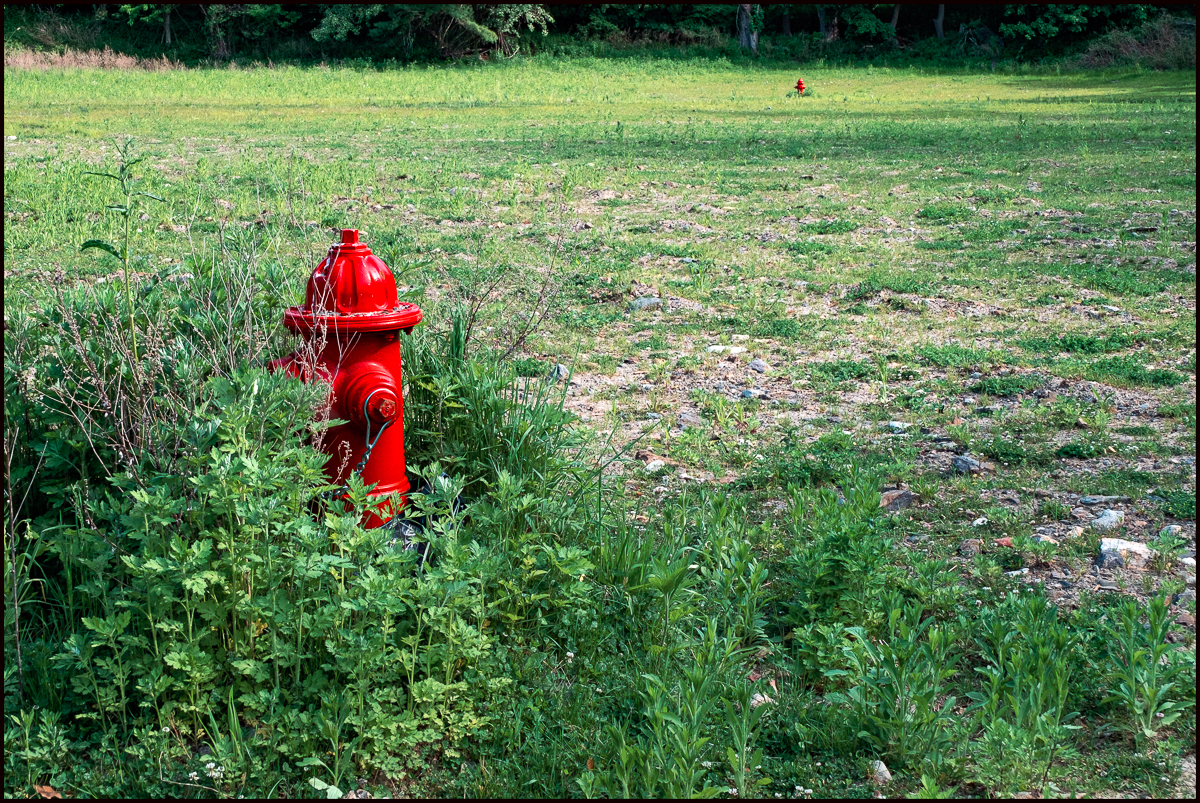
Around the Neighborhood – Red hydrants

A little while ago I was watching a Youtube video by a well known landscape photographer. He suggested that a good photograph should pose questions to the viewer.

This one certainly made me ask a few questions, the most important being why are these two (yes there are two of them, one is far off in the distance) brightly colored fire hydrants out in the middle of a field with no proximity to any buildings?

Taken with a Fuji X-E1 and Fuji XC 16-50mm f3.5-5.6 OSS II