In New York City – Horace Greeley Statue

According to Tulane University:

“Horace Greeley, the son of a New England farmer and day laborer, was born in Amherst, New Hampshire in February 1811. The economic struggles of his family meant that Greeley received only irregular schooling, which ended when he was fourteen. He then apprenticed to a newspaper editor in Vermont, and found employment as a printer in New York and Pennsylvania. Seeking to improve his prospects, he gathered his possessions and a small amount of money, and in 1831, set out for New York City. The twenty year old Greeley found various jobs, which provided some capital, and in 1834, he founded a weekly literary and news journal, the New Yorker.
An omnivorous reader, eager to write as well as edit, Greeley contributed to the journal. It gained an increasing audience and gave him a wide reputation. However, it failed to make money, and Greeley supplemented his income by writing, especially in support of the Whig Party. His connections with Thurlow Weed, William H. Seward, and other Whigs led, in 1840, to his editorship of the campaign weekly, the Log Cabin. The paper’s circulation rose to about 90,000, and contributed significantly both to William Henry Harrison’s victory and Greeley’s influence. Greeley also directly participated in the Whig campaign by giving speeches, sitting on committees, and helping to manage the state campaign.

In April 1841, Greeley set himself on the path to national prominence and power when he launched the New York Tribune. The Tribune was multifaceted, devoting space to politics, social reform, literary and intellectual endeavors, and news. It was very much Greeley’s personal vehicle. An egalitarian and idealist, Greeley espoused a variety of causes. He popularized the communitarian ideas of Fourier, and invested in a Fourier utopian community at Red Bank, New Jersey. He advocated the homestead principle of distributing free government land to settlers, attacked the exploitation of wage labor, denounced monopolies, and opposed capital punishment.

Assisted by a talented and versatile staff, a number of whom were identified with the Transcendentalist movement, Greeley made the Tribune an enormous success. It merged with the Log Cabin and New Yorker, expanded its staff and circulation throughout the 1840s and 1850s, and by the eve of the Civil War had a total circulation of more than a quarter of a million. This number, however, vastly understated the paper’s influence, as each copy often had more than one reader. The weekly Tribune was the preeminent journal in the rural North.

Greeley opposed slavery as morally deficient and economically regressive, and during the 1850s, he supported the movement to prevent its extension. He opposed the Mexican War, approved the Wilmot Proviso, which called for the restriction of slavery in territories gained as a result of that war, and denounced the Kansas-Nebraska Act. Greeley’s free-soil sentiments brought him quickly into the Republican Party’s camp, and he attended the national organization meeting of the party at Pittsburgh in February 1856. He supported the Republican candidate in the presidential contest of 185 6, and four years later, he attended the Republican national convention in Chicago. Initially supporting Edward Bates, he turned to Lincoln on the eve of the balloting.

The secession crisis found Greeley strongly opposed to making concessions to slavery. He denounced the Crittenden proposals, and while he argued that succession should be allowed if a majority of southerners truly wanted it, he made clear his belief t hat the rebellion was, in fact, the work of an unscrupulous minority.

Once war came, Greeley joined the radical antislavery faction of the Republican Party and demanded the early end of slavery. He denounced more conservative Republicans, like Francis and Montgomery Blair, and criticized Lincoln for proceeding too cautiously to eradicate the institution. When Lincoln finally announced his Emancipation Proclamation, Greeley applauded the decision.

During and after the Civil War, Greeley’s political course proved highly controversial. His reluctance to support Lincoln’s renomination in 1864 lost him some popular support, as did his premature efforts to bring about an armistice and peace negotiations. After the war, he joined the Congressional Radicals in supporting equality for the freedmen. The Tribune also advocated the impeachment of President Andrew Johnson. At the same time, Greeley favored measures to restore relations with the South. In 1867, he recommended Jefferson Davis’s release from prison, and he signed Davis’s bond. He gradually grew disaffected with the Grant administration because of its corruption and indifference to civil service reform, and also because of its continued enforcement of Reconstruction measures in the South.

While much admired, Greeley was also regarded as eccentric and odd, in both his personal appearance and his reformist ideas. His behavior during and after the war raised widespread doubts about his judgment. When in 1872, the anti-Grant Liberal Republicans and the Democrats nominated Greeley to challenge Grant, Greeley was attacked as a fool and a crank. So merciless was the assault that Greeley commented later that he sometimes wondered whether he was run ning for the presidency or the penitentiary. He suffered a tremendous defeat in the election, carrying only six border and southern states.

During the period following the Civil War, Greeley’s association with the Tribune underwent significant change. The era of personal editorship was ending, and as the Tribune increased in size, Greeley’s influence diminished. Following his defeat in t he election of 1872, Greeley found that control of the paper had passed out of his hands. Shocked by his electoral repudiation, the recent death of his wife, and the effective loss of his editorship, Greeley suffered a breakdown of both mind and body, and died on November 29, 1872.”

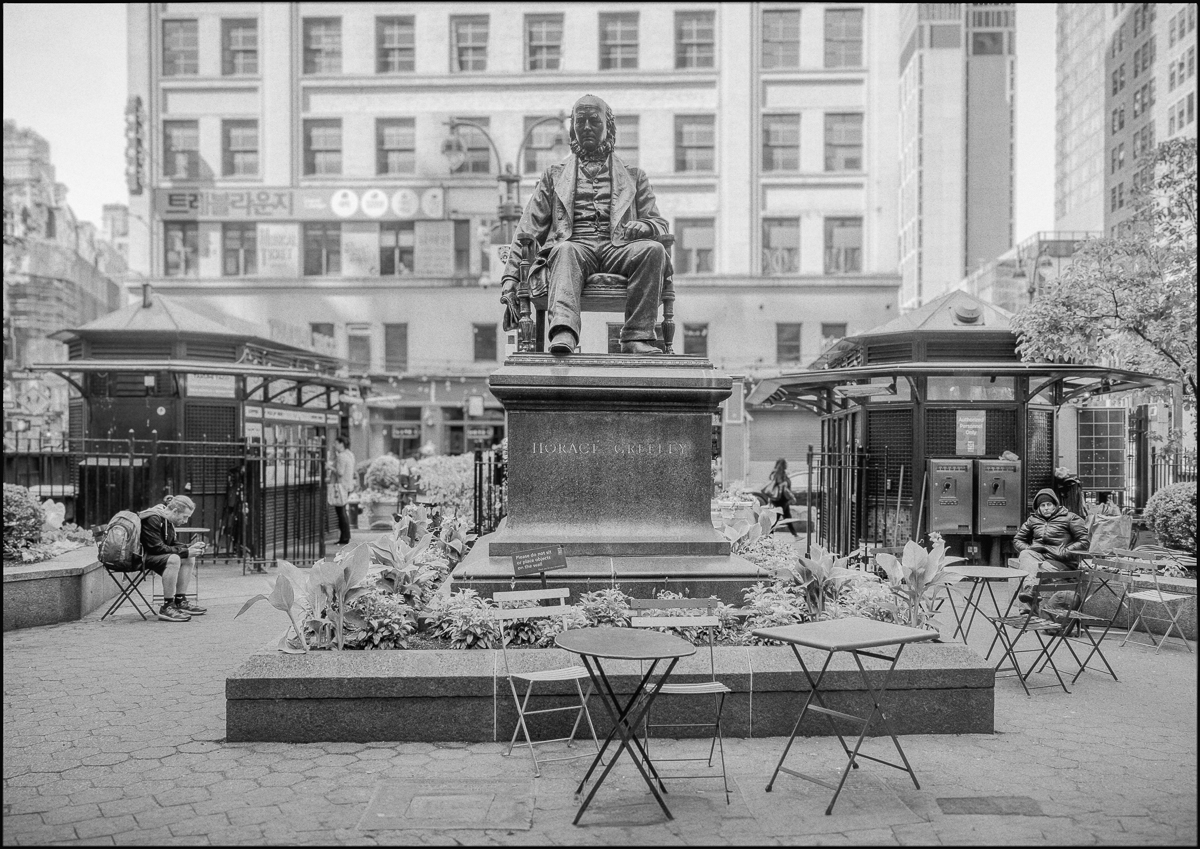
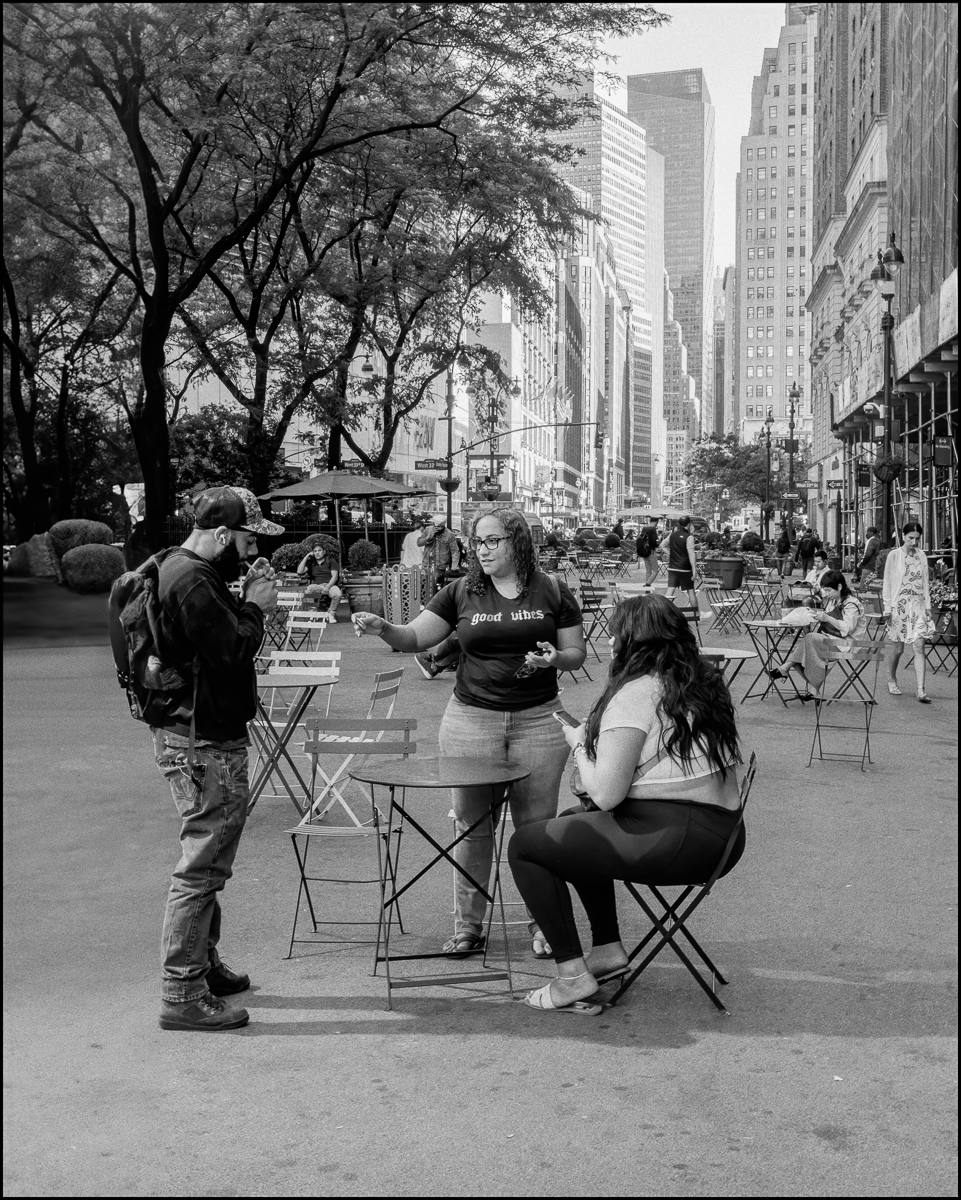
The outdoor bronze sculpture of Horace Greeley by Alexander Doyle stands in Greeley Square Park, New York City. It was cast in 1892, dedicated on May 30, 1894 and sits atop a Quincy granite pedestal. It contains the following inscription:

THIS STATUE OF THE FIRST PRESIDENT
NEW YORK TYPOGRAPHICAL UNION NO. 6
WAS PRESENTED TO THE CITY OF NEW YORK BY
HORACE GREELEY·POST NO. 577 G.A.R.
NEW YORK TYPOGRAPHICAL UNION NO. 6 AND
BROOKLYN TYPOGRAPHICAL UNION NO. 98

GIVEN TO THE CITY OF NEW YORK IN 1890

Horace Greeley is also major figure in the history of Chappaqua, a town five miles away from where I live. The town’s high school is name after him. He lived in Chappaqua in what is now known as The Greeley House:

“The Greeley House is located at King (New York State Route 120) and Senter streets in downtown Chappaqua, New York, United States. It was built about 1820 and served as the home of newspaper editor and later presidential candidate Horace Greeley from 1864 to his death in 1872. In 1979 it was listed on the National Register of Historic Places along with several other properties nearby related to Greeley and his family.

Built in the 1820s as a typical small farmhouse, it was expanded in the mid-19th century. Greeley, editor of the New-York Tribune, settled in Chappaqua shortly before the Civil War in the mid-19th century, living there with his family primarily during the summer. After a mob of citizens opposed to Greeley’s abolitionist editorial stance threatened his wife at their earlier “House in the Woods,” Greeley bought the farmhouse and moved his family there, near the hundred acres (40 ha) where he ran a small farm and practiced experimental agricultural techniques.

After the war, Greeley built a mansion called “Hillside House” to live in, but died along with his wife shortly after the 1872 presidential election, where he ran on the Liberal Republican line against incumbent Ulysses S. Grant, so his children lived there instead, pioneering the suburban lifestyle that was later to define Chappaqua and its neighboring communities. Both of Greeley’s other houses burned down later in the 19th century, leaving the Greeley House the only one extant.

It, too, was almost demolished after falling into serious neglect in the early 20th century. After its restoration in 1940, it was used as a restaurant and gift shop. Following another restoration effort in the early 21st century, it is now the offices of the New Castle Historical Society.” (The Greeley House)

Taken with a Fuji X-E3 and Fuji XC 16-50mm f3.5-5.6 OSS II
In New York City – Colorful Critters

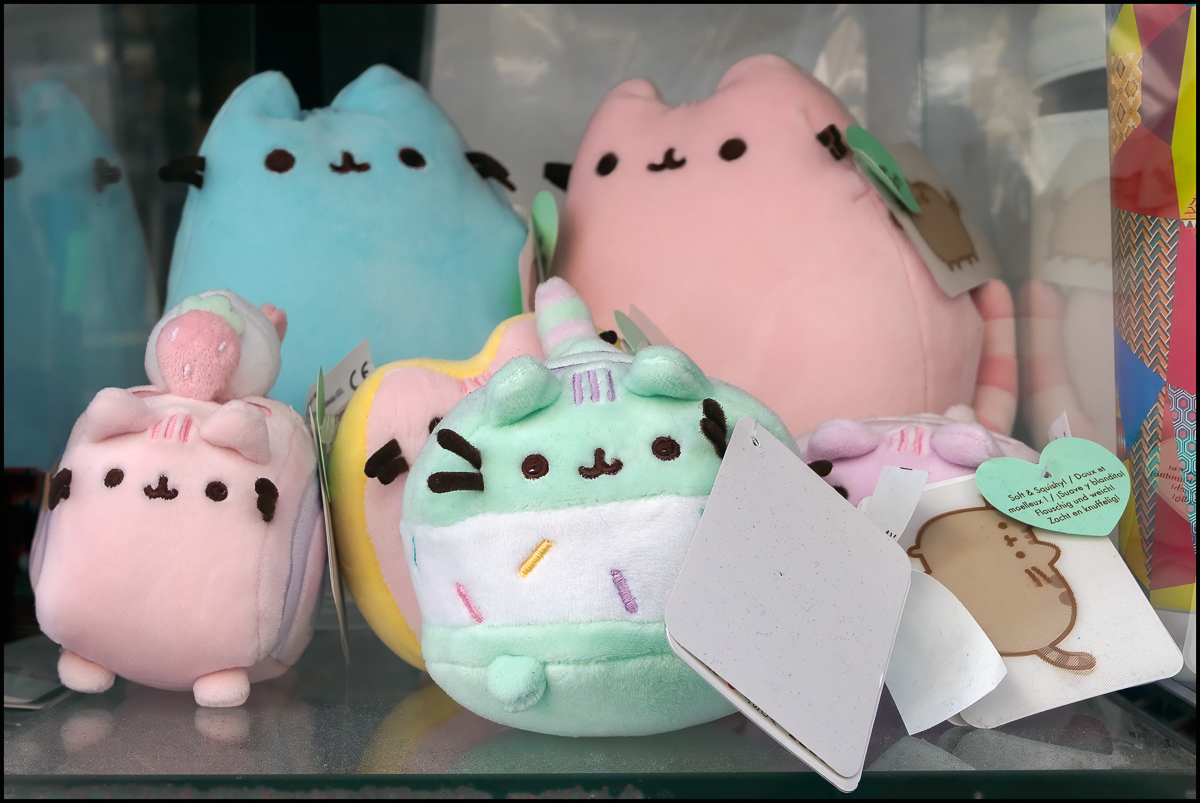
When I spotted these colorful creatures in a shop window I realized that I must be near New York’s “Koreatown”. This was confirmed when I noticed a number of Korean Restaurants.

Koreatown, or K-Town, is an ethnic Korean enclave in Midtown Manhattan, New York City, centered on 32nd Street between Madison Avenue and the intersection with Sixth Avenue and Broadway, which is known as Greeley Square. The neighborhood in Midtown South features over 150 businesses of various types and sizes, ranging from small restaurants and beauty salons to large branches of Korean banking conglomerates. Koreatown, Manhattan, has become described as the “Korean Times Square” and has emerged as the international economic outpost for the Korean chaebol.

Historically, Manhattan’s Koreatown has been part of the Garment District. In the 1980s, a Korean bookstore and a handful of restaurants were founded in the area. Their success drew other Korean-owned businesses, sustained by increased immigration from Korea and the high levels of tourist traffic stemming from nearby Midtown Manhattan landmarks like the Empire State Building, Macy’s Herald Square, the United Nations Headquarters, Penn Station, Madison Square Garden, the Garment District, and the Flower District. Today, Koreatown is primarily a Korean business district, but the resident Korean population in the area has grown as well. More broadly, Koreatown is attracting new Korean residents to the adjacent Manhattan neighborhoods of Murray Hill, Kips Bay, and Rose Hill.

The heart of Koreatown is the segment of 32nd Street between Fifth Avenue and Sixth Avenue, officially nicknamed Korea Way. Korea Way features stores and restaurants on multiple stories, with independently run establishments reaching up to higher floors, exuding an ambience of Seoul itself. The New York City Korean Chamber of Commerce estimates there to be more than 100 small businesses on Korea Way. Signage in Hangul is ubiquitous. Koreatown’s central location and high density of crowded restaurants, bars, karaoke clubs, and spas on Korea Way have rendered it a major tourist attraction and a center of nightlife in Manhattan.

Korea Way features numerous restaurants that serve both traditional and/or regional Korean cuisine and Korean fusion fare (including Korean Chinese cuisine, several bakeries, grocery stores, supermarkets, bookstores, consumer electronics outlets, video rental shops, tchotchke and stationery shops, hair and nail salons, noraebang singing bars, nightclubs, as well as cell phone service providers, internet cafés, doctors’ offices, attorney offices, banks, and hotels. Numerous Japanese restaurants have also emerged in Manhattan’s Koreatown. Although Korea Way continues to represent the heart of Koreatown, situated between Broadway, Sixth Avenue, and Fifth Avenue, Koreatown itself as of 2015 has been expanding further eastward from Fifth Avenue along East 32nd Street, toward Madison Avenue in Midtown Manhattan, in the direction of Queens and Nassau County. (Adapted from Wikipedia)

I love Korean food and lately had been craving for it (although there are a couple of Korean restaurants near where I live, they’re not conveniently close and I suspect that the food in Manhattan is better), so I thought that I must remember to ask my granddaughter if she likes Korean food?

Taken with a Fuji X-E3 and Fuji XC 16-50mm f3.5-5.6 OSS II

In New York City – Three Facades

After arriving at Grand Central Terminal I set off towards the West Side where we were to meet. However, initially I went South and later turned West. I hadn’t gone far along Madison Avenue when I came across these three facades. I believe the firs one is part of the Morgan Library:

“The Morgan is not only a repository for some of the world’s rarest books and manuscripts—it’s an important museum of art as well. The library’s holdings include treasures such as one of 23 copies of the original Declaration of Independence; an edition of the collected works of Phillis Wheatley, the first known African-American poet; Mozart’s handwritten score of the Haffner Symphony; the only extant partial manuscript of Milton’s Paradise Lost; an important collection of Mesopotamian seals; and a manuscript article by Albert Einstein describing how he developed his General Theory of Relativity.

The library also possesses medieval and Renaissance illuminated manuscripts and many old master drawings and prints. In addition to maintaining this fine trove of primary source materials for scholars, the library mounts four large and eight smaller exhibitions every year. Drawing on its holdings and the loans from other institutions, these shows present some of the greatest works ever rendered on paper, ranging from Edward Curtis’ early 20th-century photographs of Native Americans to precious drawings from important European collections.

J. Pierpont Morgan (1837-1913) was an immensely influential banker and, fortunately for New York City and the nation, a generous philanthropist and collector. The Morgan Library—built between 1902 and 1906 as a Renaissance-style palazzo—was originally Morgan’s private library. It was designed by McKim, Mead & White, the firm that also designed much of the campus of Columbia University, the Brooklyn Museum and dozens of other structures throughout the United States. Constructed of pinkish Tennessee marble, it combines features of Italian Renaissance garden casinos and urban palazzi. The richly colored and ornamented interior possesses an opulence that can only be described as regal. Since its incorporation as a public institution in 1924, the library has grown to occupy half a city block, including the adjacent brownstone, which belonged to Morgan’s son, J.P. Morgan, Jr. and had 45 rooms. In 2006, the Italian architect Renzo Piano completed renovations and additions that brought a new auditorium, new galleries and a new reading room with electronic resources. (NYC-ARTS. The Complete Guide)

For more information on the Morgan Library and its history see here.

The second one seems to have the same address as the Church of the Incarnation so I assume it’s part of it:

“The first services in the church building were held on December 11, 1864. The architectural style of the church is “Neo-Gothic;” it is best known for the windows and other decorations by great American and English artists of the late Victorian period. Incarnation is a New York City Landmark and has been placed on the National Register of Historic Places.

In the Beginning…

During the 19th century, it was customary for Episcopal churches in New York to meet their expenses with a system of pew rentals, rather than through what has now become traditional weekly tithes. Certain pews were kept open for visitors and those who could not afford a pew, but some churches went a step further and built mission chapels where pews were either free or rented for very small amounts.

In 1850, such a chapel was established on Madison Avenue and 28th Street, as a mission of Grace Church, a famous Greenwich Village house of worship, which still stands on Broadway and 10th Street. Two years later, the growing chapel became an independent church under the name of The Church of the Incarnation. The Murray Hill area flourished, and new space was soon required. However, the rector at that time, the Rev. Dr. Henry Eglington Montgomery, refused to consider a larger building until Incarnation had first founded a mission chapel of its own. This was accomplished by 1863 on east 31st Street (today, The Church of the Good Shepherd), and land was duly bought for the new church on 35th Street and Madison Avenue.

Strong Bones, Healthy Body

The building, designed by Emlen T. Littell, laid its cornerstone on March 8, 1864, and had its first services on December 11 of the same year; it was consecrated on April 20, 1865.

Littell described the architecture as “Early Decorated Church Gothic,” with its opulent use of gilding, color, stencilling and painted panels. Frequently referred to as “Neo-Gothic,” the architecture of the church is historically based on the so-called English 19th century Commissioners’ style, named for the Commission of the Church Building Society. This group built modest, attractive churches for the many new communities in England created during the industrial revolution. The churches feature a narthex, an open nave with side aisles, and a short chancel; Gothic Revival style added steeply pitched roofs, towers and a clerestory.

Builder Marc Eidlitz is also known for the building of the former B. Altman department store, across the street from Incarnation. Today, the building is called the “B. Altman Office Superblock,” and houses the graduate school of the City University of New York, Oxford University Press, and the Science, Industry and Business branch of the New York Public Library” (.

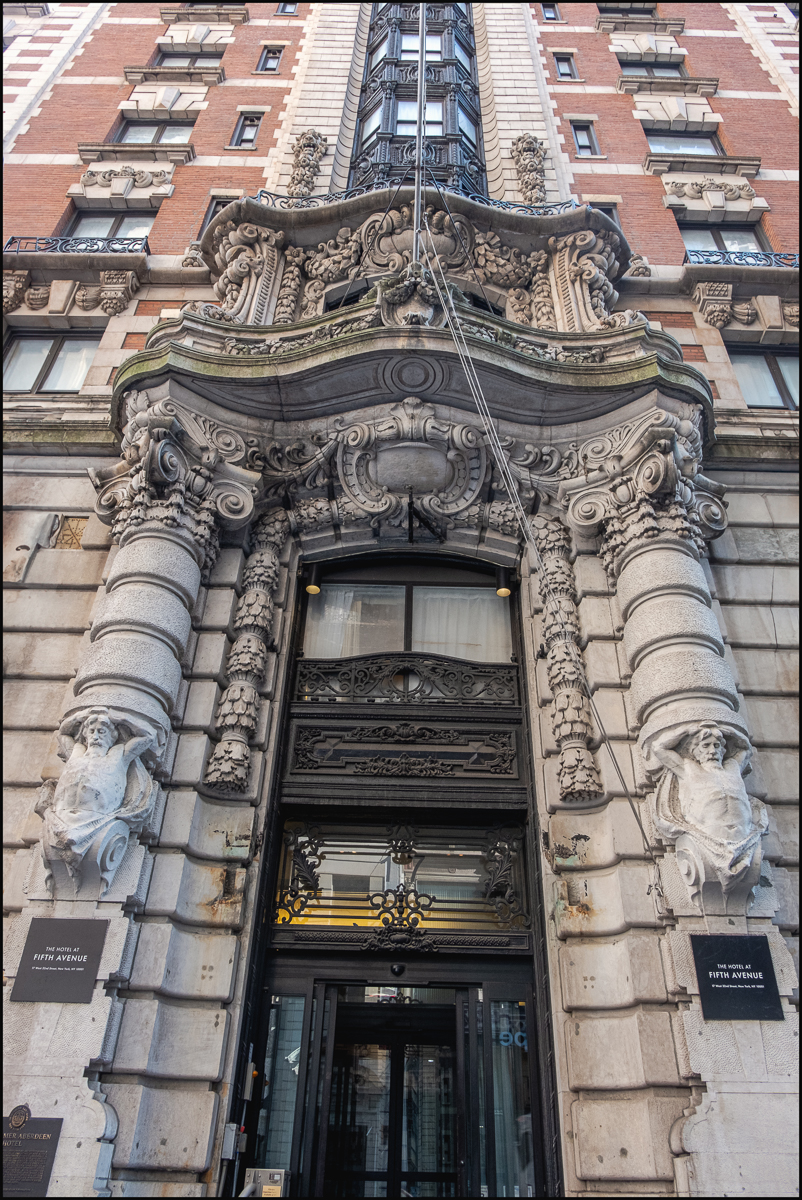
The third is the entrance to the Hotel at Fifth Avenue (even if its not on Fifth, but rather on Madison).

“The Hotel @ 5th Ave is full of history, it is the old Aberdeen Hotel built in 1902-04 as an apartment hotel to the designs of architect Harry B. Mulliken. The area around 32nd Street between 5th Avenue and Broadway was one of excitement and change in 1901. Around the corner on Fifth Avenue were upper class stores like Tiffany, Gorham Silver and B.Altman and the fabled Waldorf-Astoria Hotel lured wealthy travelers from around the globe. Out-of-towners who spent extended periods in New York but did not want the expense of a second home sought out pied-a-terres in the innovative “apartment hotels.” These provided long-term accommodations without the need to bring servants or worry about maintenance. Apartments had no kitchens nor dining rooms – residents would dine in communal dining rooms or restaurants – and the hotel staff could cater to the guests’ needs.”

Much, much more information can be found on the wonderful and highly informative Daytonian in Manhattan site, specifically in this post: The 1902 Aberdeen Hotel – Nos. 17-21 West 32nd Street.

I could, perhaps, have corrected the third one so it would more closely match the other two, but I liked it the way it was – even with the tilt.

Taken with a Fuji X-E3 and Fuji XC 16-50mm f3.5-5.6 OSS II
In New York City – Overview

My granddaughter was passing through New York en route to Alaska so we agree to meet in New York City (Manhattan). We would be meeting around noon so I decided to go in early, walk around and take some pictures.

The picture above was one of the last I took. It was taken at Grand Central Terminal just before I left to take my train home.

Taken with my granddaughters phone (I’m not sure what it was and the exif data sheds no light on it.).