According to Mary Cheever in her “The Changing Landscape – a History of Briarcliff Manor-Scarborough” published in 1990:
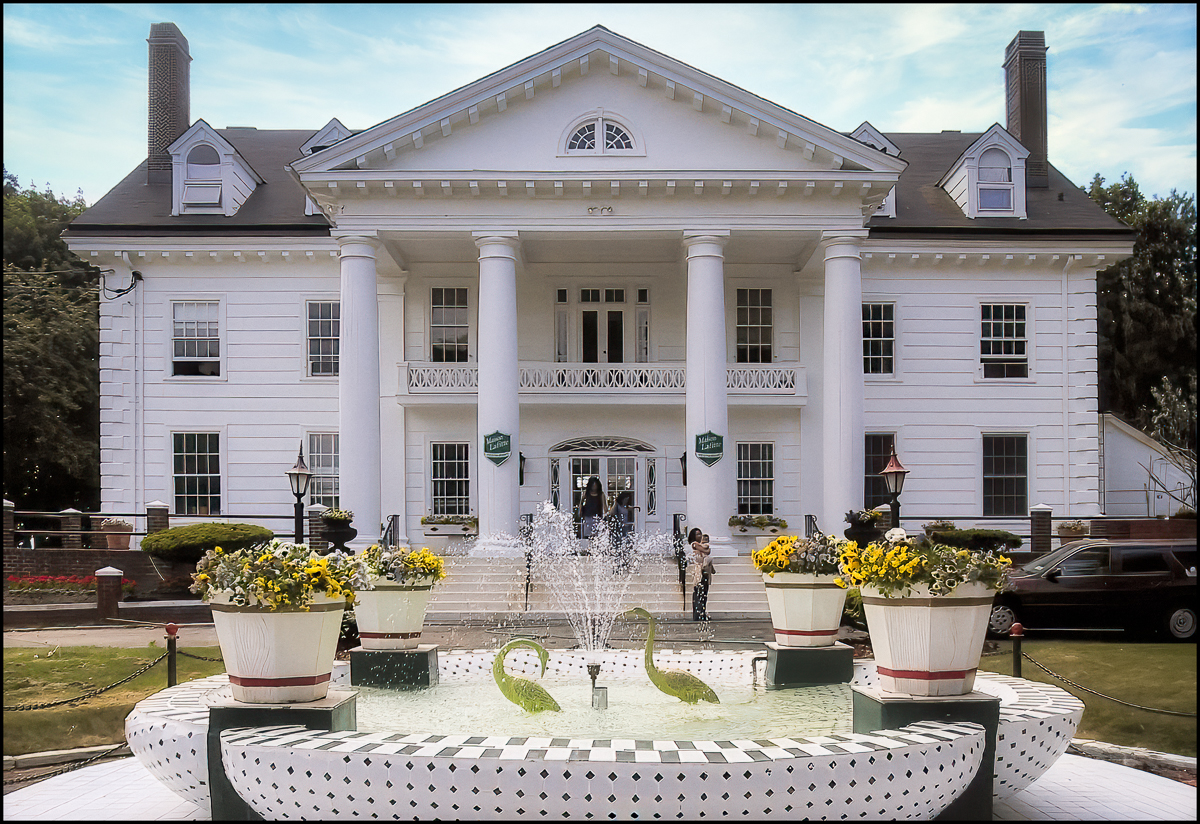
Haymount, high on the hill north of Chappaqua Road, was built around 1910 by William Whitehead Fuller. The central section, with its pediment and huge pillars, was balanced by long three-story wings at both ends, the present parking lot was a formal garden and the mansion stood on some two hundred acres that in 1901 had belonged to the Ryder family. Fuller, a native of North Carolina, was general counsel, and for a time, president of the American Tobacco Company and other corporations. When he was fifty-four years old, in 1912, he retired from business “to devote himself to farming and country life” until his death in 1934.
In the 1940s the Fuller estate was occupied by Bernard Van Leer and his Holland Classical Circus. An historical sketch in the April 28, 1970, Citizen Register tells the story of a fire near the stables that was extinguished by Briarcliff firemen, “as the flames were licking the barn in which were quartered a prize retinue of 16 world famous Ippanzer [sic] horses imported from Holland and four elephants, the grateful owner…working with the Briarcliff Fire Council decided to stage a circus, the profits to be used for an ambulance.” On the very day of the circus the tragedy of the death of President Roosevelt “clouded the entire country” but “it was decided that the ‘show must go on’ and go on it did, with all the thrills of the finest traditions: elephants, clowns, hot dogs, pop corn and the famous Ippanzer horses. The circus realized the handsome profit of $2,174.11 and with this as a starter the ambulance was ordered.
After the war Van Leer and his circus moved away, and J. Henry Ingham, who had been mayor of Briarcliff Manor from 1936-1941, bought and worked the Fuller farm. Ingham owned the gasoline and oil concessions of a string of service stations on the Taconic Parkway.
In the 1950s, Robert and Pauline Morin operated a riding stable called the Walk, Trot and Canter Club on the Fuller property, Morin sold the property around 1960 and went into real estate.In 1962, Giovanni Susech, a native of Trieste, Italy, opened a restaurant in the Fuller mansion, by that time missing the two lateral wings. Even without the wings, the restaurant rooms, the lobby and the terrace (for summer luncheons) were spacious and handsome. The a la carte Continental cuisine menu was as extensive as any hotel dining room in the city. In the 1980s the main dining room was done over with wood paneling and hung with 19th-century American oil paintings provided by art dealer Rudolf Wunderlich, a long time Ossining resident and executive of the Kennedy Galleries (in New York City), which was founded by this grandfather in the 1870s. Giovanni named his restaurant the Maison Lafitte, perhaps as a souvenir of his many years of service on the high seas, starting at the age of fourteen, as bartender and cook on oceangoing ships and liners. He had also worked in the bars and kitchens of several of several New York City hotels. At the celebration of its twenty sixth anniversary in 1989, Giovanni Suchech’s Maison Lafitte was doing well.
I took this picture in May 2000. As you can see from the signs on the columns, it was still “Maison Lafitte” at that time. Since then, it’s been through a number of renovations; a few name changes (and probably ownership changes), but it’s still there, now called “The Briarcliff Manor” featuring Banquets, Events and Catering.
When I came to Briarcliff Manor, I heard what seems to be a persistent legend: That the building was used for exterior shots of Tara in “Gone with the Wind”. I am, however, assured by the Executive Director of the Briarcliff Manor-Scarborough Historical Society that this is not the case.
Taken with a Canon Powershot S10