Rubus Macro

What’s a “Rubus” you may ask? Well, my initial inclination was to call it a “Bramble”, but it seems this might have been incorrect. According to Wikipedia:

Rubus is a large and diverse genus of flowering plants in the rose family, Rosaceae, subfamily Rosoideae, with over 1,350 species, commonly known as brambles.

Raspberries, blackberries, and dewberries are common, widely distributed members of the genus, and bristleberries are endemic to North America. Most of these plants have woody stems with prickles like roses; spines, bristles, and gland-tipped hairs are also common in the genus. The Rubus fruit, sometimes called a bramble fruit, is an aggregate of drupelets. The term “cane fruit” or “cane berry” applies to any Rubus species or hybrid which is commonly grown with supports such as wires or canes, including raspberries, blackberries, and hybrids such as loganberry, boysenberry, marionberry and tayberry. The stems of such plants are also referred to as canes.

Bramble bushes typically grow as shrubs (though a few are herbaceous), with their stems being typically covered in sharp prickles. They grow long, arching shoots that readily root upon contact with soil, and form a soil rootstock from which new shoots grow in the spring. The leaves are either evergreen or deciduous, and simple, lobed, or compound. The shoots typically do not flower or set fruit until the second year of growth (i.e. they are biennial). The rootstock is perennial. Most species are hermaphrodites with male and female parts being present on the same flower. Bramble fruits are aggregate fruits formed from smaller units called drupelets.

Around 60-70% of species of Rubus are polyploid (having more than two pairs of each chromosome), with species ranging in ploidy from diploid (2x, with 14 chromosomes) to tetradecaploid (14x).

So, it seems that I wasn’t entirely wrong. I merely underestimated the complexity of the species. You’ve got to love that last sentence. I particularly liked: “…with species ranging in ploidy from diploid..to tetradecaploid”. Clearly, this article was not written for the uninitiated reader.

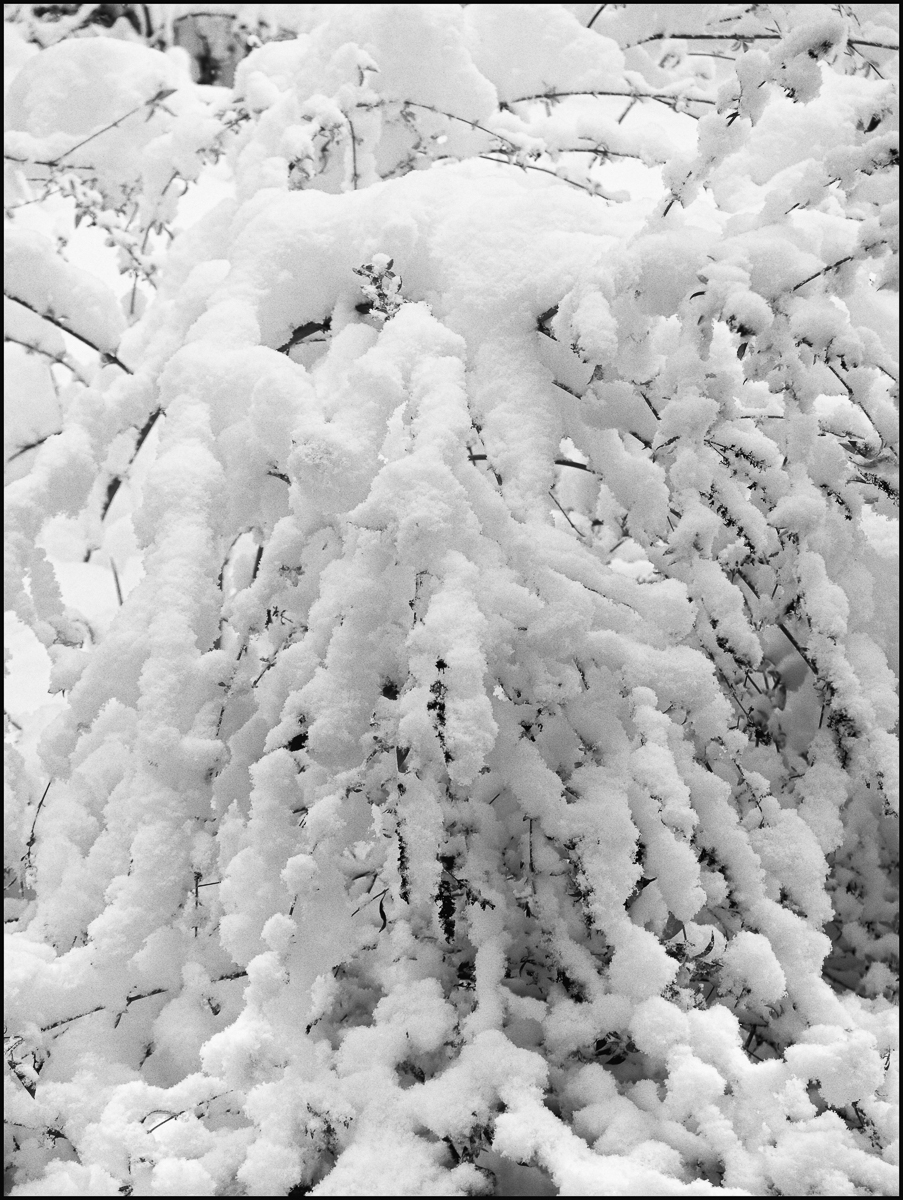
I just liked that way that the sinking sun was backlighting the thing.

Taken with a Sony A6000 and Venus Optics Laowa 85mm f5.6

A Soccer Match

As I was returning home from one of my walks I noticed this soccer match taking place at a local high school.

Of course, I’m British and I have to call it soccer rather than what the rest of the world calls it: football. This is because in the US they have a very popular sport (the Superbowl was just yesterday), which is called football. Now I know very little about American football. I’m not knocking the sport; I just don’t understand it. I know a number of Americans who don’t seem to understand soccer either (don’t get me started on cricket. I’ve tried to explain cricket to Americans, but very soon their eyes start to glaze over – can’t say I blame them). I watched about five minutes of yesterday’s Superbowl and then left because I couldn’t figure out what was going on. One thing I do know though is that they almost never use their feet to kick the ball.

As I was walking past someone kicked the ball over the fence. I heard a voice, and it was one of the players asking me to throw it back. I dutifully picked up the ball, carried it across the street and threw it back over the fence. The boy picked it up and ran off – not a word of thanks. Ah, the youth of today. I think I’ve become a grumpy old man. Actually I know I have. There’s a line in the musical, “Ragtime”, which reads:

Grandfather had been a professor of Greek and Latin. Now retired and living with his daughter and her family, he was thoroughly irritated by everything.

Sounds a lot like me.

Taken with a Panasonic Lumix GX85 and Panasonic Lumix 20mm f1.7

An Oldie – Giambologna’s equestrian statue of Ferdinando I de’ Medici

According to Walks in Rome (strangely because the statue isn’t in Rome. It’s in Florence):

The bronze equestrian statue (1602-07) of Ferdinando I de’ Medici (r. 1587-1609), which stands in Piazza Santissima Annunziata, was created by the Flemish sculptor Jean de Boulogne (1529-1608), better known as Giambologna, and his star pupil Pietro Tacca (1577-1640).

The statue was cast by recycling the cannons from an Ottoman galley, which had been captured by the Cavalieri di Santo Stefano (Knights of Saint Stephen), a holy/military order set up by Cosimo I de’ Medici (r. 1537-74), Ferdinando’s father. The capture and reuse of the Turkish cannons is proudly recorded by the inscription on the strap under the horse’s belly: DEI METALLI RAPITI AL FERO TRACE (Of metal captured from the ferocious Turk).

Ferdinando, who was the third grand duke of Tuscany, wears armour emblazoned on the chest with the cross of the Cavalieri di Santo Stefano.

The marble pedestal is decorated with two bronze panels, one of which depicts concentric circles of bees, all facing the queen bee, which sits in the centre. At the top of the plaque are the words MAIESTATE TANTUM (Great Majesty). The political message, I think, is quite clear.

Wikipedia states:

The Equestrian Monument of Ferdinando I is a bronze equestrian statue by Giambologna, executed in 1602–1607, and erected in 1608 in the Piazza of the Annunziata in Florence, region of Tuscany, Italy. The monument was commissioned by Cosimo II, son of Ferdinando I de’ Medici, Grand Duke of Tuscany, from an elder Giambologna, and was meant to be modeled on the similar Equestrian statue of Cosimo I that stands in the Piazza della Signoria. This project was mainly completed by his pupil Pietro Tacca, and the statue was cast in 1602 and inaugurated at the site in 1608 during the festivities celebrating the marriage of Prince Cosimo II with Maria Maddalena d’Austria. Grandduke Ferdinand wears armour emblazoned on the chest with the Cross of Santo Stefano, an equestrian Order established by Cosimo the elder. It is said the statue was cast with cannons taken from the Turks by the Knights of Santo Stefano.

Flanking the statue some yards to the rear of the horse are two mannerist fountains with marine gargoyles, the Fontana dei mostri marini, also created by Tacca though initially intended to be placed at the statue of Ferdinand in Livorno.

There was a time when I was working in Geneva, Switzerland that I used to go down to Florence often on business. This picture was taken in 2011, after I had left Geneva and returned to New York. It was shortly before my retirement in April 2012 and was the last time that I visited Florence (doesn’t mean I won’t go again though).

Taken with a Panasonic Lumix ZS-3