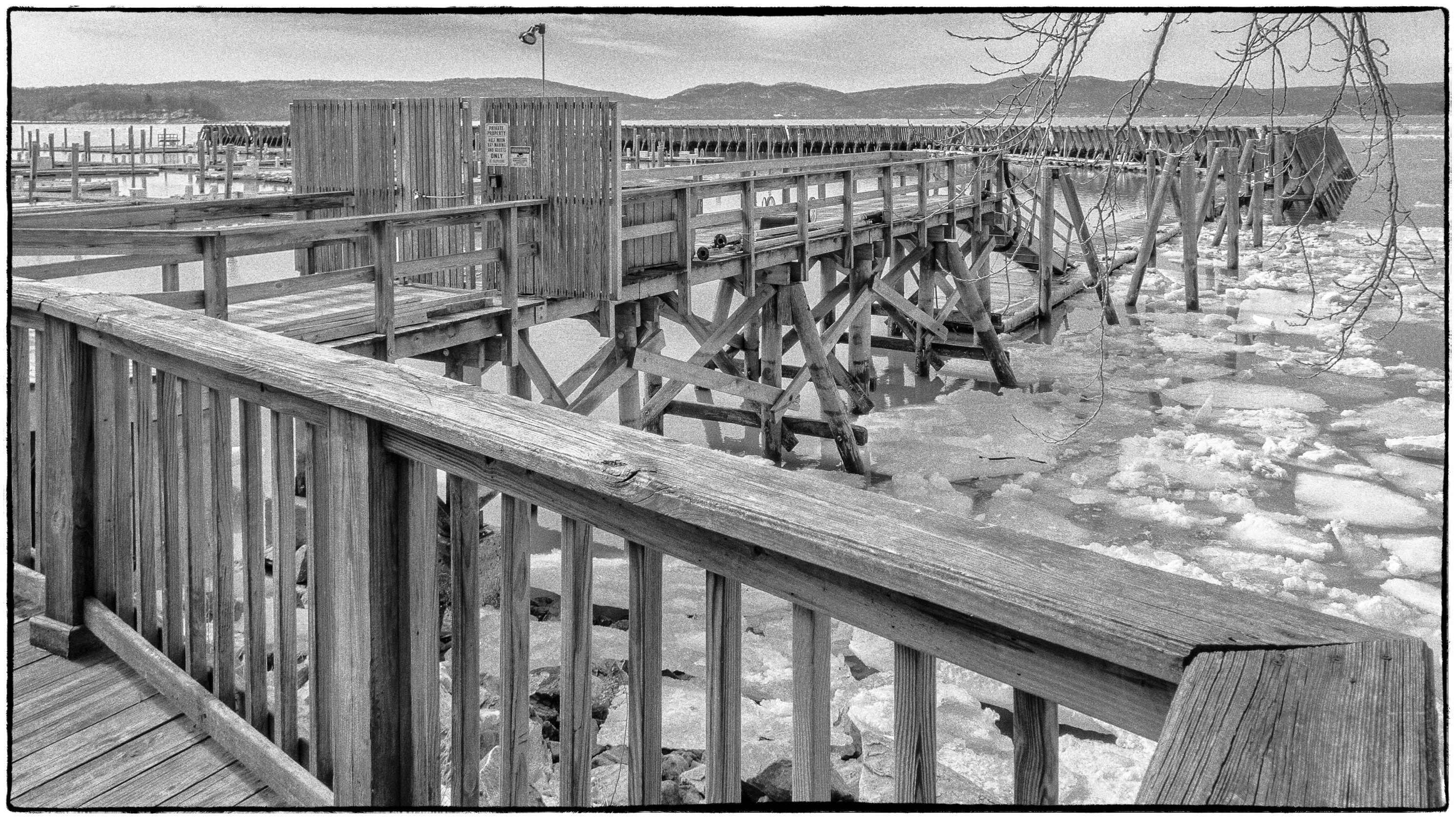
Wooden pier

Seen at Half Moon Bay in Croton-on-Hudson, NY. I liked the way this long, wooden pier zigzagged out into the Hudson. Also the textures of the wood. I find the branches to the top right of the picture distracting, but I couldn’t get this shot without including them and removing them in Photoshop was too much trouble.

Yellow flowers – an impression

In his book “Photography and the Art of Seeing“, author Freeman Patterson presents a series of exercises aimed at enabling creativity by forcing people out of their comfort zone. One of them is: “Shoot a sunset, a flower, and the surface of backlighted water, entirely out of focus”. In “Purple flower on a background of yellow” I posted a fairly conventional picture of an in-focus foreground element (in this case a flower) with an out of focus background.

However, bearing Mr. Freeman’s advice in mind I also took this picture where everything is out of focus. Both pictures were taken in a small area of unused land by the side of a busy road in Briarcliff Manor. Not a likely location for picture taking. I applied an ‘Autochrome‘ preset in post processing and enhanced the colors in Lightroom. I’ve liked autochromes since I saw some at the Metropolitan Museum of Art in New York City. I’m actually not too fond of this present, which to my mind doesn’t really provide the kind of luminous brightness that is typical of a true autochrome. In this case, however, it worked reasonably well and I like the result.

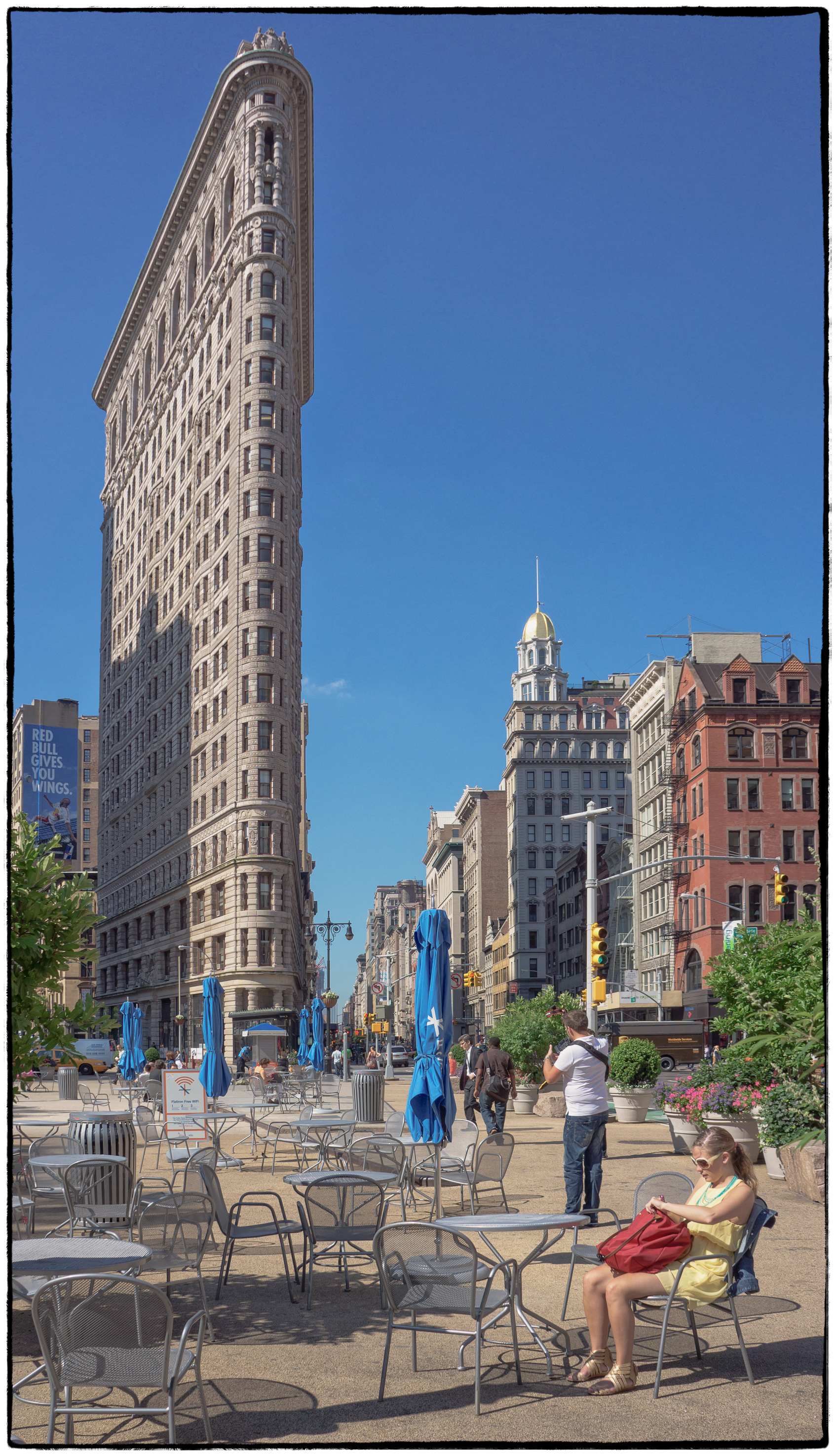
My take on the Flatiron Building

According to Wikipedia:

The Flatiron Building, originally the Fuller Building, is a triangular 22-story steel-framed landmarked building located at 175 Fifth Avenue in the borough of Manhattan, New York City, and is considered to be a groundbreaking skyscraper. Upon completion in 1902, it was one of the tallest buildings in the city at 20 floors high and one of only two skyscrapers north of 14th Street – the other being the Metropolitan Life Insurance Company Tower, one block east. The building sits on a triangular block formed by Fifth Avenue, Broadway, and East 22nd Street, with 23rd Street grazing the triangle’s northern (uptown) peak. As with numerous other wedge-shaped buildings, the name “Flatiron” derives from its resemblance to a cast-iron clothes iron.

The building, which has been called “[o]ne of the world’s most iconic skyscrapers and a quintessential symbol of New York City”, anchors the south (downtown) end of Madison Square and the north (uptown) end of the Ladies’ Mile Historic District. The neighborhood around it is called the Flatiron District after its signature building, which has become an icon of New York City.

The Flatiron Building was designated a New York City landmark in 1966, added to the National Register of Historic Places in 1979, and designated a National Historic Landmark in 1989.

It has been photographed by a number of famous photographers including Alfred Stieglitz (The Flatiron) and Edward Steichen (The Flatiron).

This is my take on it. Initially, as a kind of hommage to Steichen and Stieglitz, I thought to give the picture an old style “pictorial” look, but I didn’t like it. Then I tried a straight black and white conversion. Didn’t like that either so I decided to just leave it in its original color. If it works at all it seems to need the color. I think what’s happening is that the eye is drawn to the bright colors (the yellow dress and the red bag) to the bottom right of the picture. It them moves up through the photographer in the white shirt and follows the blue umbrellas to the base of the building from where you follow the vertical lines of the building upwards. At least that’s my story – and I’m sticking to it.

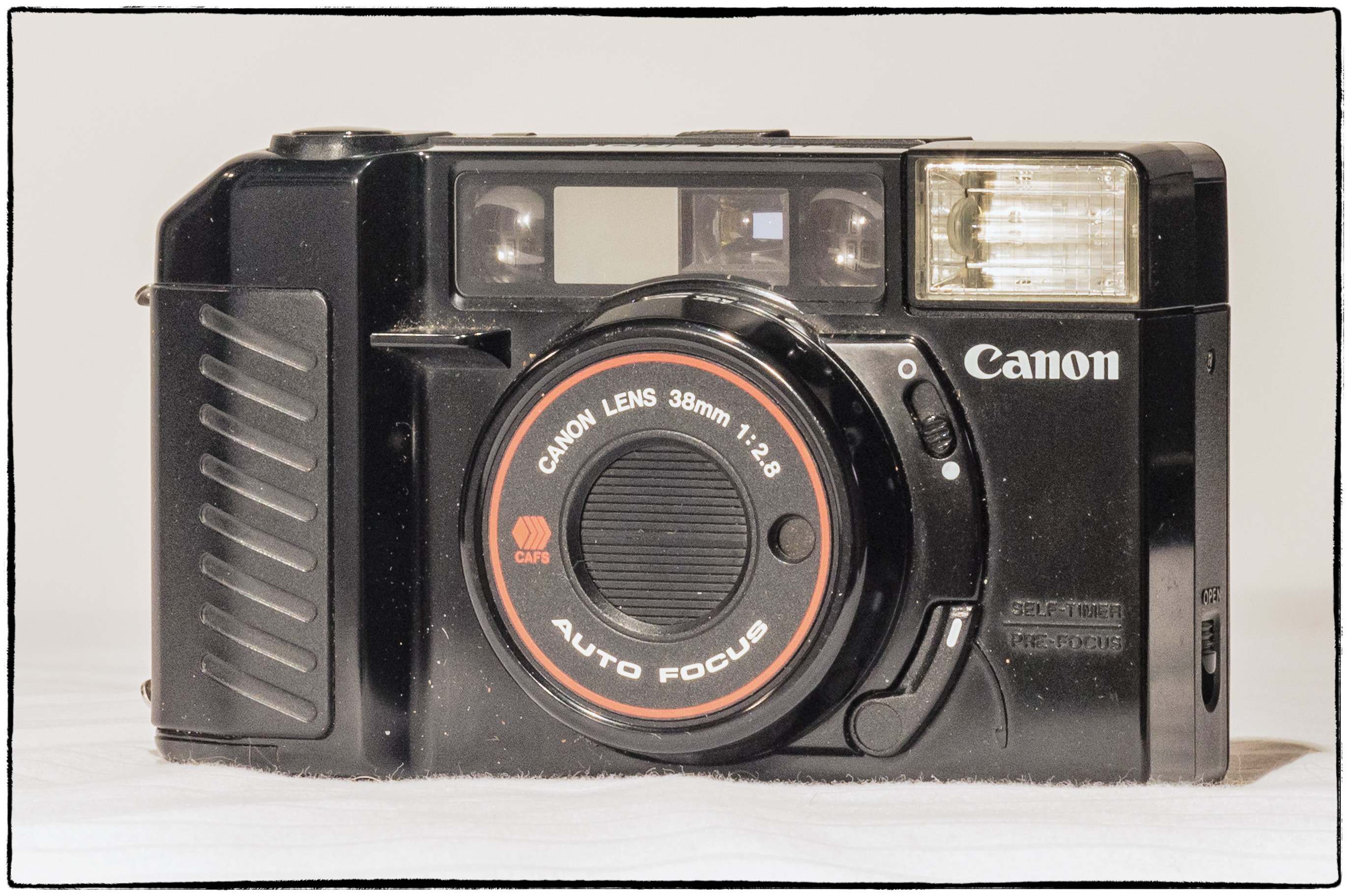
Thrift store find – Canon AF35M

I came across this camera in a nearby thrift store (Goodwill). It seemed to be in pretty good shape and had a solid feel to it. Although I’d already read about this camera before I’d forgotten about it. So I left it. After returning home I looked it up and discovered that it might have some historical significance. The Konica C35 AF (which I also have) was the first autofocus camera, but it apparently had a not particularly impressive passive autofocus system. The Canon AF35M introduced a better active autofocus system, which I believe has formed the basis for camera autofocus ever since.

According to a post (Canon AF 35M), which also provides a detailed review of the camera on Mike Eckman’s excellent site:

In terms of historical significance, the AF35M was the first camera in the world to offer a modern automatic focusing system. The reason I threw the word “modern” in that previous sentence is because its actually the second auto-focus camera released in the late 70s. The first was the Konica C35 AF which came out two years earlier in November 1977. Many people do not consider the Konica C35 AF to be a truly automatic focus camera because Konica “cheated” somewhat in how they accomplished automatic focus.

An ad from 1980 for the AF35M hyped the frustration free simplicity of the camera. Konica employed the use of the Visitronic AF system that was created and produced by Honeywell. This system was a passive auto-focus design which used a traditional two window rangefinder to compare the light entering each window, and through the use of a primitive CPU, it would estimate range and then adjust the focus of the lens to achieve proper focus. Canon’s CAFS (Canon Auto Focus System) from the AF35M used a scanning infra-red light beam that would triangulate distance by reflected light bouncing back to the camera. Konica’s system was easily tricked and could not handle moving or very small objects very well. Canon’s CAFS system was far from fool-proof, but it handled a variety of scenes, including low light situations, much more reliably.

I also discovered that the camera is capable of taking impressive pictures (see A Canon in A Minor – the AF35M on Random Camera Blog).

I had to go back to the same area the following day and I decided that, if the camera was still there, and if the price was less than $10 I’d get it (the camera had no price sticker on it). As it turned out the price was $5 so I got it.

Surprisingly the camera had functioning batteries in it and fired up immediately when I turned it on. Everything else seemed to be working fine too.

I did a bit more research and discovered that this particular model was not the first in the series though. There are a large number of different models from the first in 1979 to the last in 2005. I’m most interested in the early models. The first three models were (the names represent the way the camera was designated in the USA, Europe and Japan):

Canon Sure Shot/AF35M/Autoboy (1979)
Canon Super Sure Shot/AF35ML/Autoboy Super (1981)
Canon (New) Sure Shot/AF35M II/Autoboy 2 (1983)

The one I had was the third: (New) Sure Shot, AF35 M II, Autoboy 2. The problem arises because the first and third US models are both labeled on the top plate as simply ‘Sure Shot’. Of course I decided that I had to have the first. I found one on ebay and hope to receive it soon. Then I’ll have decide if I want the Super Sure Shot with its faster lens (f1.9 instead of f2.8). A quick look at ebay tells me that this model is somewhat more expensive so maybe I’ll just wait and see if I bump into one in a thrift store of flea market.