Flowers in our garden

Every year around this time our younger daughter has to travel on business (she goes to the Cannes Film Festival). She always asks her mother to come over (she lives in Switzerland) to help out with her two small children. So off goes my wife while I stay home and look after the houses and the pets and (most importantly for this post) the gardens. I don’t like gardening much, but I do it because I’m terrified that something important will die and I’ll get blamed for it. Moreover, my responsibilities in this regard have been increasing. First I just had to water the indoor plants (orchids, African violets and the like); then I had to water all of the outside plants too; finally I was tasked with “deadheading” the plants and looking out for caterpillars (they rappel down from our oak trees and wreak have on the roses).

With the advent of modern technology I’m now also expected to send pictures and maybe even videos to prove that I a living up to my responsibilities.

So here are a few flower pictures from the bed down by our dock (with the exception of the rhododendron, which is on our driveway). I’m afraid I only recognize the first one (Lilly of the Valley) and the last one (Rhododendron). I have no idea what the others are.

Rhododendron.

African carved wooden sculpture

This wooden sculpture sits on the wall of our TV room. It looks like a huge comb and I have no idea what it represents. I don’t even really know how we came to own it although I imagine it was given to us by our older daughter who spent a number of years in Africa (Kenya, Tanzania, Rwanda, Burundi).

I was able to find something like it on eBay, but with only one figure rather than the two we have. It’s described and a “Vintage African Ashanti Carved Wood Mother & Child Fertility Comb Sculpture“. The listing describes the sculpture as follows:

The Ashanti (Asanti) are an ethnic group with their own kingdom as a sub-nation in what is now Ghana in Western Africa. The Ashanti Kingdom has a long and illustrious history beginning in 1670.

This comb sculpture is a fertility symbol that is ornamental and not functional. It is hand carved from one solid piece of wood. The figure has a lovely face with detailed hair style and elaborate carved decorations on the back of the comb as pictured. The multi-colored surface appears to have been stained or painted with red and black, then covered with a white wash.

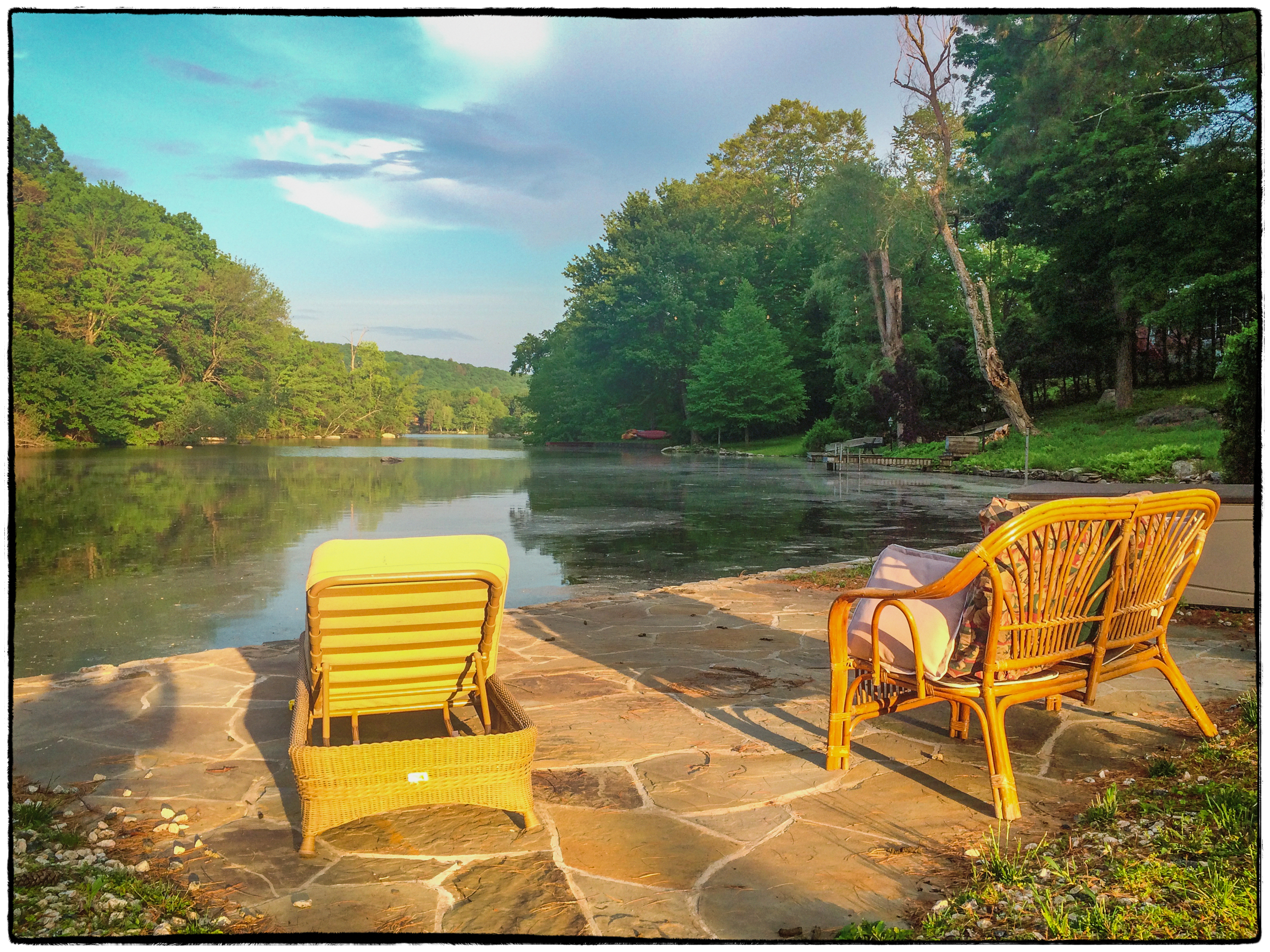
Wonderful early evening light on the cove

I was walking past our friend Roxana’s house when her dog, Buster came running out – excited to see Harley. It was a hot day and she invited me for a beer. Where we live on the open lake, she lives on one of the coves: shallower inlets, of which there are a few around the lake. They’re quite picturesque, but unfortunately when they lower the lake level in Winter the water in the coves disappears and instead of a lake view you have a mud view. Today was gorgeous, however. We were sitting on her raised deck overlooking the water when I noticed that the light was particularly interesting. So I went down to the water to take this picture. Once again I didn’t have the camera with me so I used the iPhone.

Chipmunk

I was walking the dog past a neighboring garden when I noticed movement out of the corner of my eye. Inside the garden was a grid and from time to time a small head would pop out: a chipmunk. Up it would pop. Then it would get nervous and disappear for a while. It repeated this process for quite some time. Regrettably the only camera I had with me was my iphone and I couldn’t get anywhere near enough to take a decent picture. Nonetheless I snapped away and came up with something, which (after very severe cropping) I felt I could share with my wife and grandkids.

A few days later I passed by this garden again and sure enough there was the chipmunk going through the same routine as before. This time I was better prepared and had a more sophisticated camera with me. Patience has its rewards. Not a great picture, but kinda cute.

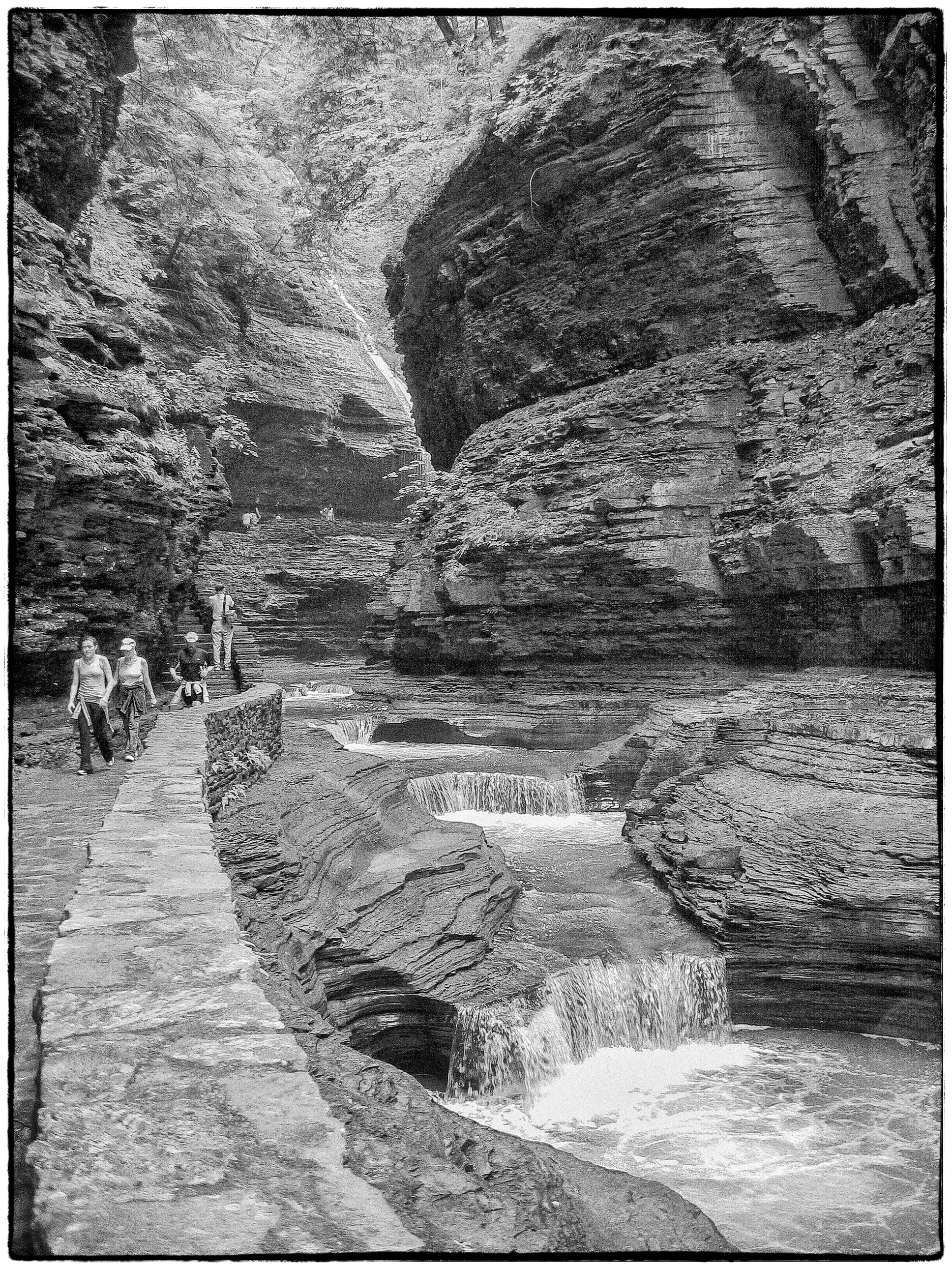
Watkins Glen State Park

Watkins Glen State Park taken in July, 2006 with a Canon Powershot S50. Quite remarkable rock formations. According to Wikipedia:

Watkins Glen State Park is located outside the village of Watkins Glen, south of Seneca Lake in Schuyler County in New York’s Finger Lakes region. The park’s lower part is near the village, while the upper part is open woodland. It was opened to the public in 1863 and was privately run as a tourist resort until 1906, when it was purchased by New York State. Since 1924, it has been managed by the Finger Lakes Region of the New York State Office of Parks, Recreation and Historic Preservation.

Jacob’s Ladder, near the upper entrance to the park, has 180 stone steps, part of the 832 total on the trails.
The centerpiece of the 778-acre (3.15 km2) park is a 400-foot-deep (120 m) narrow gorge cut through rock by a stream – Glen Creek – that was left hanging when glaciers of the Ice age deepened the Seneca valley, increasing the tributary stream gradient to create rapids and waterfalls wherever there were layers of hard rock. The rocks of the area are sedimentary of Devonian age that are part of a dissected plateau that was uplifted with little faulting or distortion. They consist mostly of soft shales, with some layers of harder sandstone and limestone.