
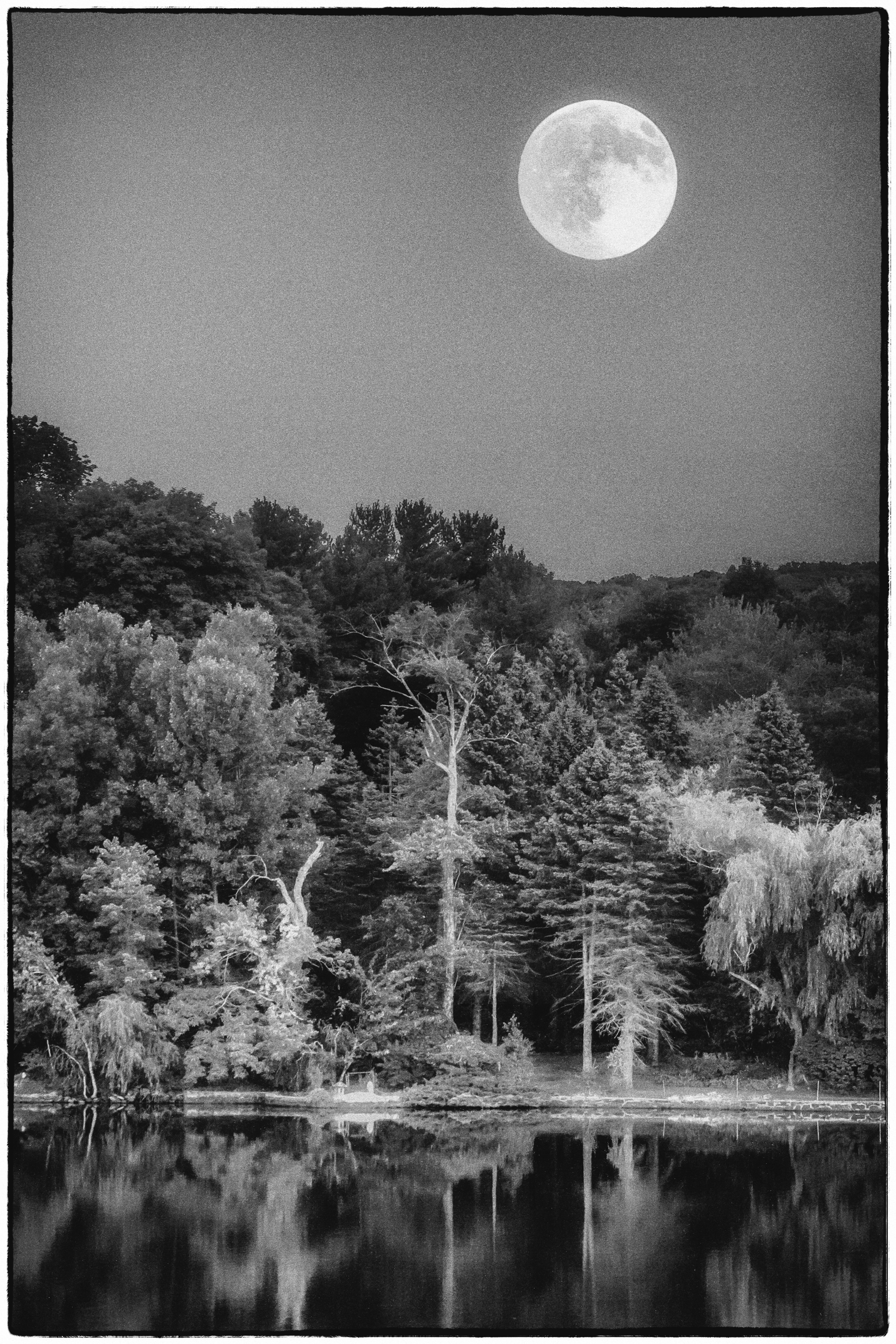
Moonrise Roaring Brook Lake

My wife and I were returning down the Taconic State Parkway from a shopping expedition to the Danbury Fair Mall when I noticed what seemed to me to be an exceptionally large moon over our lake. I rushed home, got out my camera and tripod and rushed out to take the picture. The situation was dire. The light was changing very quickly and if I didn’t take the shot quickly I wouldn’t have it at all. I didn’t trust my exposure meter but knowing the luminance of the moon I was quickly able to get off a picture. I was about to take a second picture when the light suddenly changed and the opportunity was gone forever.

Of course the above is mostly complete nonsense liberally adapted from Ansel Adams‘s famous description of the circumstances surrounding the taking of his picture “Moonrise, Hernandez Mexico“. The reality was quite different.

It’s true that we were returning from Danbury and that I saw a large moon over the lake. It’s also true that I grabbed my camera and tripod and went to get the picture. Unfortunately, I then discovered that the picture I had in mind was impossible to get. I wanted the trees and the lake and over them a very large moon. I quickly found that if I wanted a large moon I had to exclude the trees and the lake or if I wanted the trees and the lake then I would have to accept a small moon. Neither of these was a good alternative so I decided on something else: two exposures, one of the trees and the lake and the other of the large moon, which I then combined. The picture was originally in color, but I thought it would look better in black and white.

I quite like the result, but it’s a complete fake.
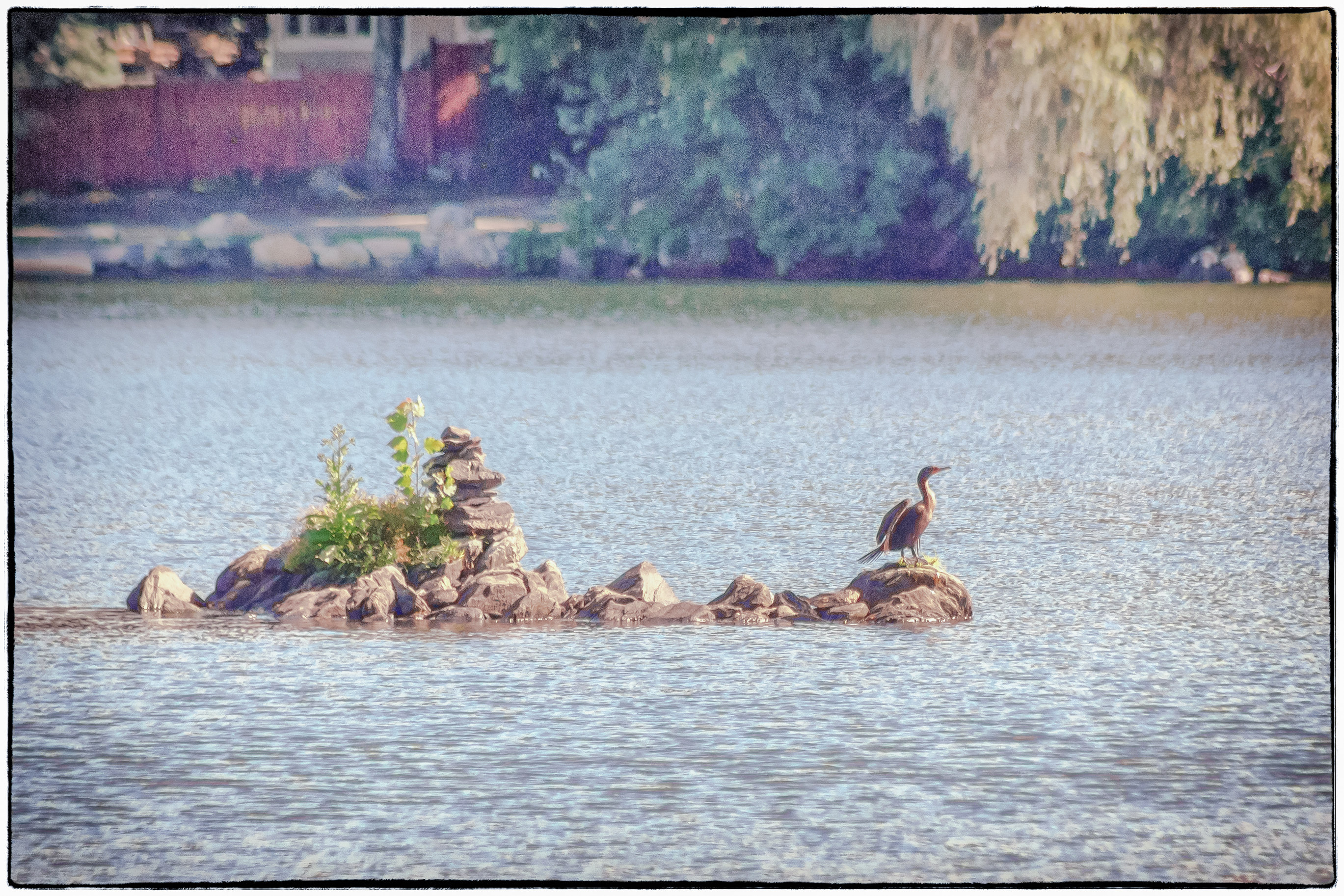
Cormorant on a Rock

I knew that I would be going to the NY Air Show with some friends and would need to use a long focal length lens. The last time I’d tried to capture aircraft in flight I hadn’t been particularly successful – and these were WWI vintage aircraft that didn’t move particularly quickly. This time there would be fast jet aircraft (AV-8b Harrier, F/A 18 Super Hornet, F-22 Raptor etc.) so I didn’t give much for my chances without some practice (or even with it for that matter). Anyway out came the Sigma 70-300mm f4-5.6 – The longest lens I own. Since this is a Sony/Minolta A-mount lens out too came the Sony Alpha 500 – a camera I’m getting to like more and more as I use it. Down I went to the dock where I’d seen a Cormorant standing on a rock on the lake. It was a good distance from our dock and I thought it would be a suitable subject – it wasn’t moving much and I thought it would be a good opportunity to try out the lens without worrying too much about the movement.

I wasn’t too impressed with the results but I did learn a lot from the exercise:

1. I can’t handhold at long focal lengths. So out came an old monopod.
2. The monopod by itself helped but the pan/tilt head seemed to get in the way so I put on the ball-head from my tripod. This gave me much more flexibility while still providing stability.
3. This really is a sunny day lens. I took the pictures late in the afternoon and had to bump the ISO up to 800 in order to get a decent shutter speed. This increased the noise.
4. At 300mm the lens is very soft even at small apertures. 200m was better.
5. Using continuous autofocus seemed to work better than single shot. Even though the subject wasn’t moving maybe I was.
6. The sun was behind and to the side of the cormorant and it was difficult to get the exposure right. Spot metering seemed to help but even then the subject was often too dark requiring shadows to be boosted in PP and more noise.

So not much of a picture, but a useful exercise. We’ll see how I do at the air show.

A Statue on top of Grand Central Terminal

Hercules looks up at Mercury in this statue by Jules-Félix Coutan called Glory of Commerce. The third statue (Minerva) is not visibly in this picture.

According to The Secrets of Grand Central, Part 2 on the Untapped Cities website:

The statue “Transportation”, alternatively “The Glory of Commerce” adorns the front of Grand Central facing south. On the left sits Hercules, representing physical strength; on the right, Minerva, goddess of wisdom and protectress of cities; featured at the center is Mercury, god of travel and commerce. This sculptural grouping was considered the largest of its kind when it was built in 1914. Made of the same Bedford limestone façade as the Terminal, it is 48 feet high and weighs 1500 tons. Underneath Mercury is the world’s largest example of Tiffany glass, at 14 feet in diameter.

Though it was designed by the French sculptor Jules-Felix Coutan, then a professor at the École des Beaux-Arts in Paris, the artist himself never set foot in the United States. Asked if he would visit to oversee the construction of his piece he replied in the negative, explaining, ”I fear some of your [American] architecture would distress me.” The piece was instead constructed/assembled by William Bradley and Son of Long Island City, Queens. It took 7 years, whereas the building of Grand Central itself took 10.

Ansel Adams: A Documentary Film 2002

When I was just getting into photography Ansel Adams was the first major photographer that I knew and that made an impression on me. I have a vague memory (possibly faulty) that his photograph: “Moonrise Hernandez Mexico” had recently become the most valuable photograph in the world. I also recall that someone had loaned me his book “The Camera”. Until then I’d been buying “gear” thinking it would dramatically improve my photographs (of course it didn’t). Then I saw some pictures in his book taken with a pinhole camera. This convinced me that it isn’t the “gear” that makes the picture it’s the photographer. For a while, influenced by Adams, I thought I wanted to be a landscape photographer.

Later, as I got deeper into photography, I got to know other famous photographers: e.g. Weston, Strand, Evans, Cartier-Bresson, Atget etc. I realized that other genres (e.g. documentary photography; abstract photography) appeal to me more than landscape. I also realized that photographs by other photographers provoked more of a reaction in me than Adams’ landscapes. I still consider Adams’ photographs to be technical masterpieces. I also recognize his influence on photography – as a photographer, advocate and teacher. I just don’t find his photographs as “earth shattering” as I once did. I also find his categorical rejection of all photographic styles other than the pure photography he espoused hard to take. To me no single style is intrinsically better than another. It’s the quality of the end product that counts.

I enjoyed this documentary. I was nice to actually see and hear John Szarkowski. I’d heard about him and I own a number of books written by him, but this was the first time I’d actually seen him speak.

I also missed a few things I’d expected to find. I recently finished a book on “Group F.64“, the famous US West Coast group of photographers (Adams was a member) that broke away from pictorialism in favor of pure or straight photography. A very influential group that wasn’t mentioned in the documentary. I also found it strange that there was no mention of the Zone System or Adam’s famous trilogy of books (The Camera; The Negative and The Print) was not mentioned. In fact his role as an educator was rather downplayed.

Give my regards to Broadway

Taken in March, 2010 at Duffy Square (between Broadway-7th Ave and 45-47th Street) in Manhattan, NY. In case anyone reading this is not familiar with New York City, Duffy Square makes up the northern part of the Times Square neighborhood. Statues: in the foreground George M. Cohan and in the background Father Francis P. Duffy.

Cohan is, of course, a famous singer, dancer, producer and all-around entertainer, considered by many to be the originator of the Broadway Musical. His life is commemorated in the movie: “Yankee Doodle Dandy” starring a singing/dancing James Cagney. If you only know Cagney from his gangster movies and impressionist takes (“You dirty rat…”) this seems odd, but he was originally a dancer. Wikipedia has this to say about Cohan:

Cohan began his career as a child, performing with his parents and sister in a vaudeville act known as “The Four Cohans.” Beginning with Little Johnny Jones in 1904, he wrote, composed, produced, and appeared in more than three dozen Broadway musicals. Cohan published more than 300 songs during his lifetime, including the standards “Over There”, “Give My Regards to Broadway”, “The Yankee Doodle Boy” and “You’re a Grand Old Flag”. As a composer, he was one of the early members of the American Society of Composers, Authors, and Publishers (ASCAP). He displayed remarkable theatrical longevity, appearing in films until the 1930s, and continuing to perform as a headline artist until 1940.

Known in the decade before World War I as “the man who owned Broadway”, he is considered the father of American musical comedy. His life and music were depicted in the Academy Award-winning film Yankee Doodle Dandy (1942) and the 1968 musical George M!.

Father Francis P. Duffy (after who the square is named) is perhaps lesser known. Wikipedia has this to say about him:

Francis Patrick Duffy (May 2, 1871 – June 27, 1932)[1] was a Canadian American soldier, Roman Catholic priest and military chaplain.

Duffy served as chaplain for the 69th Infantry Regiment (known as the “Fighting 69th”), a unit of the New York Army National Guard largely drawn from the city’s Irish-American and immigrant population.[2] He served in the Spanish–American War (1898), but it is his service on the Western Front in France during World War I (1917-1918) for which he is best known. Duffy, who typically was involved in combat and accompanied litter bearers into the thick of battle to recover wounded soldiers, became the most highly decorated cleric in the history of the United States Army.

Taken with a Panasonic Lumix ZS-3, a very small digital point and shoot camera with tiny sensor and a long zoom range. In poor light pictures taken with this camera can look a little like watercolor, but it good light it could produce great results and was very easy to carry around.