Buddha group

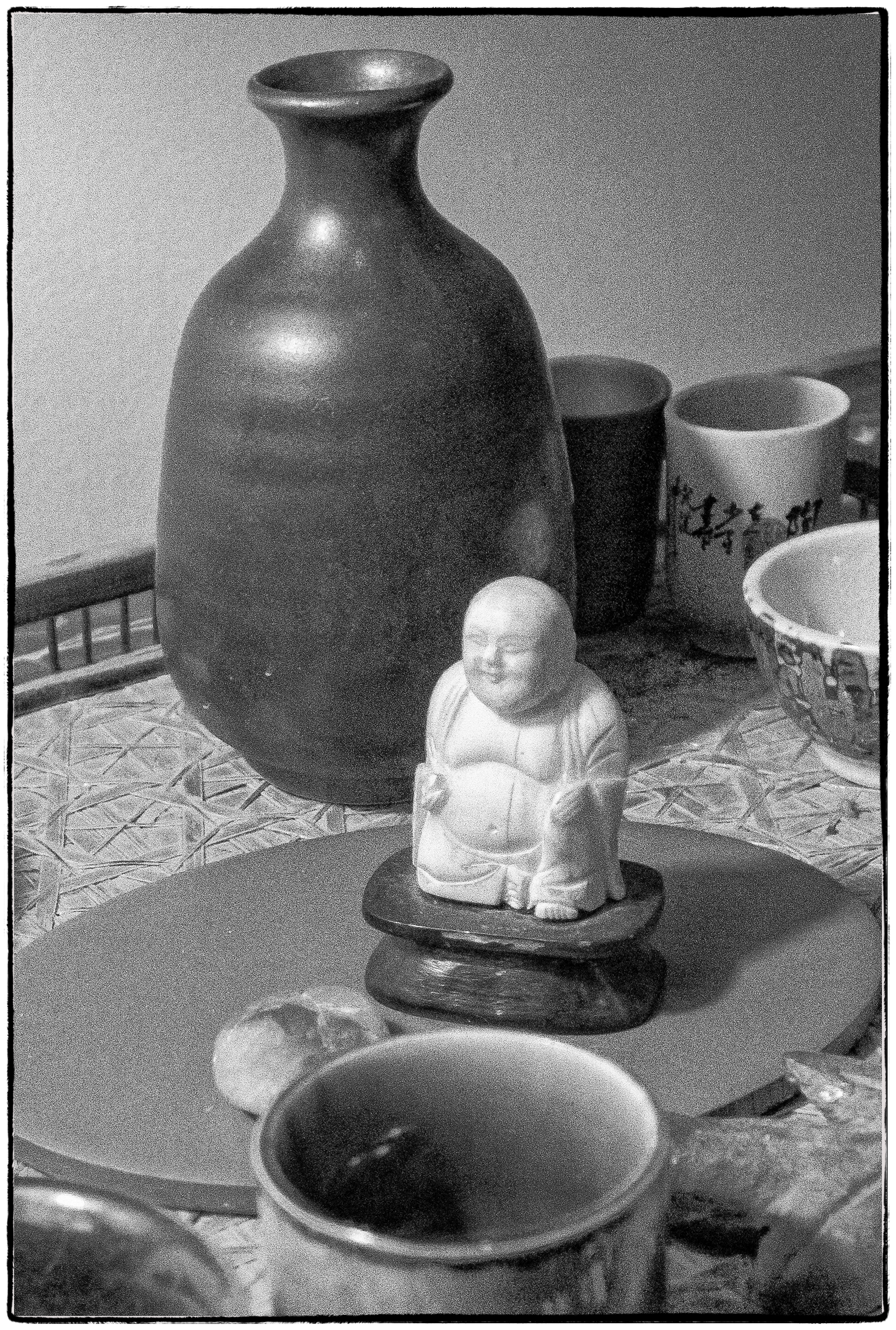
We were invited to have Thanksgiving dinner at a friend’s house. I came across this interesting grouping of objects in his living room. It aroused in me a sense of peace and tranquility (as I’m sure he intended). It was rather dark in the living room and since there were others around I didn’t want to spend too long over it. So as a result of the slow shutter speed and high ISO the picture isn’t as sharp as I’d like it to be. Also if I had to do it again I’d move the stone in front of the buddha statue a bit to the left – or maybe better change my position – to make a little separation between the stone and the bowl below.

Indian statuette

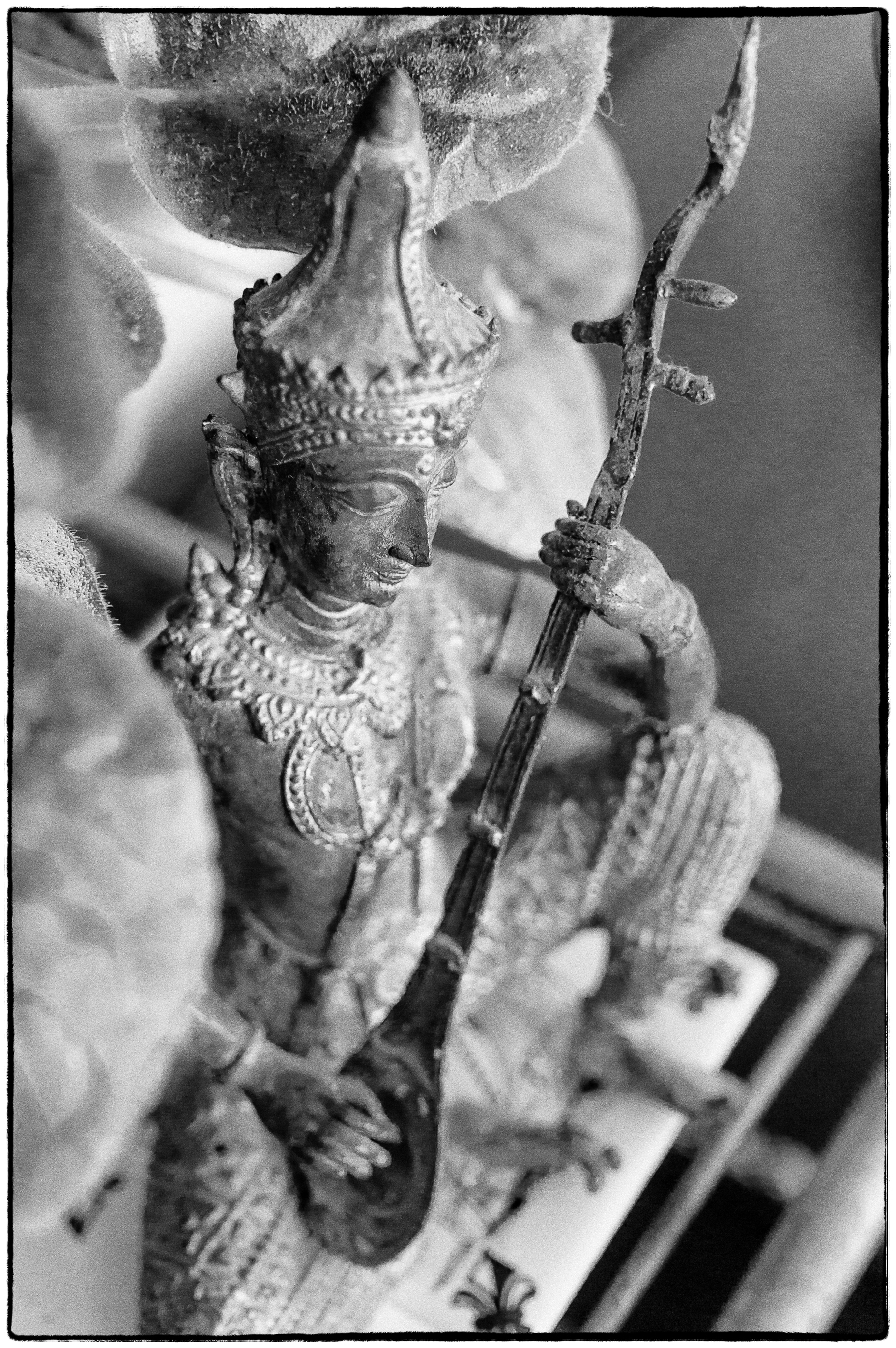
We have three of these small statuettes on a small pyramid shaped shelving unit in our living room. Right next to it is a slightly taller mirror-fronted armoire on which I’m accustomed to leaving cameras so the cat can’t get at them (it’s a little bit too tall even for her, and in any case she’s shown no inclination to try to get up there. Probably for the best since if she did try to get up there she’d probably cause damage). When we have visitors my wife doesn’t like my cameras to be out in the open so I have to remove them. On this particular day I happened to glance down and notice this figure. I’d seen it many times before, but never from this particular angle. I liked the way it was peeping out from between the leaves of a couple of african violets – like some exotic figure in the jungle. I was trying to keep the face in focus while blurring the foreground and background and I pretty much succeeded I think. If I could change anything I’d try to get the figure’s right hand in focus too.

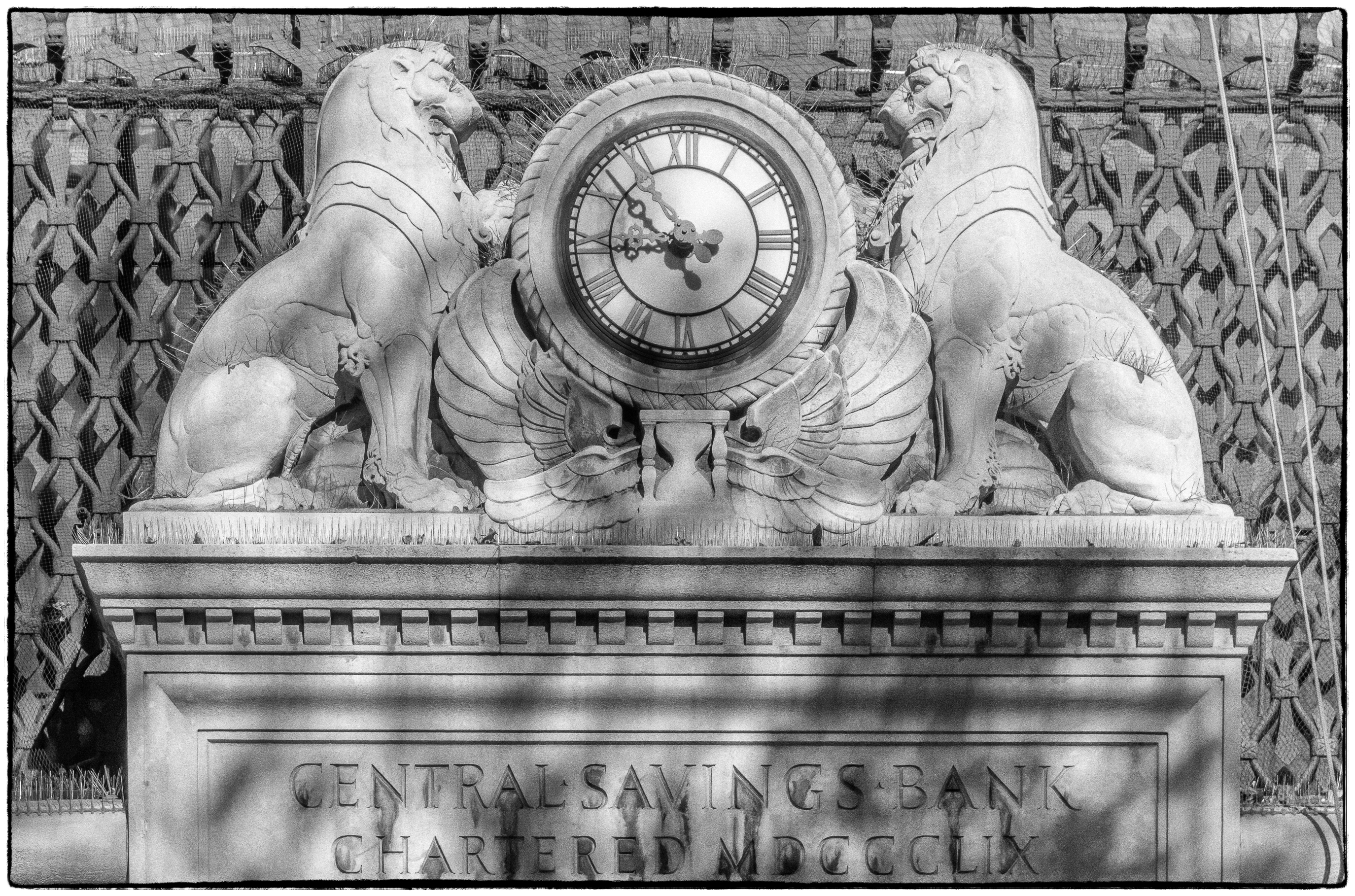
Lion clock on the former Central Savings Bank

According to a post (The Solidity and Stature of NYC’s Central Savings Bank) on the Curbed, New York site:

The Central Savings Bank (currently Apple Bank), located at 2100-2108 Broadway at West 73rd Street, was built between 1926 and 1928 by the architecture firm of York & Sawyer. The bank had been founded in 1859 and was originally known as The German Savings Bank in the City of New York, with its first location inside the Cooper Union building. Just five years later, in 1864, the bank would move a bit uptown to Fourth Avenue and 14th Street, eventually occupying a new bank building that was constructed in 1872. Decades later, during World War I, the bank changed its name to “Central Savings Bank.” Though the name change may have been due to anti-German sentiment, the bank continued to flourish and the trustees banked (sorry) on the Upper West Side’s business and residential development and chose to open an uptown branch.

York and Sawyer was an obvious choice for the new building. In addition to both working for the prolific firm of McKim, Mead and White, York and Sawyer were experienced in designing other noteworthy banking institutions, such as the Federal Reserve Bank of New York on Liberty Street and the Bowery Savings Bank on 42nd Street. The Central Savings Bank commission would be especially stately given its unique location atop a trapezoidal lot adjacent to Verdi Square. With the latitude to design a building free from the confines of adjacent structures, and complemented by nearby open space, the designers were able to create a unique, iconic structure.

That structure was a six-story freestanding building designed in the style of an Italian Renaissance palazzo. Constructed of rusticated limestone, the building was adorned with decoration that would in fact be very fitting for a palazzo. This included the two lions surrounding the clock above the main entrance, cartouches featuring the heads of classical figures and shields containing the caduceus motif; two snakes ensnarled around a staff?which has become the modern symbol of commerce and negotiation. In addition, the exterior features stunning wrought iron doors, gates, grilles and lanterns designed by Samuel Yellin, considered the country’s master iron craftsman during the 1920s. The building is still not as highly decorated and elaborate as its Parisian-inspired neighbors to the south, the Ansonia and the Dorilton, but is instead serious and refined.

The building stands like an imposing fortress, exuding strength and stability, qualities that very much befit a financial institution. And the building is even more majestic inside. Upon initial entry, the visitor is transported into the cavernous and vaulted main banking hall, in which the building’s tall arched windows provide natural light. The 65-foot coffered ceiling is based on the ceiling of Florence’s Davanzati Palace. The main hall also showcases Yellin’s interior ironwork, specifically the bank screens, grilles, mailboxes and signs. And don’t forget to look down, or you might miss the intricate multi-colored marble floor, which has sustained nearly ninety years of wear.

The bank’s executive offices located on the mezzanine level are also highly stylized. According to Christopher Gray, the offices were “decorated by the Barnet Phillips Company” and “included double-height meeting rooms with large fireplaces flanked by iron torcheres, beamed ceilings, wooden paneling and elaborate faux wall painting with imitation garlands and spirals of fabric.” In order to make some profit from the large building, the upper floors were designed to be rental office space. And although these offices on the upper floors are considered plain and less decorative than the rest of the building, there is elegance in their simple design. These offices feature “solid metal doors with inset panels and an upper section of frosted glass,” brass signboards and “walls wainscoted with marble.”

The Central Savings Bank stands as a monument to commerce, consumerism and finance. Through its design, the building fosters a sense of safety and security – a prime example of how architecture can be emblematic of its building’s purpose and function. The architects sought to create a building in which people would be comfortable investing and depositing their hard-earned money. And what better way to represent strength, stability and success than to have the bank designed in the style of a Renaissance palazzo? The words spoken at the bank’s 75th anniversary in 1934 still ring true: “The Central Savings Bank is housed in truly a noble building, its lofty interior and its massive exterior typifying all that the Bank has represented in the past?all that the future may bring to us in the way of health and happiness.”

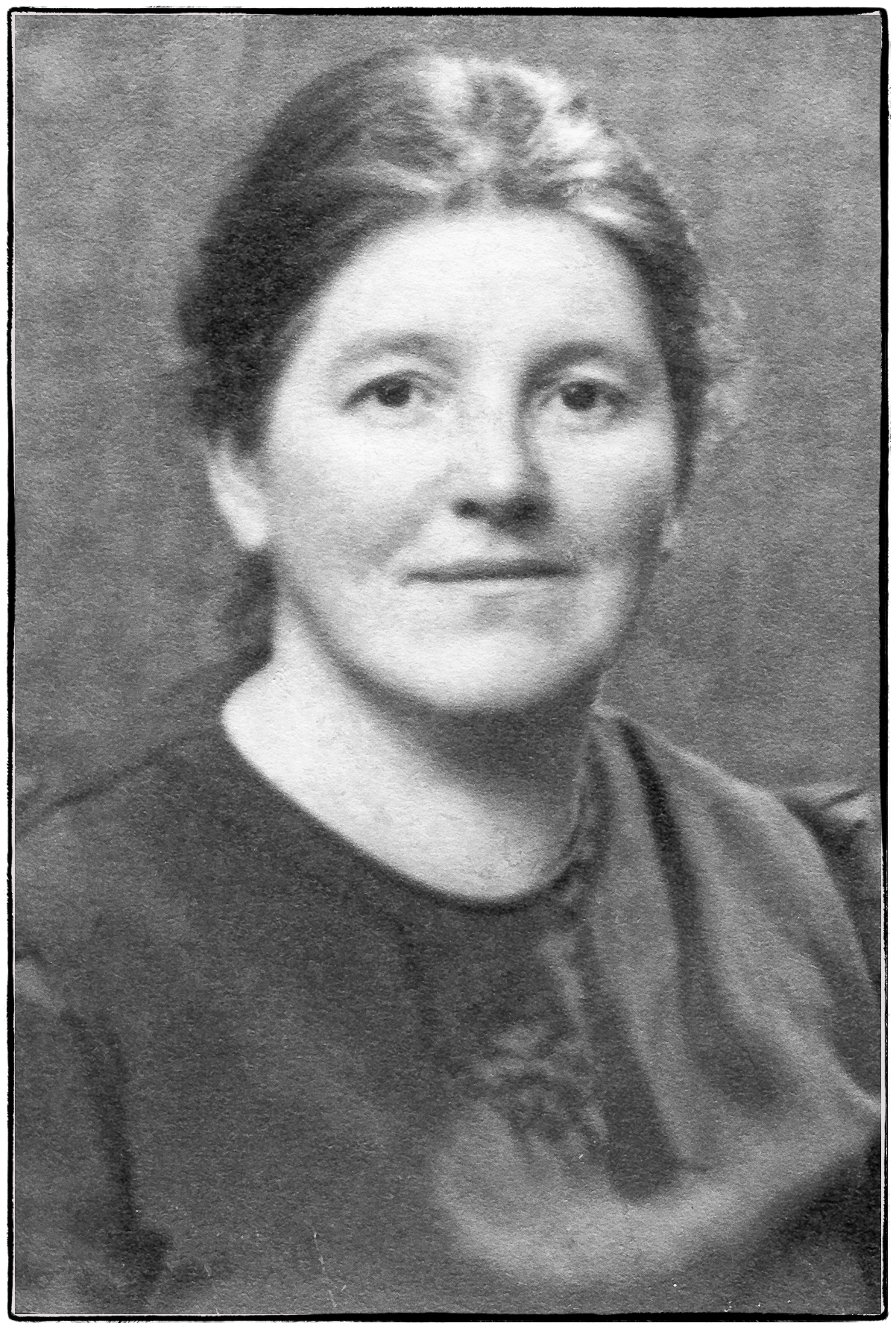
My grandmother

As I came downstairs this morning I passed this picture in a frame on a shelving unit. The picture had slipped and was now crooked in the frame. So I decided to take it out and straighten it. Then it occurred to me that I should probably scan it and post it to this blog.

It’s a picture of my grandmother on my fathers side and as I was scanning it I realized how little I knew about her. Since I’d always known her as ‘grandma’ I did’t even know what her real name was.

So I did some browsing around on the internet and this is what I discovered. She was originally Mary Elizabeth Poole (born 1898) and in 1918 she married George Dale. They had two children: my father, Thomas (born 1919) and my aunt, Bessie Margaret (born 1925). From what my father told me his father died (I don’t know when, but apparently from Peritonitis). Subsequently my grandmother married again – this time in 1930 to a certain John W. Watts. They had two children: My aunt, Kathleen Joan (born 1930) and my uncle, Albert John (born 1935). Unfortunately, Mr. Watts was not long for this world either. I recall my father telling me that he died in a mine accident. In 1937 she married again to a Mr. William Smith. Perhaps seeing the writing on the wall he took off never to be seen again. According to my father he was a thoroughly unpleasant person so his disappearance was no great loss.

My grandmother passed away at the age of 83 in 1981. Our wedding also took place in NY in 1981 and I recall that my grandmother was very sick at the time. My father thought about cancelling their trip to NY. However, his sister encouraged him to go as nobody knew how long my grandmother would linger and that in any case she didn’t recognize anyone at that point. She passed away while they were in the US.

I wasn’t particularly close to her. She lived nearby, but her home was far enough away to discourage my father from visiting frequently. I remember her as a fairly terrifying old lady. She was heavily involved in the local church (she was a church warden) and owned a farm. By the time I knew her she’d gone through three husbands and raised four children while running a working farm (that’s probably why she was so tough). When I was a kid I remember playing in the hay barns and watching her milk cows. Later she sold much of the property, but retained the farm house. My Aunt Bessie, her husband (we always referred to him as John or Johnny, but I find from my research that his name was actually George) and their five children Clifford, Margaret, Peter, Geoffrey and Gillian. I remember that we would usually visit on Sunday lunchtime and the meal was always the same: canned salmon doused in malt vinegar, lettuce and bread and butter. Every time we went there I hoped that, for once, it would be something different, but it never was.

The photograph has the words ‘Mother, 1942’ in my father’s handwriting on the rear. While I was scanning it I noticed that there was also a faint inscription on the front: “To Thomas with…”. You can just see the top of a second line, but someone has trimmed the photograph and it’s impossible to read what it says. My mother called my father Tom, his friends called him Tom or Tommy, but I never heard my grandmother call him anything other than Thomas.