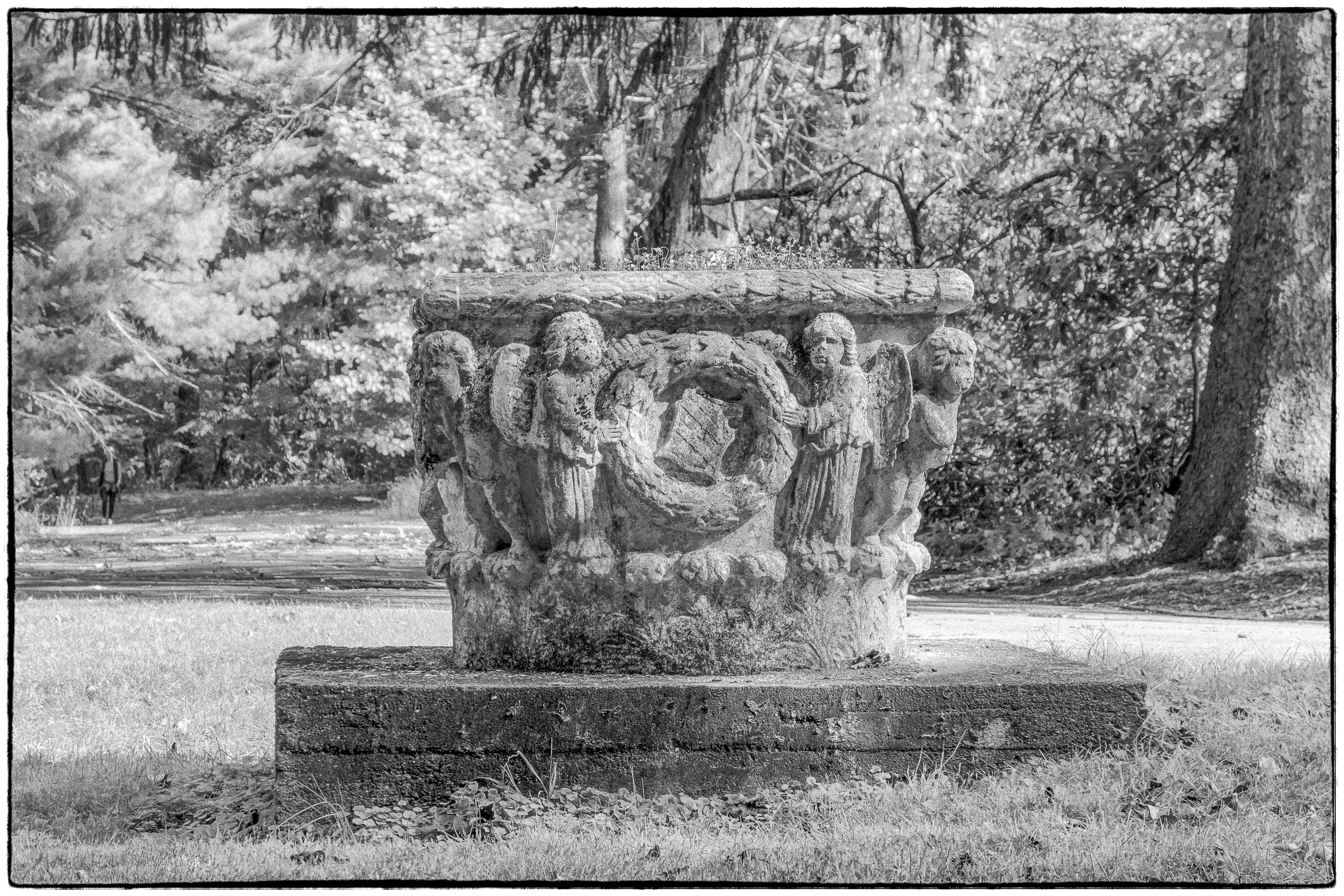
This planter (if indeed that is what it is) stands in the grounds of Glenclyffe – just across the grassy area in front of the old Hamilton Fish mansion. It’s large, heavy and ornately decorated. If, indeed, it is a planter it’s presently empty.
Photographs and thoughts on photography and camera collecting

This planter (if indeed that is what it is) stands in the grounds of Glenclyffe – just across the grassy area in front of the old Hamilton Fish mansion. It’s large, heavy and ornately decorated. If, indeed, it is a planter it’s presently empty.

I was returning to the car from the historic overlook when, about half way to the former monastery, I came across this tangle. I don’t really know what it is – some kind of vine I imagine. I just liked the shape and the textures.
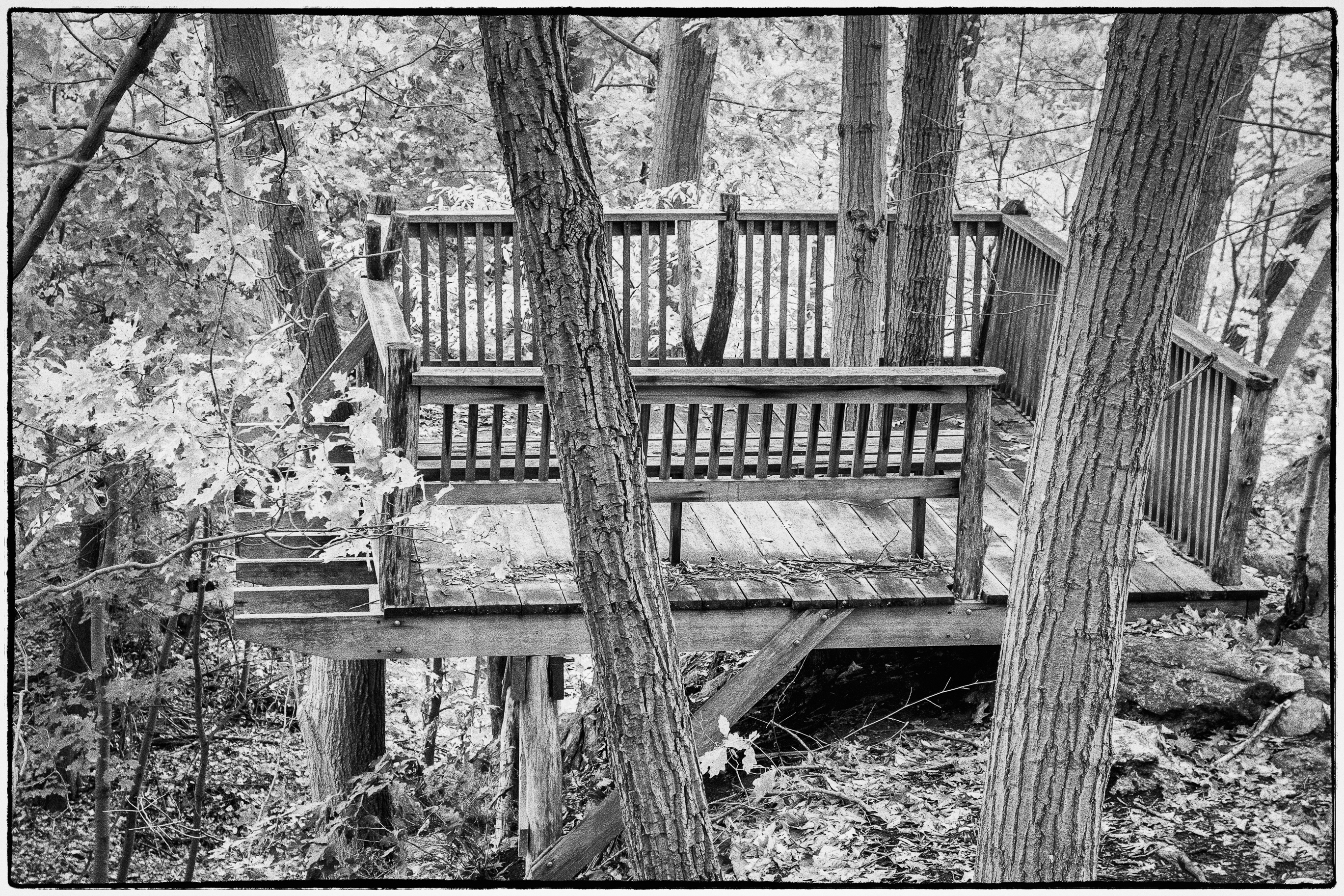
On my earlier walk into Glenclyffe (see Glenclyffe 1 – all that remains of the original mansion and Glenclyffe 2 – Monastery of Mary Immaculate) I walked up to the former monastery, continued on to the former Hamilton Fish house, and then kept going until I reached what was labelled on the map as ‘historic overlook’. Although trees pretty much obscured the view I could see that it ‘overlooked’ the Hudson. However, I had no idea why it was ‘historic’. We had plans for the evening and I was already running late. So I turned around and retraced my steps back to Garrison Station.
I’d seen from the trail map that the trail continued along what was referred to as ‘Benedict Arnold Escape Route’. For years I’ve been fascinated by Benedict Arnold so I returned a few days later. This time rather than starting from Garrison station I started from Route 9D (turn into the entrance to the Garrison Institute and the parking is a little way down on the right). After crossing the grassy area on the opposite side from the parking I found the trail on the other side. After walking for a couple of minutes I came across an information kiosk, which explained what was ‘historic’ about the ‘overlook’:
This walking path follows the historic Beverly Dock Road, which from 1756 until 1892 linked the Robinson House (which formerly stood on a site 600 feet to the south of this spot, on the east side of what is now Route 9D) to a landing dock on the Hudson River, originally called Robinson’s Landing, and later Beverly Dock. On the morning of September 25, 1780, Major General Benedict Arnold, who had established his headquarters in the Robinson House upon taking command of West Point and its dependencies the month before, awaited the arrival for breakfast of General George Washington and his staff (including Brigadier General Henry Knox, Major General, the Marquis, de Lafayette, Lieutenant Colonel Jean Baptise de Gouvion, and Lieutenant Colonel Alexander Hamilton), returning to the Main Army from a secret conference in Hartford with their counterparts of the French Expeditionary Army. Washington, deciding to inspect the North and South Redoubts (whose ruined ramparts and batteries remain on the high ridge visible from this spot a mile to the northeast) before proceeding to the Robinson House, sent Lafayette’s aide de camp Major James McHenry and Knox’s aide captain Samuel Shaw ahead to ask Mrs Peggy Arnold (Margaret Shippen) not to wait breakfast. While Arnold was taking breakfast with Washington’s messengers, a messenger arrived from the front lines with a dispatch informing Arnold of the capture of a “John Anderson” in possession of documents detailing the defects of the defenses of West Point – a man whom Arnold knew in fact to be Major John Andre, General Sir Henry Clinton’s spymaster and co-conspirator in Arnold’s plan to surrender West Point to the British. Knowing that his on arrest would be certain upon Washington’s arrival at the Robinson House some minutes hence, Arnold excused himself from this guests, took hasty leave of his young wife and baby, fled by horse down Beverly Dock Road and ordered his commandant’s barge standing ready at Robinson’s Landing to take him eighteen miles downriver, where he boarded the British warship HMS Vulture, which lay waiting Andre’s overdue return.
It was only in the late afternoon of September 25 that a separate dispatch concerning Anderson’s arrest and true identity finally caught up to Washington at the Robinson House and disclosed Arnold’s treason. Deeply shocked that his most trusted general had come so close to delivering the British not only the key to America’s defense but also the person of the Commander in Chief, Washington ordered the heights above the Robinson House heavily reinforced and the entire Highlands Department put on war alert. Popular indignation at the disclosure of treachery in the highest ranks of the Revolution, combined with widespread gratitude that the enemies designs had been frustrated, stiffened the resolve of the fledgling to persevere to victory.
Fascinating stuff. The historic overlook clearly has a view toward where Beverly Dock once stood. Coincidentally we had tickets to see ‘Spamilton‘, a parody of the Broadway mega hit ‘Hamilton‘ about the same Lieutenant Colonel Alexander Hamilton mentioned above.
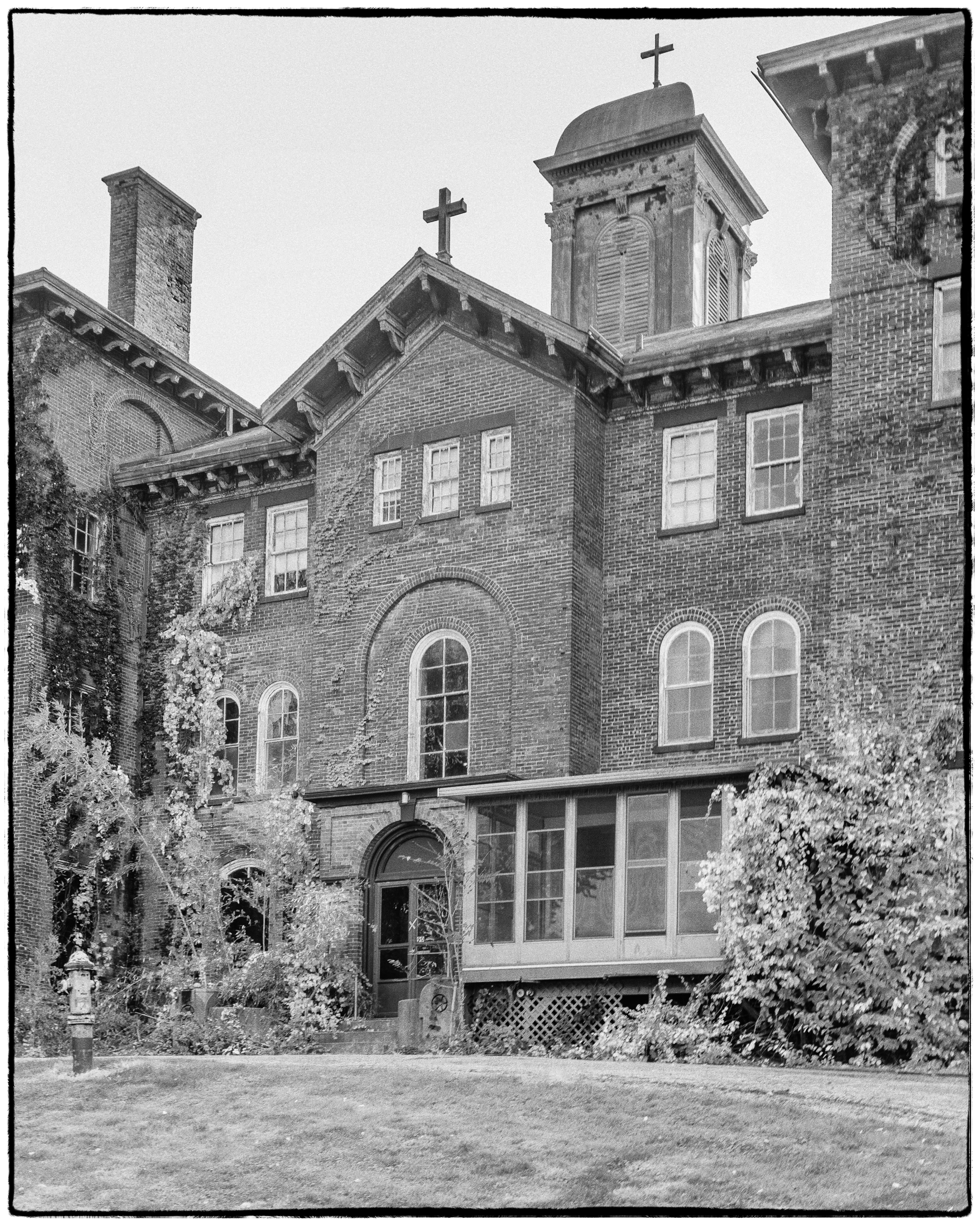
I had done part of this walk before. Starting from Garrison Metro North Station (on weekends the parking is free) I followed the first part of the trail and then turned right, passing over the railway lines to explore Arden Point.. I knew that a trail also carried on straight ahead, but it was a hot day and I was tired so I decided to return to the car. This time I was going to skip the Arden Point part and go straight ahead and see what I could find. I was expecting to discover a fairly pleasant, if ordinary walk through the woods overlooking the Hudson. While I certainly got that I was surprised to come across a lot more: impressive buildings; a wooden gazebo; an historic overlook; crosses in the woods and more. Unknown to me I’d come across the former home of Hamilton Fish, 26th US Secretary of Stare (under Ulysses S. Grant); US Senator from NY; and 16th Governor of New York.
According to The Gilded Age Era website:
In 1861 Governor Hamilton Fish bought a large plot of land in Garrison New York and constructed a large imposing estate at a cost of $30,000 for him and his family. The home, which he named “Glenclyffe”, was considerably large for $30,000 and had 5 bedrooms, 6 bathrooms, 3 servant’s rooms, a library, drawing room, dining room, billiard room, den, morning room and a boudoir. The property had a large green house, stables, expansive gardens, gate house and spectacular views of the Hudson.
After leaving the Grant Cabinet, Fish settled down at “Glenclyffe” until his death in 1893, afterward it passed to his son Stuyvesant Fish and his wife Marion “Mamie”. Mamie felt that she could not live in such a small home (almost 16,000 square ft was what she considered small), so Mamie had a large addition built to the left of the house that doubled the size of the original house making it a total of 32,000 square ft. The new addition included a new kitchen, service pantry, servant’s rooms, expanded dining room, sun room and morning room. Mamie also had the back of the house expanded so she could expand the drawing room and stair hall. Where the old kitchen and servants rooms were Mamie had constructed a large ballroom with decorative oak paneling. Every single room except the library was redone and the den was moved upstairs. The new home now had 15 bedrooms, 13 bathrooms, 15 servant’s rooms and stables able to accommodate 25 carriages.
Subsequently the property was acquired by the Capuchin Order. A magnificent new building called The Monastery of Mary Immaculate and the former Fish mansion was converted into a nunnery and school and now lies empty.
Eventually the property was acquired by the Open Space Institute and is now the Garrison Institute.
The above picture shows the original mansion, now virtually unrecognizable as a result of the extensive renovations.
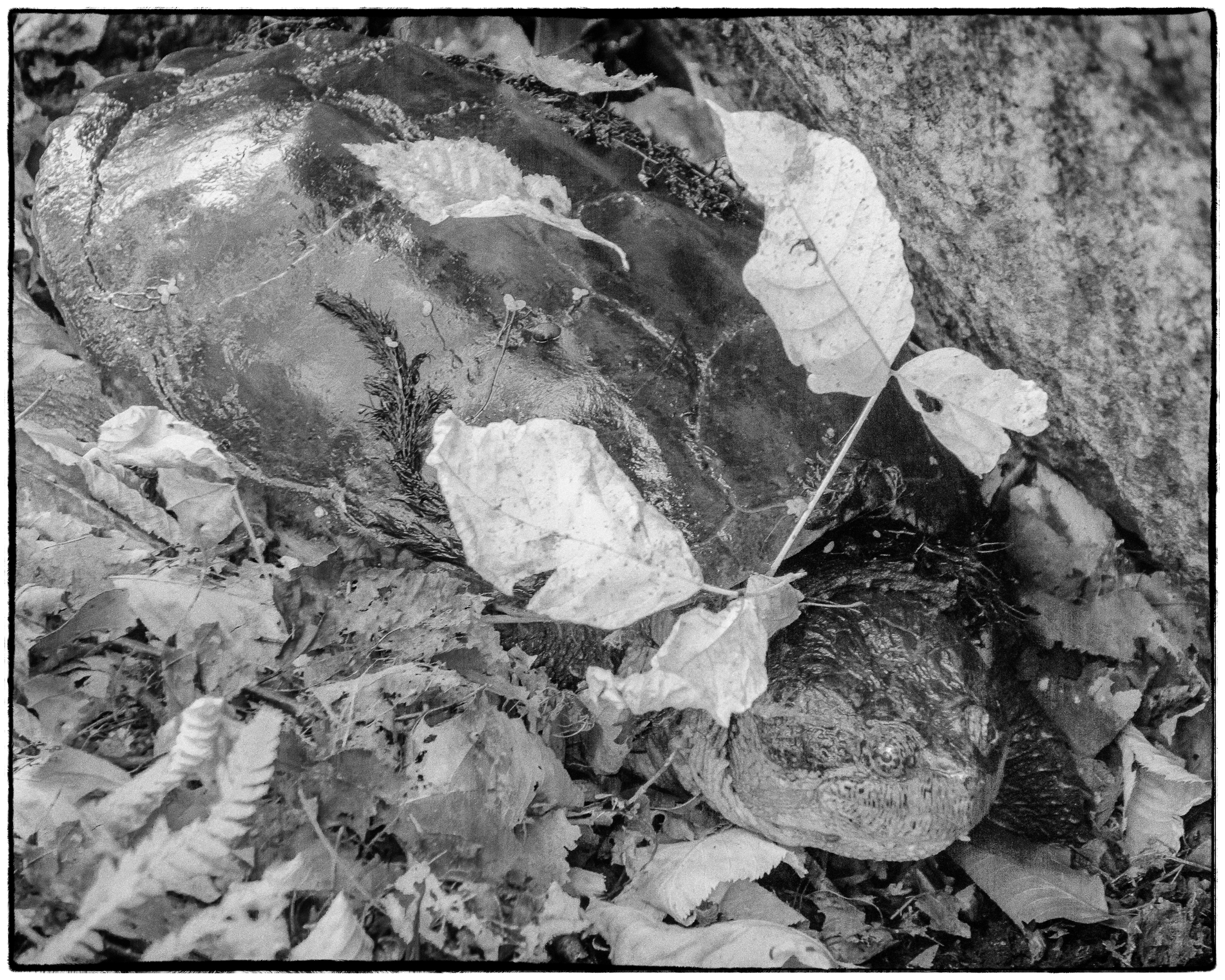
A couple of hundred yards from out house is a small dirt road called “Roaring Brook Lane”. It parallels a brook and goes over a small bridge to a dock by the lake. While walking the dog we decided (actually he decided – I merely followed) to go down to the dock. We haven’t had much rain of late and the brook was hardly “roaring”. In fact it was completely dry. As we walked down I caught a glimpse of movement out of the corner of my eye and decided to “check it out”. It turned out to be a large (I’d guess almost 2ft long) snapping turtle dragging itself out of the dry water course.
I understand from my reading that they rarely leave the water unless they are planning to lay eggs, and that the egg laying season is from April through November. This picture was taken in mid-October so I imagine that the turtle was looking for a spot to lay its eggs.
From its appearance it’s a common snapping turtle rather than an alligator snapping turtle, which I believe is found farther south in the US.
Whichever it was I stayed well away from it and quickly left. I didn’t want to disturb its egg laying and I’d also heard that such creatures can deliver a nasty bite.