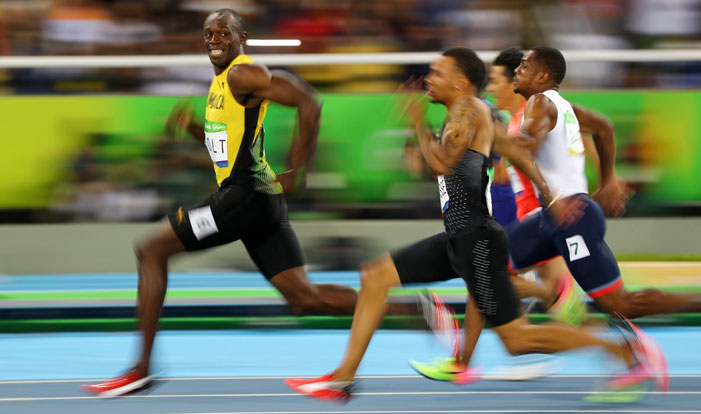
What an amazing photograph of an incredible athlete.

Source: “One Lucky, Very Lucky Shot” | THEME. Usain Bolt @ Rio Olympics 100-meter semi-final | Kai Pfaffenbach / Reuters

And no I didn’t take it! Although I’ve been to Rio a few times I wasn’t there for the Olympics. Incredibly the photographer, Kai Pfaffenbach had this to say (in a Reuters video) about his iconic picture:

The German photographer is humble about his work. In this Reuters interview he says he was “just playing around and had a bit of fun.”

See, you dead serious photographers? Start playing around and have some fun!

Let’s loosen up a bit, experiment, as the best things in life are hardly ever planned.

Pfaffenbach went for a 1/50th panning shutter speed, “trying to do some arty shot.” Framing, composition, detail and out-of-focus areas, all just perfect.

“One lucky, very lucky shot,” says Pfaffenbach.

I should be so lucky. I’m sure this photograph will go down as one of the greatest sports photographs of all time.

Grinning Usain Bolt, winning the semi-final to his third 100-meter gold medal at three consecutive Olympics (a first!), and still having ample time to smile back at his drudging, smaller-than-Bolt pursuers, captured by Pfaffenbach — simply iconic

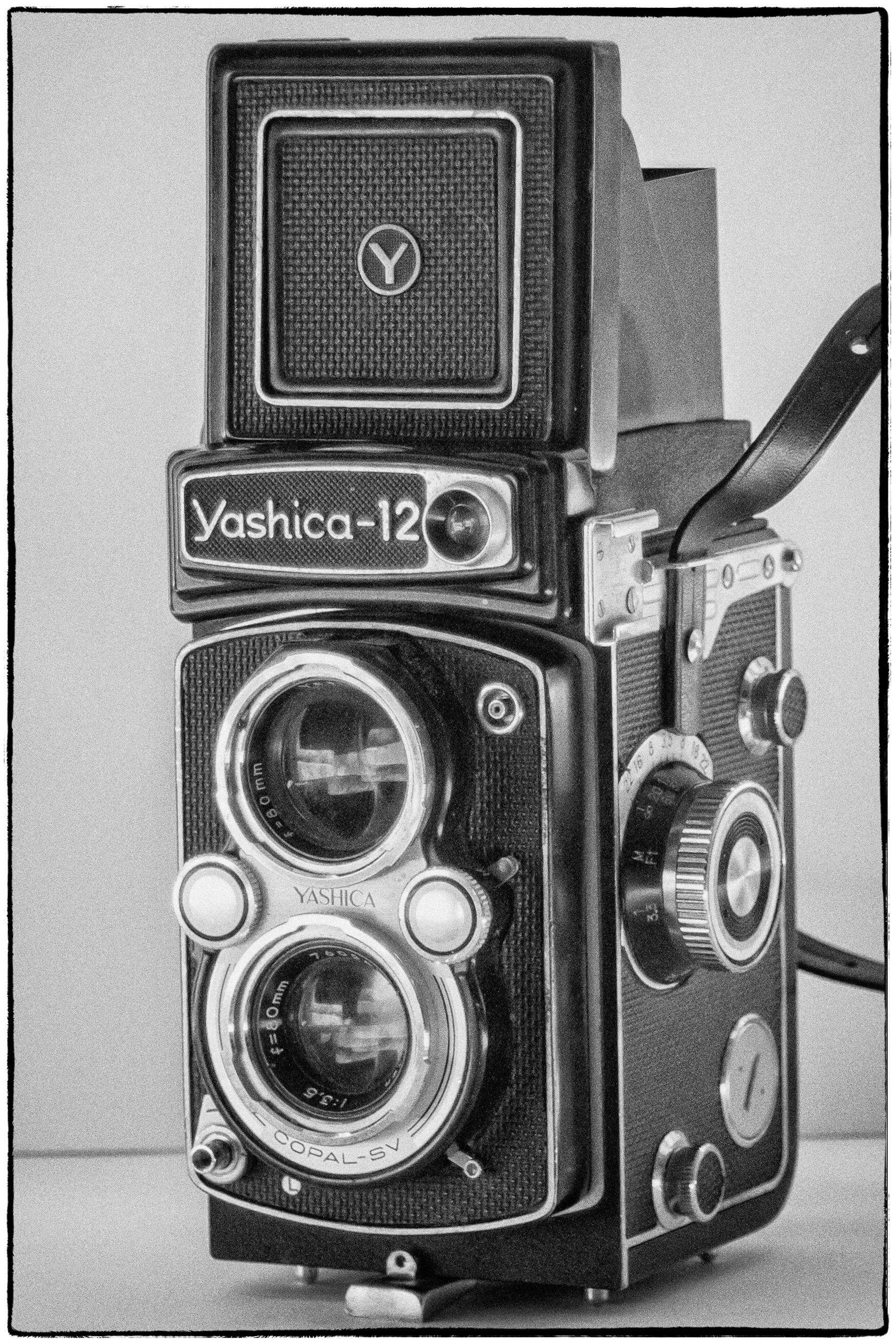
Yashica TLR

Of late I’ve developed an interest in Twin Lens Reflex (TLR) Cameras (above my own Yashica 12 – unfortunately not working because of a stuck shutter. I’ll get it fixed one of these days). A couple of days ago I was browsing around and I came across this very useful resource related the many models produced by Yashica. The Yashica TLR site describes itself as follows:

The first camera made by the fledgling camera maker, Yashima, later to adopt the name of its Yashica cameras, was a twin lens reflex (TLR) taking twelve 6 cm x 6 cm negatives on 120 format film. Like most other Japanese TLRs, it was patterned on the German made Franke & Heidecke Rolleicord and used a separate viewing lens matched to the taking lens below it, the camera front panel moving in and out to achieve correct focus. The view through the waist level finder is very similar to what the taking lens is seeing except that the view is correct side up but reversed left to right, courtesy of the 45 degree mirror (hence “reflex”). Yashica went on to make movie cameras, sub-miniature cameras and various categories of 35 mm cameras and in 1959, it even claimed to be the “largest manufacturer of cameras and photographic products in Japan”, but the offspring of the first model would continue in production for the next 33 years.

This site is dedicated to understanding and preserving the details and development history of the company’s TLR cameras from the first model Pigeonflex introduced in early 1953 through to the Yashica Mat-124G which ended manufacture in 1986:

For those Twin Lens Reflex (TLR) aficionados out there

If you’re into Twin Lens Reflex (TLR) cameras you’ll love this site. It has a very simple name: TLR Cameras Website and it’s not all that attractively presented. It has a very ‘old style’ look to it, but it’s packed with information about TLRs of all kinds. The section on his collection (one of eight sections in all) contains sub-sections on:

  • American TLRs (mostly – some are rebadged Japanese)
  • British TLRs (not very extensive, just MPP from Kingston)
  • Chinese and Hong Kong TLRs
  • Czechoslovak TLRs – some of the nicest made
  • French TLRs (surprisingly many)
  • German – this button takes you to a sub-index
  • Japanese TLRs – this button takes you to another sub-index
  • Polish TLRs – all from WZFO’s factory
  • Russian TLRs – not just Lyubitels!
  • Other sections include:

  • Links to other sites with strong TLR content
  • A very abbreviated history of the TLR
  • Other bits and pieces of TLR history
  • Items for sale – surplus collectables
  • Key reference sources used for this site
  • Cameras I’d like to buy!
  • It’s a veritable treasure trove of information on TLRs. I never knew that there were so many different models of TLRs, from so many different manufacturers.

    The copyright notice on the site extends only as far as 2013, which makes me wonder if the site is still being maintained. A contact link provides a mechanism for getting in touch with the site creator.

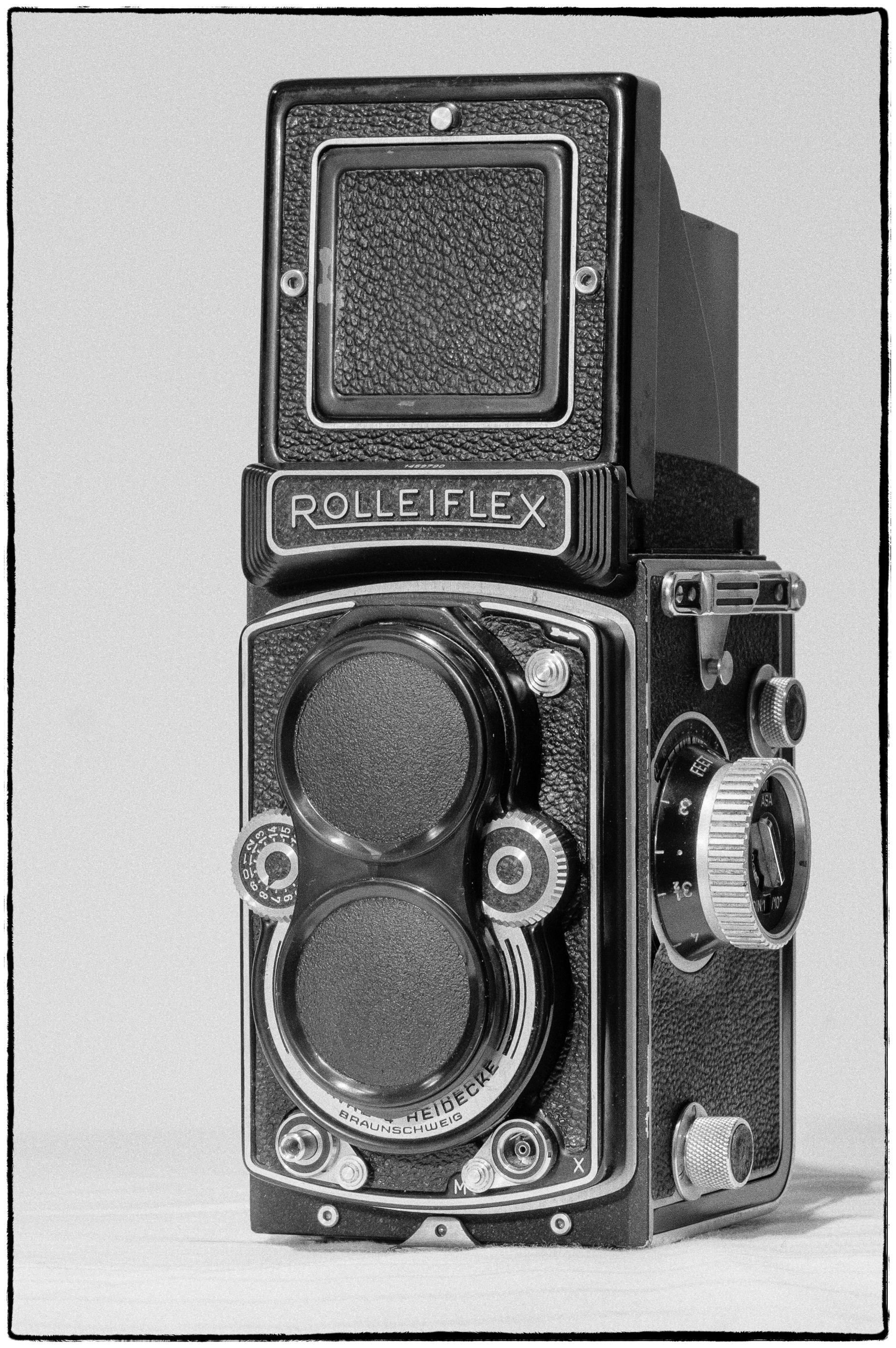
    The camera above is my own Rolleiflex. I’m by no means an expert on the various Rolleiflex models, but according to the lists of serial numbers on the internet it’s a 1954 MX-EVS type 1 with 75mm f3.5 Schneider Xenar lens. This makes it about the same age as myself and it’s in similar condition: cosmetically not great and a bit worn around the edges, but still ticking. I bought it on a whim sometime in the 1980s. I think I used it twice and wasn’t too happy with the results (I’m sure it was because of my lack of familiarity with the camera and my photographic skills, which were much more rudimentary in those days). I tried it out again today. Everything seemed to work. The aperture opened as expected and the shutter fired with no problem. To my untrained ear the shutter speeds seemed to be working OK (e.g. 1/8th second sounded much longer than 1/60th). I’ve read that after not being used for such a long time it’s likely that the shutter speeds are off. I guess I’ll have to try it and find out and then possibly arrange for a thorough CLA. Focus was fine even if the viewfinder is a bit dim.

    I really like TLRs and I have a sneaky feeling that I might be on the verge of a GAS attack.

    Mike Eckman on old cameras

    Source: Mike Eckman – Breathing New Life into Old Cameras

    .

    I just discovered this site by Mike Ekman. The photography section has lots of information on classic cameras. Each camera has an extensive review (much more detailed than reviews on most other sites I’ve come across). Pictures of the cameras are also provided as well as sample photographs taken with the camera. So far getting on for 50 cameras have been reviewed (I think the actual number is 43).

    There are also other useful articles not related to a specific camera such as: Breathing New Life into Old Cameras; Mike’s Guide to Buying Old Cameras; and What Is My Camera Worth?

    If you’re into old cameras this is well worth looking at.

    According to Mike:

    I made my first old camera post in August 2014. At that time, I had no idea where this hobby would take me. I already had an interest in digital photography, but acquiring 100 year old film cameras wasn’t something I had ever considered. I was on my third Nikon DSLR and had already started to acquire some extra Nikkor lenses and accessories, but never did I think that I would become so interested in this “subculture” of photography, and certainly would have never thought I would one day be a resource for other people to learn about these wonderful devices or how to repair them.

    Eighteen months have passed since that first post, and while I still would never consider myself to be an authority on old cameras or their repair, I have learned a few things along the way that I think are worth sharing. I’ve taken apart 20-30 cameras and in most cases, have been able to put them back together in better shape than when I started. Sure, there have been some failures like my attempt at replacing curtains on a Soviet made FED 2 camera, or correcting a mirror problem on a junk box Pentax Spotmatic, but my successes greatly outnumber my failures and I feel the time has come to try and pass on what I’ve learned.

    Source: Breathing New Life into Old Cameras

    Be sure to read his disclaimers (as described in Breathing New Life into Old Cameras) though.

    Old Cameras 

    Interesting YouTube channel from Ade Torrent on, as the name implies, old cameras. I’ll leave it to the video to explain what it’s all about, but if you’re interested in camera collecting you’ll certainly find it useful (with certain caveats – see below).

    He’s so far considered the following cameras: Zenit-E; Kiev-4; Praktica BX-20; Olympus 35-RC; Ihagee Exa; Lomo Lubitel 166B; Yashica Electro 35 GTN; Lomo Smena 8M; Fotorama PC-500; Holga 120SF; Nikon F-501 AF; Mamiya 16-EE; Zeiss Super Ikonta 530. The videos are quite short (none of them so far are more than about 9 minutes) and fairly basic.

    He’s very enthusiastic about his cameras, but this enthusiasm leads him, on occasion, to be less critical than he might be. For example he seems to like the focus free “plastic fantastic” Fotorama PC-500 as much as he likes the Olympus 35-RC, a vastly superior camera. Still if you’re not too familiar with old cameras this basic introduction can be very useful. For example he mentions that on some older cameras (e.g. the Kiev 4) you shouldn’t change with shutter speed until you have wound the shutter. This is certainly useful information as doing it the wrong way can lead to a broken shutter.

    You can subscribe on the channel’s home page.