A couple of Ebay experiences

I recently had a couple of very different ebay experiences.

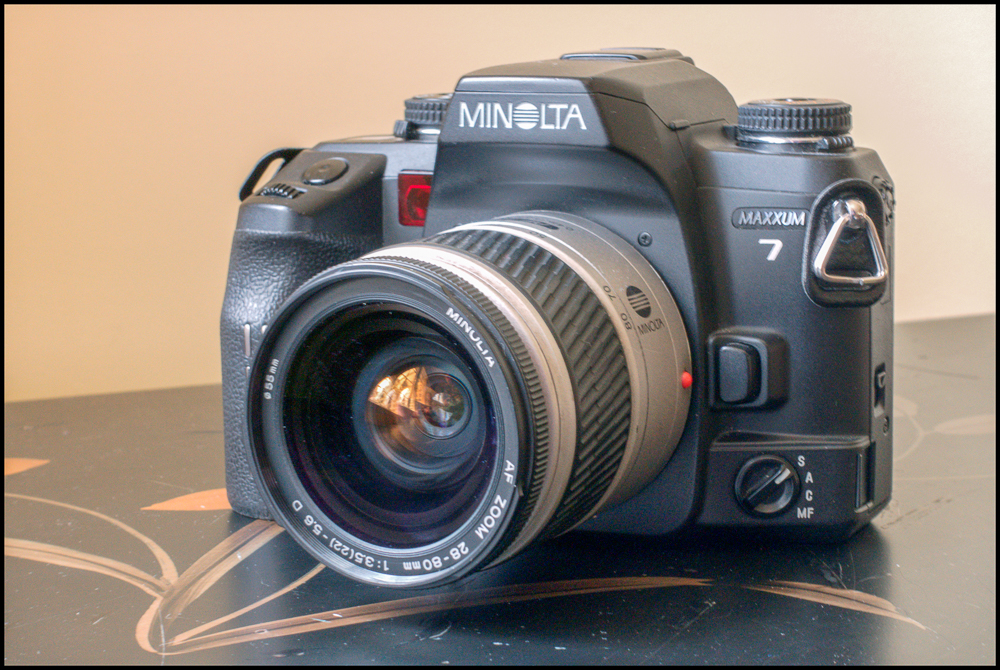
The first was very positive and relates to the camera above. I’m very fond of Minolta cameras and have several. I came across a listing for a Minolta Maxxum 7 and 28-80mm lens at a very attractive price. It was shipped quickly and when it arrived I tried it and everything seemed fine. Then I turned it off and tried again. This time I got an error message. Turned it off. Turned it on. Again everything seemed fine. Pressed the shutter release. Error. After ‘googling’ a bit I discovered that this is a known problem. Apparently there’s a small plastic part that breaks. It’s essentially unfixable as the parts are no longer available. So I communicated with the seller telling him that the camera, advertised as working, in fact wasn’t and giving him the information I’d found on the web. After a couple of messages over a few hours he sent me a message apologizing and saying that he would refund my money (including the shipping). Since the camera was non functional I shouldn’t send it back, and I should keep the lens for my inconvenience (which was a nice thought even if I already had two or three of these lenses, purchased with Minolta bodies I wanted).

What a wonderful experience!

The second – not so much. A large piece of metal fell off our cooktop hood and fell on a blue and white china spoon holder and broke it. My wife was a little upset so I decided to see if I could find something suitable on ebay. Eventually I found a nice, vintage delft blue and white spoon holder that I felt sure she would like. So I purchased and paid for it. Time (about three weeks) went by and nothing was received so I contacted the seller to ask what the status was. He replied: “I’m sending it now I haven’t had any help until now so sorry for the inconvience (sic)”. Ok, fair enough. More time went by so I contacted the seller again. This time he replied: “I can’t ship this item for $2.16”. $2.16 was the advertised amount. I contacted him again asking what price he could ship it for. No response. All this time the item was marked as shipped even though it hadn’t been. Finally I sent a formal request through ebay. This time the seller responded: “The item has been stolen that’s why it never got shipped. And PayPal is holding my money”. I responded that this wasn’t my problem and that he should refund my money. After waiting the required amount of time I requested ebay resolve this and they very quickly refunded my money. So in the end all’s well that ends well. Not such a pleasant experience though. I’ve been using ebay for several years and this is the first such experience I’ve had.

That Minolta camera is lovely though. I’ve still got my eye out for one.

Film Camera 2019/3 – Minolta XD

This is the Minolta XD (as it’s known in Japan), also called the XD11 in North America and the XD7 in Europe.

This was given to me a while ago by a friend but I forgot about it and didn’t try it. Then I got to try a Leica R4 for a while. I didn’t really like it that much, but I discovered that the Leica was a result of a collaboration between Leica and Minolta and the the R4 and the XD had a lot in common. This encouraged me to dig out the XD and give it a try.

There’s lots of information on the web relating to this camera – these articles to name but a few:

I liked it much more than I liked the R4. It’s a solid, feature packed camera that did everything that I would want to do. The only problem I encountered was in framing. On a couple of occasions it was off. In future I must remember to not frame too tightly

In it’s day it was Minolta’s top of the line camera and I’m not at all surprised to read that it is considered by many to be Minolta’s all time best manual camera.

Film Camera 2019/2-Olympus XA2

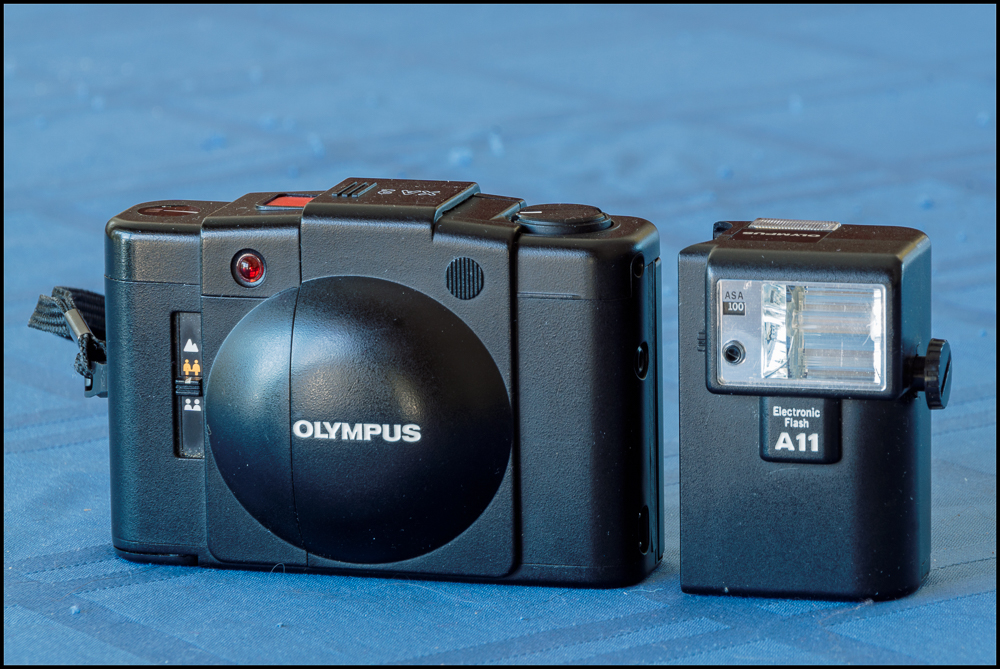
Soon after I started collecting cameras in 2011 I bought an Olympus XA. I also read that the XA2 was a decent camera so I acquired on of those too. In a box, with flash included I recall that I paid less than $10 (this was of course before the vintage film cameras started to increase in price).

There’s not a lot to say about it and it’s all been said elsewhere. For example Mike Eckman has his usually extremely thorough review here.

It’s very simple and very small with a clamshell design that turns the camera on when you open it. It loads easily and feels good in the hands. It has something of a “plasticky” feel, especially the film advance, which feels like something on a disposable camera.

I’d never used a scale focus camera before and thought that I would have difficulties, but the Olympus implementation was quite easy to use. Just three icons (one for close up:portrait; one for middle distance:group; and one for far/infinity:landscape). It turns out that you’ll use the middle distance the most because, combined with the large depth of field from the 35mm lens this covers most possibilities. In fact when you turn the camera on it cleverly sets itself to the group setting.

The viewfinder is very basic and shows only an LED showing that flash is required and another one indicating that a slow shutter speed is being chosen. Other than that only the bright line is displayed i.e. no aperture, shutter speed or focus distance information.

ISO is set manually and exposure is fully automatic.

I rather liked the camera: its size, portability, ease of use. It’s a great carry around everywhere camera and the scale focus turned out to be much easier than I thought.

The only thing that I didn’t like is also shared with other cameras in this line (including the fabled XA): the extremely sensitive shutter release. It’s far to easy to trip the shutter by mistake. I must remember to keep the camera closed until I need it and to keep my finger away from the shutter release until I’m ready to take the shot.

Film Camera 2019/1 – Minolta Hi-Matic 9

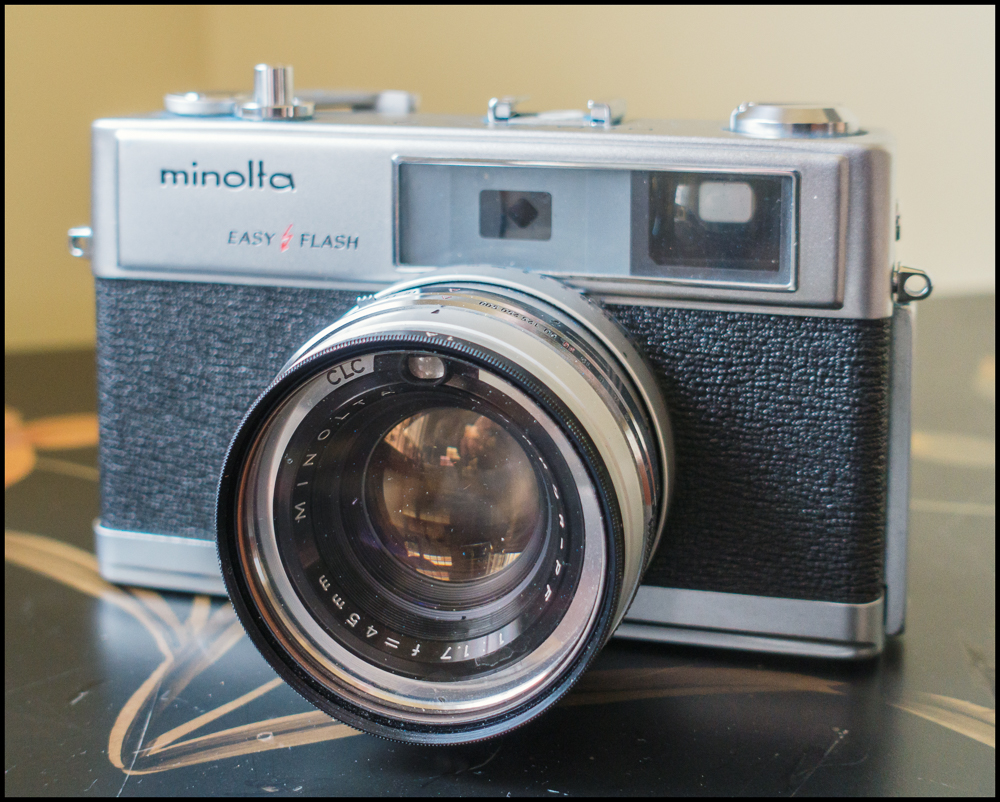
This is one solid camera. It’s big and heavy, but at the same time feels quite comfortable in my hands.

The exposure system is intriguing. For fully automatic exposure you set both the aperture and shutter speed to ‘A’ and shoot away (or at least I hope you do. I still waiting for results).

If you don’t want to leave all exposure decisions to the camera you can use the camera in fully manual mode. As the manual explains:

For unusual conditions or for special effects and techniques, you may want to operate the camera manually selecting the shutter speed and aperture yourself. 1) Move the “A” marks away from the “arrow” by pressing the AUTO release button (on the right side of the lens) and turning the shutter speed ring. Then, press the button once again in order to disengage the diaphragm ring. 2) You are now in complete command of the camera (just as with any fine 35mm camera) and can set any shutter speed or aperture opening combination you wish.

Of course you’ll need to have an instinctive grasp of exposure, follow the the “sunny 16“ rule or use an external meter for this to work.

And that’s not all. You can also meter semi-automatically:

Even after disengaging the automatic system you can, if you wish, use it as and independent exposure meter. When using the Minolta Hi-matic in this way, aim at your subect, and watch the point to which he indicator needle moves on the EV scale. Set this EV number in the EV window on the lens barrel. 1) Press the AUTO release button and set any shutter speed you wish. 2) Read the EV figure indicated by the needle in the viewfinder. Then set the figure in the EV window by turning the diaphragm ring 3) You may also set the aperture opening first and then move the shutter speed ring to obtain the correct EV number.

It all sounds a bit “fiddly” and I haven’t yet plucked up the courage to try this method (for my first roll I used fully automatic operation).

The lens is a Minolta Rokkor PF f1.7 45mm and if it’s like other Rokkor lenses I’ve used it will be a good performer.

Focus is via a tabbed ring on the lens barrel and the coupled rangefinder is well defined in quite a large and clear viewfinder.

Loading is much as you would expect except for one unexpected useful feature: a small window that shows you if the film has loaded properly and is advancing correctly.

The film advance level has rather a long throw (which doesn’t bother me much) and the shutter release requires quit a lot of pressure (which does bother me. I wouldn’t be surprised if I got some blurry pictures as a result of camera shake).

As with many fully automatic exposure camera it bothers me that I don’t know what aperture and shutter speed settings the camera has chosen. I suppose if I really want to know I can set them myself using either the fully manual or semi-automatic modes described above. I’ll try these modes for the next roll.

The camera came with one of the least objectionable every ready cases I’ve come across. It was in very good condition and it was easy to remove the entire front half leaving only a half case, which didn’t get in the way of picture taking.

All in all I really liked this camera and I’m looking forward to seeing the results.

For a more thorough review see this one on K2 photography.

A Perfect Present for my wife

I’ve mentioned in a number of earlier posts that my wife loves blue and white china. She collects it and also administers a group on Facebook devoted to it.

I recently came across the perfect present for her. Presently it’s available on ebay, which is also the source for this picture and ebay user samprivet.

He also has a red one similarly based and a Zorki 4 as well as another blue one based on a Fed 3.

I’m tempted!