Yorktown Heights, NY – A couple of artillery pieces

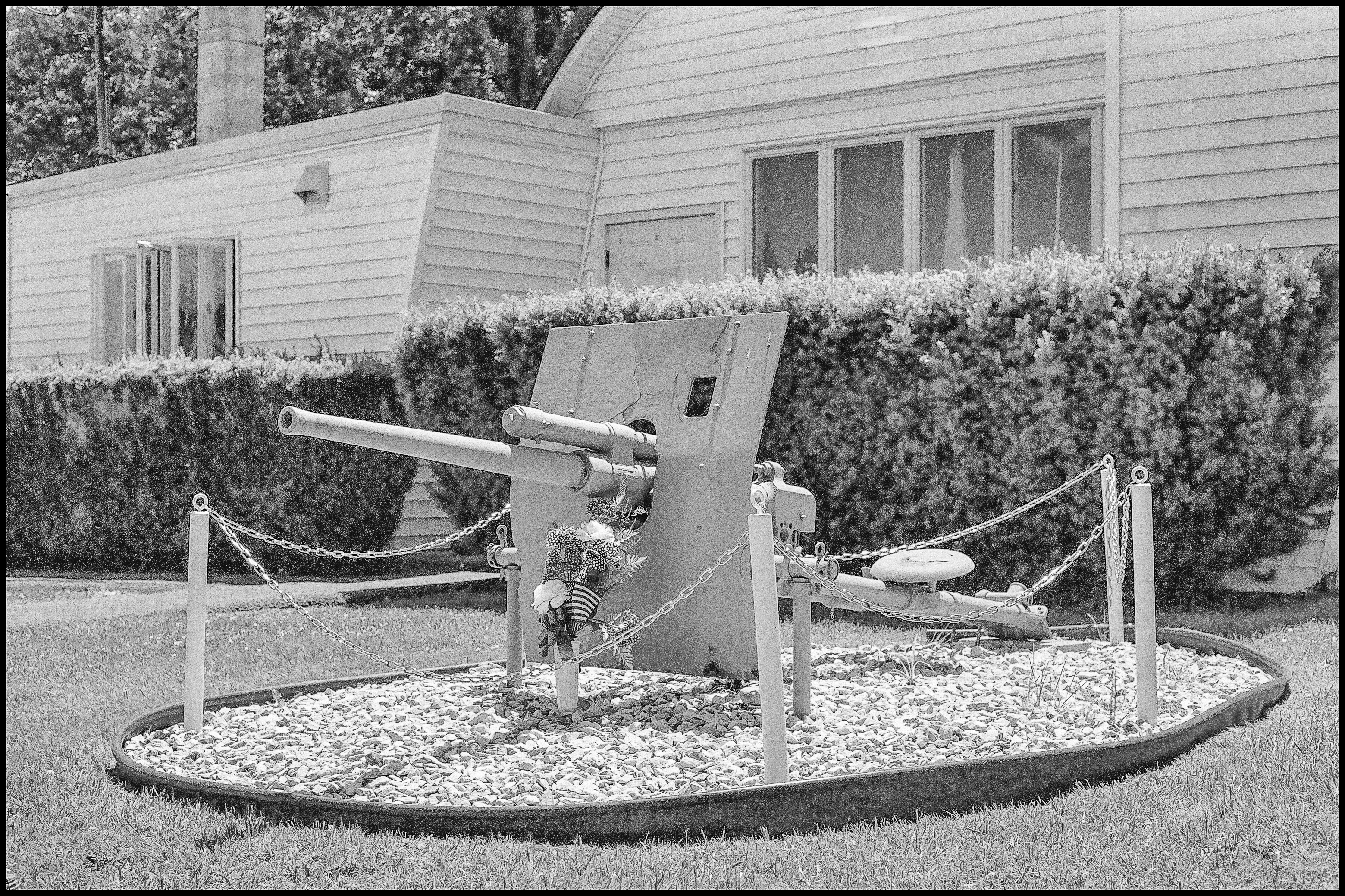
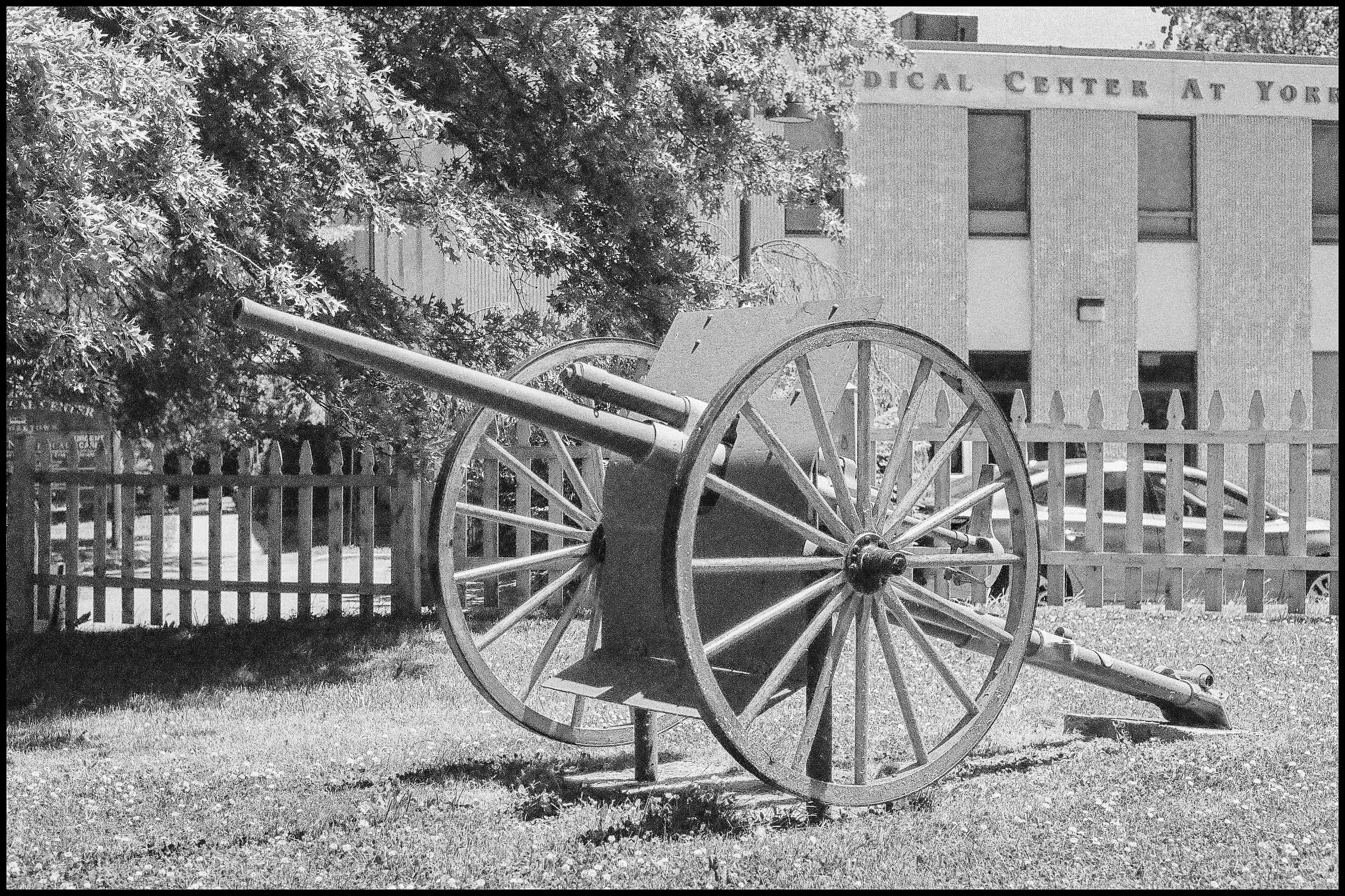
I took most of the pictures with the Pentax ME Super while walking around Yorktown Heights, NY as I waited for my wife to finish with her dental appointment. Shortly after I left the car I came across, in quick succession an American Legion Post and a Veterans of Foreign Wars post.

Outside each of them was a small artillery piece. I have no idea what they are. I’ll have to consult with my friend, a former artillery lieutenant-colonel. Although these are probably long before his time he’s usually pretty good at “ferreting out” the required information.

Taken with a Pentax ME Super and SMC Pentax-MM 50mm f1.7

Film Camera 2018/1 – Pentax ME Super – Results

Bicycle Shop, Yorktown NY.

This post considers the results from using the Pentax ME Super mentioned in an earlier post (See:Film Camera 2018/1 – Pentax ME Super).

My first reaction on getting the scans back from processing was one of surprise. I thought I had put in a roll of Tri-X and so it was a bit of a shock to see the images in color. Then I realized that I must have used the last of a number of rolls of Fuji Superia X-TRA 400, which I bought because they were inexpensive. I’ve used this film a number of times and I can’t say that I like it very much. A post on the Phoblographer describes it “…as being moderately saturated with little contrast and a sometimes almost matte look when underexposed”. I’d agree. To me it also has a quite pronounced green tint, which I find unattractive. Could it be that this is because it was quite old and the color had shifted?

Since I had it in my head that I was getting black and white images and I didn’t much like the colors in what I did get I decided to convert the pictures to black and white.

Otherwise I was quite satisfied with the results. The camera seemed to function as desired apart from one possible issue: a couple of the frames suggested that there might be a problem with the shutter at the highest shutter speeds. Unfortunately, I didn’t record what shutter speeds I used so I can’t say for sure.

Taken with a Pentax ME Super and SMC Pentax-M 50mm f1.7

Film Camera 2018/1 – Pentax ME Super

I made a New Year’s Resolution in 2016 to use a different film camera every month. I did pretty well in 2017, using 10 cameras rather than the anticipated 12. Towards the end of 2017 going into 2018 I somehow “lost the thread” and haven’t used a single film camera since last October.

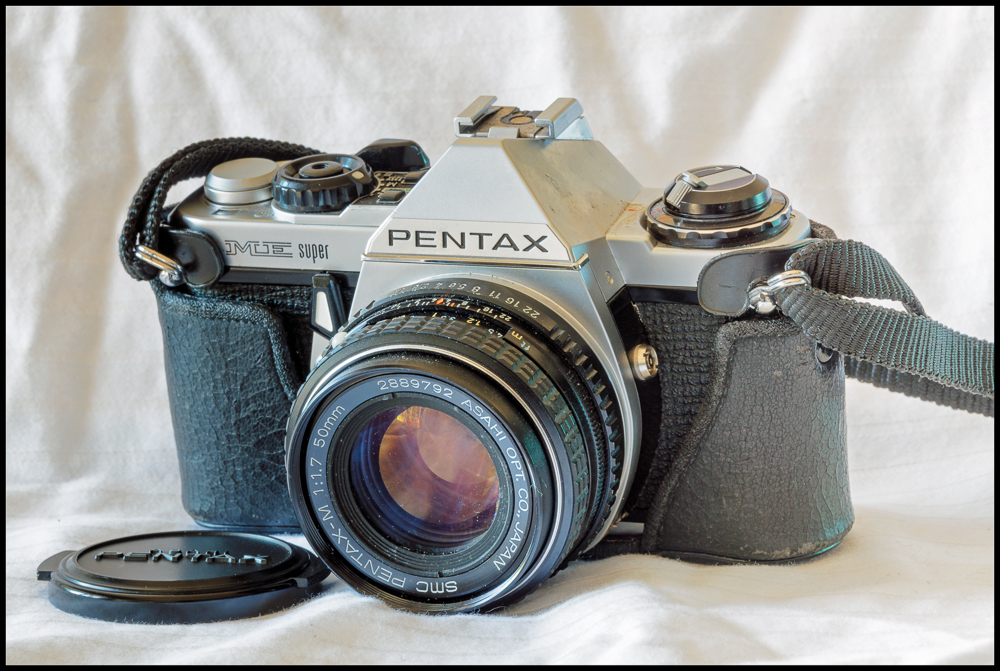
So I’ve decided to start again and try harder. I still hope to use 12 cameras during 2018, but clearly my former way of naming them (e.g. January Film Camera; February Film Camera etc.) isn’t going to work. Instead I’m going to use a numbering scheme. This is the first: Film Camera 2018/1 and it’s a Pentax ME Super.

It’s the first Pentax camera I’ve acquired. Some old friends from the UK were visiting and we were browsing around in the antique/bric-a-brac stores in Cold Spring, NY. I’d found a couple of cameras, but nothing that really interested me. I was about to leave when my friend came over and, knowing my interest in old cameras, brought me over to a cabinet I’d missed. In it was this Pentax ME Super and SMC Pentax-M 50mm f1.7. Everything seemed to be working and the price was absurdly low.

A Quirky Guy With a Camera has a good review (ME Superb! The Pentax ME Super) of it so I’ll try not to duplicate and focus more on my own impressions.

I liked this camera a lot. It’s small, light and consequently easy to carry around. It offers my preferred aperture priority exposure. There is also a manual exposure option, but I found the need to use two small buttons on the top plate rather “fiddly” and I didn’t try to use it. The viewfinder is large and bright and the combination of micoprism and split image rangefinder in the center made it very easy to focus. A series of shutter speeds appears along the left side of the viewfinder along with a green LED indicating which one has been selected. When the chosen shutter speed is too low the LED turns yellow.

I couple of things I didn’t like: 1) No depth of field preview; 2) I found it difficult to move the control dial from ‘auto’ to ‘lock’. You have to press a small white button and then turn a dial and somehow I struggled to get it to move.

I don’t have much to say about the lens at this point. I’ve finished a roll and sent it off for processing. I’ll have more to say when I get back the results. I’ll also know better whether the camera is functioning as well as it seems to.

Taken with a Sony A77 II and Tamron A18 AF-18-250mm f3.5-6.3.

An Excursion to the Dutchess County Fair – Tower 34

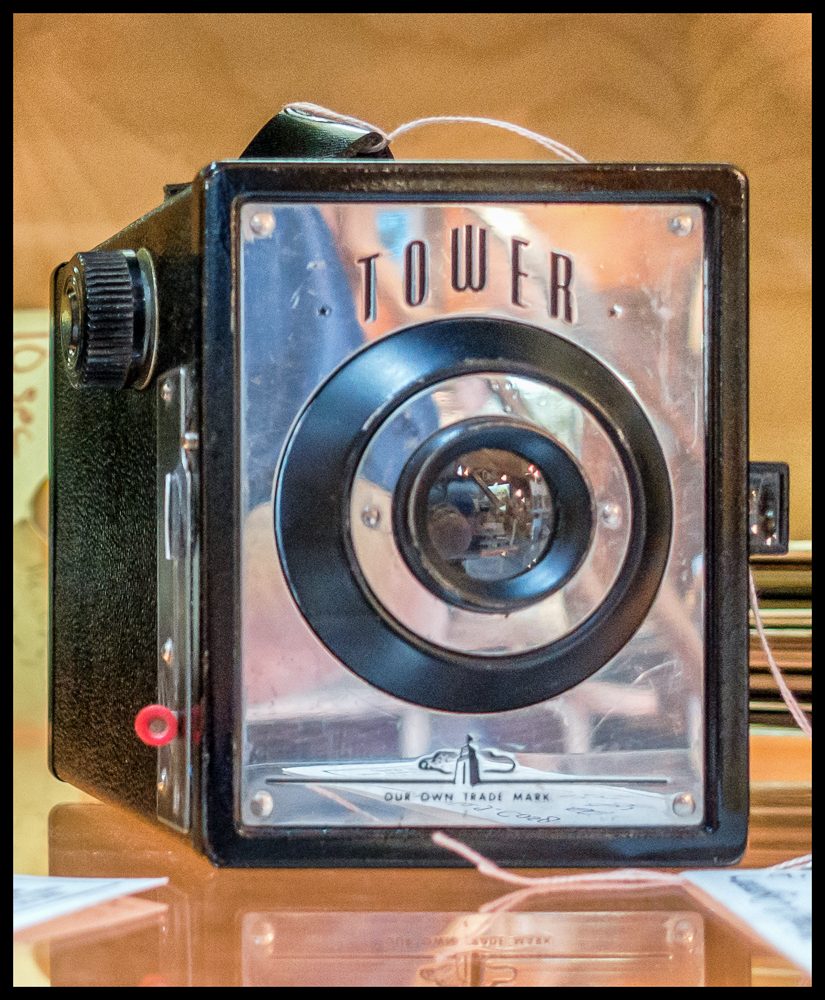
This was the camera I eventually chose (See: An Excursion to the Dutchess County Fair – An Antiques Store in Rhinebeck). There were a couple of later brownies that also take 120 film on the shelf, but in the end I decided to go with this one. It just seemed so shiny!

According to Collectiblend:

The Sears & Roebuck Tower 43 (sic. should read 34) box camera was first listed in 1948 and production ceased in 1951. The front face of this box camera is entirely chrome as is the lens ring escutcheon. This camera uses 120 type film and was sold in very great quantities by correspondence thanks to the seasonal catalogs of Sears and Roebuck. It is Ansco which manufactured it for Sears. This accounts for when it is opened, the film recommended is format 120 or B2, and B2 is the name of the 120 film by Ansco/Agfa. An optical finder is on right side of the camera and occupies the depth of the camera. The camera also has a red window in the back cover for frame count using the paper backing of the roll film, a frame advance knob that is pulled out to release the film carriage, a red shutter release lever, a two socket flash attach point, a pull out aperture tab with two stings (f/8 to f11), a shutter speed of 1/50 of a second, and it came with a leather handle. The camera originally sold for about $8.50 and $2.50 for the flash unit.

Taken with a Sony RX-100 M3.

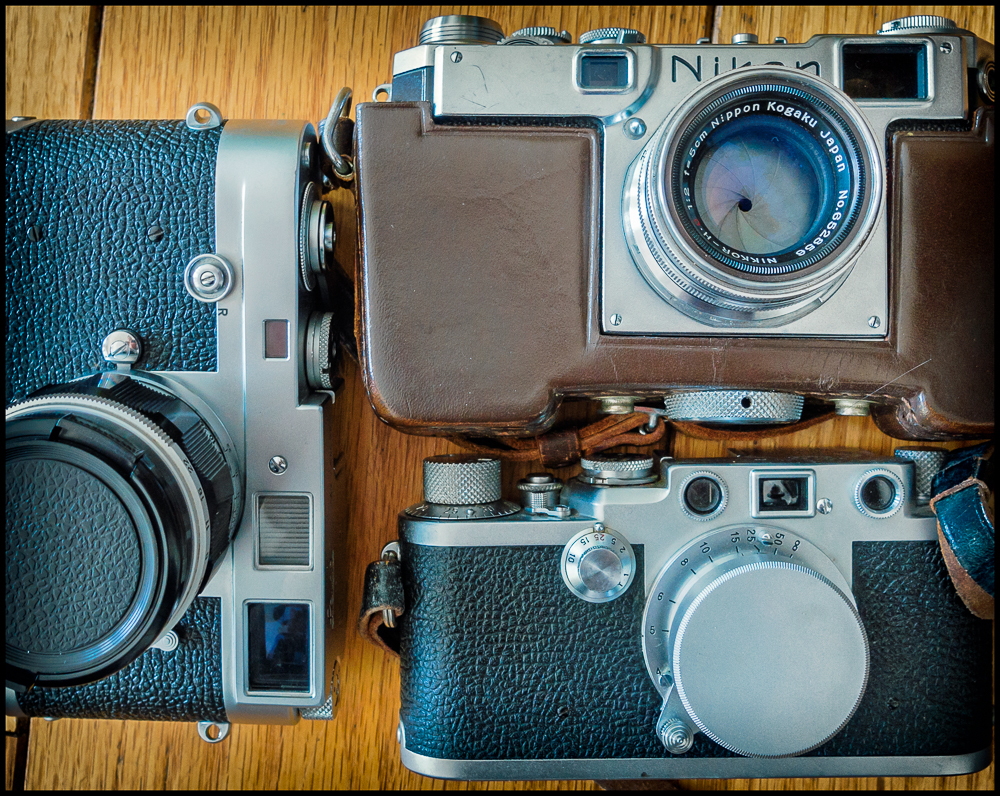
An irrational liking for rangefinders?

I recently came across this useful post on 35mmc: What is a rangefinder camera, and is one right for you?. It does a terrific job of explaining the advantages and disadvantages of rangefinder cameras.

I have an emotional attachment to rangefinder cameras. My first serious camera was a rangefinder. It was given to me by my wife early in our relationship and I used it for many years. When I started to collect cameras it was an easy decision to start with rangefinders. I’m also a big fan of Henri Cartier-Bresson and perhaps subconsciously could see myself as the almost invisible photographer flitting around taking pictures of all and sundry (if you haven’t seen Cartier-Bresson at work see: Henri Cartier-Bresson Documentary: Pen, Brush and Camera).

The problem is that I just don’t take that kind of picture. I rarely take pictures of people and my usual subjects (buildings, objects, still life, landscapes etc.) are pretty static. So the usual benefits of rangefinders (small, discrete, reduced camera noise, reduced camera shake etc.) don’t seem to be too much of an advantage to my kind of photography. Also I find that as I get older it becomes more and more difficult to make out the rangefinder patch – especially with the compact non-interchangeable lens rangefinders that I favor.

But then In another post (The Viewfinder effect – and why I choose to cripple myself with an offset viewfinder) Hamish notes:

During a chat on the phone with a friend a few days later I happen to mention this difference in framing and he explains how he once had a similar realisation, by coincidence, also through shooting with a Leica. We concluded that the difference in framing comes from a completely different way that the camera is used. With an SLR the tendency is to frame with the camera to the eye; with the viewfinder. The camera shows the photographer depth of field and perfect framing. What results is a reliance on the camera, the camera almost finds the shot for the photographer by giving him or her the extra levels of information about the end result before the photo is taken

It seems to me that he has a point here. The rangefinder experience is different, but until reading this post I’ve never been able to figure out exactly how. But, at least in my case, Hamish is spot on. When I use an SLR I tend to look through the viewfinder a lot more. With a rangefinder I tend to look around with the camera down and only raise it to frame when I want to take the picture.

Hamish concludes with:

The problem is, there’s more to what makes rangefinder cameras attractive or otherwise than the more obvious pros and cons. As I talked about in the couple of paragraphs about frame lines, and indeed the couple of posts I link to, shooting a rangefinder is very different experience to shooting an SLR. For me – and actually I suspect most rangefinder camera photographers – this mostly comes down to the experience of using a camera with an offset viewfinder and frame lines. The experience of being able to see what’s just about to come into the frame verses the more accurate framing an SLR brings might seem like something quite small, but in practice there’s so much more to how this difference impacts on the process of taking a photo.