Sunset Drinks at 3 Westerley part II

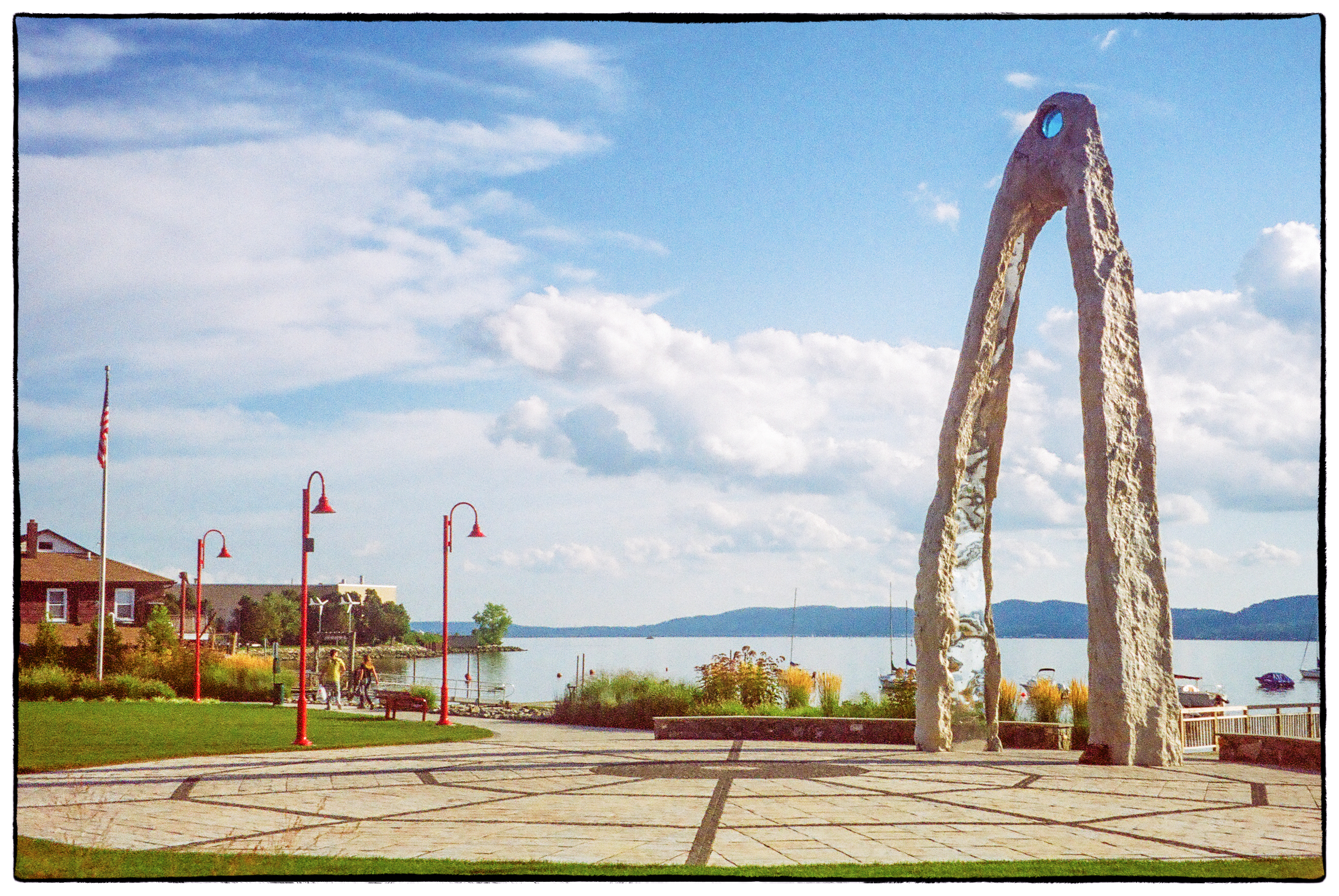
It’s interesting to compare this with a similar shot posted earlier: Sunset Drinks at 3 Westerley. Where this picture was taken with a film camera, the earlier one was taken with a digital Sony RX-100. The earlier shot was also taken about an hour later, when the light was much more interesting.

Taken with an Olympus Infinity Stylus Epic Zoom 80.

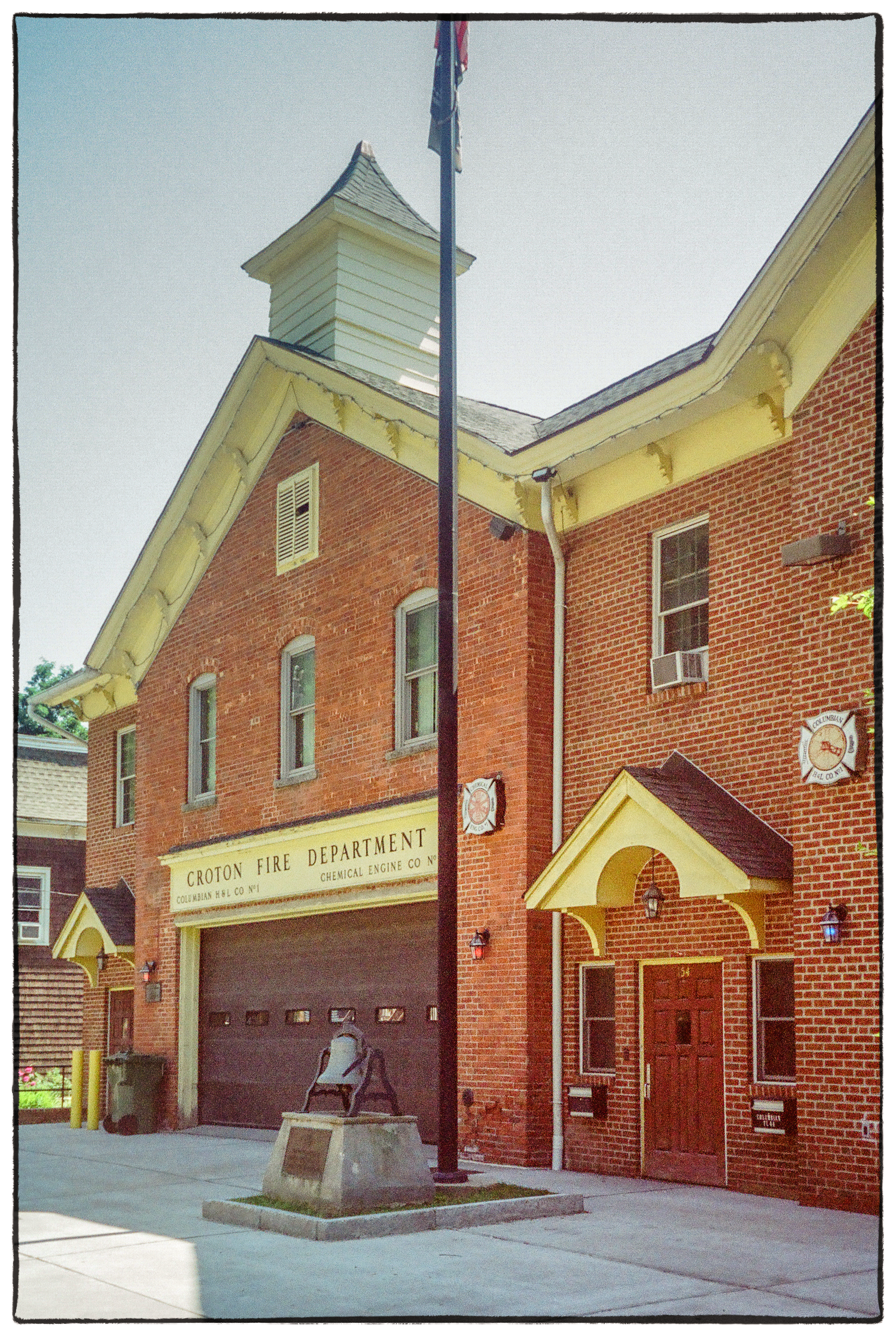
Croton-on-Hudson – Fire Department, Hook and Ladder Company No. 1. Chemical Engine Company No. 1

The Croton-on-Hudson Fire Department has a lengthy, and interesting section on its history, which includes a number of fascinating historical photographs. I’ve included a summary below, but it’s well worth taking the time to read the entire section.

“Washington Hand Engine Company” founded in 1891 after an inadequate response to a fire. Soon afterwards additional companies were started: “Independent Fire Company” and “Columbian Hook and Ladder Company”.

Because of a poor water supply a The Independent Fire Company adopted a chemical (“soda-acid”) system changed its name to “Chemical Engine Company No. 1“ in 1907.

The Department was motorized in the period between 1917 and 1923 and an alarm system including a steam whistle was also installed during the 1920s. Hydrants were also becoming more widespread.

With the merger of the Croton and Harmon communities, a need for a third pumper company, Harmon Engine Company No. 3 was founded in 1922.

In 1953 two way radio was introduced, in 1954 the first air-pack and the first true ambulance.

The 1970s saw the entry into service of a new ladder truck. Harmon Engine accepted a new pumper.

Washington Engine’s firehouse was replaced with a new building in the 1980s and the department also began to experiment with the use of a water tanker, the first of which had a 2,700 gallon tank.

In June of 1990, the department welcomed a new addition in the form of a 1990 International / Emergency Equipment Inc. 3,300 gallon Tanker/Pumper. In 1992, the Department celebrated its 100th anniversary. The 1990s also saw the introduction of Thermal Imaging Cameras, increased training requirements and the use of “Firefighter Assist & Search Teams (FAST).”

Two events, which I didn’t include in the summary, but which nonetheless are still worth reading involved aircraft:

On October 9, 1972 an air show was the major attraction in Croton, during which the crowd watched as a plane crashed in to the Croton Reservoir. Rescue crews sped into action while the Mastor of Ceremonies, Geraldo Rivera, called for a moment of silent prayer for the pilot. Though search crews scoured the area, the wreck was never found.

October 14, 1986 began like any other day for most people, but it quickly became a day for the department to remember. On that day, a small airplane became lost in the dense fog, which blanketed the area. At 10:25 AM it crashed into the house at 31 Elmore Avenue. The pilot died in the crash, the only resident home at the time escaped unharmed while neighbors turned in the alarm. When the department arrived on the scene, flames were rapidly consuming the home. Under the command of Chief Gerald A. Munson, crews advanced multiple hose lines, and the department brought the fire under control quickly, saving most of the structure.

Taken with an Olympus Infinity Stylus Epic Zoom 80

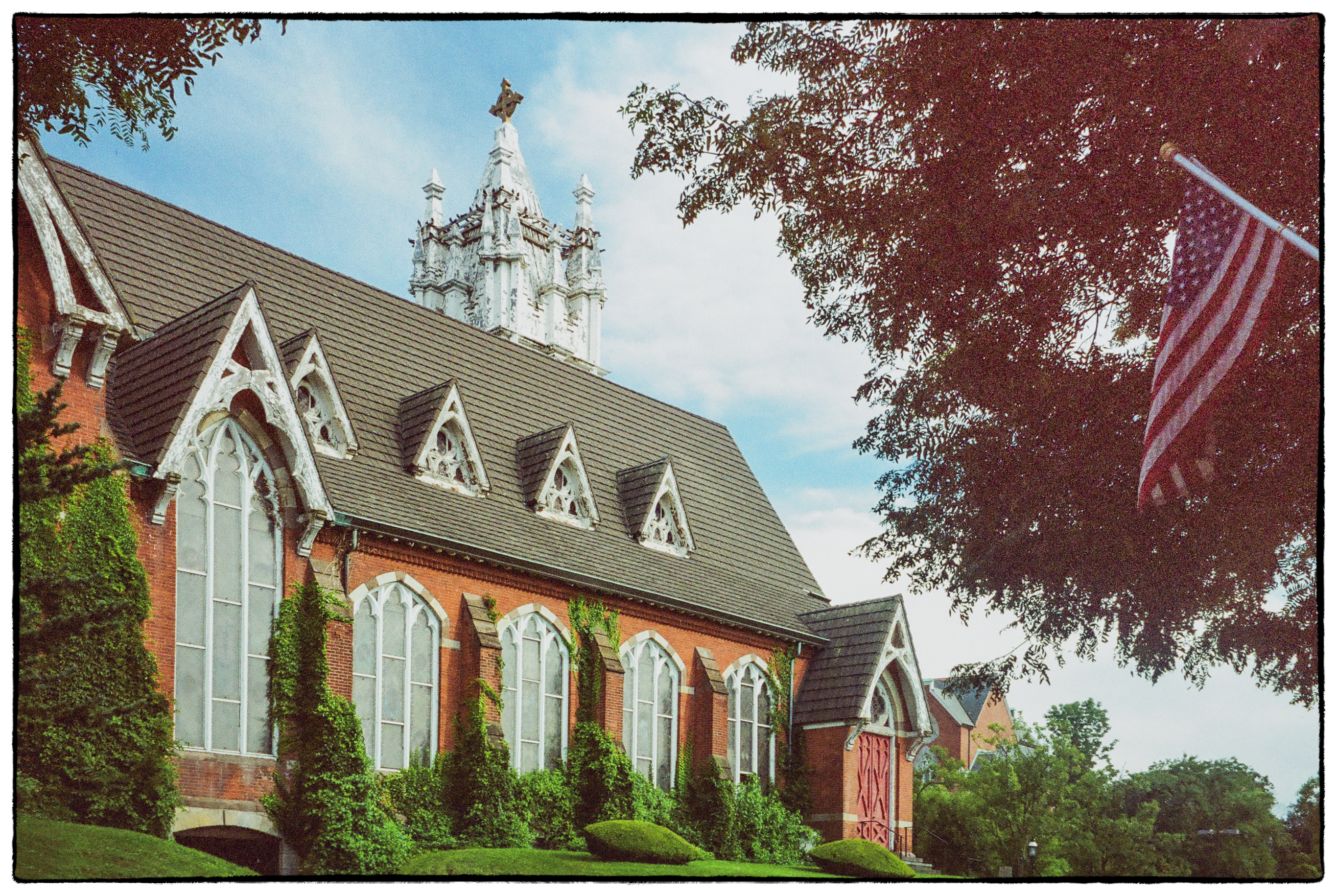
Ossining First Baptist Church

According to the church’s website:

Elijah Hunter, a captain in the Revolutionary War who founded Ossining, started holding Baptist prayer meetings at his house in 1786. This grew rapidly, and four years later, 33 congregants formally incorporated the church. They continued to meet in homes until Hunter donated the land for a small meeting house on the present site in 1815. During the early years, slaves and their masters attended services. Both were considered full members of the congregation, and treated equally in the church.

The original building was altered in 1834, and again in 1850. Originally the church had no facility for baptisms, so those took place in a small cove on the Hudson River just south of where the village’s train station is now. In 1865 the present white marble baptistry was installed.

By that time the church was beginning to outgrow its original structure, and the congregation began considering a new one. Brooklyn architect J. Walsh’s Gothic Revival design, with triangles and quatrefoils representing the Trinity and the four Gospels respectively, was dedicated in 1874. It had cost $75,000 ($1.59 million in modern dollars) for local contractor John Hoff to build. The church was able to finance it purely from donations from the congregation, without taking out a mortgage.

Later in the 19th century the church continued its early tradition of support for the local African-American community. At its centennial celebrations in 1890, an itinerant African-American minister requested the church’s help in establishing a ‘black’ Baptist Church in the village. First Baptist and its congregation responded, and Star of Bethlehem Baptist Church was established on South Spring Street. It continues to hold services today.

In 1916 the church was wired for electricity. Almost a century later, after its 200th anniversary celebrations, the church and donors were able to restore all the original stained glass windows. There have been no significant alterations to the building other than those.

Two significant features of the building, in addition to its Gothic design and the beautifully carved interior woodwork, are the steeple and the stained glass windows. It is truly one of the most recognizable buildings in Ossining.

Apparently Mr. Hunter, in addition to founding the church, was also quite a successful spy. According to an article on the New York History Blog entitled Elijah Hunter: Revolutionary War Spy:

Early in the War Elijah Hunter, served as lieutenant and as captain of Grenadiers at the Battle of White Plains. He was also a delegate to the Assembly of Westchester County. However, his most important service was a civilian when he supervised a network of counterintelligence agents operating in the Fishkill area. He later worked for the American side as a spy and double agent in New York City and there exists a number of letters and other related documents in the George Washington papers that reference Hunter’s role as a secret agent. One of these is Washington’s letter to Hunter in which the General attaches exaggerated information about the strength of the American forces in the lower Hudson valley area. He intended that it fall into the hands of the British and force them to keep a large force pinned down in New York City to defend the it and unavailable to assist General John Burgoyne’s forces who were marching down from Canada. In part the letter says:

“Inclosed (sic) you will find a return of the troops fit for duty under my immediate command. For the reasons I mentioned to you the other day I have not the least objection to our real strength being known, and it will be well for you to inform that you came by the knowledge of it from inquiry and your own observations of the troops when under arms upon which you formed an average estimate of the force of each regiment in the different Brigades; to give your account, the greater air of probability you may observe that the Officers are very incautious in speaking of the strength of their regiments. “

Taken with an Olympus Infinity Stylus Epic Zoom 80.

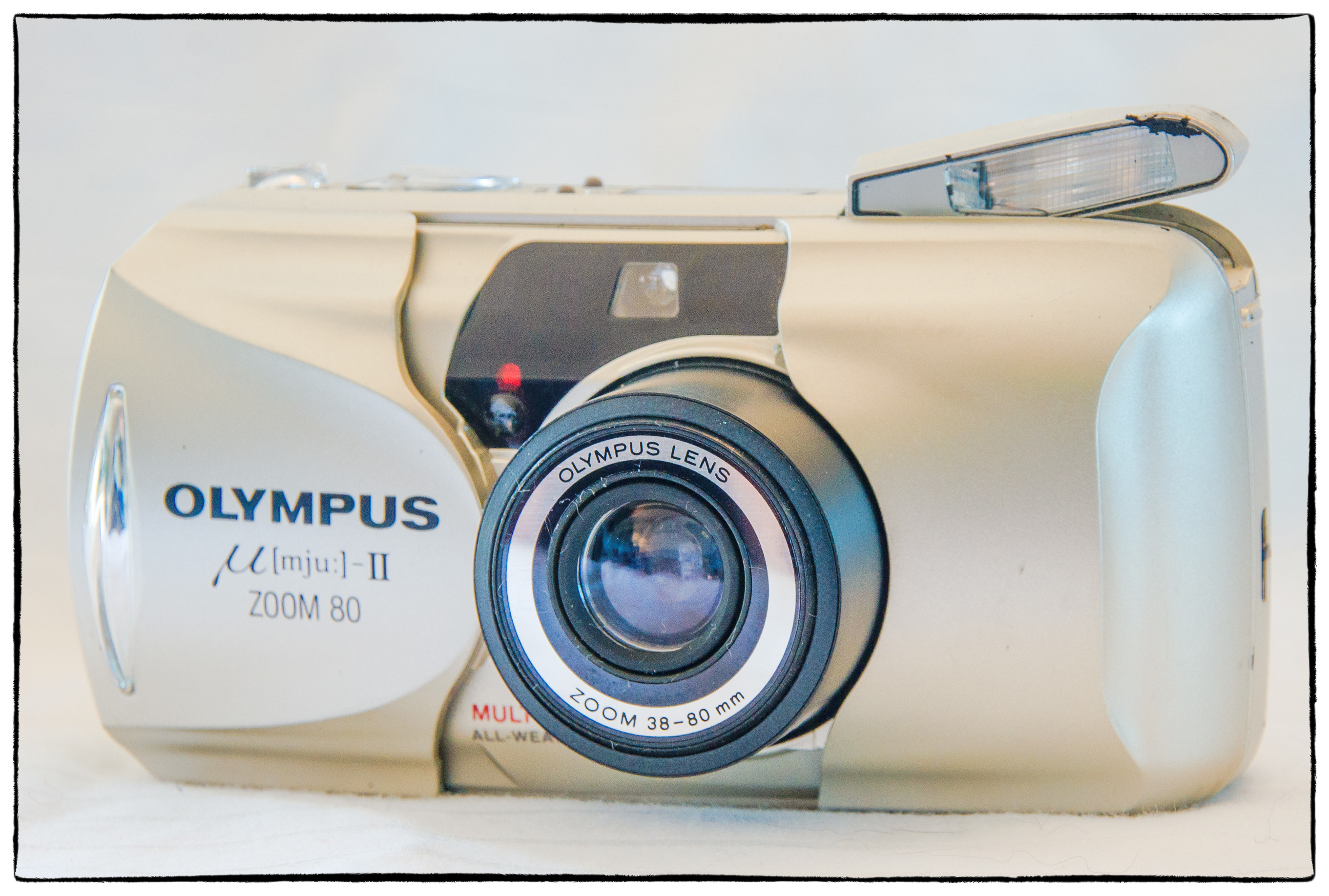
July Film Camera – Olympus Mju (Infinity Stylus) II Zoom 80

Unlike the Mju (Infinity) and Mju II (Infinity Stylus Epic), which both have fixed 35mm lenses (at f3.5 and f2.8 respectively) this one has a 38-80mm, f/4.5-8.9 zoom (5 elements in 4 groups) focusing to two feet and with apertures from f/4.5-8.9. I bought it at a nearby Goodwill store for the astronomical price of $1.99 in great cosmetic condition.

There’s not really a lot you can say about this camera. It’s a pretty standard Olympus camera of the period with a sleek, still fairly modern (it was manufactured from 1999-2003) look. It’s small and fits easily into a pocket and has the standard sliding door design. Slide the door to the right and with a whir the lens extends and a flash pops out.

The camera top has rocker switch which allows you to zoom the lens. When you do the lens extends about an inch more bringing its total length to about two inches. Right next to the zoom switch is the fairly large shutter release, and to the left of that a couple of small buttons, one of which controls the self timer and remote, and the other the flash (on, redeye reduction, off). This latter button also allows you to set an infinity mode and a night scene mode. Between these two buttons and the flash sits a small LCD, which shows which frame you’re on (or ‘E’ of if no film is in the camera) and also displays the various icons indicating which options (flash, self timer etc.) you’ve chosen. I have the quartz date version so the LCD also displays the date and time.

Just behind, and a little lower than the LCD is a viewfinder and two small buttons (mode and set) for setting the quartz date options. The viewfinder has no framelines, but it does have marks for parallax concentration. It’s fairly bright and clear and displays a central cross.

When you half-press the shutter release one or both of to LEDs light up. A green LED indicates that focus has been achieved, and an orange one warns of a slow shutter speed (suggesting that flash should be used or the camera stabilized).

The rear door has a small window to show you what film is in the camera. Film loading is easy: pull up on a small tab on the left side of the camera and the back opens; put in the film; extend the leader and then close the door. The film then advances to the first frame and a number ‘1’ appears in the LCD on top. ISO (50-3200) is set automatically based on DX code (if the film is not DX coded a default of 100 is set). After the shutter release has been pressed the film advances automatically and when you reach the end of a roll rewinds automatically

There’s a tripod socket on the right side of the base, a film plane indicator to the left and right next to it a tiny button for rewinding the film mid-roll. On the right side of the body a door to the battery compartment opens to allow you to insert a single CR123 battery. Some models have a panorama switch, but apparently mine doesn’t. That’s OK as I wouldn’t have used it anyway. The camera claims to be weather proof.

That’s really about it.

Using it was easy and everything appeared to work as anticipated (of course I won’t really know until I get the film back). The viewfinder was, in my opinion, better than that of last month’s Mju I. Even with my glasses on I could see the entire frame and both LEDs. I have the usual complaint (common to all Olympus Infinity models I think) that when you turn on the camera it defaults to having the flash on. So if you don’t want it on (which I don’t almost all of the time) you have to remember to turn it off. I also have my usual quibble about all point and shoot cameras i.e. that it bothers me that I don’t know what aperture/shutter speed the camera is selecting.

I’ve read that there’s a more serious problem with this camera. Apparently over time the light baffles around the lens deteriorate and let light in. This seems to be a common problem, but of course I won’t know if mine suffers from it until after the film has been developed. Apparently there’s no easy solution for this problem.

Jim Grey has an interesting review of this camera on Down the Road. In his initial paragraph he writes:

I wonder if the Olympus Stylus Epic Zoom 80 ever really had a chance, given that it was introduced in 1999. Within a few years everybody who bought auto-everything 35 mm cameras like these would be ditching them for digital cameras. If the number of these cameras available on eBay at any moment is an indication, Olympus sold a ton of these cameras. That they all seem to be in like-new condition says a lot about their unfortunate place on photography’s timeline. This camera’s time in the sun was so short that many of them show up on eBay with marketing stickers still on their faces.

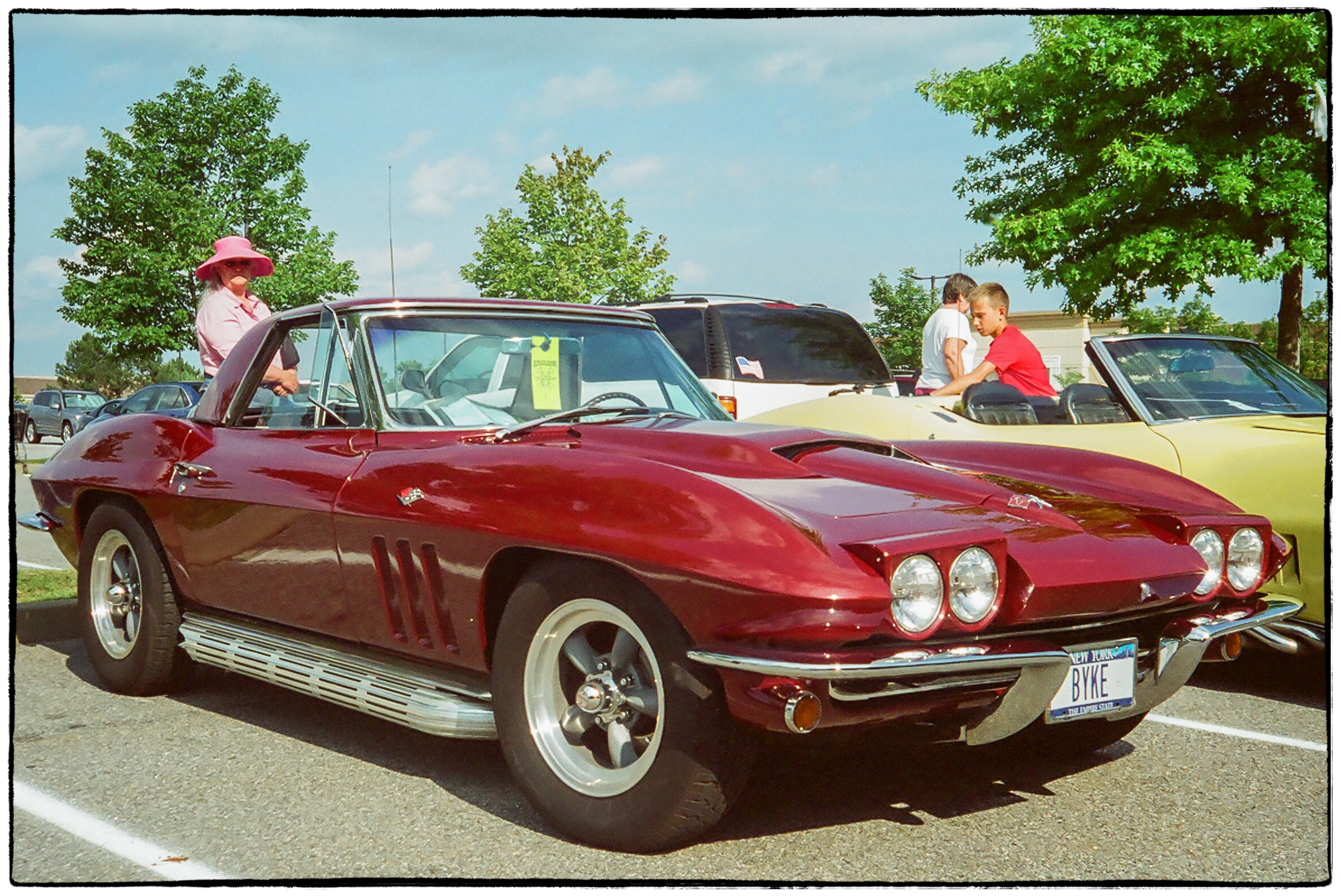
Corvette Stingray

This is the last picture I’m posting of the vintage cars outside DiCicco Market in Brewster. It’s also my personal favorite: it looks like it was taken in the 1960s. The woman with the hat is just perfect.

I’ve always been fond of Stingrays and I believe this is one of the early ones circa 1963-67.

According to Wikipedia:

The 1963 Sting Ray production car’s lineage can be traced to two separate GM projects: the Q-Corvette, and perhaps more directly, Mitchell’s racing Sting Ray. The Q-Corvette, initiated in 1957, envisioned a smaller, more advanced Corvette as a coupe-only model, boasting a rear transaxle, independent rear suspension, and four-wheel disc brakes, with the rear brakes mounted inboard. Exterior styling was purposeful, with peaked fenders, a long nose, and a short, bobbed tail.

Meanwhile, Zora Arkus-Duntov and other GM engineers had become fascinated with mid and rear-engine designs. It was during the Corvair’s development that Duntov took the mid/rear-engine layout to its limits in the CERV I concept. The Chevrolet Experimental Research Vehicle was a lightweight, open-wheel single-seat racer. A rear-engined Corvette was briefly considered during 1958–60, progressing as far as a full-scale mock-up designed around the Corvair’s entire rear-mounted power package, including its complicated air-cooled flat-six as an alternative to the Corvette’s usual water-cooled V-8. By the fall of 1959, elements of the Q-Corvette and the Sting Ray Special racer would be incorporated into experimental project XP-720, which was the design program that led directly to the production 1963 Corvette Sting Ray. The XP-720 sought to deliver improved passenger accommodation, more luggage space, and superior ride and handling over previous Corvettes.

While Duntov was developing an innovative new chassis for the 1963 Corvette, designers were adapting and refining the basic look of the racing Sting Ray for the production model. A fully functional space buck (a wooden mock-up created to work out interior dimensions) was completed by early 1960, production coupe styling was locked up for the most part by April, and the interior, instrument panel included was in place by November. Only in the fall of 1960 did the designers turn their creative attention to a new version of the traditional Corvette convertible and, still later, its detachable hardtop. For the first time in the Corvette’s history, wind tunnel testing helped refine the final shape, as did practical matters like interior space, windshield curvatures, and tooling limitations. Both body styles were extensively evaluated as production-ready 3/8-scale models at the Caltech wind tunnel.

The vehicle’s inner structure received as much attention as the aerodynamics of its exterior. Fiberglass outer panels were retained, but the Sting Ray emerged with nearly twice as much steel support in its central structure as the 1958—62 Corvette. The resulting extra weight was balanced by a reduction in fiberglass thickness, so the finished product actually weighed a bit less than the old roadster. Passenger room was as good as before despite the tighter wheelbase, and the reinforcing steel girder made the cockpit both stronger and safer.

Taken with an Olympus Infinity Stylus (Mju).