Stony Point Battlefield


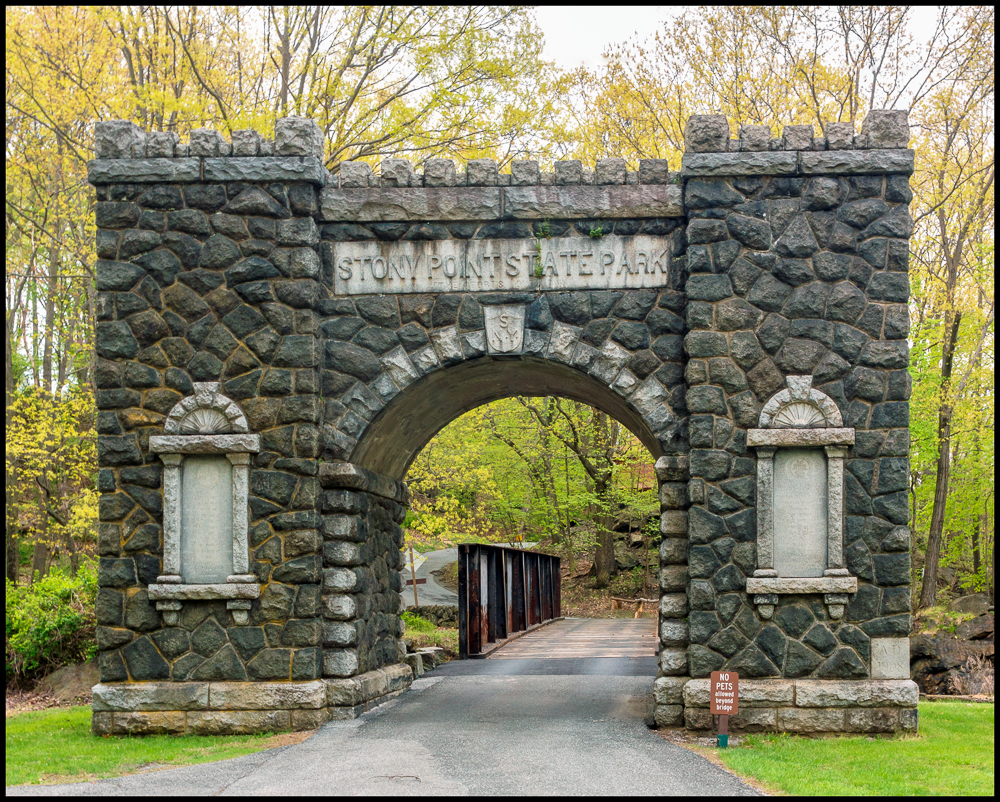
After visiting Fort Montgomery we decided to have lunch and then afterwards follow the trail over Popolopen Creek up to what’s left(virtually nothing) of Fort Clinton. However, we changed our plans and decided to visit the nearby Stony Point battle site, described on its website as follows:

…Battle of Stony Point, one of the last Revolutionary War battles in the northeastern colonies. This is where Brigadier General Anthony Wayne led his corps of Continental Light Infantry in a daring midnight attack on the British, seizing the site’s fortifications and taking the soldiers and camp followers at the British garrison as prisoners on July 16, 1779.

By May 1779 the war had been raging for four years and both sides were eager for a conclusion. Sir Henry Clinton, Commander-In-Chief of the British forces in America, attempted to coerce General George Washington into one decisive battle to control the Hudson River. As part of his strategy, Clinton fortified Stony Point. Washington devised a plan for Wayne to lead an attack on the garrison. Armed with bayonets only, the infantry captured the fort in short order, ending British control of the river.

The Stony Point Lighthouse, built in 1826, is the oldest lighthouse on the Hudson River. De-commissioned in 1925, it now stands as a historical reminder of the importance of lighthouses to commerce on the Hudson River. The opening of the Erie Canal in 1825 unleashed a surge of commercial navigation along the Hudson River, by linking New York city to America’s heartland. Within a year, the first of the Hudson’s fourteen lights shone at Stony Point and others soon followed, designed to safely guide maritime travel along the river. Many light keepers, including several remarkable women such as Nancy and Melinda Rose at Stony Point, made their homes in the lighthouse complexes, and ensured that these important navigational signals never failed to shine.

The site features a museum, which offers exhibits on the battle and the Stony Point Lighthouse, as well as interpretive programs, such as reenactments highlighting 18th century military life, cannon and musket firings, cooking demonstrations, and children’s activities and blacksmith demonstrations.


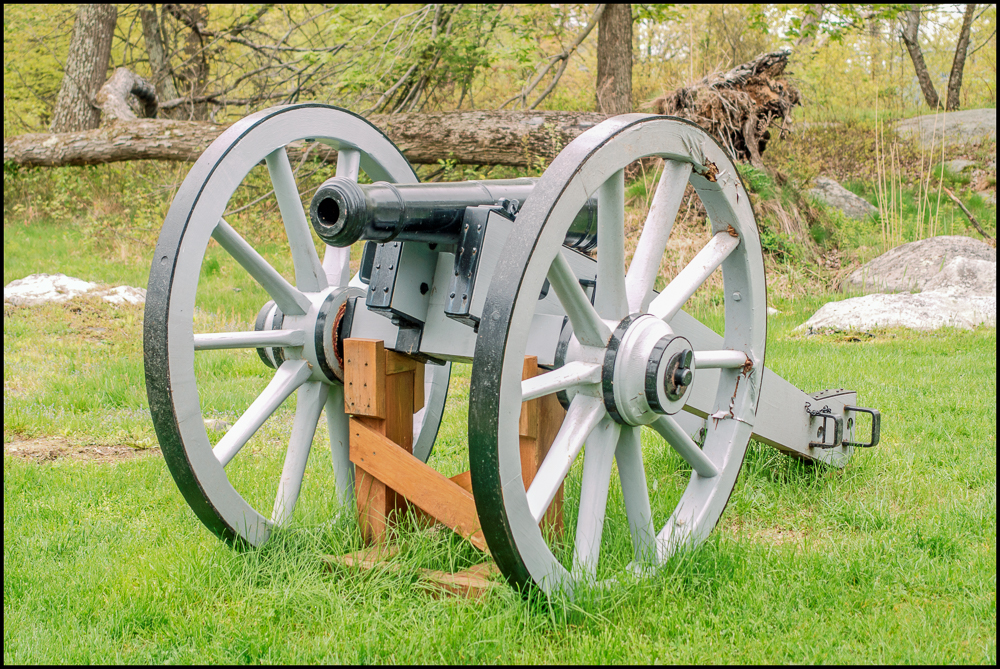
Cannon overlooking the Hudson River. I believe they fire it on weekends.


Stony Point Lighthouse.
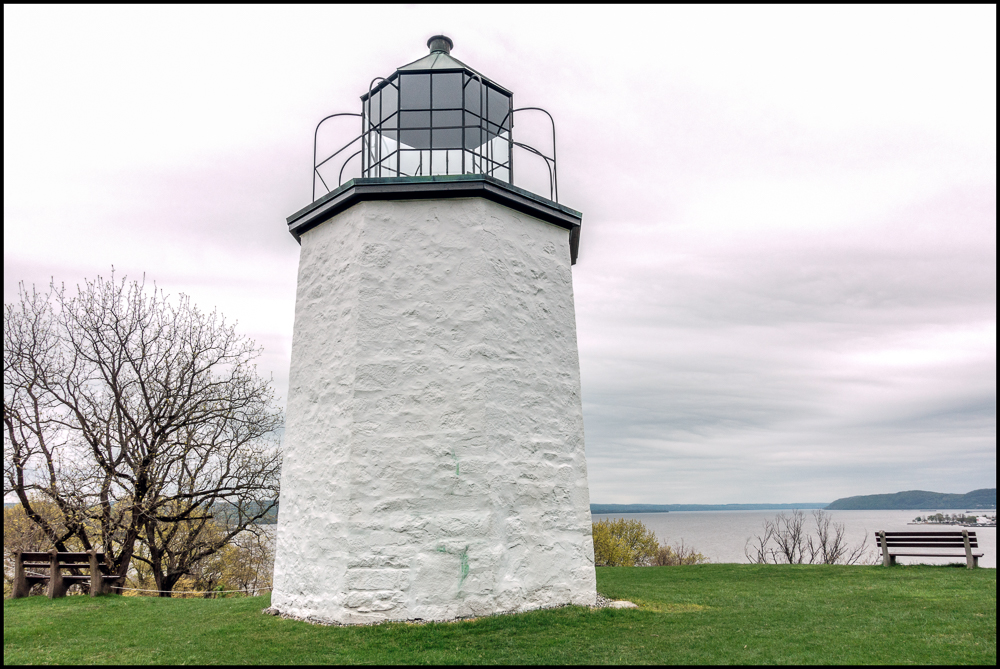

Another view of the lighthouse giving only a hint of the spectacular view down and across the River Hudson.
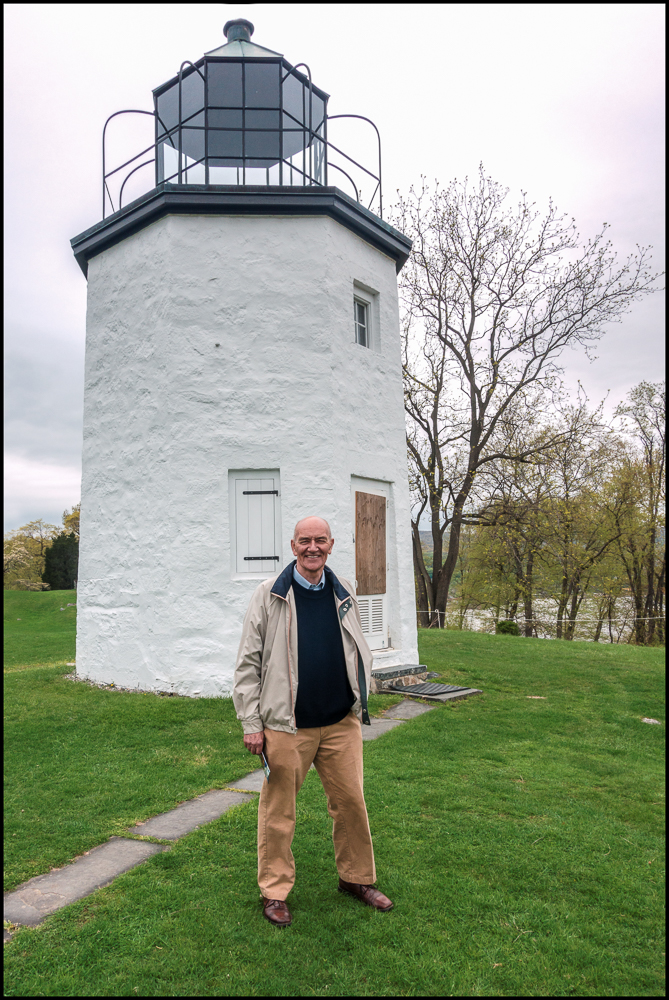

Ken by the Lighthouse.


I reclaim Stony Point for the British Empire.

Taken with a Sony RX-100 M3.

Fort Montgomery Revisited


Cannon overlooking the Hudson River.

I recently went with a friend to Fort Montgomery.

According to the Fort Montgomery web site:

Fort Montgomery was the scene of a fierce Revolutionary War battle for control of the Hudson River. Visitors today can tour the remains of the 14-acre fortification, perched on a cliff overlooking the magnificent Hudson. On October 6, 1777, British, Loyalist and Hessian forces attacked Fort Montgomery and nearby Fort Clinton. The defending American Patriots, outnumbered 3 to 1, fought desperately until driven out of their forts at the points of the enemy bayonets. More than half of the Patriot forces were killed, wounded or captured.

Visitors can learn about this important military post at the site’s museum, which showcases original artifacts and weapons, large scale models of the fort and the attack, highly detailed mannequins frozen in poses of battle, and an action packed fifteen minute movie of the 1777 assault. Archeologists have revealed many of Fort Montgomery’s remains, including stone foundations of barracks, the gunpowder magazine and eroded redoubt walls. There is a spectacular view of the Hudson River from the Grand Battery, where reproduction cannon stand guard and are occasionally fired by the fort’s staff. The past comes alive at Fort Montgomery with living history demonstrations of artillery, musketry, music and camp life activities.

I’d been to Fort Montgomery before, but at that time the visitor’s center wasn’t open. This time of focused more on the visitor’s center and a few cannons that weren’t there the last time I visited.


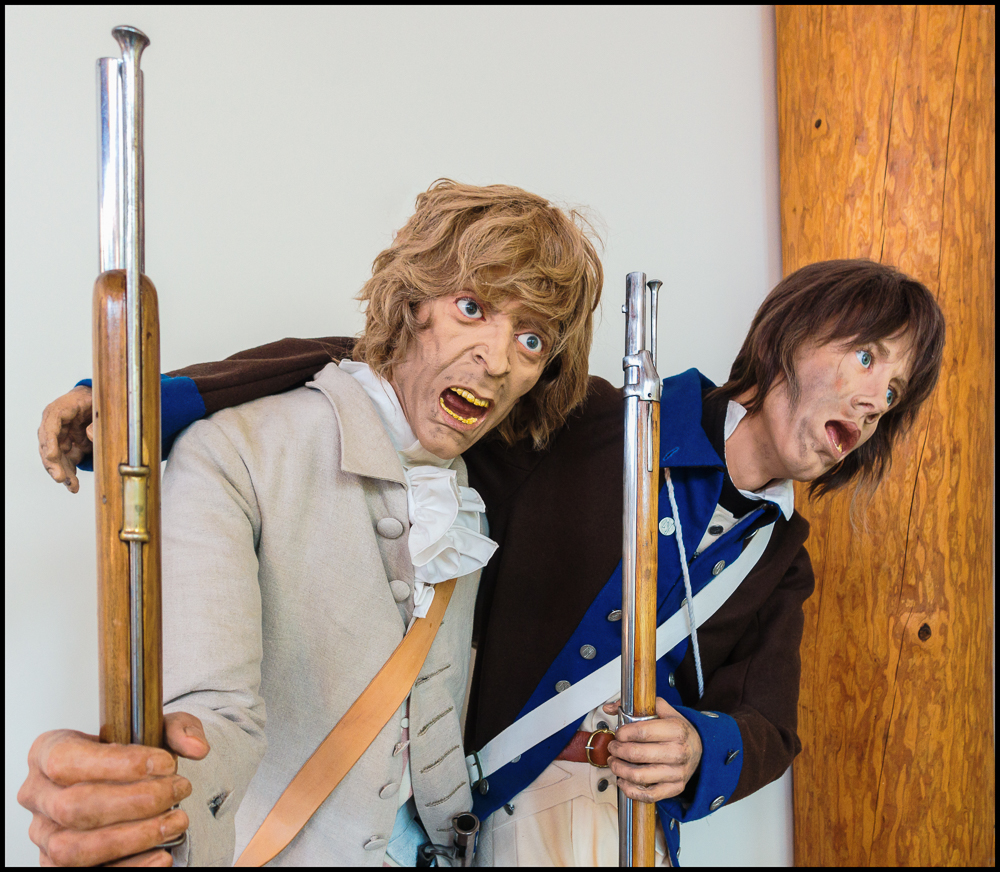
The Redcoats are coming.


American Soldier.


Night of the Living Dead????


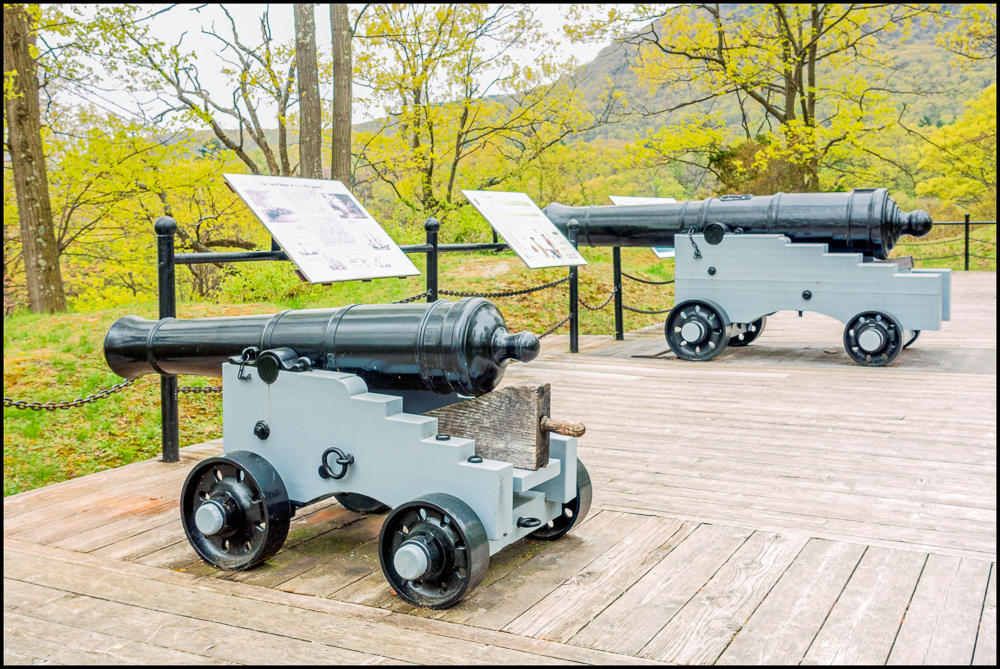
Another Cannon.


Still more cannons at the site of the Grand Battery.

For more on Fort Montgomery see:

Fort Montgomery – Overview
Fort Montgomery – Route 9W Bridge over Popolopen Creek
Fort Montgomery – Footbridge over Popolopen Creek.
Fort Montgomery – A view from the 9W bridge
Fort Montgomery – A view from Fort Clinton
Fort Montgomery – Large Boulders
Fort Montgomery – The Naval Battle
Fort Montgomery – Enlisted and Officers Barracks
Fort Montgomery – The Redoubts
Fort Montgomery – Barracks
Fort Montgomery – Powder Magazine
Fort Montgomery – Guard House
Fort Montgomery – Soldier’s necessary
Fort Montgomery – Regimental Gardens

Taken with a Sony RX-100 M3

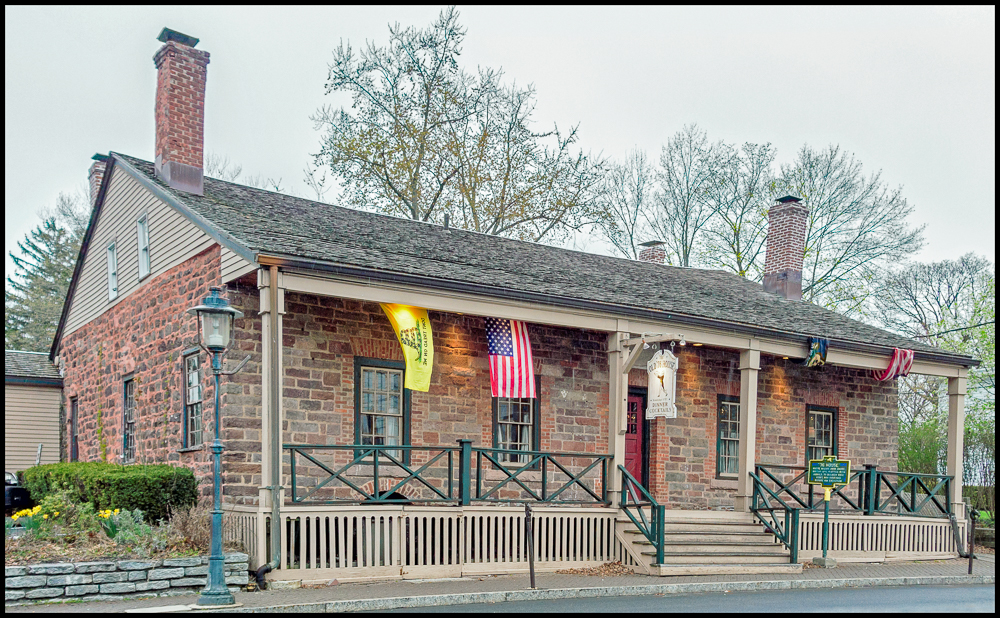
’76 House – Exterior views

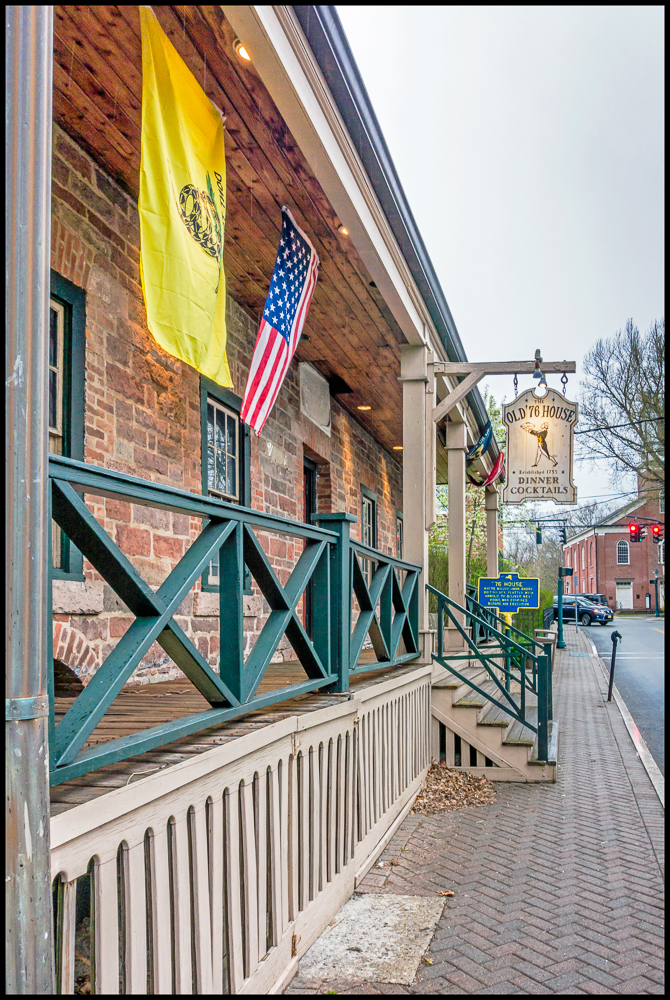
Yesterday was my birthday and we went to the ’76 House in Tappan, NY. It’s a great place, all dark wood, thick beams, muskets on the wall etc. It reminded me a lot of many of the pubs I used to frequent back in the UK. The menu was certainly different featuring items such as alligator empanadas (which I had), wild boar sausage, and red deer. We had a great time. It was a triple treat: good food, great friends and for me at least a location of some historical significance.

An historical marker outside reads: “Where Major John Andre, British spy, plotter with Arnold, to deliver West Point, was confined before his execution” (in Tappan, 2 October 1780). Apparently for once George Washington didn’t sleep here. He stayed at the nearby De Windt house. But he did eat here.

The ’76 House web site elaborates on it’s history:

The Old ’76 House is not simply one of America’s oldest taverns. Built in 1668, The Old ’76 House had a profound effect on the outcome of The Revolutionary War. Through its long use as a meeting place for patriots, The Old ’76 House established itself as safe ground for Americans when the air was rife with revolution and the tavern itself served as the “prison” of the Revolution’s most notorious spy, Major John Andre. That is why The Old ’76 House is often referred to as “Andre’s Prison”, not a real prison, in fact never having been a place of incarceration for anyone before or since. On the contrary, The Old ’76 House has been a haven for many a weary traveler for more than two hundred years. This great tavern has accommodated on various occasions, every General of the west wing of the Continental Army including Commander-in-Chief General George Washington who, with his chief provisioner Samuel Fraunces, dined in the comfortable atmosphere of The Old ’76 House.

The story of Major Andre and Benedict Arnold is one strewn with deception, fateful remorse, and mortal consequences. It is also a story which could have changed the outcome of the Revolution. Andre, a charming, handsome, young man, was adjutant general to General Sir Henry Clinton, Commander-in-Chief of the British forces in North America. Arnold was a brilliant and respected general as well as a great friend of General Washington.

General Benedict Arnold, having been severely reprimanded by Congress and, in fact, court martialed, had become embittered and ready to betray his country. Truly a brilliant general, he realized the strategic importance of West Point and, drawing on his longterm friendship with Washington, sought to secure the command of the fortress. Washington, who regretted the treatment and reprimand of Arnold, granted his request and thus Benedict Arnold was placed in a position to betray his country.

Arnold began to correspond secretly with General Clinton about his plan to let West Point fall into British hands. As a result, Clinton sent Major Andre up the Hudson in the British Sloop-of- War, Vulture, on September 20, 1780 to meet with Benedict Arnold. Andre was rowed ashore at the long cove just south of Haverstraw, where the two men conferred until sunrise. Their plans for the handing over of West Point still not complete, they rode on horseback to the home of Joshua Hett Smith, which stood on what is now known as Treason Hill. There it was agreed that Arnold should have one of the links removed from the great iron chain which stretched across the Hudson from West Point to King’s Ferry to prevent the passage of British ships up the river. Arnold planned to replace the iron link with rope, on the pretext that the chain needed mending.

Plans were completed and Andre hid his papers, showing the fortifications of West Point and the placement of soldiers, between his “stockings and feet”. Toward evening he asked to be rowed back to the Vulture, but Smith said it was too dangerous and persuaded Andre to cross the Hudson at Stony Point and proceed to the British lines by land. Near Tarrytown he was stopped by three American soldiers who discovered the incriminating papers and took him to the nearest commanding officer. From there he was taken to Tappan, where Washington had placed his headquarters, and imprisoned in The Old ’76 House – then called Mabie’s Inn.

After a trial in the Dutch Church in Tappan, a court of inquiry reported that Andre ought “to be considered a spy from the enemy and that, agreeable to the law and usage of nations, it is their opinion he ought to suffer death.” He was marched up the hill to a gallows at noon on October 2, 1780. As he stood beneath the gibbet he said: “All I request gentlemen is that while I acknowledge the propriety of my sentence, you will bear me witness that I die like a brave man.” In 1820 Andre’s remains were brought to rest in Westminster Abbey, London where he is regarded as a hero. Benedict Arnold died in London in 1801, shunned by friend and foe alike.

Taken with a Sony RX-100 M3.
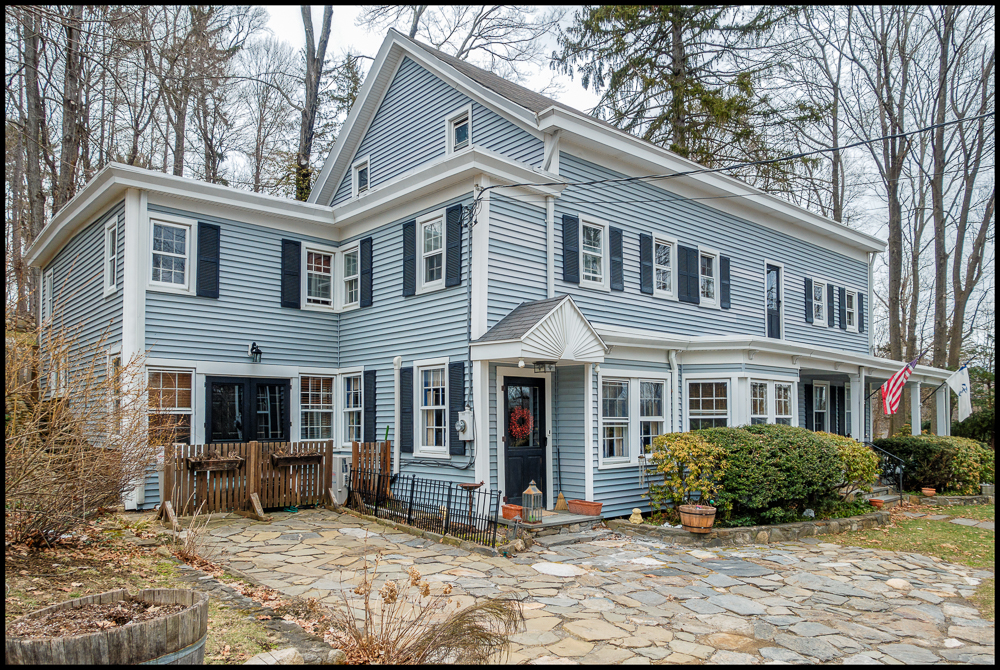
The other battle of Yorktown – Davenport House

This was where the battle took place.

According to the Croton Heights Community Association:

June 7, 1697: Sylvanus van Cortlandt received a grant of land in the New World from William III of England. It extended from Croton Point on the Hudson River to the present Connecticut border, and northward ten miles. It included the present townships of Cortlandt, Yorktown, Somers, Poundridge and North and South Salem.

In 1734, upon his death, the land was divided among his heirs. His daughter Elizabeth received “Lot 4 of the Middle Ward” (covering Yorktown and Somers). She was married to Cortlandt Skinner.

About 1744 J. Danfurt from Holland bought land and built the western part of the present Wilson house on Croton Heights Road. It was inherited by Richardson Davenport, who added the part east of the present hall, and ran it as the Davenport Inn during the Revolutionary War. It was said to have been a good one.

In May 1781 the Inn became the scene of a skirmish between American and British troops. At this time the British had invaded as far north as White Plains, and the American forces had retreated to northern Westchester, under General Washington. American soldiers had been stationed in the Inn to protect the Oblenus Ford over the Croton River, and they were betrayed to the British by a disgruntled Tory. About sunrise one day a British force under Col. Delancey crossed the ford and marched up the valley along Turkey Mountain (no road there then) and up the hill to the Inn.

During the subsequent engagement Major Flagg was killed, and Colonel Christopher Green, badly wounded, was carried out on a horse, on a lane leading to the old Pines Bridge, thrown off into the “whortleberry bushes,” and left to die. Both officers were given a military funeral and buried, it is said, in a common grave, in the churchyard of the Presbyterian Church. A large stone monument marking the spot is easily visible to passers-by to this day.

In his report to Congress May 17, 1781 General Washington ends: “The loss of these two officers is to be regretted, especially the former (Colonel Greene) who has, upon several occasions, distinguished himself.”

The account of a witness continued: “Between ten and twenty fell, in and around the house, and were afterward interred in one common pit or grave, in the northwest corner of the lot, under an ash tree.”

Later Jacob Carpenter married Davenport’s daughter and they lived in the Davenport house. Their daughter married Daniel K. Griffen, who built the farmhouse across the road, now the Croton Heights Inn (Note: now called Peter Pratt’s Inn). Legend has it that he built the wings on either side for his sons as they grew up and married. He was owner and resident of the property in 1881, when the Bolton History of Westchester was published.

An old calf-bound ledger, found in the attic of the Wilson house bears the inscription “Daniel K. Griffen & Sons, 1877,” on the flyleaf. The latest entry in the same handwriting is September 19, 1892. The book then became the daybook of George C. Griffen. Entries run from September 1894 to November 31, 1902. Its pages, many of which are nearly illegible from flowers having been pressed therein, cast interesting sidelights on the local industry, and the prices and wages of the time.

Taken with a Sony RX-100 M3.
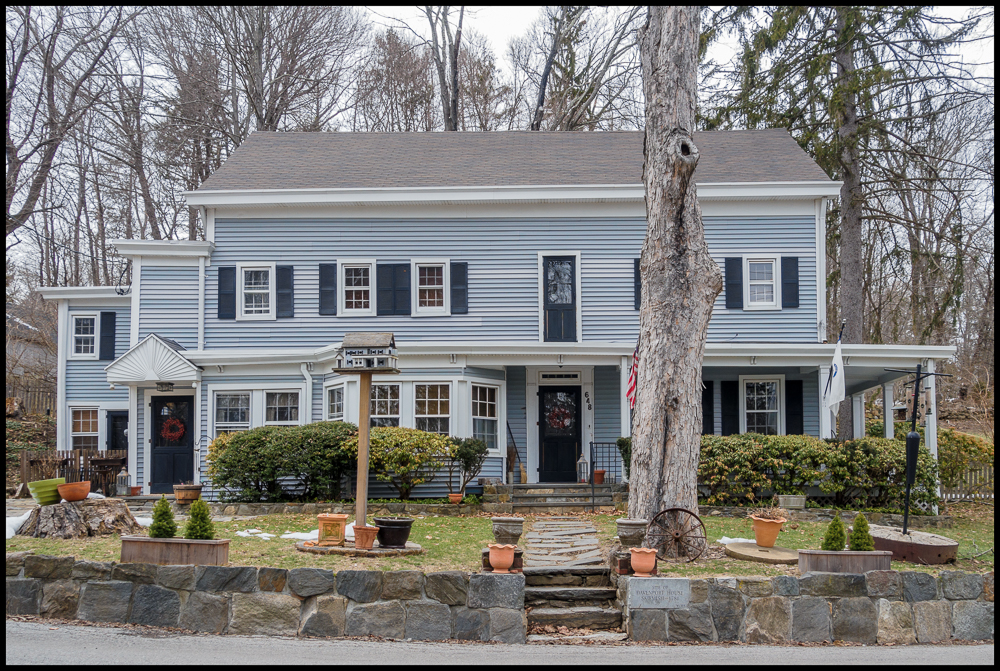
The other battle of Yorktown – Pines Bridge Monument

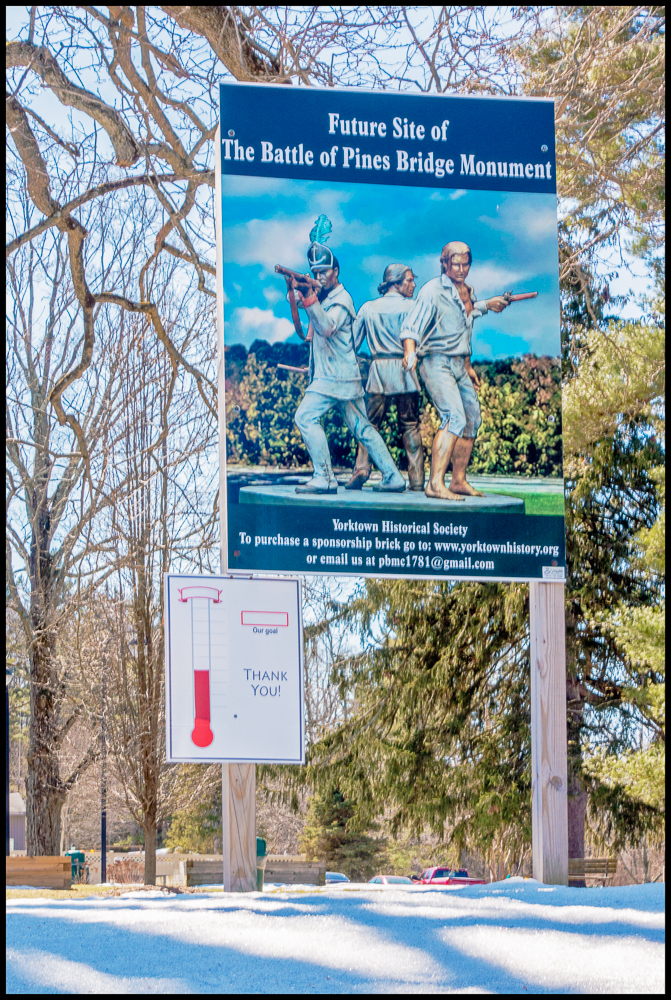
Although there are two memorials in the First Presbyterian Church of Yorktown (see: The other battle of Yorktown – memorials) it seems that there are plans for a monument for the battle/skirmish. I saw the above sign at what it describes as the site of the future monument.

According to the Yorktown Historical Society:

The Pines Bridge Monument is a project to commemorate the soldiers who sacrificed their lives defending the Pines Bridge Pass over the Croton River during the Revolutionary War. The 1st Rhode Island Regiment under Colonel Christopher Greene was comprised of African Americans and Native Americas as well as European-American settlers. The monument is designed to reflect that diversity, and will be the first Revolutionary War memorial to depict all three races together in combat.

After months of deliberating and considering diverse designs, the Pines Bridge Monument Committee (PBMC), in conjunction with the Yorktown Chamber of Commerce, the Yorktown Historical Society, and the Yorktown Planning Department announced the selection of the design by renowned sculptor Jay Warren from Rogue River, Oregon.

Mr. Warren’s previous commissions include both portions of the New Jersey World War II Memorial, the New Jersey Korean War Memorial, Victims of Terrorism Memorial at the Raritan Bay Waterfront Park overlooking the World Trade Center Site; John Coltrane Monument in High Point, NC, and the Sojourner Truth Memorial in Northampton, MA among many others (www.warrensculpture.com).

The monument will be comprised of three statues including a Native American soldier, an African-American soldier, and a White soldier. This diversity would represent the inter-connectedness of each group in the fight for independence that centered around Yorktown’s Pines Bridge in the 1700’s. The statues would be life-size plus (approximately 8 ft. tall), and made of bronze. Bronze is the best material to be used due to its low susceptibility to the outdoor elements.

The memorial will be situated in Downing Park across from the Presbyterian Church where Colonel Greene was buried on Route 202 in Yorktown.

Vendors will be able locate themselves at this landmark to sell goods, food services, etc., and local school districts can incorporate this element of local history into their respective curriculums that NYS Education Law requires they teach about the American Revolution.

Taken with a Sony RX-100 M3.