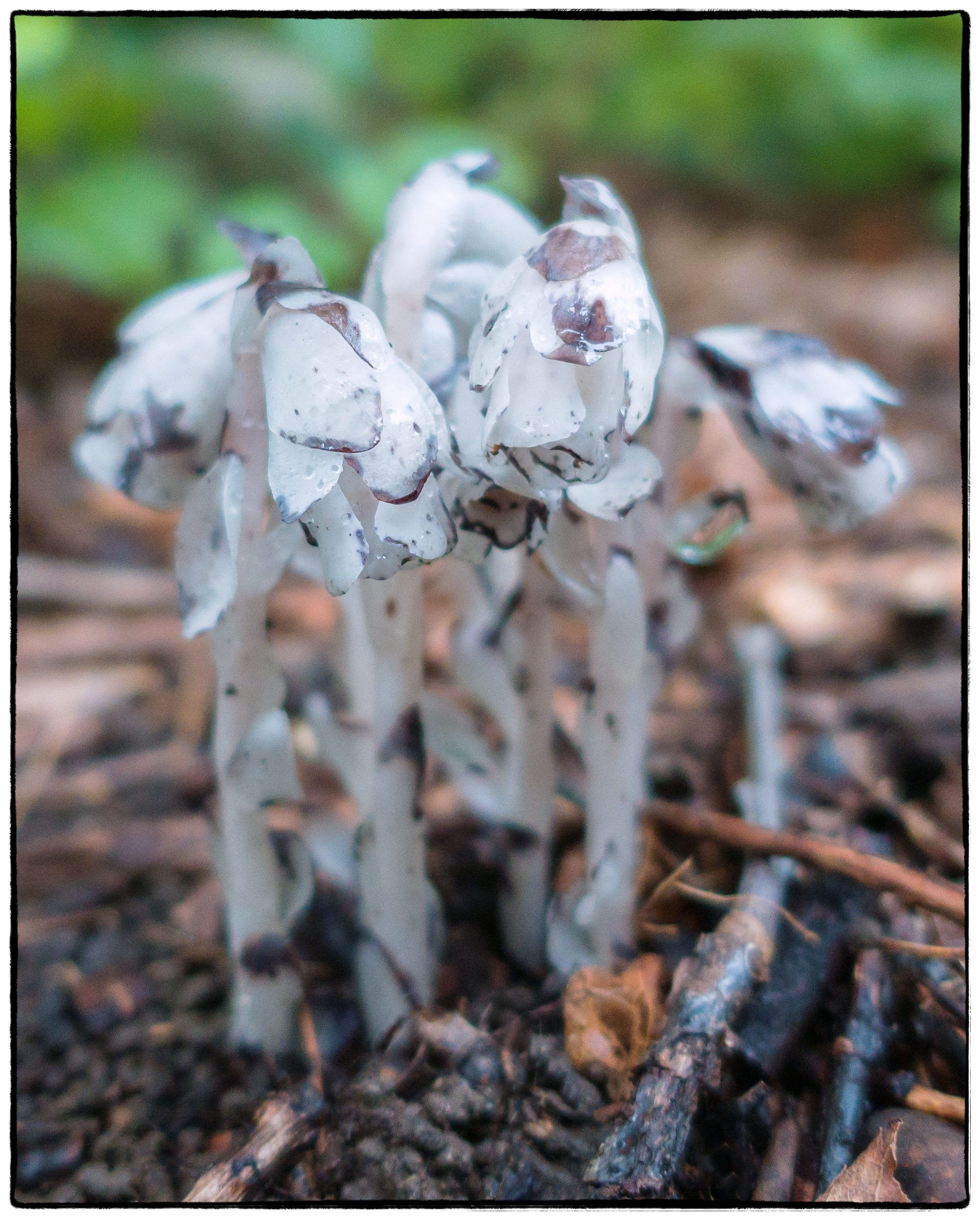
I had just about given up on this one. I had no idea what it was and I couldn’t think how I could find out. I didn’t want to post it without some additional information, so I was just going to leave it when, as I was browsing around on Facebook I came across this comment: “Indian Pipes in my woods.” and there was a picture accompanying it. There it was, my mysterious plant. And apparently it is a plant, not a fungus as I had supposed.
According to Wikipedia:
Monotropa uniflora, also known as ghost plant (or ghost pipe), Indian pipe or corpse plant, is a herbaceous perennial plant native to temperate regions of Udmurtiya in European Russia, Asia, North America and northern South America, but with large gaps between areas. It was formerly classified in the family Monotropaceae; however, it has now been included within the Ericaceae. It is generally scarce or rare in occurrence.
Unlike most plants, it is white and does not contain chlorophyll. Instead of generating energy from sunlight, it is parasitic, more specifically a myco-heterotroph. Its hosts are certain fungi that are mycorrhizal with trees, meaning it ultimately gets its energy from photosynthetic trees. Since it is not dependent on sunlight to grow, it can grow in very dark environments as in the understory of dense forest. It is often associated with beech trees. The complex relationship that allows this plant to grow also makes propagation difficult.
The plant is sometimes completely white but commonly has black flecks and a pale pink coloration. Rare variants may have a deep red color.
The stems reach heights of 10–30 cm, clothed with small scale-leaves 5–10 mm long. As its scientific name suggests, and unlike the related Monotropa hypopitys (but like the closely related Monotropastrum humile), the stems bear only a single flower, 10–15 mm long with 3-8 petals. It flowers from early summer to early autumn, often a few days after rainfall.
Like most mycoheterotrophic plants, M. uniflora associates with a small range of fungal hosts, all of them members of Russulaceae.