
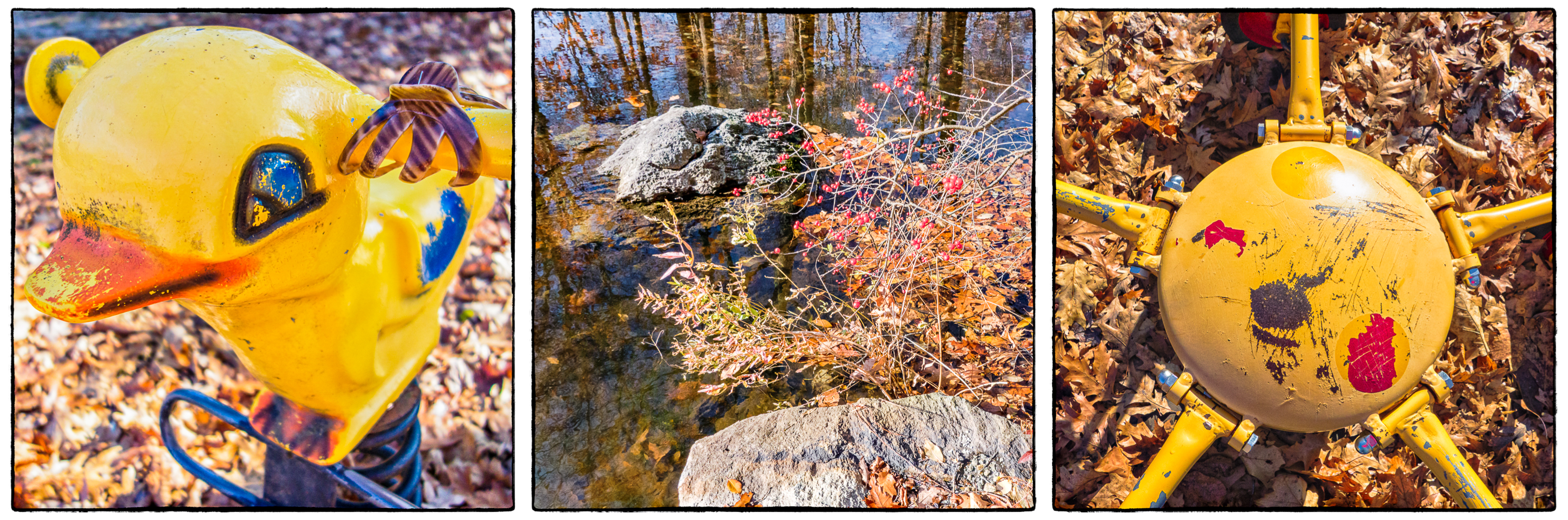
Children’s beach tryptch

It’s now that time of year when all the leaves have fallen from the trees and everything looks rather drab and colorless. So during one of my walks I started to look for things that would add a little color to my life. I found these at nearby Children’s Beach. From left to right: children’s playground animal; bright red berries by the side of the brook; another children’s playground machine – seen from above.

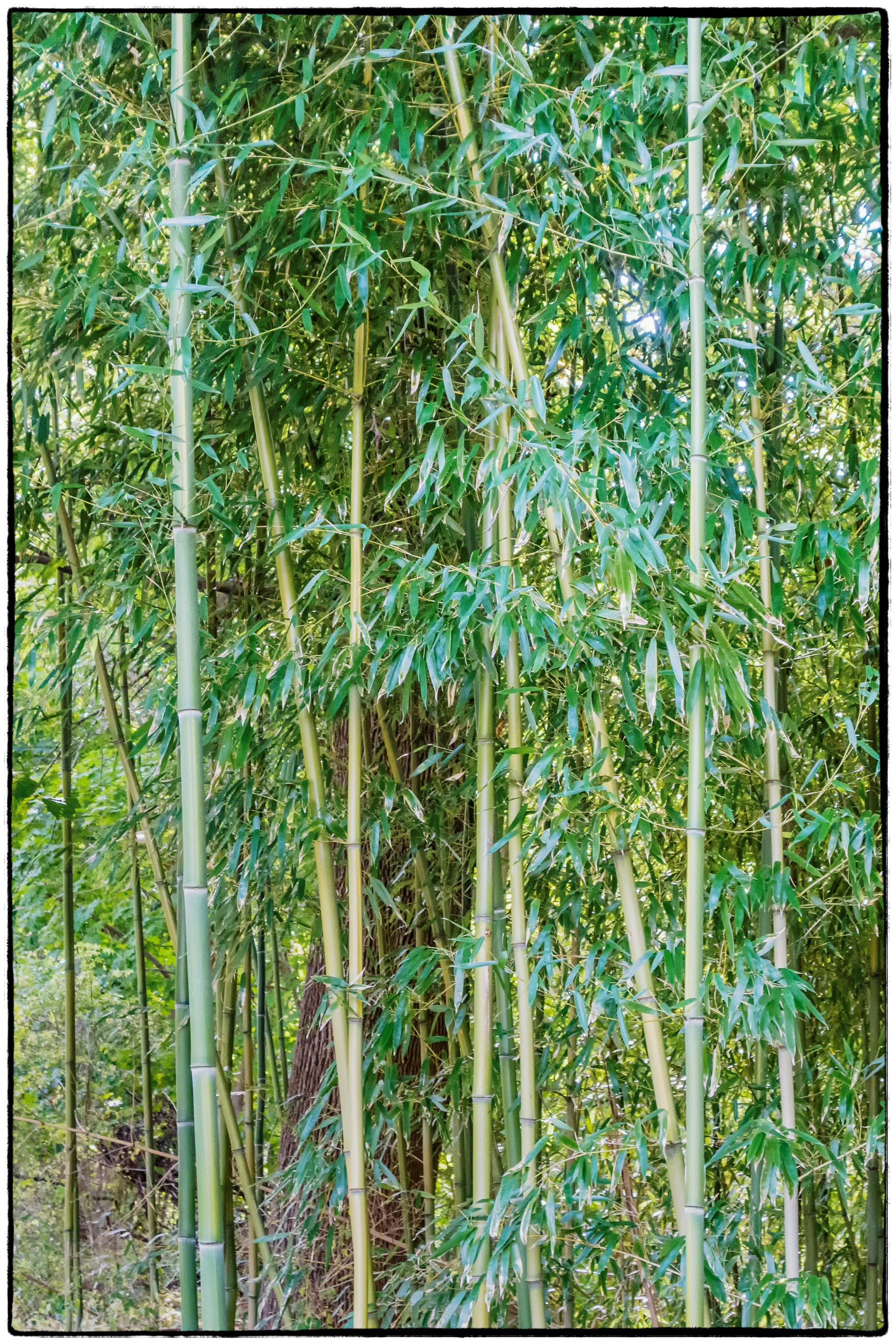
Bamboo

In an earlier post (Fred Dill Wildlife Sanctuary 6: Bamboo grove) I noted that I was surprised to see such large groves of bamboo in Putnam County as I had always thought of it as a tropical plant.

I just came across some more – lots of it. I love the bright green color.

Fascinating stuff bamboo. I didn’t know much about it so I looked it up. It seems that it’s the largest member of the grass family. It also grows incredibly quickly – certain species can grow three feet in 24 hours, that’s 1.5 inches per hour, or about one inch every forty minutes. You could almost sit and watch bamboo grow.

In India it’s a symbol of friendship and in China a symbol of decency and integrity. A number of Asian cultures believe that humanity arose from a bamboo stem.

By the roadside 18: Lamium amplexicaule

According to Wikipedia:

Henbit dead-nettle is an annual herb with a sprawling habit and short erect squarish, lightly hairy stems. It grows to a height of about 10 to 30 cm (4 to 12 in). The leaves are in opposite pairs, often with long internodes. The lower leaves are stalked and the upper ones stalkless, often fused, and clasping the stems. The blades are hairy and kidney-shaped, with rounded teeth. The flowers are relatively large and form a few-flowered terminal spike with axillary whorls. The calyx is regular with five lobes and closes up after flowering. The corolla is purplish-red, fused into a tube 15 to 20 mm (0.6 to 0.8 in) long. The upper lip is convex, 3 to 5 mm (0.12 to 0.20 in) long and the lower lip has three lobes, two small side ones and a larger central one 1.5 to 2.5 mm (0.06 to 0.10 in) long. There are four stamens, two long and two short. The gynoecium has two fused carpels and the fruit is a four-chambered schizocarp.

This plant flowers very early in the spring even in northern areas, and for most of the winter and the early spring in warmer locations such as the Mediterranean region. At times of year when there are not many pollinating insects, the flowers self-pollinate