Terrapin Restaurant, Rhinebeck, NY

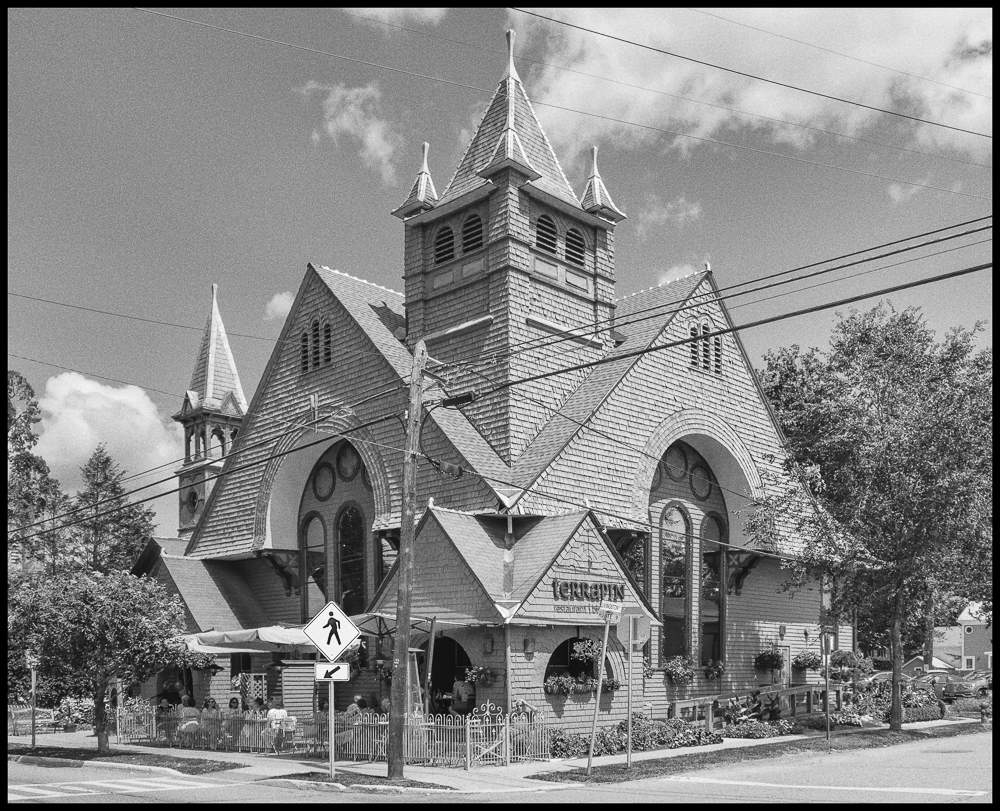
This restaurant in located right in the center of Rhinebeck, NY. It’s looks like a church, because once upon a time that’s what it was. According to the restaurant’s website:

Our restaurant is housed in a historic, renovated church building, formerly the First Baptist church of Rhinebeck, constructed circa 1825. The building’s soaring cathedral ceilings and windows offer a unique place for gathering in Rhinebeck.

In 1794, a man named Robert Scott, a cabinet maker and English Wesleyan, sailed to New York City from England. In 1795, persuaded by Margaret Beekman, he and his wife moved to Rhinebeck to open a school. He soon became a Baptist and worship was held in various houses in Rhinebeck Flats, as it was then called.

In 1824, land was donated by Mrs. Janet Montgomery, widow of General Montgomery, to build the first Baptist Church of Rhinebeck. The original church was finished in 1825, and now houses our formal dining room. The two doors which lead into the kitchen were the original entrances, one for women and the other for men. The Pulpit was where the large wooden arches still stand. An addition was added on in 1905, from money donated by Senator William Kelly, which now houses our bistro.

Two restaurants occupied the building prior to Chef Kroner purchasing it in 2003, when he completely renovated the space and moved Terrapin from its original location in West Hurley, NY.

This picture presented a bit of a dilemma. A lot of wires criss cross the frame. I find them distracting, but despite my best efforts I was unable to find an angle which didn’t show them. I could get a lot closer, but then I would be focusing on details and wouldn’t be able to get the view I wanted. Or I could try to remove them in post processing. I don’t usually mind removing a small distracting element, but this seemed a bit much. What if at some point in the future someone came across this image and thought that at the time it was taken there were no wires along Route 9 in Rhinebeck? In the end I decided to leave them in – probably because I’m lazy and it would be just too much trouble to try to take them all out.

Taken with a Sony RX-100 M3.

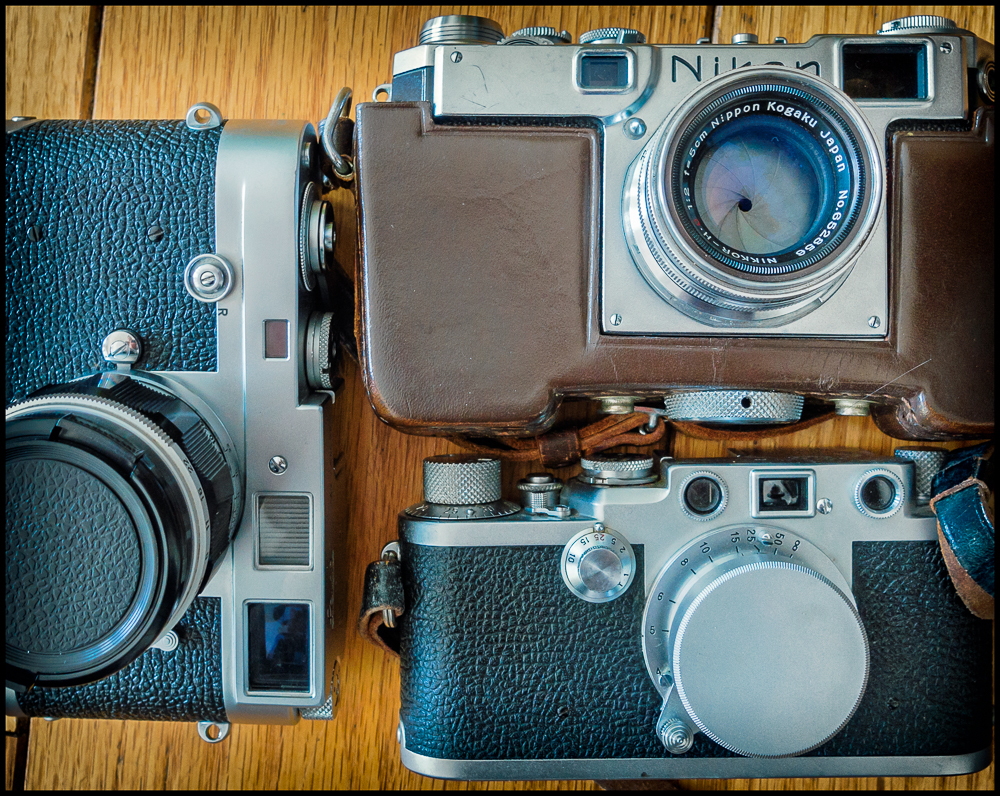
An irrational liking for rangefinders?

I recently came across this useful post on 35mmc: What is a rangefinder camera, and is one right for you?. It does a terrific job of explaining the advantages and disadvantages of rangefinder cameras.

I have an emotional attachment to rangefinder cameras. My first serious camera was a rangefinder. It was given to me by my wife early in our relationship and I used it for many years. When I started to collect cameras it was an easy decision to start with rangefinders. I’m also a big fan of Henri Cartier-Bresson and perhaps subconsciously could see myself as the almost invisible photographer flitting around taking pictures of all and sundry (if you haven’t seen Cartier-Bresson at work see: Henri Cartier-Bresson Documentary: Pen, Brush and Camera).

The problem is that I just don’t take that kind of picture. I rarely take pictures of people and my usual subjects (buildings, objects, still life, landscapes etc.) are pretty static. So the usual benefits of rangefinders (small, discrete, reduced camera noise, reduced camera shake etc.) don’t seem to be too much of an advantage to my kind of photography. Also I find that as I get older it becomes more and more difficult to make out the rangefinder patch – especially with the compact non-interchangeable lens rangefinders that I favor.

But then In another post (The Viewfinder effect – and why I choose to cripple myself with an offset viewfinder) Hamish notes:

During a chat on the phone with a friend a few days later I happen to mention this difference in framing and he explains how he once had a similar realisation, by coincidence, also through shooting with a Leica. We concluded that the difference in framing comes from a completely different way that the camera is used. With an SLR the tendency is to frame with the camera to the eye; with the viewfinder. The camera shows the photographer depth of field and perfect framing. What results is a reliance on the camera, the camera almost finds the shot for the photographer by giving him or her the extra levels of information about the end result before the photo is taken

It seems to me that he has a point here. The rangefinder experience is different, but until reading this post I’ve never been able to figure out exactly how. But, at least in my case, Hamish is spot on. When I use an SLR I tend to look through the viewfinder a lot more. With a rangefinder I tend to look around with the camera down and only raise it to frame when I want to take the picture.

Hamish concludes with:

The problem is, there’s more to what makes rangefinder cameras attractive or otherwise than the more obvious pros and cons. As I talked about in the couple of paragraphs about frame lines, and indeed the couple of posts I link to, shooting a rangefinder is very different experience to shooting an SLR. For me – and actually I suspect most rangefinder camera photographers – this mostly comes down to the experience of using a camera with an offset viewfinder and frame lines. The experience of being able to see what’s just about to come into the frame verses the more accurate framing an SLR brings might seem like something quite small, but in practice there’s so much more to how this difference impacts on the process of taking a photo.

2017 – The Year in Review

Since it continued over into 2017 I guess Tim and Carmen’s New Years Eve party was technically the first event of the year. We also invited friends over for our Wedding Anniversary on January 10. Ken came on a flying visit from Bangkok. It was great to see him again.

In February we were invited to a birthday celebration for our friend, Germain. I believe it was her 95th birthday and she’s still going strong. I went into New York City for lunch with an old friend and colleague, Tom Franklin.

March saw us at a garden club get together in honor of Kate and Muriel, a concert featuring Happy Traum at the Tompkins Corners Cultural Center and a presentation to the garden club on local birds given by a speaker from the Audobon Society. For Eirah’s birthday we went into New York City for dinner at NY’s only revolving restaurant: “The View” – 47 floors up at the Marriott Marquis followed by a performance of “The Book of Mormon”.

In April we visited Locust Grove the former home of Samuel Morse. An old friend, Marieke came to New York and we were able to get together for lunch at “The Boathouse” in Central Park. For Easter Sunday lunch we went to the amazing Mohonk Mountain House. The month ended with Eirah organizing a celebration of my birthday at our lake house to which she invited a number of our friends.

We spent just about all of May in Geneva, Switzerland with our young daughter and her family. We couldn’t figure out what to do with our dog so we just took him with us. Part way through the visit Eirah went to Amman, Jordan to stay with our older daughter. She had a great time visiting Petra and the Dead Sea and spending more time with additional grandkids.

The Garden Club’s Annual garden tour and lunch took place in June. It’s always great to see how others have organized their gardens. It’s remarkable how the views of the lake vary so much from property to property. We went into New York City again for a birthday celebration for former colleague and friend, Shannon at her spectacular new apartment. Sadly our friends George and Gloria moved down to South Carolina. We had a goodbye lunch with them at “Il Laghetto” on the lake in Mahopac. The sadness of their departure was somewhat offset by the arrival of our friends and neighbors Ken and Doreen who returned from an assignment in Bangkok

July was a busy month with the New York Airshow at Stewart airport near Newburgh (with Ken and Gustavo); July 4th fireworks on the Ossining Waterfront; a visit to our lake house from Menchie and Chita; a twilight, lakeside party at Kate and Terry’s. We also went to the 46th Annual Putnam County 4-H fair. Our friend Carmen came for lunch. We spent a pleasant evening sitting outside with friends eating and listening to music in Peekskill.

In August we took our friend Paul to dinner at “The Riverview” restaurant in Cold Spring. We also went to the Hudson Valley Ribfest in New Paltz with Ken and Doreen and to Stonecrop Gardens with Olga and Gustavo. After a bit of “antiquing” in Rhinebeck we went with Ken and Doreen to the Dutchess County Fair. For me the highlight of the month was a visit to the New England Air Museum. So many gorgeous old aircraft.

September saw Eirah take off on a trip to Los Angeles to meet up with some of her brothers (who live there) and some visiting relatives from the Philippines. She managed to visit the Getty museum. We also managed to get to a couple of arts/crafts shows: The Lyndhurst Castle Crafts Fair in Tarrytown and the Armonk Art Show. Old friends Tony and Safiya invited us to lunch at their house in Paramus, NJ where we were pleased to see our old friend Robert Cohen and his lovely wife, Rachel.

In October we attended “A rewarding cultural & culinary experience tonight at the Putnam Valley Library. ‘Taste Korea: Korean Cuisine’ presented by the Korean Spirit & Culture Promotion Project.”, which included insights into preparing and cooking well known Korean dishes as well as a sumptuous Korean meal. We went for a pleasant walk (including dogs) with friends Susan and Stephen at the Rockefeller trails.

Our younger daughter came to visit in Briarcliff Manor in November. We went into New York City for lunch with her and other friends at Brasserie Ruhlmann in Rockefeller Center. She was doing PR work for a company that was exhibiting at Christies so we were able to see the spectacular (and extremely expensive – very little went for less than $1 million) artwork on display. We were also able the see the Da Vinci, “Salvator Mundi”, which eventually sold for $450 million. Other highlights included a visit from Tim and Carmen who came for dinner at the lake; a performance of “Miss Saigon” on Broadway and Thanksgiving lunch at “Equus” at the Castle Hotel and Spa in Tarrytown.

December started off badly. Eirah was involved in a very serious car accident on December 1. The car was ‘totaled’ but thankfully the BMW’s safety features did their job and she escaped with major and painful bruises, but no broken bones or other injuries. She’d recovered enough by mid-month to attend the annual garden club Christmas party. On Christmas day we went for lunch at Jean-Georges in Pound Ridge. This was followed by a Boxing Day party at friend Marcia’s in Hastings-on-Hudson. The year concluded as it started with a New Year’s Eve party at Tim and Carmen’s.

My photography is somewhat opportunistic i.e. I always carry a camera with me and most of my photographs arise because I see something interesting while doing something else. Nonetheless I did go on a number of excursions where I anticipated that I would find “photo ops”. These included: The Peekskill Waterfront; The Friends Meeting House in Yorktown; A Couple of visits to Sleepy Hollow Cemetery; Woodlawn Cemetery (particularly interesting); The New Croton Dam; The Ossining Waterfront; The Depot restoration in Hopewell Junction and the Dutchess Rail Trail; Croton Point Park; Fort Montgomery; Mystery Point preserve; Verplanck Point/Kings Ferry; A garden club hike to the nearby Kings Chamber; Geneva (lots including lakeside, old town, parc des bastions, carouge, augustins, saleve, troinex, pinchat, veryrier); Oscawana park and Oscawana Island; New York Airshow; Connecticut Aircraft Museum; Ossining 4th July Fireworks; Croton-on-Hudson; Putnam County 4-H fair and Veterans Memorial Park; Pleasantville; Hudson Valley Ribfest; Muscoot Farm; Rhinebeck and the Dutchess Count Fair; Doodletown; Hollowbrook Trail; Teatown Lake; Pelton Pond; White Pond; Granite Knolls; Lasdon Park and Arboretum; the North County Trailway.

I made a 2017 New Years Resolution that I would try to 1) limit my old camera purchases; 2) use the cameras that I have more often. I was partially successful. I bought 11 old cameras and one vintage lens in 2017 (less than in 2016 but more than in 2015). I also bought one recent generation digital camera: a Sony A77II to replace my 7 year old Sony A500. On using old cameras I did better. In 2017 I used 10 different film cameras and would probably have used a couple more if it hadn’t been for the mishaps in December.

I added quite a few items to my photography library including: American Witness. The art and life of Robert Frank by R.J. Smith; Karsh, a Biography in Images; Focus – Michael Gross’s book on fashion photographers; The Univex Story by Cynthia A. Repinski; Taschen 20th Century Photography; David DuChemin’s The Soul of the Camera: The Photographer’s Place in Picture-Making; Photography – A Critical Introduction by Liz Wells; Dorothea Lange: A Life Beyond Limits by Linda Gordon; Ansel Adams – Autobiography; Ansel Adams – The Camera, The Negative, The Print. Vivian Maier: A Photographer’s Life and Afterlife by Pamela Bannos.

All things considered it’s been a full year with much to be thankful for.

Happy New Year.

Picture above taken with an iphone 5s at Tim and Carmen’s New Year’s Eve party.

Revisiting Ansel Adams

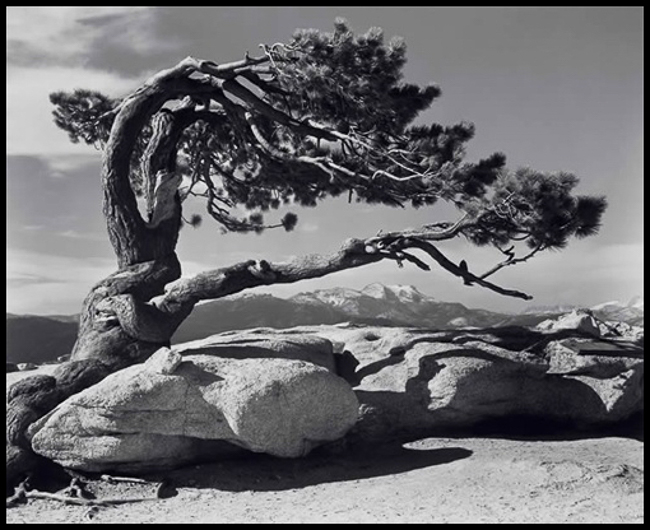
Jeffrey Pine.  Source: Ansel Adams Galleries

Jeffrey Pine, Sentinel Dome. Source: Ansel Adams Galleries

I got the idea for this post from a video that I came across on the internet. I was well worth seeing so I thought I would post a link to it. However, as I started to do so it occurred to me that I might have posted about this video before. I checked and indeed I had (see Ansel Adams: A Documentary Film 2002).

So instead this post revisits my love/hate relationship with Ansel Adams. Actually ‘hate’ is the wrong word. Even when I’m ‘down’ on Adams I don’t ‘hate’ his work. It’s just that once upon a time I thought he was THE great photographer. This was in the late 1970s-early 1980s. My wife had recently bought me my first serious camera (a Minolta Hi-Matic 7sII) and I was new to photography. At that time Adams was (and continues to be) immensely poplar. A print of “Moonrise, Hernandez, New Mexico” sold at auction in 1981, for a then record price for a photograph – $71,500 (doesn’t seem much now when Rhein II by Andreas Gursky is fetching in excess of $4 million!). This was the kind of photographer I wanted to be. I wanted to make (Adams himself preferred the verb to ‘make’ a photograph rather than to ‘take’ one) landscape photographs like these.

Over the years I learned more about photography and famous photographers and discovered that even though to this day I continue to photograph landscapes, my passion for landscape photography pales in comparison to Adam’s. Other genres started to interest me. Other photographers began to interest me and I started to turn away from Ansel Adams. I began to think of him as more of a superb technician than a great creative photographer.

Then in the late 1990s-late 2000s I almost entirely lost interest in photography, ‘making’ pictures only when required to document travel and family events. Starting around 2010 my interest was re-kindled and since then I’ve been taking pictures, collecting cameras and reading about famous photographers like there’s no tomorrow.

So where do I stand on Adams now. My collection of photography books includes Examples: The Making of 40 Photographs (a great book). I’d also read Looking at Ansel Adams: The Photographs and the Man and I have a copy of Ansel Adams: 400 Photographs. In preparation for this post I read his autobiography: Ansel Adams: An Autobiography.

I also did quick and totally unscientific test. I looked at all of the photographs in “Ansel Adams: 400 Photographs” one evening. The next day I repeated this exercise noting down those that if felt, from a quick perusal, had moved me. Only 24 had.

Of course there’s much more to Ansel Adams than just his photographs. He was an accomplished pianist (headed for a career as a concert pianist before photography became his passion). Judging from his autobiography he was no slouch at writing either. He was a tireless advocate for the environment, a founder member of the West Coast circle of photographers Group f64 that also included (among others) Edward Weston and Imogen Cunningham, a founder of ‘Aperture‘ magazine. He was also an educator and a prolific writer. Adams, along with Alfred Stieglitz, probably had the most impact on the evolution of photography in the United States.

His best photographs are superb! However, I feel that the totality of his work falls behind other great American photographers like Paul Strand and Edward Weston. Neither of these photographers had the same overall impact on photography as a whole though.

Regrettably the tree in the picture above has now gone. According to the Ansel Adams Gallery:

Though Adams’ photograph made the Jeffrey Pine famous, it was long an icon for photographers visiting Yosemite ; Carleton Watkins photographed it in 1867. the easy hike to reach Sentinel Dome from the Glacier Point road, the tree became a popular destination; over the years, thousands of visitors carved their initials into it. Despite the efforts of park rangers who carried buckets of water to it, the tree perished in the drought of 1976-77 and fell in August 2003.