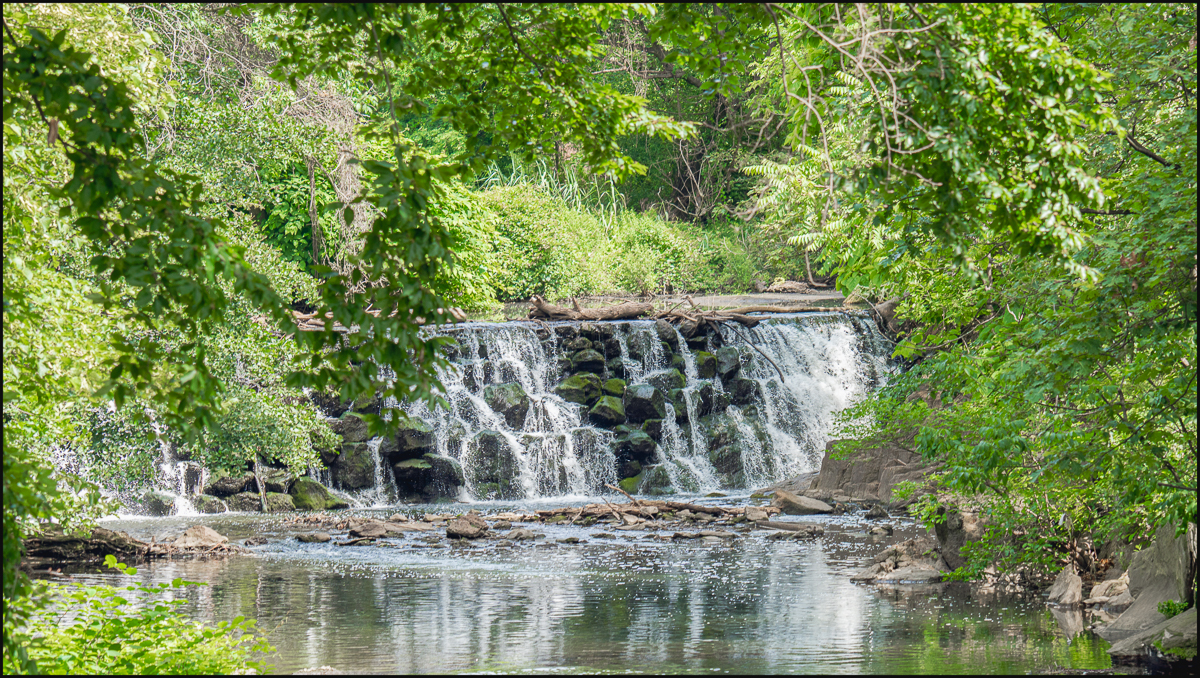
Waterfall on the Bronx River

The 23-mile Bronx River winds down through southern Westchester County and the Bronx creating a peaceful corridor of green. Called Aquehung or “River of High Bluffs” by the Mohegan Indians who lived and fished along it, the river attracted European traders, farmers, and millers in the 1600s and 1700s. The construction of the New York Central Railroad in the 1840s turned the valley into an industrial corridor, and by the end of the 19th century the Bronx River had degenerated into what one official commission called “an open sewer.”

Two major reclamation projects served as buffers against further industrial development. In 1888, land was set aside for Bronx Park, which would include the New York Botanical Garden and the Bronx Zoo. In the early 20th century, the first modern automotive parkway with restricted frontage, limited access, and grade separations was built along the Bronx River in New York City and Westchester County. The Bronx River Parkway was initiated in 1906 as a river conservation effort; however, efforts lagged until after World War I. It was not until 1925 that the 15.5-mile linear park and winding roadway, between Bronx Park in New York and the Kensico Dam in Valhalla, was completed.

The automobile industry had rapidly expanded in the meantime, and the beautifully landscaped, curvilinear Bronx River Parkway was greatly appreciated by car owners. Driving along at 35 miles per hour, they enjoyed picturesque views of the restored river and the surrounding park. The convenience and beauty of the many rusticated stone bridges that carried intersecting traffic over the parkway were equally unprecedented.

In 1938, the City of New York acquired land for the extension of the Bronx River Parkway from Bronx Park south to Soundview Park. Construction of the parkway was completed after the war, by 1952. Much of the land for the James Burke Ballfields (named by the City Council in 1968) was acquired in 1946. This 4.6-acre playground was opened to the public in 1956. It featured three softball diamonds, shower basin, swings, and slides for older children, as well as see-saws, sandpits, swings, and slides for tots.

In 1995, sixteen Council Members co-sponsored the local law which renamed the playground area in James Burke Ballfields in memory of six children who were slain between 1986 and 1990. Parque de los Niños (Park of the Children, or Children’s Park) was dedicated in memory of Annette Rosario, Shamira Bello, Heriberto Marrero, Nilda Cartagena, Lisa Ann Rodriguez, and Jessica Guzman, all of whom grew up in New York City. A Linden tree (Tilia spp.) was planted in the park that year. This tree has heart-shaped leaves and round, hard fruits which remain on the tree until winter. (Official Website of the New York City Department of Parks & Recreation).

Taken with a Sony A7IV and Sigma 150-600mm f/5-6.3 DG DN OS Sports Lens
Balloon Milkweed

This is the unusual looking fruit of a shrub technically known as Gomphocarpus physocarpus. In addition to “Balloon Milkweed”, other common names include balloon wild cotton and hairy balls (I was so tempted to use this in the title). All parts of this plant are poisonous if ingested.

Taken with a Fuji X-E3 and Sigma 18-50mm f2.8

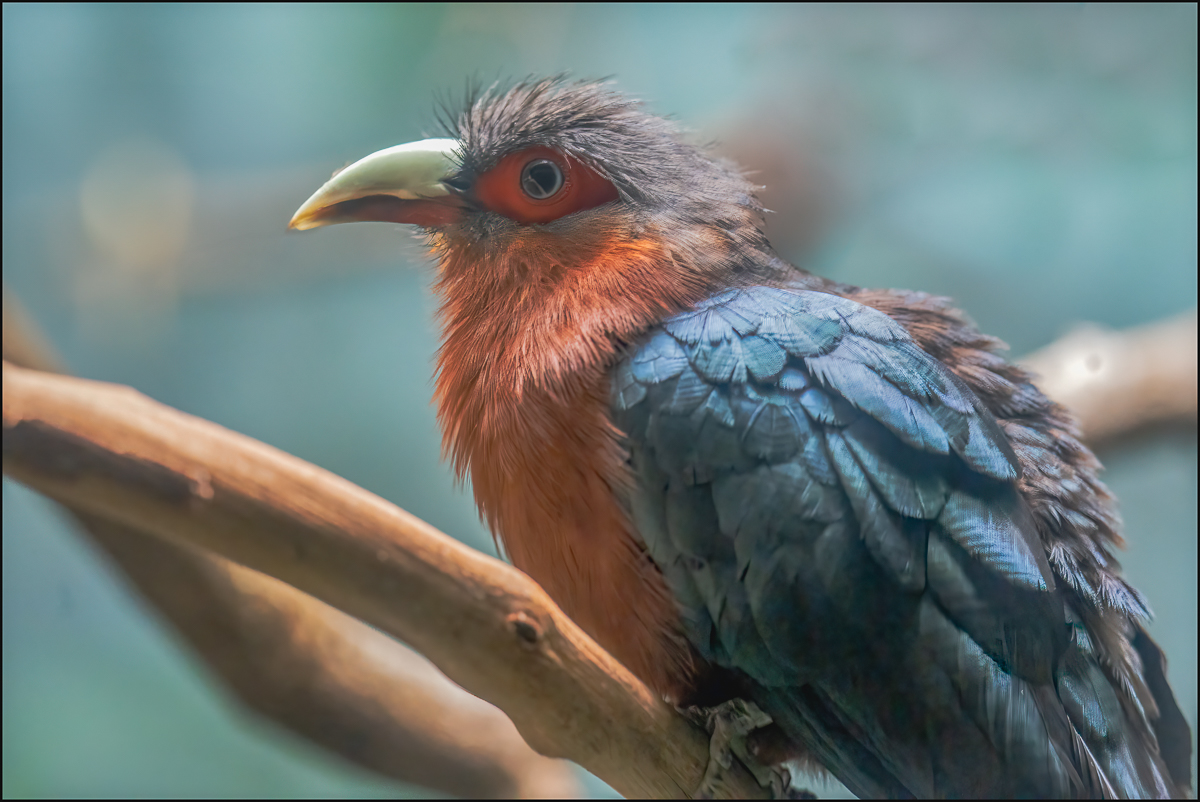
At the Bronx Zoo – Birds – Chestnut-breasted malkoha

The chestnut-breasted malkoha (Phaenicophaeus curvirostris) is a species of cuckoo in the family Cuculidae. Found in Southeast Asia from Myanmar through to eastern Java, the Philippines and Borneo, it is a large cuckoo measuring up to 49 cm (19 in) with grey and dark green upperparts and chestnut underparts, and a large curved pale upper mandible. The male and female are similar in plumage. Unlike many cuckoos, it builds its nest and raises its own young.

Measuring 42–49 cm (17–19 in) in length, the chestnut-breasted malkoha has a large, curved, pale yellow upper mandible and darker red or black lower mandible, and a bare red patch of rough skin around the eye. The head is grey and wings are dark green fading to blue with age. Its underparts and rump are chestnut, and feet are dark grey. Little sexual dimorphism is seen, as the male and female are similar in plumage, although the male has a pale blue iris and the female yellow.

Taken with a Sony A7IV and Sigma 150-600mm f/5-6.3 DG DN OS Sports Lens

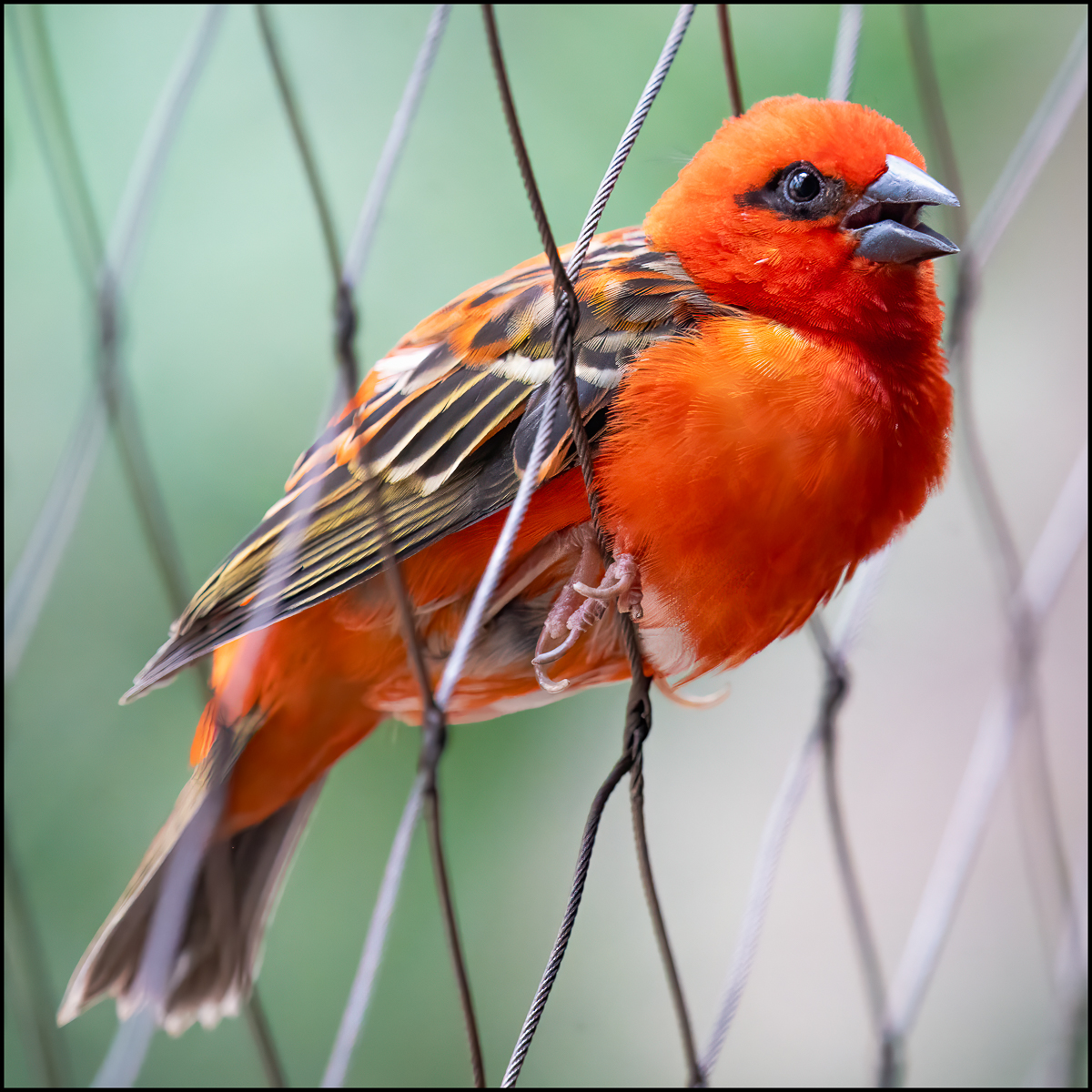
At the Bronx Zoo – Birds – Red Fody

The red fody (Foudia madagascariensis), also known as the Madagascar fody in Madagascar, red cardinal fody in Mauritius, or common fody, is a small bird native to Madagascar and introduced to various other islands in the Indian Ocean. It is a common bird within its restricted range, and the International Union for Conservation of Nature has assessed its conservation status as being of “least concern”.

In 1760 the French zoologist Mathurin Jacques Brisson included a description of the red fody in his Ornithologie based on a specimen collected in Madagascar. He used the French name Le cardinal de Madagascar and the Latin Cardinalis Madagascariensis. Although Brisson coined Latin names, these do not conform to the binomial system and are not recognised by the International Commission on Zoological Nomenclature. When in 1766 the Swedish naturalist Carl Linnaeus updated his Systema Naturae for the twelfth edition, he added 240 species that had been previously described by Brisson. One of these was the red fody. Linnaeus included a brief description, coined the binomial name Loxia madagascariensis and cited Brisson’s work. This species is now placed in the genus Foudia that was introduced by the German naturalist Ludwig Reichenbach in 1850. The type species was subsequently designated as the red fody. The species is monotypic.

The English word “fody” and the name of the genus Foudia are from the Malagasy name for the red fody Foudi or Fodi.

The red fody is about 5 inches (13 cm) in length and weighs 14–19 grams (0.49–0.67 oz). The male of the species is bright red with black markings around each eye. Its wings and tail are olive-brown. Its underparts are also red, which distinguishes it from other fodies in areas where it has been introduced. The female fody’s upper parts are olive-brown and its underparts are greyish brown. (Wikipedia)

Taken with a Sony A7IV and Sigma 150-600mm f/5-6.3 DG DN OS Sports Lens