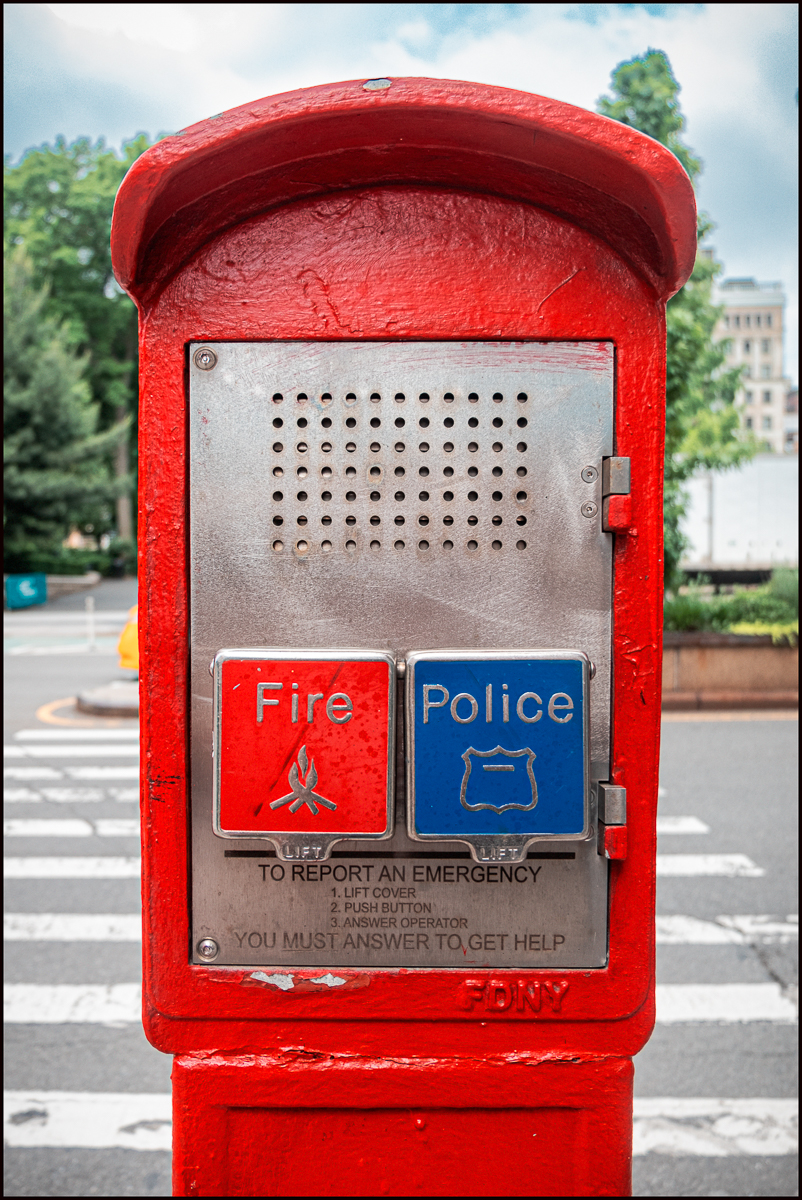
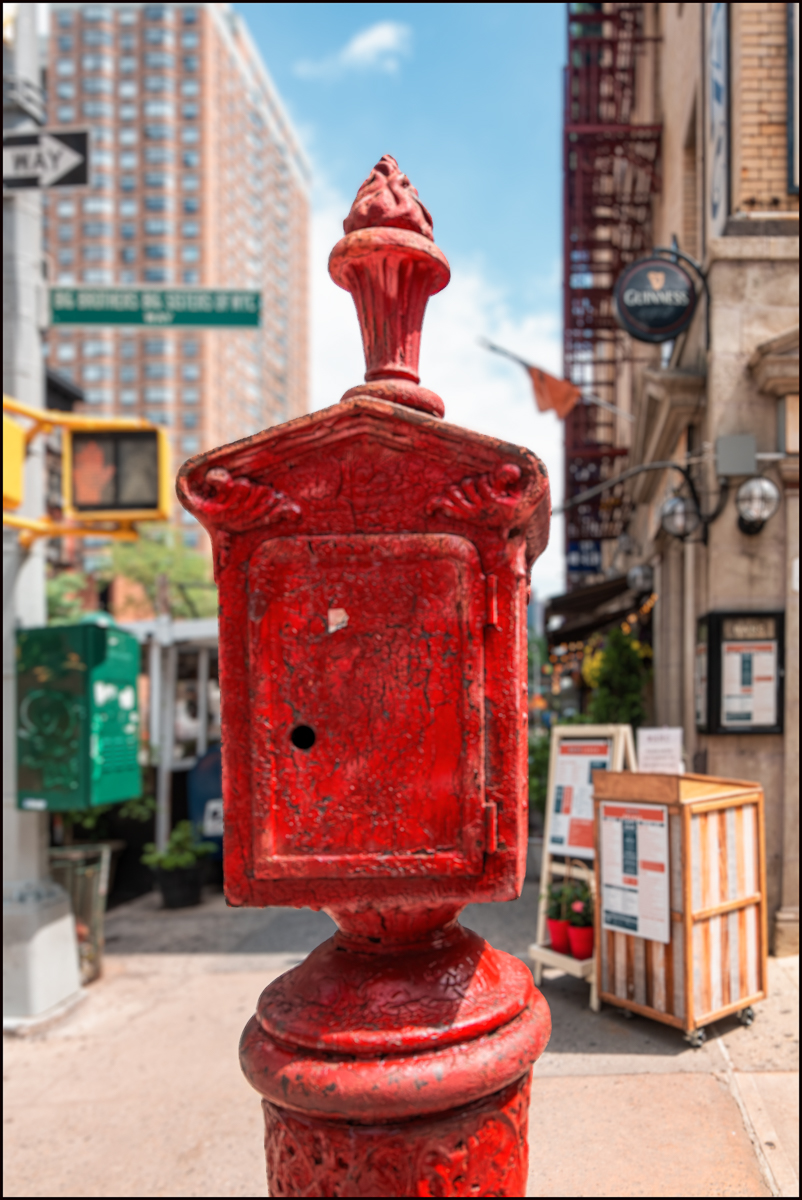
I came across these odd objects while walking around in Manhattan one day. I don’t really know what they are, but they look like some kind of emergency communications device. The second one below looks older than the one above.
After a bit more research I’ve discovered that they are indeed Police, Fire and Emergency call boxes. An article entitled: CITIES 101: RED FIRE ALARM BOXES IN NYC, DO THEY EVEN WORK? on Untapped New York provides more detail.
Throughout New York City, you may be familiar with these red fire alarm boxes that are supposed to summon the fire or police department in the event of an emergency. But how do they work? Many of them have been in the streets for over a century and for more than a decade, several initiatives have emerged to reassess their utility in today’s cell phone age.
The FDNY reports that only 2.6% of calls that they receive come from these boxes, which connect callers directly to their local fire dispatcher, as opposed to the 911 system which acts as a middle-man to the appropriate emergency services. However, 88% of calls from the City’s 15,000 fire boxes are false alarms.
The call boxes come in different shapes and sizes, representative of the decade during which they were installed. Most common are the stand alone rounded posts with a red torch on the top. Some are denoted by an orange bulb attached to a post above a box; these are some of the older ones, as the orange bulbs were used in the 1910s. According to The Works, by Kate Ascher, the oldest boxes date back to 1870:
“when the Fire Department installed fire alarm boxes on telegraph poles south of 14th Street. Though few boxes from that time have survived, a large number of those on the streets today still rely on the original technology: pulling a revolving coded-wheel mechanism sends a signal identifying the box number of the central office of the borough…and dispatchers there forward the alarm to the appropriate firehouse.”
The newer boxes are the ones with two buttons, specifying “Fire” or “Police,” and have a speaker system which the caller can use to speak with the emergency dispatcher. These were installed to lower the instances of false alarms, but pranksters still afflict the system even with these boxes. Posters featuring “Foxy the Firefighter” were pasted to the side of many fire posts in the 60’s and 70’s when false alarms were out of control (the FDNY reported 263,000 false alarms in 1977).
Since the mid-90s the City began to see the fire boxes as a nuisance and former Mayor Rudy Giuliani was the first to attempt to extinguish the problem. Mayor Bloomberg was a major proponent in favor of removing the City’s fire boxes as well (thousands of which are no longer working since Hurricane Sandy). But these removal attempts have received backlash from those who feel that they are crucial in the event of a power/telephone outage (like 9/11) or when servicing a deaf caller. “By removing this system, the city would be leaving our clients with no way to report emergencies from the street,” said Attorney Robert Stulberg, who represented the Civic Association of the Deaf of New York City in 2011 against the initiative. In 2011 it was estimated that the city would save $7 million a year in repair costs related to the fire boxes. To report an out of service call box in your neighborhood, call 311
Taken with a Fuji X-E3 and Fuji XF 35mm f1.4 R