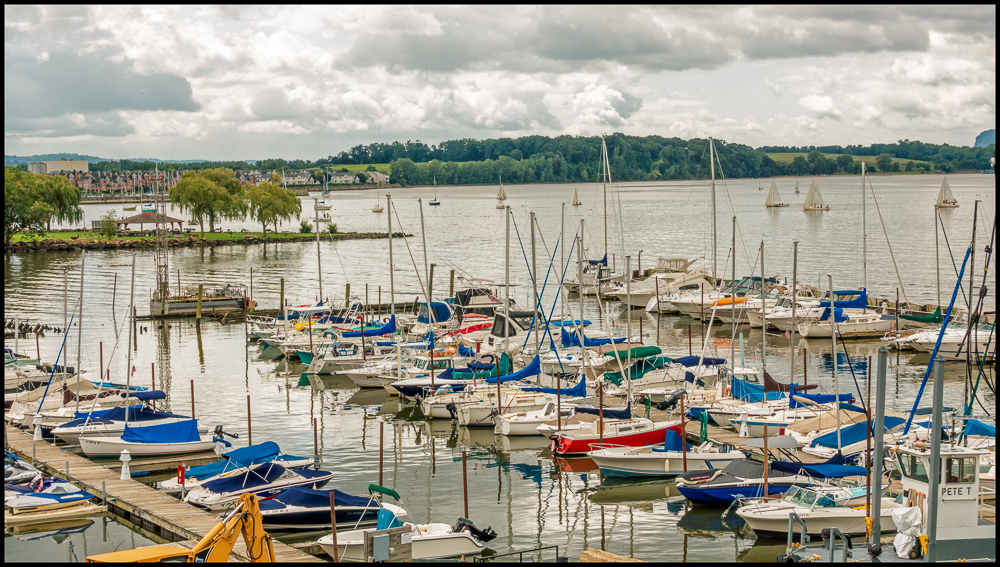
View of the Croton Yacht Club Marina as seen from the overpass over Route 9 from North Riverside Avenue.
Taken with a Sony RX-100 M3.
Photographs and thoughts on photography and camera collecting

View of the Croton Yacht Club Marina as seen from the overpass over Route 9 from North Riverside Avenue.
Taken with a Sony RX-100 M3.
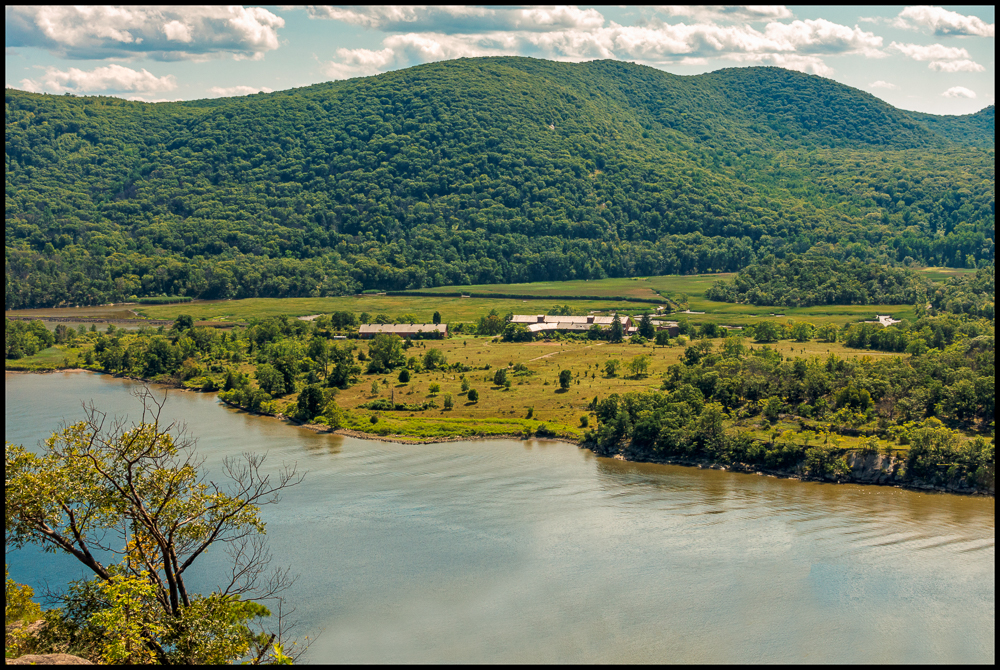
According to Wikipedia:
Native Americans spent the summers fishing from the island’s shores, and named the island Wa-na-ka-wagh-kin, which has been translated as meaning “good land”. Artifacts excavated on Iona Island are on display at the Bear Mountain Trailside Museum and Zoo. In 1683, members of the Van Cortlandt family purchased the land from the natives. It was originally known as Salisbury Island, and later as Weyant’s Island (for the local Weyant or Weiant family). The island has also been known as Beveridge’s Island. It was occupied by British troops during the American Revolution.
In 1847, it was bought by John Beveridge for Dr. E. W. Grant, his son-in-law, who renamed it Iona Island and planted it with Iona grapes and fruit trees. Grant supplied the Union army with produce during the Civil War. In 1868, his creditors foreclosed on the island.
The island was purchased by a group of investors, and a summer resort was developed on the island. Grant’s mansion home became a hotel, and the investors gradually added an amusement park with a carousel, Ferris wheel, dance floor, pavilion, and picnic grounds. It also had a dock to accommodate steamboats which brought pleasure-seekers up from New York City and New Jersey. The construction of the West Shore Railroad across the island in 1882 made it even more accessible to tourists.
In 1899, the island was bought by the U.S. Navy for use as a naval ammunition depot, becoming one of the largest ammunition facilities in the nation, at that time. On November 4, 1903 an explosion at the site killed six workers, and blew out windows across the river in Peekskill, three miles away. The explosion occurred while men were drawing the explosive charges from a consignment of old shells recently arrived from the battleship Massachusetts.
The depot supplied much of the munitions for both World War I and II, and remained in service until 1947. Approximately five of the original 164 arsenal buildings remain, which the park now uses for storage. Following World War II until the early 70s, the famous “mothball fleet” of decommissioned warships were moored near the island at Tomkins Cove.
The island was bought by the Palisades Interstate Park Commission in 1965. In 1974 it was named a National Natural Landmark by the National Park Service. As an active wildlife sanctuary, Iona Island is currently closed to the public, however the island and its wildlife may be viewed from overlooks on nearby Route 6, as well as from overlooks within Bear Mountain State Park. Although public canoeing and kayaking is prohibited in the marsh itself, free guided canoeing programs to the marsh are offered during the summer. However, the waterway around the marsh are affected by tides and hence are “navigable-in-law” by the public.
Taken with a Sony RX-100 M3.

For as long as I can remember we’ve had, from time to time, crickets make an appearance in our house.
I believe they live in the crawl space and make occasional forays into the lower level of the house. They don’t bother me and I’m hesitant to get rid of them. The thing is that our house is probably their entire universe. We’ve been there for twenty years and I’ve been seeing these crickets throughout that time period. Since I imagine crickets down have a particularly long life span, we’re talking about generation after generation of crickets.
The funny thing is that, unlike other crickets I’ve encountered, they never make any noise.
Taken with a Sony RX-100 M3.
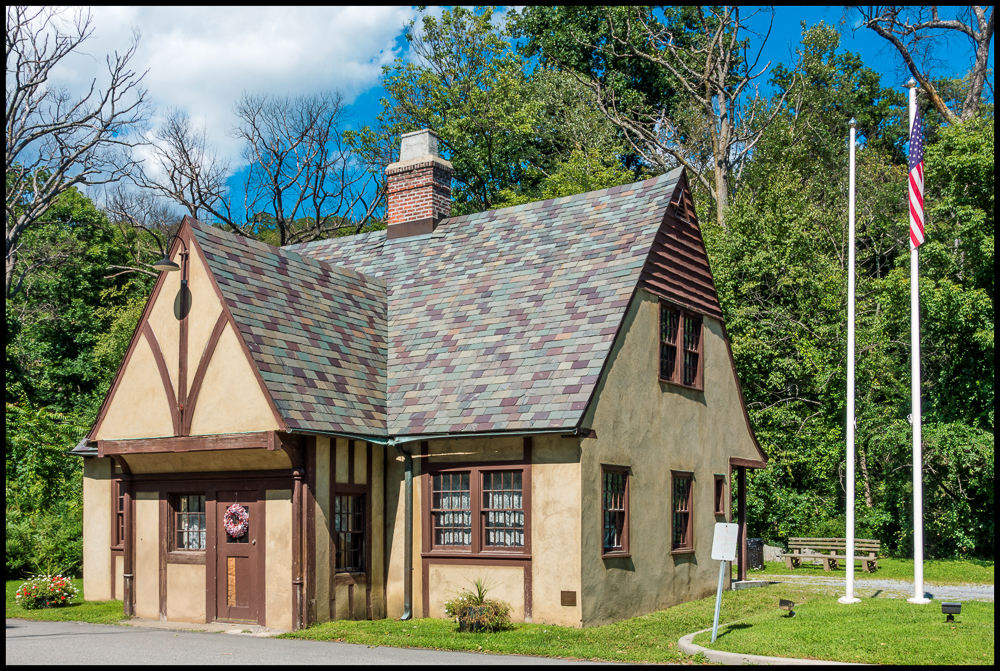
I took the dog for a walk in the Hudson Highlands the other day.
First stop was the Information Center in the old Bear Mountain Toll House where we parked. According to the Town of Cortlandt website:
Architecturally the Toll House is an excellent example for its time period and it is unique because of its use as a toll collection facility and home. The Bear Mountain Bridge, which opened to traffic on November 27, 1924, was the first bridge to span the Hudson River between Albany and New York City. The Harriman Family built it after the passing of a New York State legislative act in 1922 creating the Bear Mountain Hudson River Bridge Company. The private company also constructed Bear Mountain Road as a vehicular connection to the Bridge. The Road and Bridge were privately owned and tolls for such were collected at the Bear Mountain Road Toll House and at the Bridge itself. The one-story Tudor-style Toll House has a gabled slate roof, exposed timbers, and smooth stucco finish. The west bay of the Toll House housed the office and collection area for tolls. In 1940, the Bridge and Road were sold to the State of New York. Under ownership of the State, collection of tolls for the Road ceased and the Bear Mountain Road Toll House was essentially left vacant.
The Town of Cortlandt restored the Toll House on Route 6/202 (Bear Mountain Bridge Road) with NYS and the Town of Cortlandt funds. The restored Toll House is used as a Tourist Information and Welcome Center. Display areas for local history, the history of the Toll House, and local organizations will also be located in the building. The Bear Mountain Bridge, Route 6/202 (Bear Mountain Bridge Road) and the Toll House are listed on the National Register of Historic Places in 1982 as part of the Hudson Highlands Multiple Resource listing.
The Toll House is located at the beginning point of the designated Scenic Road, (Scenic Byways Program of the New York State Department of Transportation), portion of the Bear Mountain Road. The Toll House is located about 2.5 miles south of the Bear Mountain Bridge and backs up to the Camp Smith Military Reservation. The Building is a simple Tudor Style Toll House with a steep gabled slate roof, exposed half timbering and smooth stucco finish. A central bay for collecting tolls projects from the western facade of the building towards Bear Mountain Parkway (Route 6/202). The Toll House and Bear Mountain Road were constructed between 1923 and 1924 to connect the newly constructed Bear Mountain Bridge with Route 9.
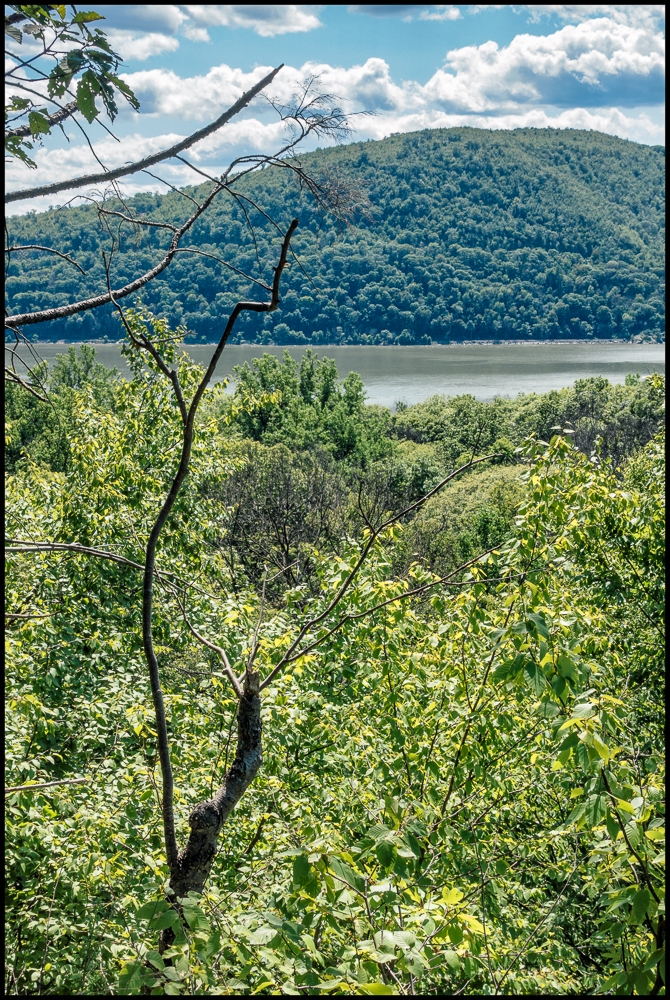
From the Tollhouse the trail ascends with occasional glimpses out over the Hudson River, in this case towards Plum Point on the other side.
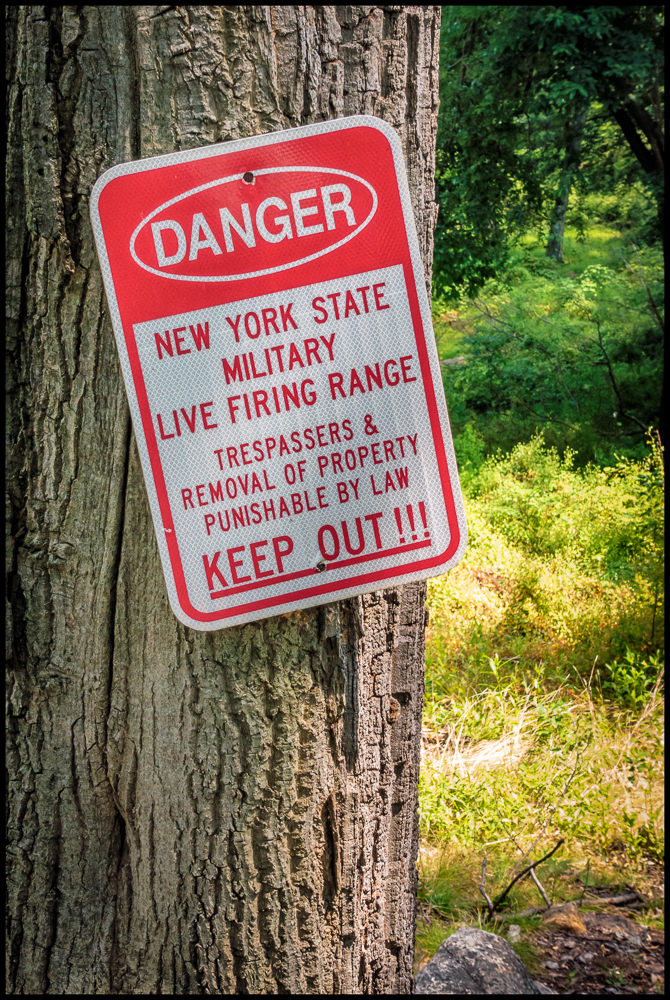
Make sure you stay on the trail.
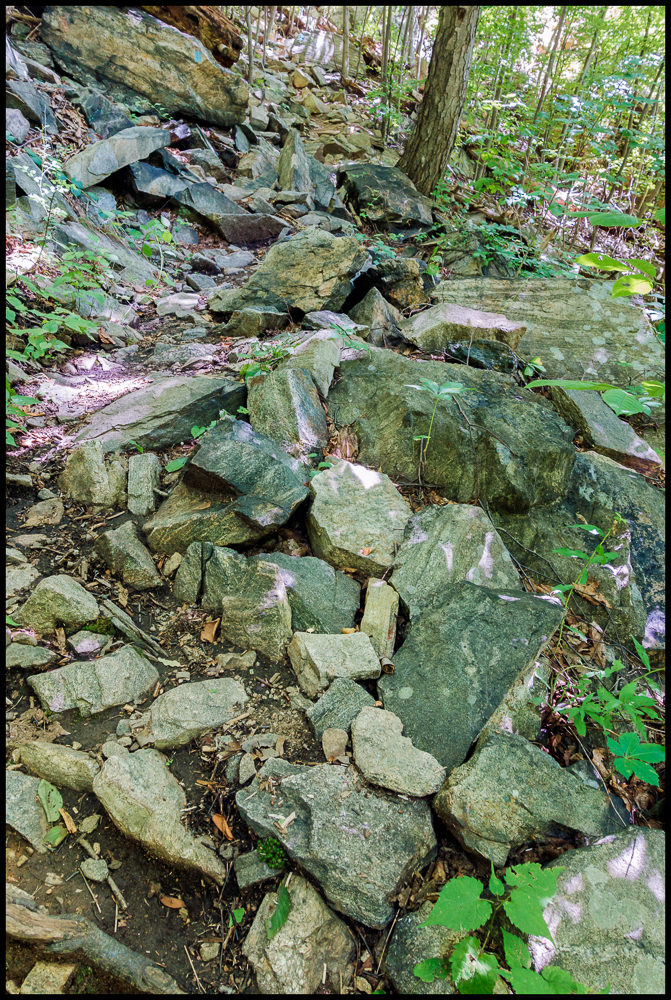
After a while the trail started to get very rocky. The rocks were a little large for our dog, Harley and I was afraid of losing my footing (I wasn’t prepared for such a rocky trail) so we turned around and went back to the Tollhouse.
Taken with a Sony RX-100 M3.
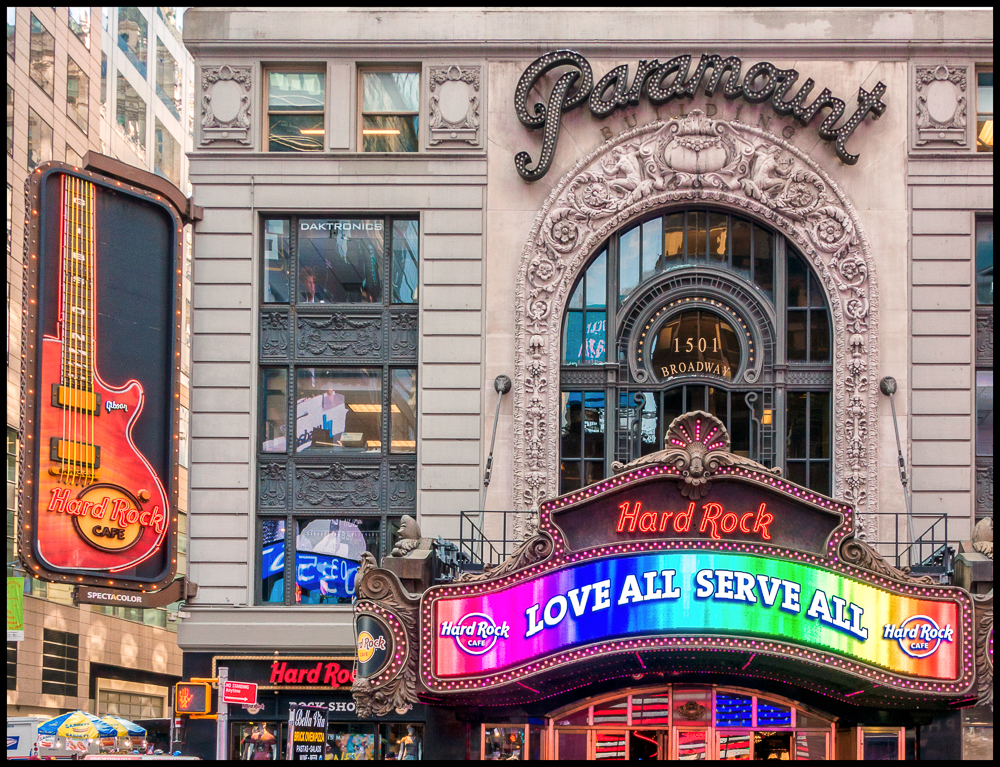
Although this is clearly the Hard Rock Cafe, what really caught my attention was the ornate facade and the lettering above it, which reads: “Paramount” – all of which hinted at a story behind this building.
Indeed, it’s the former Paramount Theater, which according to Wikipedia:
…was a noted 3,664 seat movie palace located at 43rd Street and Broadway in the Times Square district of New York City. Opened in 1926, it was a premiere showcase theatre and New York headquarters of Paramount Pictures. Adolph Zukor, founder of Paramount predecessor Famous Players Film Company, maintained an office in the building until his death in 1976. The Paramount Theatre eventually became a popular live performance venue. The theater was closed in 1964 and its space converted to office and retail use. The tower which housed it, known as the Paramount Building located at 1501 Broadway, is in commercial use as an office building and is still home to Paramount Pictures offices, and remains a Times Square landmark.
Following the closing of the Times Square Paramount Theatre, two other theaters in Manhattan have had the same name: The Paramount Theatre at Madison Square Garden and a movie theater in Columbus Circle, now demolished.
The article provides additional information on the history of the theater:
The Paramount Theatre opened on November 19, 1926 with the gala showing of God Gave Me 20 Cents with Mayor Walker and Thomas Edison as guests. The stage gala was produced by John Murray Anderson.
The theater housed one of the largest and most admired theater organs built by the Wurlitzer company. Designed for the famous organist Jesse Crawford, the organ was used for solos and to accompany silent films. The organ had 36 ranks of voiced metal and wooden pipes weighing a total of 33 tons. Crawford, who advised on the construction and installation of the organ, was the theater’s featured organist from the 1926 opening until 1933. The organ continued to be played intermittently throughout the Paramount’s history by George Wright and other noted organists.
The murals in the theater’s dome, Grand Hall and Elizabethan Room were painted by the Chicago-based artist Louis Grell. Grell was noted for murals that he painted in the 1920s and 30s in many Rapp and Rapp-designed theaters in the Paramount-Publix chain.
The Paramount began hosting live music along with its feature films as the swing era got underway. Glen Gray’s orchestra was the first live band to play there during the week of Christmas 1935. Over the following years, the Paramount became the leading band house in the United States, as performers such as Benny Goodman, Jack Benny, Tommy Dorsey, the Andrews Sisters, Ray Herbeck, Harry James, Phil Spitalny, Xavier Cugat, Fred Waring, Eddy Duchin, Gene Krupa, Augusto Brandt, Bill Kenny & The Ink Spots, Glenn Miller and Guy Lombardo played extended runs there. The use of the Paramount by the big bands was immortalized in Barry Manilow’s 1994 song “Singin’ with the Big Bands” from the album of the same name.
Leo Fuld, Billy Eckstine, Perry Como, Frank Sinatra, Dean Martin and Jerry Lewis all enjoyed success performing there.
With the theater spin off in 1950, Paramount Pictures rented the theater to United Paramount Theatres. During the 1950s, along with the Paramount Theatre in Brooklyn, it was the site of live rock’n’roll shows presented by promoter Alan Freed. It was also the site of the world premiere of Love Me Tender, Elvis Presley’s first movie. Thousands of fans gathered outside the Paramount Building, which was adorned with a huge paperboard picture of Presley, on the night of the premier. Also, Buddy Holly & The Crickets performed “Peggy Sue” there after becoming a big hit.
The last showing under United Paramount Theatre (UPT) ownership was The Carpetbaggers. The theater closed on August 4, 1964 under UPT ownership only to be reopened later that year on September 4 owned by Webb and Knapp.
The theater was gutted and turned into retail space and office space for The New York Times. The entrance arch was closed in and the marquee removed. There was no trace of the theater remaining, but in 2000, a large section of the Broadway office building was leased by World Wrestling Federation, which recreated the famous arch and marquee (with the Paramount logo restored) and developed the space into WWF New York, a themed club and restaurant. Though after a battle with the World Wildlife Fund in 2002 the complex was renamed The World (WWE). The WWE operation closed in 2003, and the location then became home to the Hard Rock Cafe, relocated from its previous home on 57th Street.
The Paramount’s Wurlitzer organ was removed prior to the theater’s demolition and installed in the Century II Convention Hall in Wichita, Kansas in 1968. The organ continues to be used today for concerts and other events.
Taken with a Sony RX-100 M3.