
The assembled multitude with the spectacular Hudson River view in the background.
Taken with a Sony A77II and Tamron A18 AF 18-250mm f3.5-6.3.
Photographs and thoughts on photography and camera collecting

The assembled multitude with the spectacular Hudson River view in the background.
Taken with a Sony A77II and Tamron A18 AF 18-250mm f3.5-6.3.
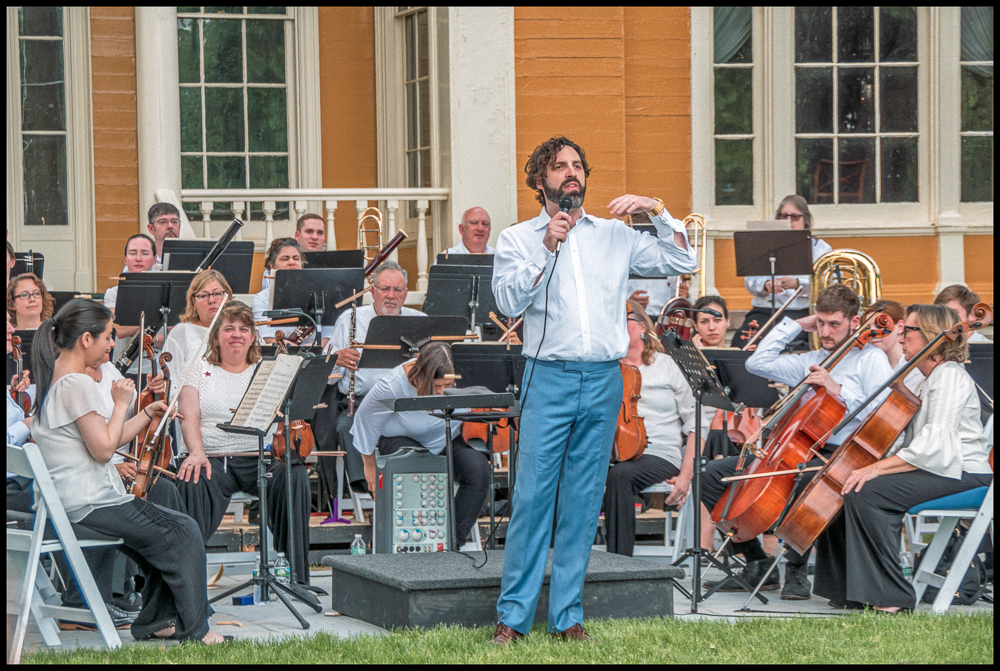
At the beginning of the concert The orchestra’s conductor, Russell Ger presents the evening’s programme: Jean Sibelius – Finlandia; Percy Grainger – Country Gardens; Johann Strauss – Blue Danube Waltzes; Ludwig van Beethoven – Symphony No. 5.
Taken with a Sony A77II and Tamron A18 AF 18-250mm f3.5-6.3.

About a month ago we went with friends to a symphony concert at Boscobel. It was given by the Greater Newburgh Symphony Orchestra on the lawn at picturesque Boscobel. Participants were invited to bring along a picnic to eat both before and during the concert.
According to the orchestra’s website:
2017-2018 marks our 23rd season, and the Greater Newburgh Symphony Orchestra has grown to become one of the most respected cultural resources in Orange County and the Mid-Hudson River Valley. Dedicated to presentations of great music performed by skilled musicians who are also your neighbors, the GNSO offers a full concert season, a highly regarded choral ensemble, educational outreach through its Side-by-Side program, and a glorious summer pops concert.
…
Founded in 1995 by Dr. Woomyung Choe, and led by George Handler and Fred McCurdy, the GNSO’s first presidents, the orchestra has succeeded in reaching wider audiences every year. This season we welcome our new Music Director, Russell Ger, to the podium, after an extensive, two-year search of over 100 candidates. Maestro Ger is dedicated to continuing the tradition of the Newburgh Symphony offering music that appeals to all ages and tastes – including exciting original compositions — is a hallmark of GNSO concert programming. Delighting young people is an essential goal, underscored by our free admission policy for students, a special Family Concert offered every January, the annual “Side by Side” concert where our orchestra members play alongside student musicians, and the magical “Pops” concert in July.
…
The majority of concerts take place in beautiful Aquinas Hall in Mount Saint Mary College in Newburgh. We also travel to venues such as Sugar Loaf Performing Arts Center, Newburgh Free Academy and other local high schools. The GNSO plays an educational role through the pre-concert previews offered by cellist Gordon Shacklett, who gives the audience an “inside look” at the pieces about to be performed.
Taken with a Sony A77II and Tamron A18 AF 18-250mm f3.5-6.3.

I generally use either fairly recent generation digital cameras (e.g. Sony A77II; Sony RX-100; Sony NEX 5N) or any of a quite large number of old/vintage film cameras. In this case the camera is also fairly old (I don’t know exactly how old, but the date on the accompanying manual is 2003), but rather than being a film camera it’s digital.
It’s a HP photosmart 433 and it was given to me by a friend. It’s quite small (4.6in x 2.2 in x 1.5in deep) and light (0.44lbs) and has a 3.1 megapixel, 1/27 inch CCD sensor and uses standard AA batteries.

Floating dock at Spur Beach.
It also has a tolerably large and bright optical viewfinder and a tiny (1.5 inch diagonal, 61,600 pixel screen). The lens is fixed focus with an f4.0 aperture. Shutter speeds range from 1/1.5-1/1000 seconds. The camera also has a built in flash with a range of 8ft.
Quality settings are: Super-fine JPEG 2048 x 1536; Fine JPEG 2048 x 1536; Normal JPEG 640 x 480. It also has video capture (.avi) at 320 x 240 – 15 fps. ISO ranges from 100-400.

Fisherman at Spur Beach.
Exposure compensation in the ±2 EV range, in 1/2 EV steps is available view a menu option.
Exposure is fully automatic and action and night (via the flash settings) modes are also available. There’s also a black and white mode and a self timer.
The camera does not offer an optical zoom. Instead a digital zoom (up to 3.0x) is provided.
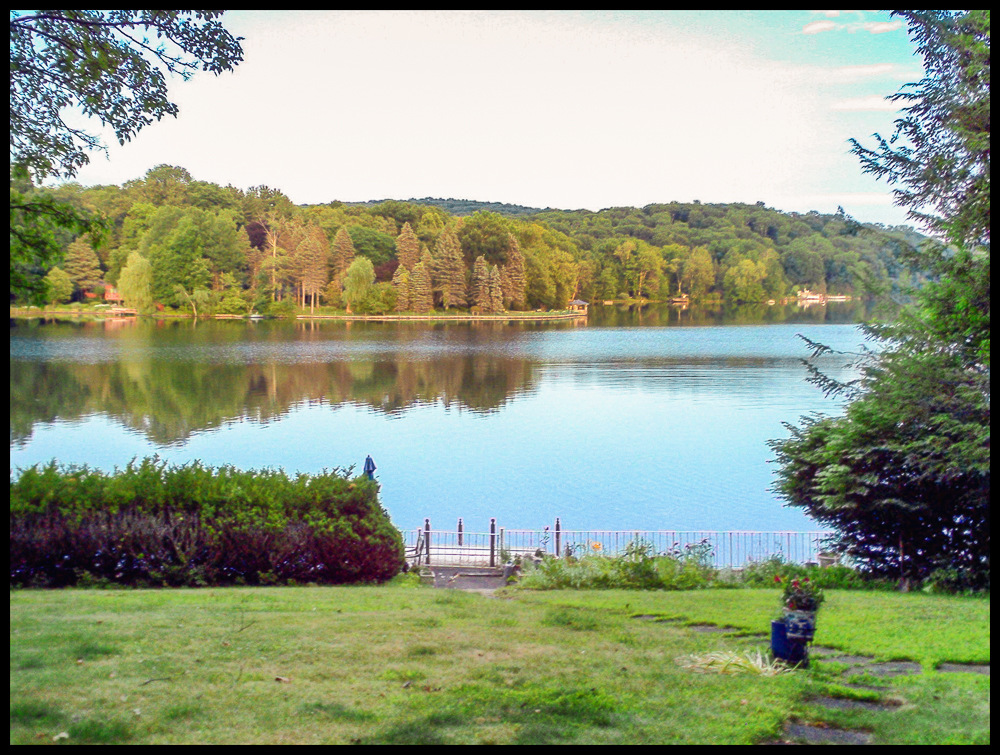
Lake view from our house.
Images are stored in memory (16mb) and on an SD card.
Digital Print Order Format (DPOF) support is also provided.

Floating dock at Moon Beach.
Why did I even try this antediluvian digital camera? Well, I like a challenge and I truly believe that it’s not the camera that makes a picture – it’s the photographer. I believe a reasonably competent photographer should be able to get a decent picture from any camera. How did I do? Probably I’m not as competent as I sometimes think I am and I wasn’t too pleased with the results. I didn’t really give myself a fair chance though. I took the camera with me while walking the dog and just took a few snapshots while walking around my neighborhood. I didn’t read the manual and I didn’t even go through the various, but few menu options available.
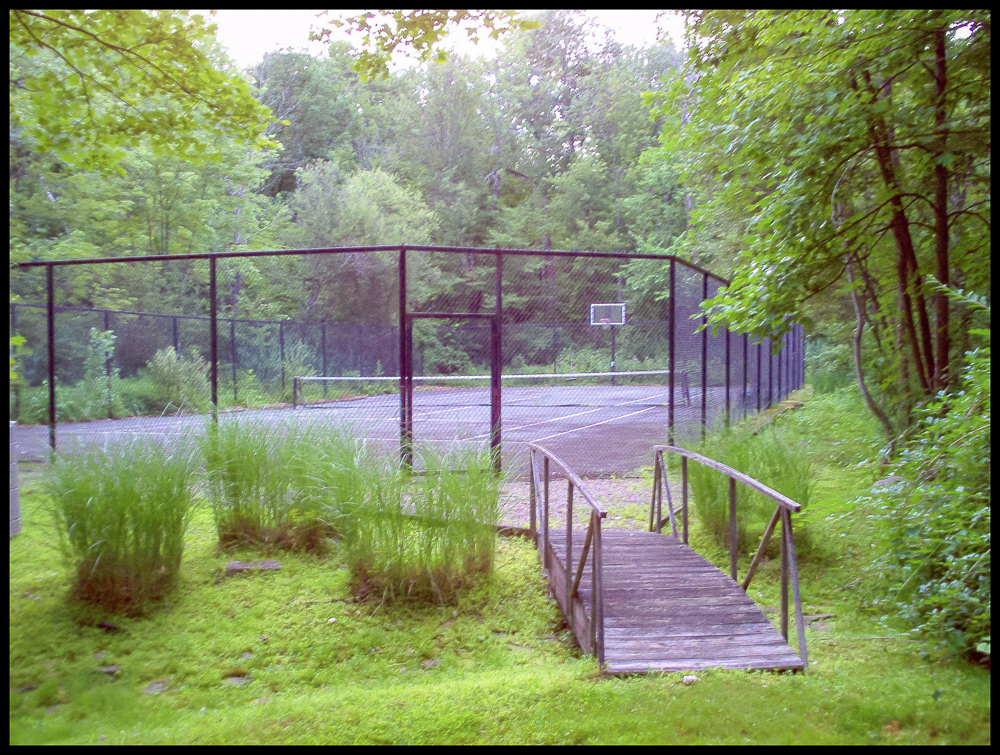
Tennis court.
The LCD is so small and has such a low resolution that it’s virtually useless. I hate digital zooms and so didn’t use it. The optical finder wasn’t bad, but I had to be careful to keep my finger away from the lens. The camera seems to have a very poor dynamic range: anything the least bit “contrasty” and the highlights were badly blown. Perhaps the exposure compensation could have helped here had I only known that it existed. I was also a bit frustrated that the camera resets a number (but not all) of the settings when you turn it off. I was particularly annoyed that the flash reset to auto when I always want it to be set to off (shades of the Olympus Infinity Stylus Epic). I only discovered later that by holding down the ‘OK’ button while turning on the camera will retain the settings from the previous session.

Guardian Lion.
By fully familiarizing myself with the camera; picking my subjects better; choosing to shoot in better light etc. I could perhaps get better results – but why bother. This particular camera is never likely to become my ‘go to’ camera. I might give it one more go before I put it out to pasture though.
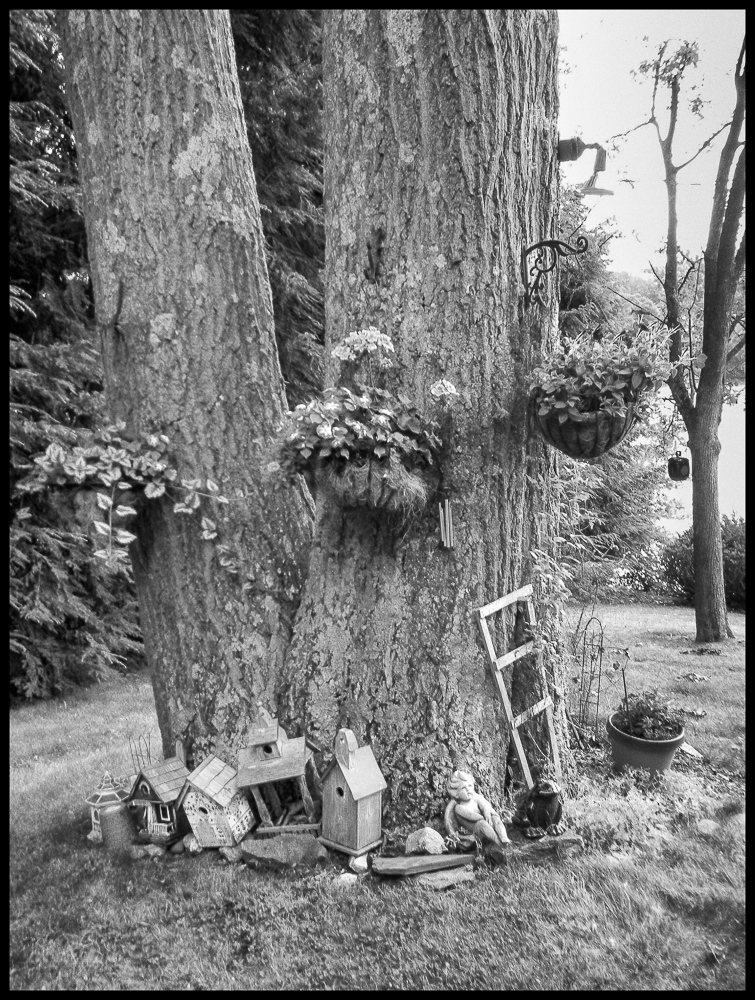
Around our tree. An example of the camera’s black and white mode.
One final anecdote to end this post. When my friend gave me the camera he initially wanted to keep the 32 gigabyte card that came with it. Unfortunately, I had to point out the it wasn’t a 32GB card but rather a 32 MEGABYTE card.

This little project (i.e. to document the variety of flowers growing along the side of the main road through our community) is starting to get a little difficult. I suppose there are only a limited number of such flowers and eventually I’ll run out of new ones (i.e. those I haven’t seen before). But not today. I’ve never come across this rather spectacular flower before. Apparently it’s a Common Milkweed.
According to the US Dept. of Agriculture Forestry Service:
Common milkweed is a member of the Asclepiadaceae (milkweed) family. It is one of about 115 species that occur in the Americas. Most species are tropical or arid land species. The genus name, Asclepias, commemorates Asklepios, the Greek god of medicine. Some of the milkweed species have a history of medicinal use including common milkweed (wart removal and lung diseases), and butterfly weed, A. tuberosa (also known as pleurisy root, used for pleurisy and other lung disease). The specific epithet, syriaca, means ‘of Syria’ in reference to Linnaeus’s mistaken belief it was from Syria. It is a widespread and somewhat weedy species known from most of the eastern United States and the eastern most prairie states as well as southern Canada from New Brunswick to Saskatchewan. It is frequently found in fence rows, on roadsides, in fields, and in prairies and pastures. Given the opportunity, it will establish in gardens and even thin lawns. It is tolerant of light shade, but generally is a full sun species.
This milkweed grows to about 1.5 meters(5 feet) tall, usually occurring in clusters of stout stems. It has rhizomes and quickly forms colonies. Leaves are 15-20 centimeters (6-8 inches) long and 5-9 centimeters (2-3.6 inches) wide. They are somewhat thick with a prominent midrib beneath. The upper surface is light to dark green while the lower surface is lighter, almost white at times. Broken leaves and stems exude a milky latex. Flowers are borne in nearly spherical clusters (umbels) at the top of the plant, usually with 2-5 clusters per plant. Each flower is about 2 centimeters (0.75 inches) long and 1 centimeters (0.4 inches) wide. Flowers are greenish-pink to rosy pink to purplish-pink and very strongly and sweetly scented. Fruits (pods) are about 10 centimeters (4 inches) long, inflated and covered in little finger-like projections. They are green initially, turning brown as they mature. They split open revealing 50-100 seeds each with a white, fluffy coma (“parachute”) that allows wind dispersal.
Common milkweed is Nature’s mega food market for insects. Over 450 insects are known to feed on some portion of the plant. Numerous insects are attracted to the nectar-laden flowers and it is not at all uncommon to see flies, beetles, ants, bees, wasps, and butterflies on the flowers at the same time. Occasionally hummingbirds will try, unsuccessfully, to extract nectar. Its sap, leaves and flowers also provide food. In the northeast and midwest, it is among the most important food plants for monarch caterpillars (Danaus plexippus). Other common feeders are the colorful (red with black dots) red milkweed beetle (Tetraopes tetraophthalmus), the milkweed tussock caterpillar (Euchaetes egle) and the large (Oncopeltus fasciatus) and the small (Lygaeus kalmia) red and black milkweed bugs. The latter two are particularly destructive as both the adults and nymphs are seed predators. They can destroy 80 to 90 percent of a colony’s seed crop. The red (or orange-red) and black coloration of most of these insects is known as aposematic coloration; that is, the colors advertise the fact that the organism is not good to eat.
Milkweeds contain various levels of cardiac glycoside compounds which render the plants toxic to most insects and animals. For some insects, the cardiac glycosides become a defense. They can store them in their tissue which renders them inedible or toxic to other animals. Monarch butterflies use this defense and birds leave them and the caterpillars alone. What the birds do not know is that northern monarchs feeding on common milkweed accumulate relatively little of the toxic compounds and probably would be edible. The more southern butterflies accumulate large amounts of the compounds from other milkweed species and are in fact toxic. Monarchs can be helped by encouraging existing patches and planting new ones. The plant grows readily from seed and spreads quickly by deep rhizomes. Because common milkweed can be weedy and difficult to remove, care should be used to establish the plant only in places where spread can be tolerated.
Taken with a Sony RX-100 M3.