Voigtlander Vitomatic II

It’s almost a year since I posted anything related to my camera collection. This doesn’t mean that I haven’t acquired additional cameras. It’s mostly because at some point I decided that I wouldn’t post anything to do with the cameras in my collection unless I could also include some pictures taken with the camera. Unfortunately, the cameras I collect are all film cameras and for some reason I haven’t been doing much film photography of late even though I enjoy the experience of shooting film a lot.

So I’ve been forced to rethink the decision mentioned above. I’ll now post pictures of the cameras themselves and if/when I get around to using them I’ll do another post with the pictures taken.

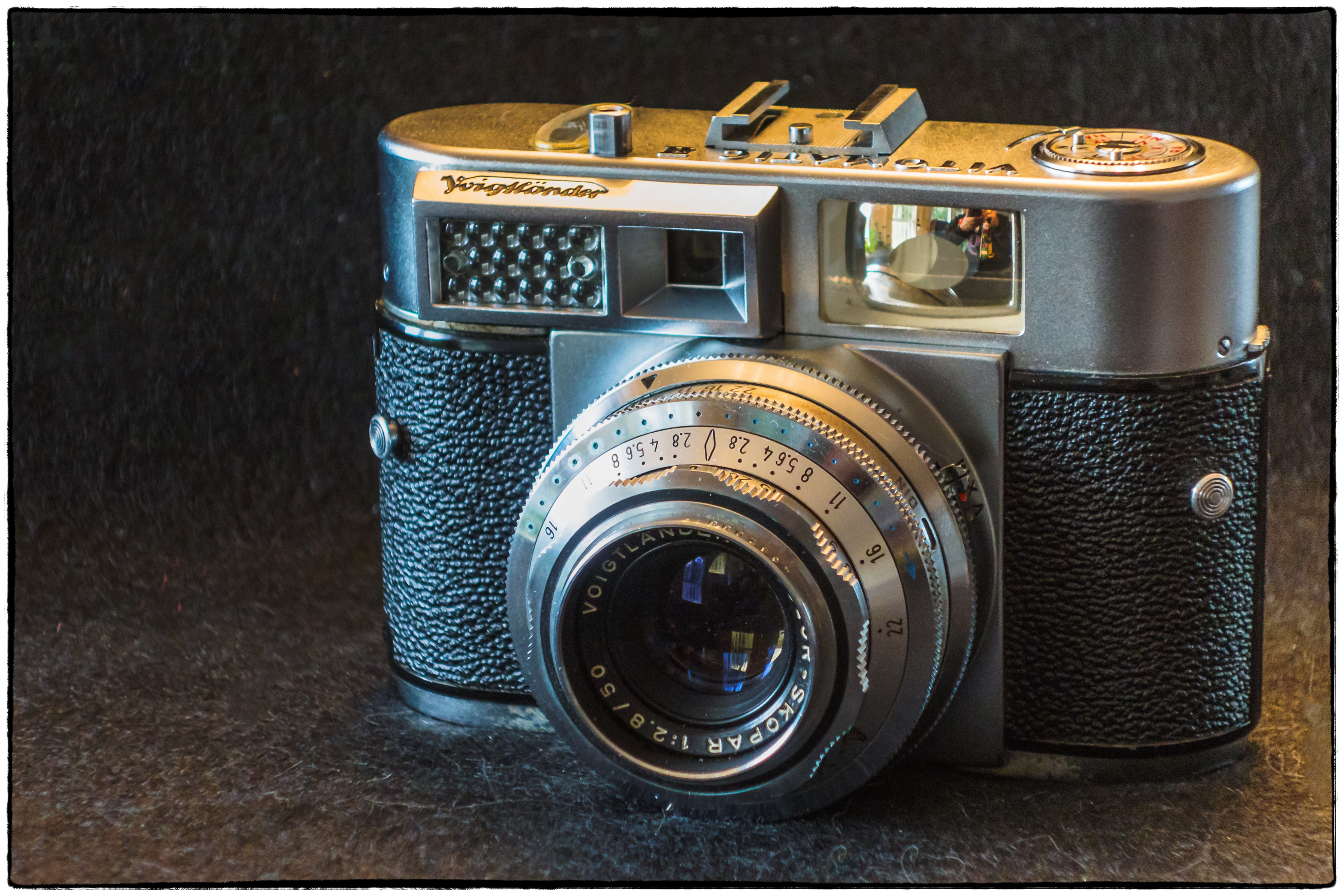
This is one of my latest acquisitions: a Voigtlander Vitomatic II from the late 1950s. It’s solidly made from metal and for a camera of its size (quite small) it’s quite heavy. It has a coupled rangefinder and meter, both of which seem to be working even though the rangefinder patch is a little dim and I’m not entirely convinced that the meter is accurate (which doesn’t bother me since older selenium cell meters rarely work at all and in any case I have a meter I can use). I suspect that the price was good because the seller thought that the shutter wasn’t working. I took a chance on this not being the case as I’d read that because of a peculiar shutter cocking mechanism the shutter won’t cock and fire without a film in the camera. This turned out to be the case and the shutter seems to be working fine. It has a Voigtlander Color-Skopar 50mm f2.8 lens with apertures from f2.8 to f22. I have a modern Color Skopar lens and if it’s anything like that it will be an excellent lens. Shutter speeds top out at 1/300 second, which is fine for me. I don’t do much ‘action’ photography. Cosmetically it’s in pretty good shape. It has a large viewfinder with bright lines.

It’s a beautiful camera. In fact I’m thinking of collecting some of these 1950s/1960s Voigtlander and Zeiss cameras. I love the way they look, they’re pretty well made and are often still working even after all this time. Also most of of them don’t cost a lot, particularly in the condition I’m looking for (I’m not looking for mint condition). This is an important factor as most of the cameras I now want cost more than I’m willing to pay. There are many variants of Vitos, Vitomatics and the like and I could see myself getting a few of these. I’ve got my eye on a Vito B, first version with the smaller viewfinder.

Touching photographs of Horace Warner’s ‘Spitalfields Nippers’

30 Astonishing Portraits of London Street Children from the Early 1900s by Horace Warner via Vintage Today

Wikipedia describes Spitalfields in the late 19th century as follows:

By the later 19th century inner Spitalfields had eclipsed rival claimants to the dubious distinction of being the worst criminal rookery of London with common lodging-houses in the Flower and Dean Street area being a focus for the activities of robbers and prostitutes. The latter street was dubbed in 1881 as being “perhaps the foulest and most dangerous street in the metropolis”. Another claimant to the distinction of being “the worst street in London” was nearby Dorset Street, which was highlighted by the brutal killing and mutilation of a young woman named Mary Kelly in her lodgings here by the serial killer known as Jack the Ripper in the autumn of 1888.

This is where the children in these pictures lived. There are signs of hardship and unhappiness. Some of the children are obviously working. Many of them have bare feet. But there are also smiles and playfulness. Children can be remarkably resilient and even in the harshest of conditions life goes on. Although too much poverty still remains, thankfully the worst excesses of Victorian London are now behind us (I hope).

Spitalfields Nippers by Horace Warner (Published by Spitalfields Life Books)

Impressions of a pieta

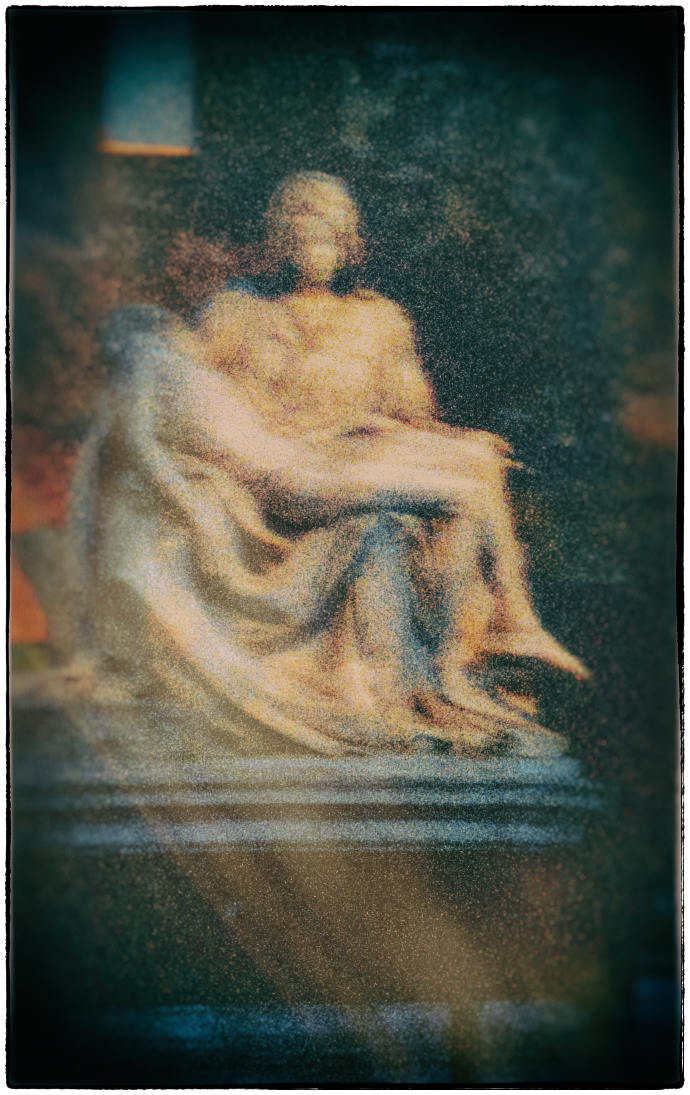
My wife posts old pictures on Facebook every Thursday. She calls it ‘Throwback Thursday’. My job is to provide the raw materials, which often requires scanning old prints and negatives. A recent ‘Throwback Thursday’ covered Italy – or at least Rome, Florence and Venice. So I set about scanning some old negatives, one of which was of the Michelangelo Pieta in St. Peters, Rome. This was a really bad picture taken many years ago when my technical skills were even less developed than they are now. It’s extremely dark, blurred because of the very slow shutter speed, and very grainy. I couldn’t include it in her ‘Throwback Thursday’, but it did give me something to play around with. By deliberately increasing the blur and bumping up the ‘graininess’ could I make this into something almost impressionistic. I also added some light streaks. So does this reflect a new direction in my work. Something more ‘out of the box’ going beyond my usual cliche’d images? Is this a more artistic Howard? Nah! Still just a lousy picture. Proves once again that “You can’t make a silk purse out of a sow’s ear” or in this case you can’t produce Monet from a digitally enhanced awful photograph. Although as I look at this again it’s starting to grow on me …..