This is one of two Civil War memorials in Ossining. The other one is more visible (it’s on the corner of Pleasantville Road and Brookville Ave) and I’d seen it on numerous occasions, but this one is “hidden” in a small park near Route 9. The Field Guide to US Public Monuments and Memorials describes it as follows:
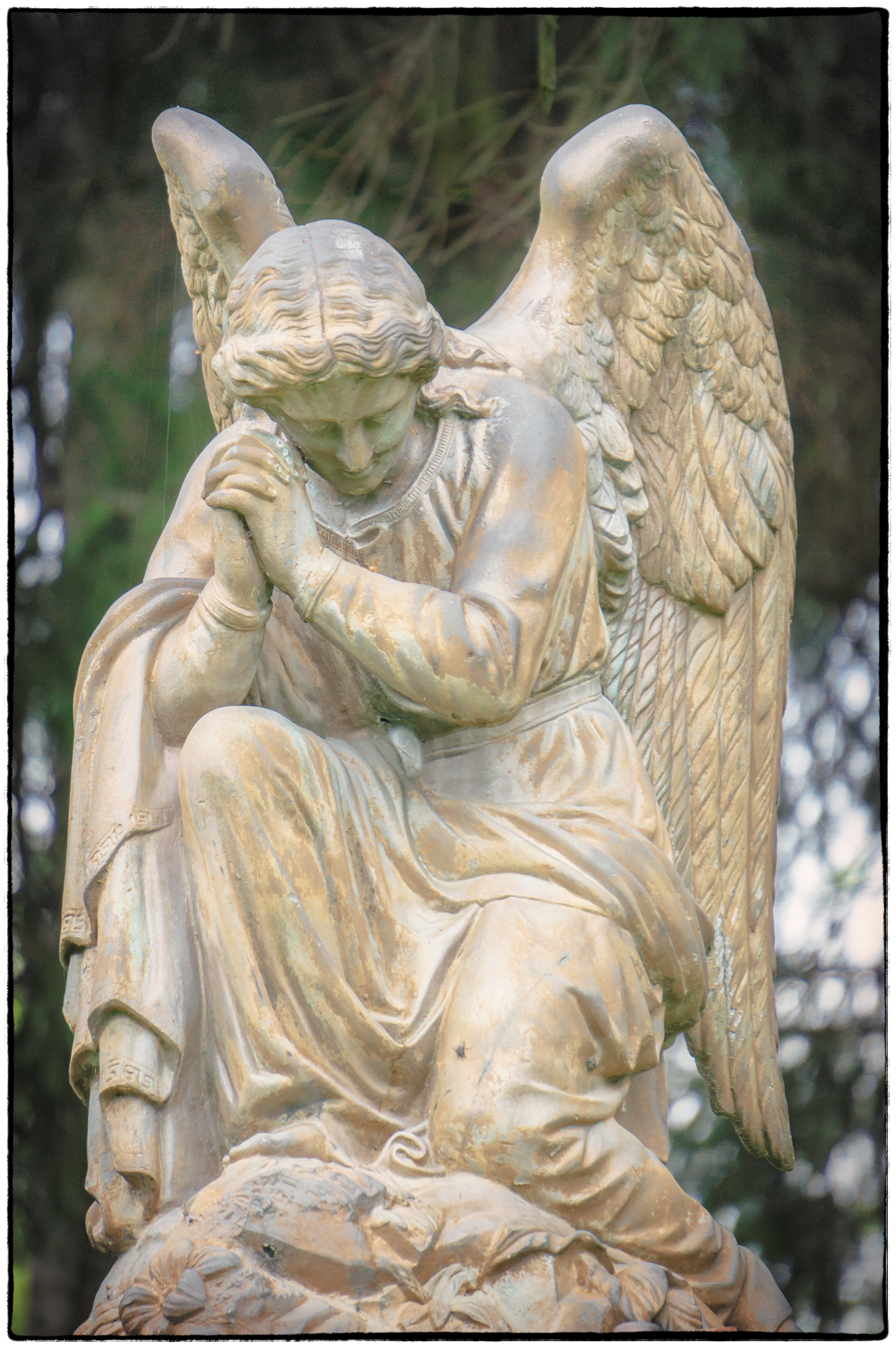
The monument remembers soldiers of Ossining, New York, who died fighting in the Civil War. Those killed were men, both privates and officers, most from the 17th U.S. Volunteer Regiment and the 6th U.S. Heavy Artillery. At the memorial’s highest point, an angel in full-length gown displaying wings is down on one knee with head bowed and hands folded, mourning and honoring those who perished in the fighting. Kneeling Angel is one of two Civil War remembrances in Ossining. The angel, surmounted on a pedestal of granite and marble, is cast in “white bronze.” This description partly obscures the detail that this material is not actually bronze (an alloy of copper and brass); but rather, it is comprised of copper, tin and zinc. The pedestal design presents in three sections. Its lowest is its base; in an older picture from the Westchester County Historical Society, the stone base seems a well polished, variegated marble. The pedestal’s second and third sections, following Scharf, are comprised of “two massive blocks of granite….” The lower contains inscriptions and plaques with the names of the war dead; two bronze, profile bust-view relief plaques, evidently painted brown, on the north-facing panel that of Lincoln and on the south-facing, a uniformed Civil War soldier. The upper pedestal section displays bunting, flags, cannon and drums. These three sections are capped by the kneeling angel. Neither artist nor maker(s) appear to be known. While the monument’s design and sculptural program are multi-dimensional and far-reaching, the work’s general deteriorated condition seems to suppress further impression-making.
After the close of the Civil War – Scharf states “shortly after,” Hernandez puts it at “1870,” a Ladies’ Monument Association emerged in the town of Sing Sing (now Ossining), formed by women seeking to erect a monument to remember and honor the men who had died in the conflict. (The year 1870, then, is the assumed Start of the monument’s creation process.) By 1872 the group had raised enough money to put the monument’s cornerstone in place, which it did on July 4, 1872. In order to continue to the next development stage, the Ladies Association and local Civil War veterans combined forces and created the Monumental Dramatic Association. This group put on entertainments, plays, which allowed them to raise further funds so they could complete the monument; they did so, in spite of difficulties, and on May 30, 1879, the monument was dedicated. The dedicatory ceremony was witnessed by a large group of townsfolk and others – veterans under the Grand Army of the Republic banner as well as local militia units, state and local officials and many civic, fraternal and religious organizations.
The monument is situated in Nelson Park, near the cross of Washington Avenue with U.S. 9 (also known as the Albany Post Road or, locally, South Highland Avenue). Originally, the Kneeling Angel was placed at the junction of Church and Main Streets, in the downtown area of Ossining. The monument was relocated in April, 1884 to the old Park School grounds, and later, when a new Park School required building, in 1939, the monument was situated across Edward Street to Nelson Park. In Nelson, it was placed initially in its “lower” part. Today, the memorial, along with other monument works, graces its eastern sloping edge.