Yashica TLR

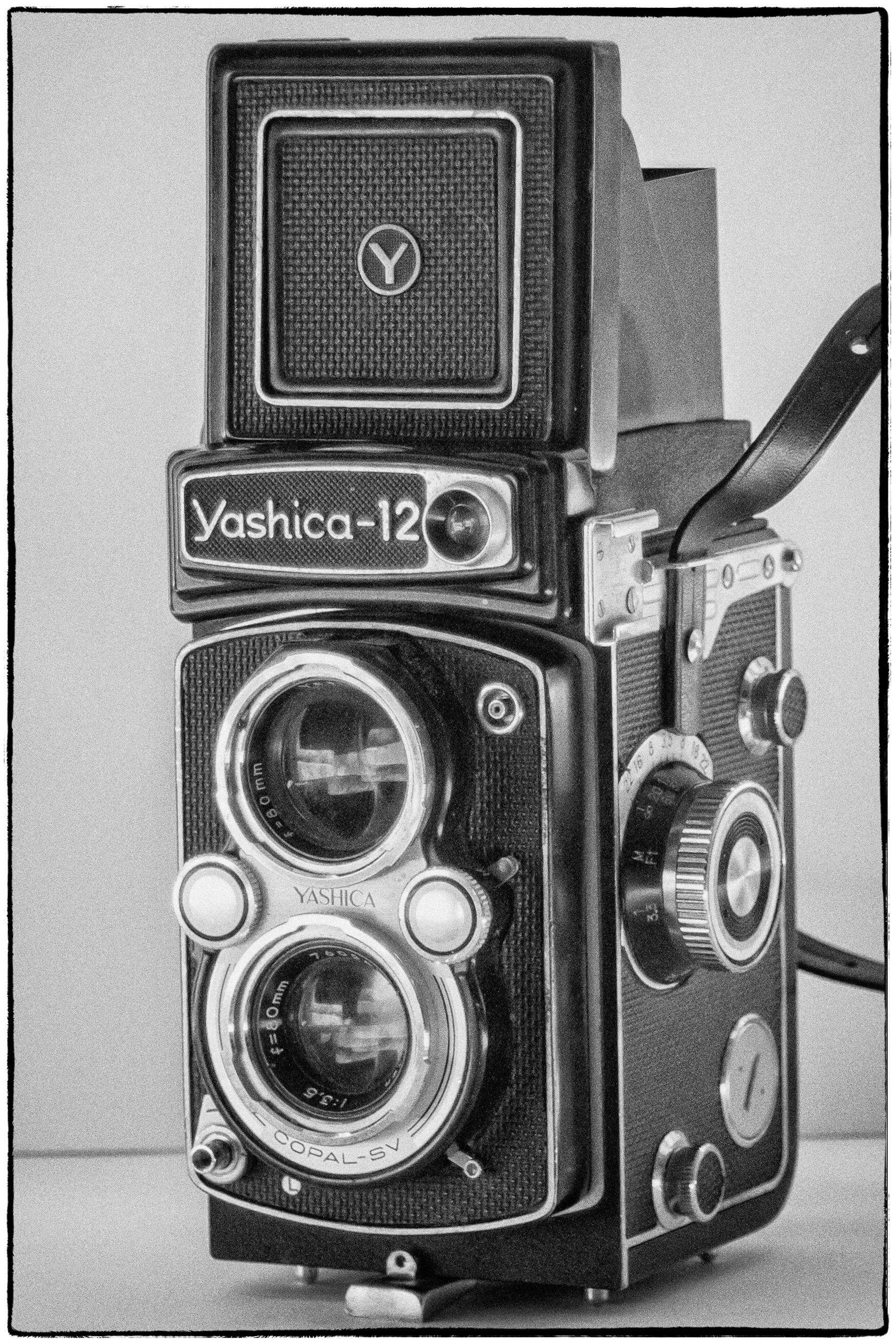
Of late I’ve developed an interest in Twin Lens Reflex (TLR) Cameras (above my own Yashica 12 – unfortunately not working because of a stuck shutter. I’ll get it fixed one of these days). A couple of days ago I was browsing around and I came across this very useful resource related the many models produced by Yashica. The Yashica TLR site describes itself as follows:

The first camera made by the fledgling camera maker, Yashima, later to adopt the name of its Yashica cameras, was a twin lens reflex (TLR) taking twelve 6 cm x 6 cm negatives on 120 format film. Like most other Japanese TLRs, it was patterned on the German made Franke & Heidecke Rolleicord and used a separate viewing lens matched to the taking lens below it, the camera front panel moving in and out to achieve correct focus. The view through the waist level finder is very similar to what the taking lens is seeing except that the view is correct side up but reversed left to right, courtesy of the 45 degree mirror (hence “reflex”). Yashica went on to make movie cameras, sub-miniature cameras and various categories of 35 mm cameras and in 1959, it even claimed to be the “largest manufacturer of cameras and photographic products in Japan”, but the offspring of the first model would continue in production for the next 33 years.

This site is dedicated to understanding and preserving the details and development history of the company’s TLR cameras from the first model Pigeonflex introduced in early 1953 through to the Yashica Mat-124G which ended manufacture in 1986:

A new look

As may be apparent I’ve changed the look of the site.

Last Saturday I started to experience severe performance problems. It was taking an inordinate amount of time to load a page and as often as not I would get an error message of some kind. So I sent a message off to my web hosting company. However, before I could get a response from them I started tinkering. First I tried a couple of things on the server. The error log told me there was some problem with ‘php55.cgi’. I took a look at my various domains and noticed that they all seemed to be using PHP 5.6 except for this one which was using PHP 5.5. So I changed it use the more recent version. Didn’t help.

Then it occurred to me that it might well be a problem with WordPress (which I was responsible for) rather than a server related problem.

I tried an automatic upgrade to the latest upgrade to WordPress and something went badly wrong. I suspect that with all the performance problems the upgrade aborted in mid course (without telling me of course) so some of the files were from the old version and some from the new – never a recipe for success! Now nothing worked so the only thing I could try was a manual re-install, which I did. Things were now much better except that I was getting error-messages related to the theme I had been using. I had been tiring of the old theme anyway. It as a bit graphics heavy and the sliding graphics seemed a bit too flashy and in any case seemed only to repeat the textual menu. So I decided to look for something simpler and came across this one, which I’ll use for now. It looks fine on my laptop and I like the way it seems to emphasize the images rather than the text, but when I checked the site on my ipad I noticed that the top menu wraps in a, to me, very unattractive way. So I may change it again if I can find something better.

I may make some other changes too – including downplaying the role of the blog, adding a static front page and other pages of galleries/portfolios. This probably won’t happen for a while though. I spent most of yesterday fixing the above problems and I’m not in the mood for another marathon session.

A carousel

This was taken in Bryant Park (behind the NY Public Library on 42nd street) and as I recall I was practicing panning the camera.

I like the bright colors and the somewhat spooky, surrealistic look of the photograph. The head of the horse is pretty much in focus, but pretty much nothing else is. The panning seems to have not only blurred the photograph, but also distorted it in ways that reinforce the surrealistic look, as do the strong shadows.

Once I got past the fact that not much of the picture is sharp I found I that rather like it.

For those interested in the history of photography

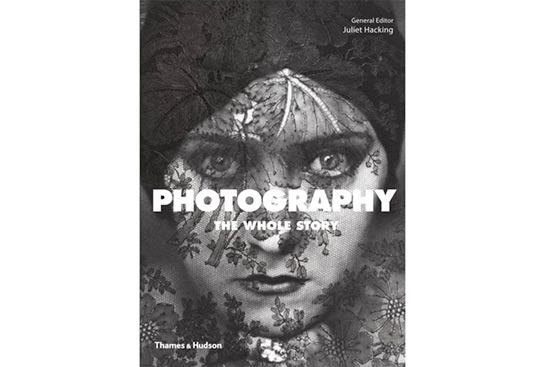
For those interested in the history of photography I can heartily recommend Photography – The Whole Story; general editor: Juliet Hacking; foreword by David Campany; 30+ contributors; 576 pages; Prestel; 2012. The Conscientious website reviewed it and I agree whole-heartedly with the points made in the review:

Much to my delight (“delight” isn’t a word I use very often) I recently discovered Photography – The Whole Story. Edited by Juliet Hacking, the book was produced featuring over 30 contributors (art historians, curators, writers). In a nutshell, a specialist for any given period or subject matter writes about just that. On top of that, the book is organized simply around time frames, with subject matters/topics then covering those. That might just be the simplest way to do it. The writing in the book is compelling and a joy to read, avoiding tedious jargon where possible, while never being superficial or simplifying.

On top of all of this, the book presents quite a few individual photographs in detail. These sections are what makes this book stand out. The general background of the photograph is explained. The artist is – briefly – introduced. What is more, four to six sections/parts of the photograph are discussed in more detail: Technical details, historical details, poses, compositions, whatever might be of relevance. Of course, learning about photography has to involve learning how to look at photographs, and Photography – The Whole Story does a wonderful job doing just that for dozens and dozens of historical photographs, some well known, many others not.

The book thus teaches the history of photography not as a large number of facts and names, which, let’s face it, are hard to remember. Instead, it uses a large number of photographs created over the course of that history, tying those photographs to what matters. Learning the history of photography has to mean seeing and understanding a lot of photographs, both how they operate as photographs and how they’re tied to the underlying history. Photography – The Whole Story superbly does just that. Given its focus, writing and design, I think it will have a large appeal for a general audience, people interested in the history of photography. For anyone seriously interested in photography, the book is a must have, must read. Highly recommended.