Edward Steichen. A Life in Photography

J.P. Morgan photographed by Edward Steichen in 1903; photo known for the light reflected off the armrest being interpreted by viewers as a knife. Source: File:JP Morgan.jpg – Wikimedia Commons

This is another book I received as a birthday present. Unlike many of my of photography books this is less a book about Steichen than it is a book by Steichen. It’s full of interesting anecdotes and is lavishly illustrated with his photographs. The problem with such a book is that it’s hard to tell how objective it is. It’s clear from the book that he had a large ego. Does this get in the way of being honest about his work. I’m not sure how I feel about his pictures. While impressive, they somehow leave a me a little cold.

Pictorialist photographer; military documentary photographer; portrait photographer; fashion photographer; photography curator. Steichen is described in The Frustrating Genius of Edward Steichen by Frank Van Riper as follows:

In short, during his nearly 94-year life, Edward Steichen had not one but four, five, even six, separate careers. After the war for example, as director of photography at the Museum of Modern Art in New York, Steichen mounted what many have called the greatest photography exhibit of all time: the monumental “Family of Man” show, featuring 503 photographs from 273 photographers in 68 countries. (To be sure, the life-affirming show, mounted at the height of the cold war in 1955, was derided immediately by some critics as mawkish and superficial – and was savaged by some of Steichen’s younger photographic colleagues. It says something about the staying power of this exhibition, however, that its catalog not only remains in print, but also is a bestseller, after nearly a half century.)

I found myself wondering what would have happened if he’d had one overwhelming passion that he had devoted himself to. Would his pictures have had more emotional impact that they did spread over so many different areas? Of course we’ll never know.

Still – a great photographer and I thoroughly enjoyed the book.
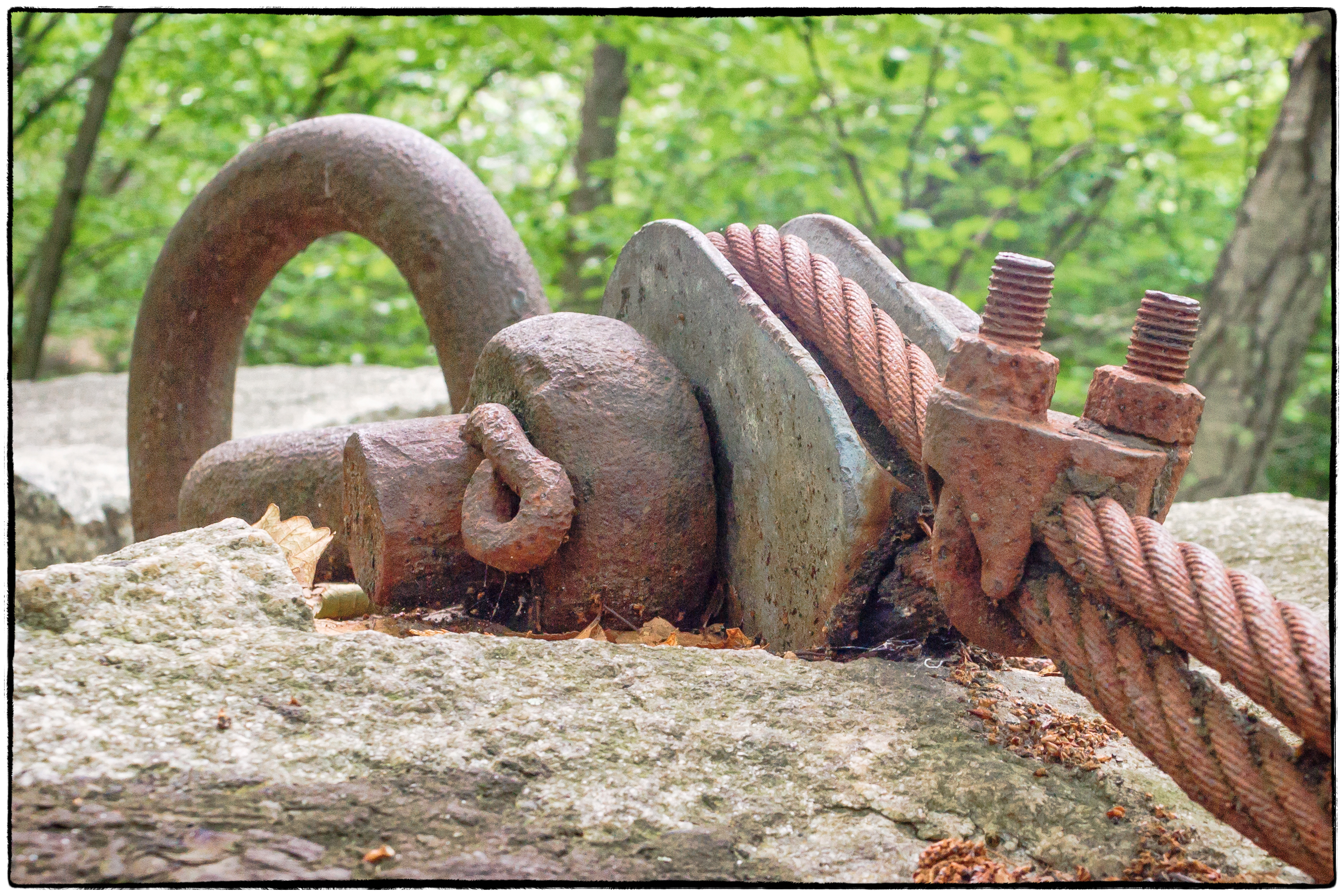
Rusting machinery at Sylvan Glen Park Preserve

I’ve been to Sylvan Glen a few times, most recently in 2014. It’s an interesting place to visit. Rusted metal cables, abandoned pieces of equipment, huge discarded slabs of granite, and an explosive shed are a few of the remains along the trails in Sylvan Glen Park Preserve, the site of a former quarry. Although I’ve never seen them there’s also supposed to be a lime kiln and a cave used by the famous Leatherman who is buried in Sparta Cemetery, Ossining.

According to the web site of the Yorktown Historical Society:

The park is the site of the largest single industry known to the Town of Yorktown. After generous deposits of granite with unusual rich mellow tones of coloration were discovered in the area, quarries were established, probably as early as the 1850’s. It was not until after the turn of the century, however, that the site was exploited to its fullest. The period of greatest activity was from 1900 to 1940. The quarries were operated by various owners – all of whom called their product Mohegan Golden Granite. The last owner, operating the quarries throughout the period of greatest production, was Grenci and Ellis, Inc. Granite from the Mohegan Granite Quarries was used in the construction of the Cathedral of St. John the Divine, the main entrance to the City Bank-Farmer’s Trust Co. building at William Street and Exchange Place (NYC), the New York State Office Building – including the carved Great Seals of the State and City of New York (NYC), the Arlington Memorial Bridge (Washington, D.C.), the Westchester County National Bank (White Plains), the Memorial to (poet) Eugene Field (NYC) and many other buildings, mausoleums and memorials. Barracks and commissaries were built to accommodate the hundreds of laborers attracted to the area. In full production during the ‘20’s, it was not unusual to have two $1,000,000 jobs running at the same time with two hundred men employed for a total weekly payroll of $15,000!

Glass marbles

A neighbor gave us some irises from his garden as a welcome back gift for my wife. They came in a glass vase (which we’ll return to him) full of colored glass beads. Seeing them on the table I thought the shapes, patterns, colors and the smooth textures were appealing and decided to make this picture. To enhance the overall effect I took a flashlight and placed it behind the vase shining through the vase towards the camera.

Taken with a Sony Alpha 500 and Tamron 18-250mm lens, f16 at 0.4sec and the camera on a tripod.