February film camera – Minolta 70W Riva Zoom

I got this camera, (along with four other film cameras), from an old friend who visited us in May 2014 (see: Cameras Galore). She knew I was into camera collecting and thought I would like them.

I put a film (or so I thought – more on that in a bit) in it, took a few shots outside our house and then put it aside. I mentioned in an earlier post (see: Back to film – Fuji GS645S) that I’d made a New Year’s resolution to try to use one of my film cameras every month. I was thinking about what camera to use for February when I remembered that this one already had a film in it. Might as well use it I thought.

Out it came. I turned it on…nothing. Dead as a doornail and yet I remembered that it had worked when I’d tried it before. Maybe the battery died? It took me a while to get a new battery, but eventually I found one. In went the new battery. I pressed the on/off button…still nothing. It seemed like it was for the garbage, but I left it for a while next to my computer perhaps hoping for divine intervention. Every so often I would press the on/of switch to no end and then suddenly after another press…click! whirr! the camera turned on, lens extended and the flash popped up. Maybe I was right about that divine intervention. I turned it off again and pressed the on/off switch once more…nothing. Obviously a dodgy on/off switch, but at least I now knew that, under the right circumstances, it would turn on. Eventually I figured out that if I pressed the on/off switch in a certain way it would turn on. I can now reliably turn it on after on a couple of presses. Interesting it always turns off after a single press.

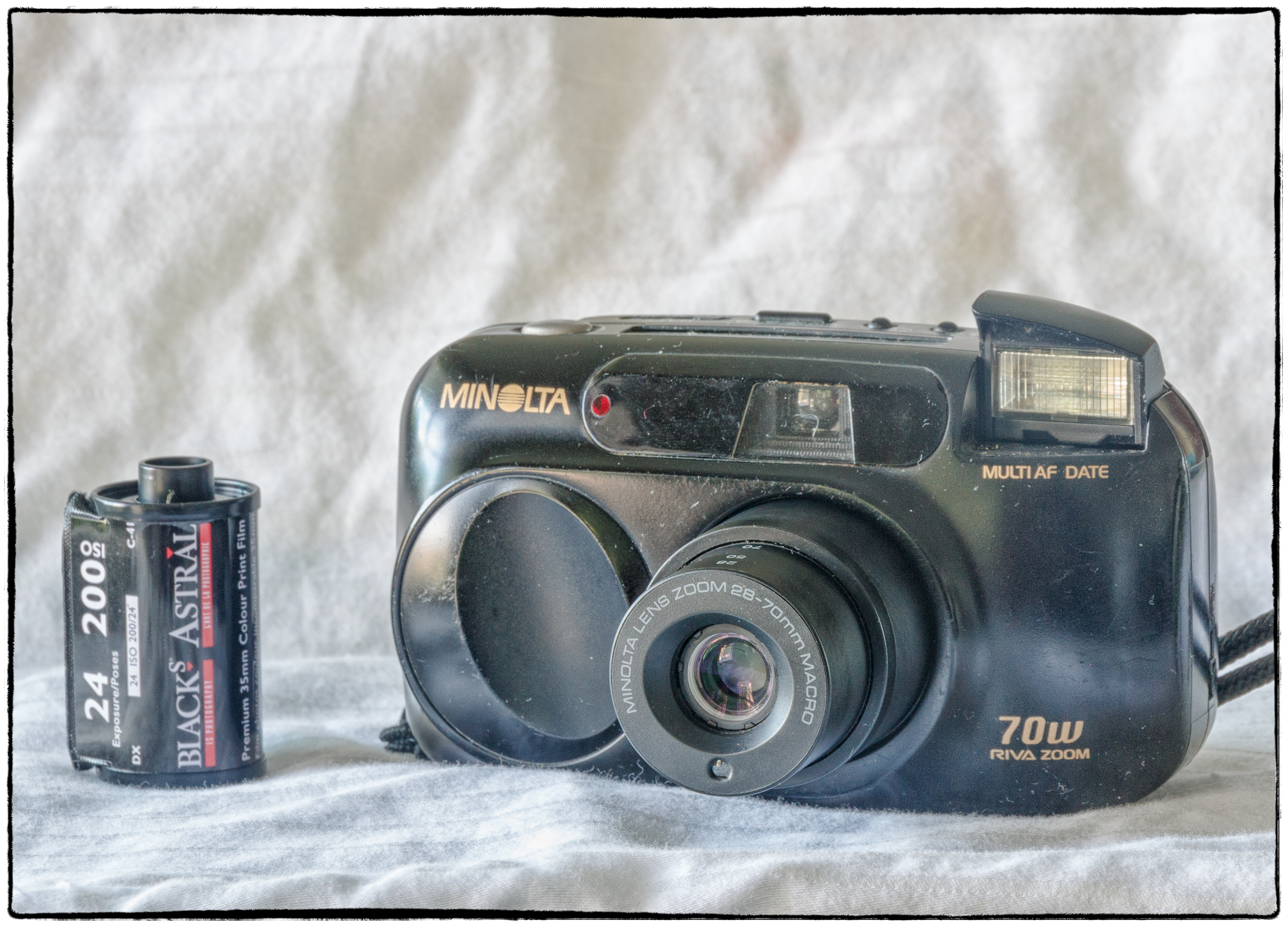
Off I went to take some pictures. Nothing special. Just a few shots around our lake. I got up to the fifteenth exposure and then…Click! Whirr!, Whirr!, Whirr!, the camera rewound. After it had fully rewound I opened the back and took the film out. What on earth…Black’s Astral ISO 200, 24 exposure. I’d never heard of the brand and I never use ISO 200 film. I ‘googled’ it and discovered it was the store brand of a now defunct chain of stores in Toronto. That made sense as my friend is Canadian. I thought I put the film in the camera, but I now realize that it was in there when she gave it to me. Moreover, she hasn’t lived in Toronto for quite some time so it’s possible that this film dates back to a time before I met her, and I’ve known her for over 25 years. Anyway the film is going off to be processed. I’m not optimistic about the results.

Once I got past the dodgy on/off switch the camera worked fine (or at least gave the appearance of doing so). It feels solid, if a little chunky. The lens is a 28-70mm (f3.5-f8.9). It’s a pretty simple camera to use. There’s a rocker switch for the zoom and a series of small buttons on the top. On the left there’s a button to set the flash options (auto; red-eye reduction; manual fill-flash; and flash). The next button to the right activates the self timer; the optional remote control; and the continuous drive mode (the manual explains that with the flash off the shutter will fire every 1.2 seconds.). Then comes a button to select from the various programme/scene modes (auto; macro; night portrait; and landscape/night view). Mine is the date model so there are really tiny (you need a pen or something like it to press them) buttons to set the date and time.

The camera was called the Minolta Explorer Freedom Zoom in the US so mine seems to be the European Version. There’s a fairly extensive review of it on 35MMC entitled Minolta Explorer Freedom Zoom (Riva Zoom 70W) – Guest Review by Benn Murhaaya. It’s not very positive

What I disliked most about this camera is that I have absolutely no idea what’s going on, particularly what aperture and shutter speed the camera had chosen. All you see in the viewfinder (which in my example has a small scratch and a lot of dust) is a green light (indicating that focus has been achieved when you half-press the shutter release) and a yellow light (steady light indicates flash is on; flashing light indicates too slow a shutter speed; rapid blinking indicates flash is charging) I suppose that’s true of pretty much all, inexpensive point and shoot cameras.

I now realize that the only reason I chose to use this camera was that when I got it it already had a film in it. I probably won’t use it much (if ever). When I get the processed film back I’ll check to see if the results suggest the camera is working well. I’ll also check to see if any poor results are a consequence of using antediluvian film rather than other factors (e.g. lousy photographer). If the former is true I might give the camera another chance with a fresh film.
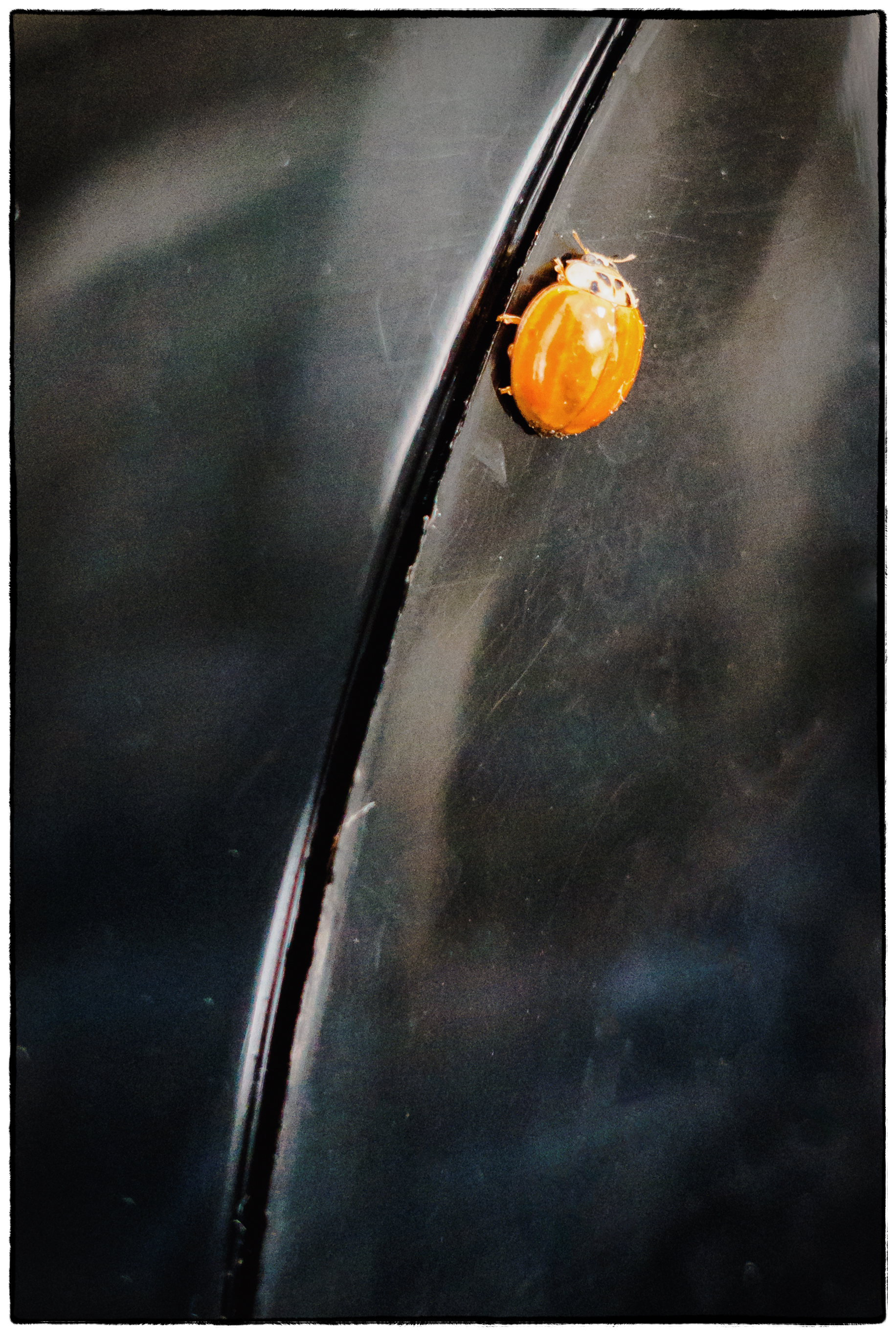
Ladybugs

I was sitting in the kitchen of our house in Briarcliff Manor yesterday when I noticed a number of ladybugs. Many of them had gone to that great ladybug home in the sky, but a couple of them were still ambling around.

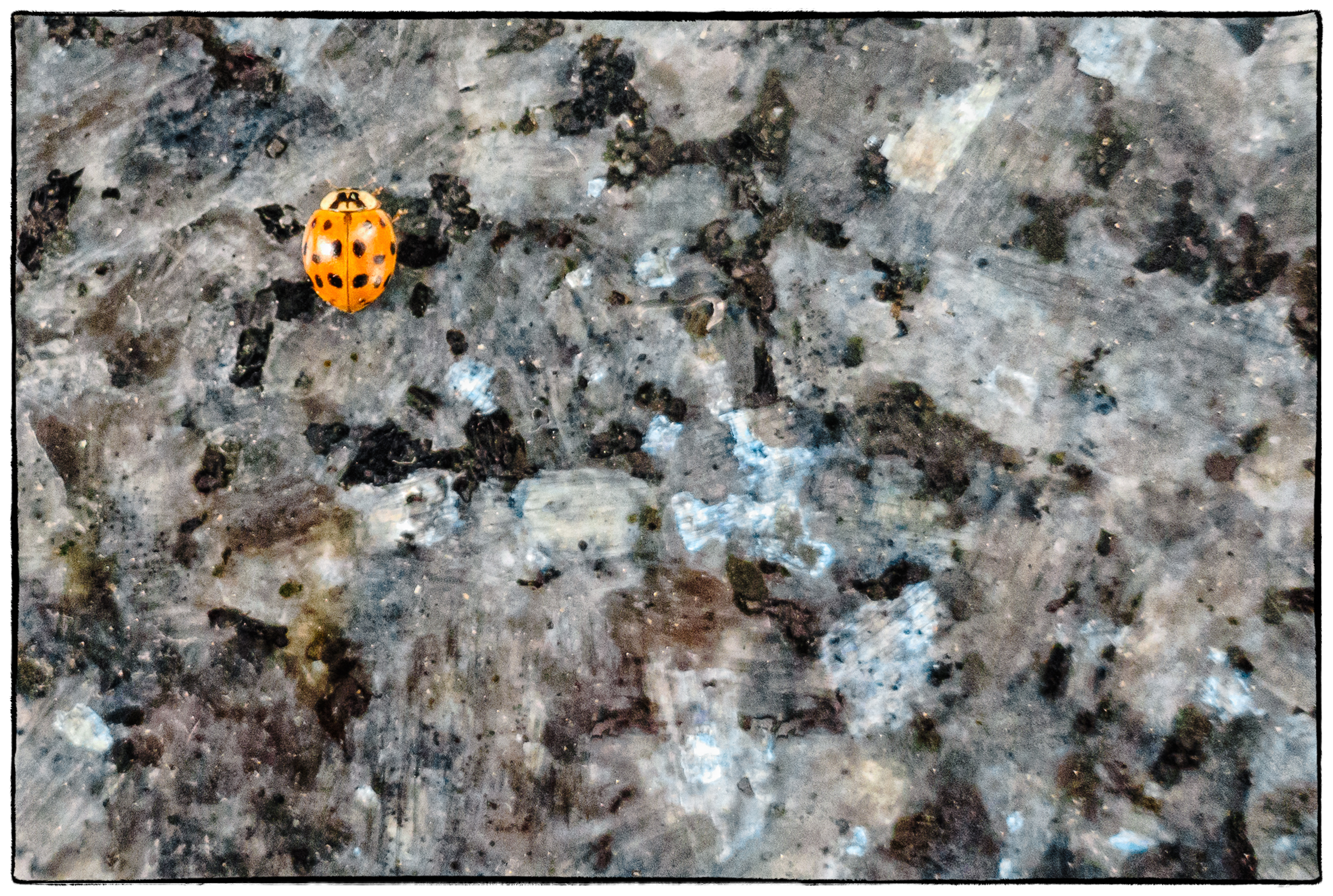
The one above was walking along our counter top. The one below was climbing up our electric kettle. Unfortunately I was using it to make my ‘nice cup of tea’ as the British almost invariably say it (I’ve never heard anyone say ‘how about a truly horrible cup of tea?’ although such a statement would have been true in the case of tea made by my father – it really was the worst I’ve ever tasted). I guess as the kettle warmed up the ladybug began to feel uncomfortable as he/she/it flew of to a window sill.

Apparently the name is incorrect though. According to wikipedia: “Coccinellids are known as ladybugs in North America, and ladybirds in other areas (Note: that’s what we call them in the UK). Entomologists widely prefer the names ladybird beetles or lady beetles as these insects are not classified as true bugs.” There’s a common myth (apparently untrue) that the number of spots indicates the ladybug’s age. If it were true then the one in the bottom picture would be in trouble as it doesn’t seem to have any spots at all.

Although they look very cute they’re said to be voracious aphid and scale insect eaters, primarily carnivorous but also known to eat honeydew, pollen, plant sap, nectar, and various fungi.

Happy Traum at the Tompkins Corners Cultural Center

I’d never heard of Happy Traum, but the events at the Tompkins Corners Cultural Center (TCCC) (see also: Tompkins Corners Cultural Center; Latino music festival at Tompkins Corners Cultural Center; David Amram Quintet at Tompkins Corners Cultural Center) are usually worth going do so when my wife mentioned that this was taking place we decided to go. She also alerted our friends George and Gloria, which turned out to be a wise move as George has a particular connection with Happy Traum and had not known that the concert was taking place.

George is a real folk afficiando (he’s particularly fond of Bob Dylan) and has, as far as I can tell, a virtually encyclopedic knowledge of folk, blues and possibly other musical genres. Mr. Traum plays a particularly important role in George’s life as the featured performer in the first folk concert he attended.

So George was excited to go to the concert and told us that he would pick us up at 7:00pm for the 7:30 start. They arrived early and we chatted for a bit while my wife finished getting ready. Consequently, when we left I forgot to take a camera so we only had access to our iphones. My old iphone 5s didn’t do a great job in the gloom of the former church. My wife’s iphone 6 did better, but not as well as I could have done with one of my other cameras. Still it’s better than having no record at all.

I very much enjoyed the concert. The first part was Mr. Traum playing the guitar and singing. This was followed by a short intermission and then an entertaining audio-visual presentation by Mr. Traum on the Folk Music Revival of the 1950s and 1960s of which he was very much a part. I was surprised to learn that Mr. Traum, as a member of the New World Singers, was involved in the first recordings of Blowin’ in the Wind, and Don’t Think Twice It’s Alright. Bob Dylan also performed in the band, but because he was under contract to another label could not use his real name. So he appeared on these recordings as Blind Boy Grunt. John Cohen (see John Cohen at L. Parker Stephenson Photographs in New York), also an important figure in the Folk Music Revival was also at the concert (he lives close by and has been heavily involved in the creation and ongoing work of the TCCC). He introduced Mr. Traum and added the occasional insight during the presentation.

Here Mr. Traum sings a song involving ‘robber baron’ Jay Gould, whose mausoleum (see: Woodlawn Cemetery – Dr. Dunlop, his parrot and magic boots) we had recently bumped into in Woodlawn Cemetery in the Bronx and whose house (see: House of Dark Shadows) we had often visited in Tarrytown, NY.

What to look for before buying vintage cameras

Useful and informative three part series on “Inspecting vintage film cameras before you buy” on Down the Road.

Part 1: The fundamentals. Covers what to look for when inspecting the body, checking out the inside, and verifying the shutter and lens. Provides simple checks to ensure that everything is functioning as desired.

Part 2: Advanced features. Covers checking the battery cover and compartment, checking the focus, testing the meter, and (if applicable) the winder.

Part 3: Research. Deals with doing research to identify common problems with cameras in order to check and ensure that your camera isn’t suffering from them. I found this particularly helpful.

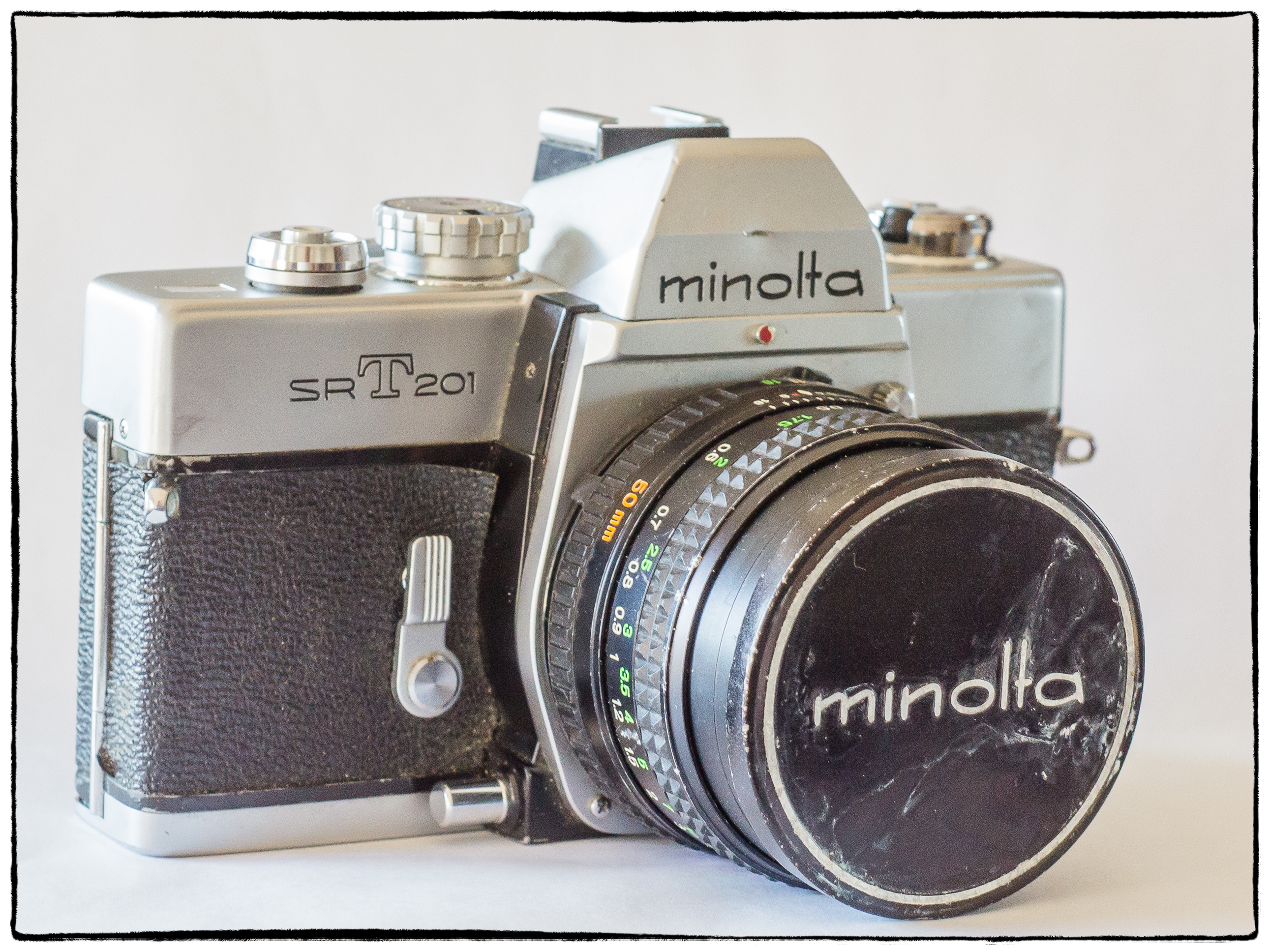
The beat up old Minolta SrT-201 above was given to me by a neighbor (for more information see A gift from a neighbor). The body is about shot (shutter frozen; missing rewind), but the lens (Minolta MD Rokkor-x, 50mm f1.7 works perfectly and produces lovely results. See Around Canopus Lake and On Pelton Pond).

The picture above was taken with a Sony NEX 5N. The lens information was not captured so it must have been one of my legacy lenses – but I can’t remember which one and didn’t record the information. From other pictures taken around the same time I suspect it was a Nikon E series lens, most likely the Nikon 50mm f/1.8 Series E.

Neighborhood dogs

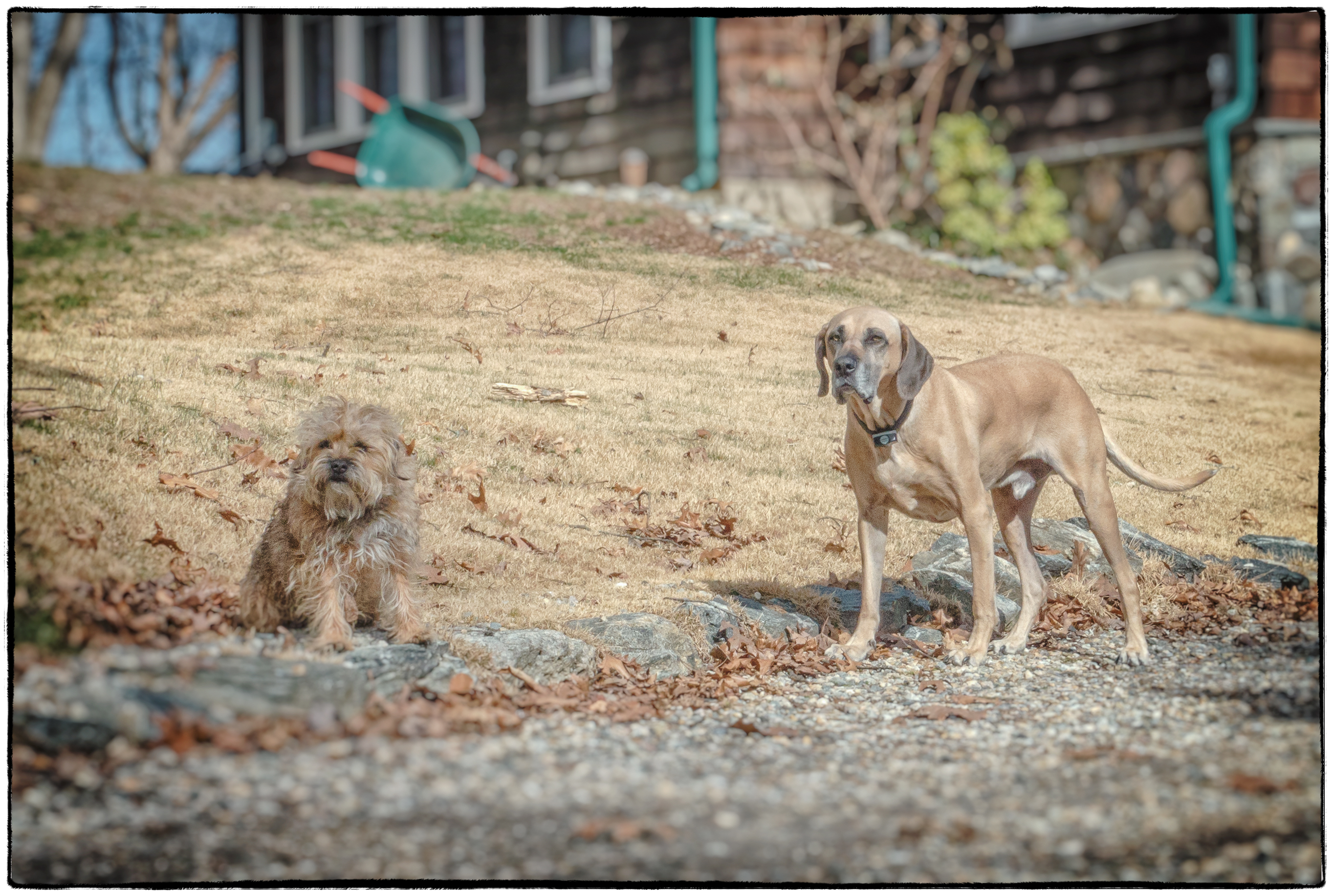
These two dogs belong to one of our neighbors. You’ll see from the box on the large one’s collar that they are subject to an invisible fence and consequently never come any further than where they are in the picture. They’re looking at our dog, Harley who’s out of the picture on the left, probably a little frustrated because they won’t come out to him and I won’t take him up the driveway to them.

They also appear in another one of my posts (see: Dogs on a Boat).

Taken with a Sony RX100 M3