Geneva – Carouge, Place du Temple

The Place du Temple is smaller, and less busy than the Place du Marche and I tend to prefer it as a place to hang out. Most places are closed on Sunday in Geneva, and when we lived there we would often pick up a newspaper and go somewhere to sit, have breakfast and watch the world go by. This is exactly what we did during our recent visit. I took a book and we were able to find a newsagents open where we picked up a copy of the London Times. We then went to Wolfisberg and ordered coffee and sandwiches.

The Place has a lovely, Gothic looking fountain (See: Geneva – Carouge, Basilisk Fountain for a close up) and a bust of one of Geneva’s luminaries: Adolphe Fontanel.

According to the Republic and Canton of Geneva website (translated from the original French):

The Fontanel family is of Savoy origin. It is mentioned as early as 1420 in the registers of the State of Geneva.

Two doctors in particular stand out: Doctor Adolphe Fontanel and Doctor Johannes Fontanel, son of the former.

Adolphe Fontanel (1818 – 1879) was born in Carouge, third of a family of seven children. He is the son of Pierre-Marie, notary, and Mélanie Plagnat. After studying at the Collège communal and the Academy, he obtained his Bachelor of Science degree in Lyon. On the advice of Carouge doctor, Louis-Appollonie de Montfalcon, his father sent him to pursue his medical studies in Paris, where he gained his doctorate in 1846.

He then opened his office at the Rue Saint-Victor, but at the same time this convinced liberal developed a passion for political reform. James Fazy solicited his invaluable support to the rising radicalism of the time. Adolphe Fontanel was elected a member of the Provisional Government of 1846.

He was elected to the Grand Council, where he served 16 years, assuming the presidency of the legislature in 1870 and 1871. He was elected Geneva State Counselor in the 1855-57-59 and 1861 elections, and became Federal States Counselor in 1853. Mayor of Carouge five times between 1847 and 1875, this active and indefatigable fellow citizen remained a medical doctor in a battalion of militia, a founding member of the Geneva National Institute, a member of the Geneva medical society and numerous Geneva and Carouge companies, including the carabinieri society.

A Freemason, who maintained the most cordial relations with the Catholic parish priest Gaspard Greffier and Pastor Henry, Adolphe Fontanel was an example of an eminent man entirely devoted to the service of his neighbor.

He was a fazist activist who actively participated in the unrest of August 22, 1864, following the electoral defeat of James Fazy.

He was arrested by federal investigators and then acquitted with the other defendants at the Federal Assizes in December 1864.

My wife sitting with our internationally travelling dog, Harley outside Wolfisberg on the Place du Temple. Harley’s somewhat strange posture is because he’d just spotted another dog across the plaza.

Taken with my Son-in-Law’s Nikon, D80 and Sigma 18-200mm f3.5-f6.3 lens.

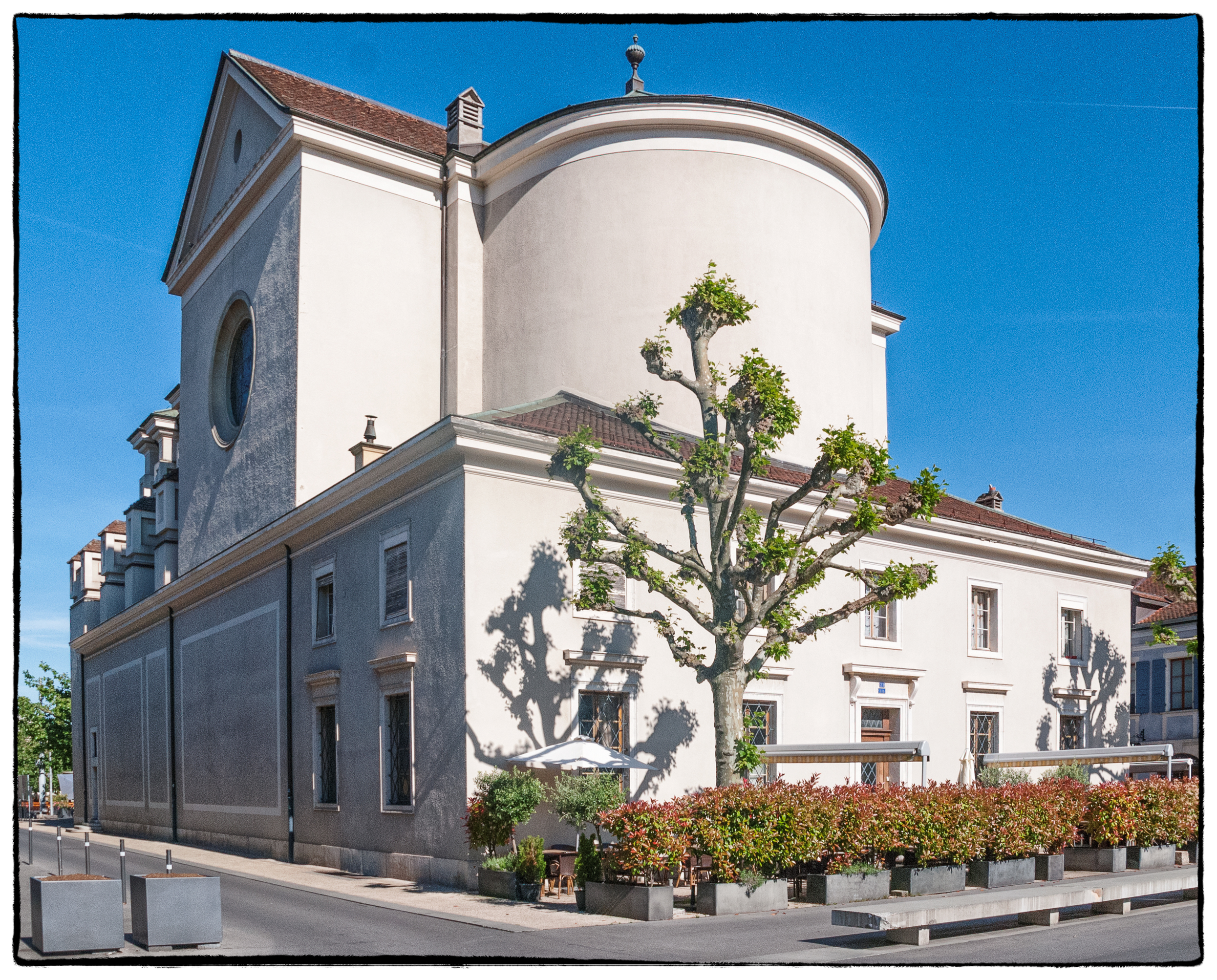
Geneva – Carouge, Temple

According to the Paroisse protestante de Carouge:

The history of the parish begins in 1804 when the City council of Carouge decided to finance the ministry of a pastor for the Protestant community of the city, which at the same time it had a church council in charge of the management of the group . At that time, the mayor of the town, Monsieur de Montfalcon, fought to restore public worship, which had been banned since 1793 because of the attachment of Savoy (of which Carouge belonged at that time) to France, then revolutionary and anticlerical. In 1806, the Church Council addressed the Ministry of Worship in Paris to formalize the process, to which Napoleon responded positively. Until 1813, the community met at the Chossat house (now Rue du Pont-Neuf 2 bis) but the owner decided to rent his property to a watchmaking factory. The Church Council, unable to find a new place suitable for the community, issued a subscription for the construction of a temple and addressed a petition to the Prefect of Leman to obtain land. This was allotted to them in place of Arms. The following year, the foundations of the temple were laid, but the construction stopped very quickly because of the political upheavals that marked the years 1814-1816: Carouge was again attached to the Kingdom of Sardinia before joining with Geneva in 1815 to form the 22nd canton of the Swiss Confederation with the other “united communes”. The Reformed community of Carouge then joined the Protestant Church of Geneva (1816). Conditions were then in place complete the temple, begun three years earlier. After a study by the Council of State, the original site was abandoned in favor of a plot located at the Place des Bois (present location, today Place du Temple) and the architect François Brolliet was mandated to carry out the project. The temple was inaugurated in 1822.

Sources:

Society of Art History in Switzerland, Ed. Benteli, 1985.

BRULHART, Armand, DEUBER-PAULI, Erica, Arts and Monuments, City and Canton of Geneva.

Christen, Ernest, The Protestant Worship, Ed. Labor, Geneva, 1934.

Dreyfus Fernand, The Temple of Carouge, presentation of a historical, artistic and spiritual place, Labor and Fides, 1999.

Reymond Bernard, Temples of French-speaking Switzerland, discovering heritage, Editions Cabédita, 1997.

Rudaz, Patrick, Carouge, foyer of sacred art, 1920-1945, edited by the City of Carouge, 1998.

I wasn’t able to go inside, but the link above to the parish site provides several pictures of the interior. For a Protestant church in Switzerland it’s surprisingly decorative. They’re usually quite plain.

Taken with my Son-in-Law’s Nikon, D80 and Sigma 18-200mm f3.5-f6.3 lens.
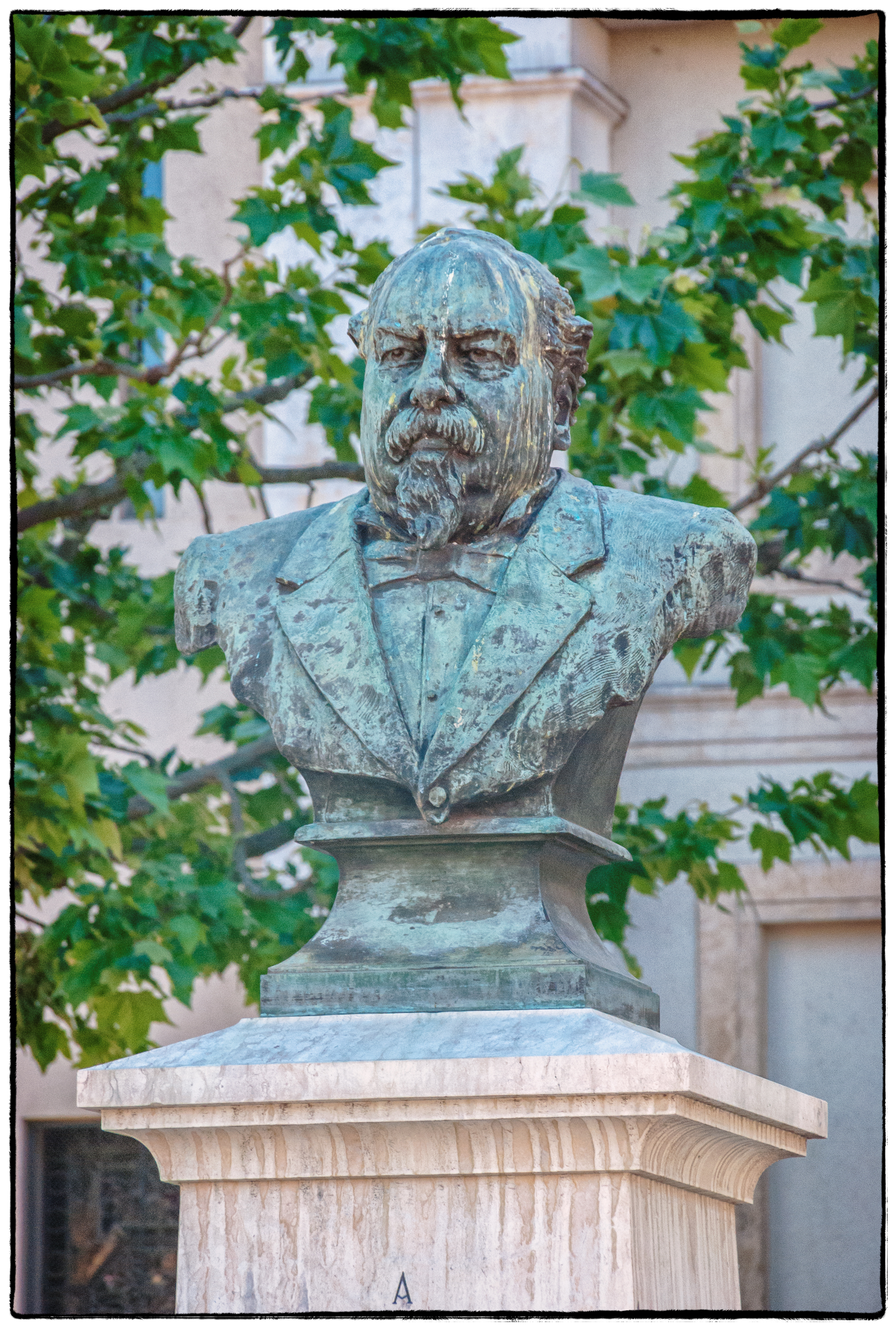
Geneva – Carouge, Moïse Vautier Statue

According to the “Tribune de Geneve” (In “1848 Les Vautier conquièrent Carouge la lime à la main“, translated from the original French:

In 1848 a lime factory was founded in 1848 in Carouge by the father of Moïse Vautier.

The Rue Vautier perpetuates the name of this family on the very premises where the factory stood. It ceased to exist in the early 1980s. Its most famous owner was Moïse Vautier (1831-1899), whose bust stands in front of Sainte-Croix church. He was the great man of the family, a state councillor with an exceptionally long career, elected for the first time in 1861 until his death in 1899 during his final term. Four decades in business, under the colors of the powerful Radical Party of James Fazy, of which Vautier was one of the most ardent defenders.

From his years in St. Gallen, where his father sent him to study German, the young Moses returned with the brilliant idea of ​​a radical guard called the “Fruitiers d’Appenzell”.

In his 1899 obituary the “Journal de Geneve” revisits the less glamorous role of the “Fruitiers”: “On election days, they do not hesitate to use violence against opponents, to destroy their ballots, or to substitute for them radical ballots, and to secure by these unscrupulous means the success of their party. We do not know what was the responsibility of Vautier in these scandals. In any case he lost nothing of his popularity. ”

In 1861, James Fazy’s influence over his troops was so strong that Moses Vautier, freshly elected to the Conseil d’Etat, had to resign with his radical colleagues as a sign of solidarity with Fazy, who did not want to go alone.

Geneva State Counselor, Federal State Counselor, Moïse Vautier was active in Geneva (including Carouge) as well as in Berne. He has left the memory of a citizen full of warmth and good-nature. He is among the fathers of the Leopard’s Circle (the one seen on the Coat of arms of Carouge), an institution created to bypass the requirement to close the cafes after 11 pm. A measure imposed in the late 1880s by the new conservative majority.

By creating their private circle at the Berthod café (Café de la Bourse), at the Place du Marché, Moïse Vautier, his sons and their notable friends and merchants, were granted the right to extend their parties as much as they wish . “As the lights of the ‘terraces’ and coffee shops went out in Carouge and Geneva, the party continued, behind the shutters of the Bourse” (René-Louis Piachaud, “Carouge”, 1936).

Taken with my Son-in-Law’s Nikon, D80 and Sigma 18-200mm f3.5-f6.3 lens.
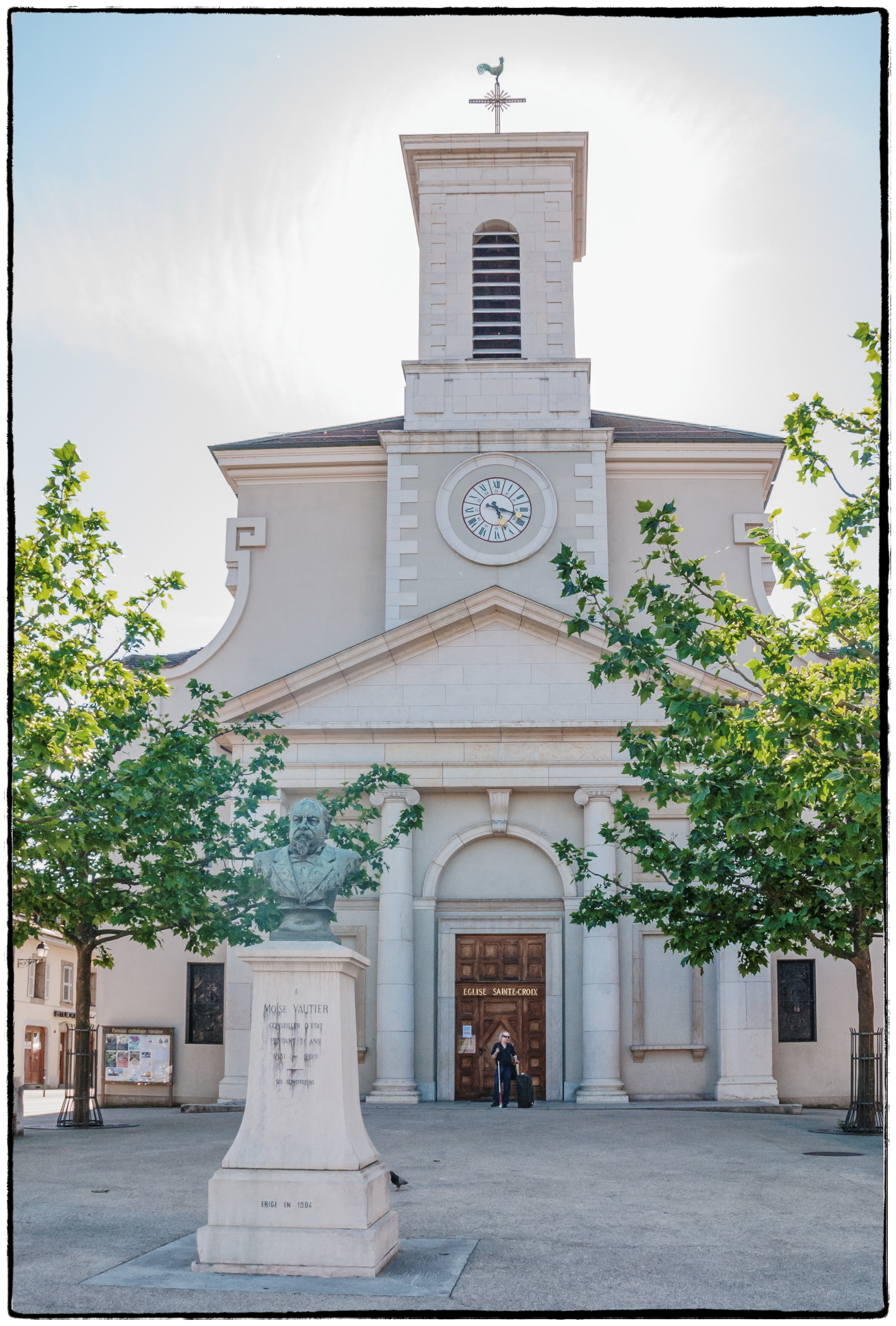
Geneva – Carouge, Eglise Sainte Croix

The Place du Marché is one of the busiest parts of Carouge – people like to gather here for a bite to eat, a drink, or just to socialize and the Eglise Sainte Croix is situated right on it.

According to the Unité Pastorale Cardinal Journet:

The history of the parish is closely linked to that of the Sardinian city and its church. In the mid-eighteenth century, the King of Sardinia decided to create a city on the borders of his Kingdom, facing the opulent Geneva. Victor-Amédée III entrusted the architect Giuseppe Piacenza (Plaisance) with drawing up a master plan for Carouge and coming up for a design for a church.

The royal intent was to create a grand and majestic church which would become the center of the city; It would be its most important monument. Work began in October 1777. Soon work on the ground and water table, engendered heavy expenses which compromised the complete realization of the Plaisance plan. On June 11, 1780, Msgr. Biord, Bishop of Geneva residing in Annecy, blessed the royal church of the City of Carouge. It was classified as a historic monument in 1923, since 1979 it has been granted federal protection.

The chime of the Holy Cross church is the second largest in Switzerland, in number (36) of bells! Of the two bell-towers originally planned, according to the plans of the Italian architect Giuseppe Piacenza in 1777, only one was built, then destroyed during the French Revolution. A new bell-tower was built in the form of a campanile. It was too high, did not resist the ringing and cracked. It was replaced by a decorative bell tower and then by the current bell tower, highly enhanced in 2001.

The Carillon can be heard throughout the during the Carouge Market on Saturday morning around 11 am. At the keyboard, Constant Deschenaux, in charge of the carillon, or one of his colleagues Andreas Friedrich or Yves Roure.

Three Saturdays every year the City of Carouge offers a thematic visit “Carouge Up High” which allows visitors to climb up the bell tower of the church Sainte-Croix.

At the end of each summer, two concerts are offered by the City of Carouge.

The church is known as the “Exaltation of the Holy Cross” or “Glorious Cross” . It is said that King Victor-Amadeus III himself wished this dedication for the church in his royal city in memory of the high altar of the Cathedral of St. Peter in Geneva before the Reformation.

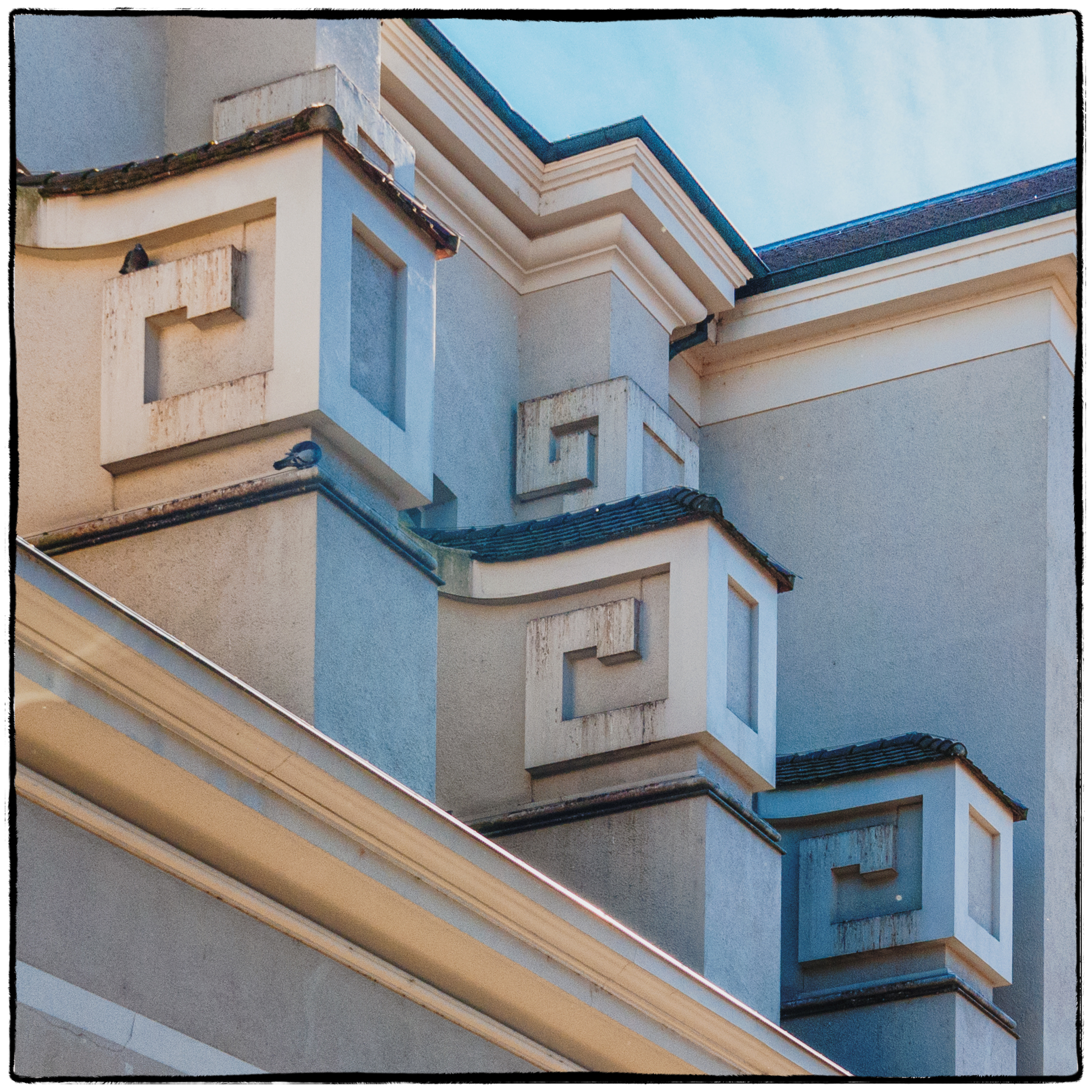
Detail of the roof.

View of the rear of the church from the Place de Sardaigne.

Taken with my Son-in-Law’s Nikon, D80 and Sigma 18-200mm f3.5-f6.3 lens.
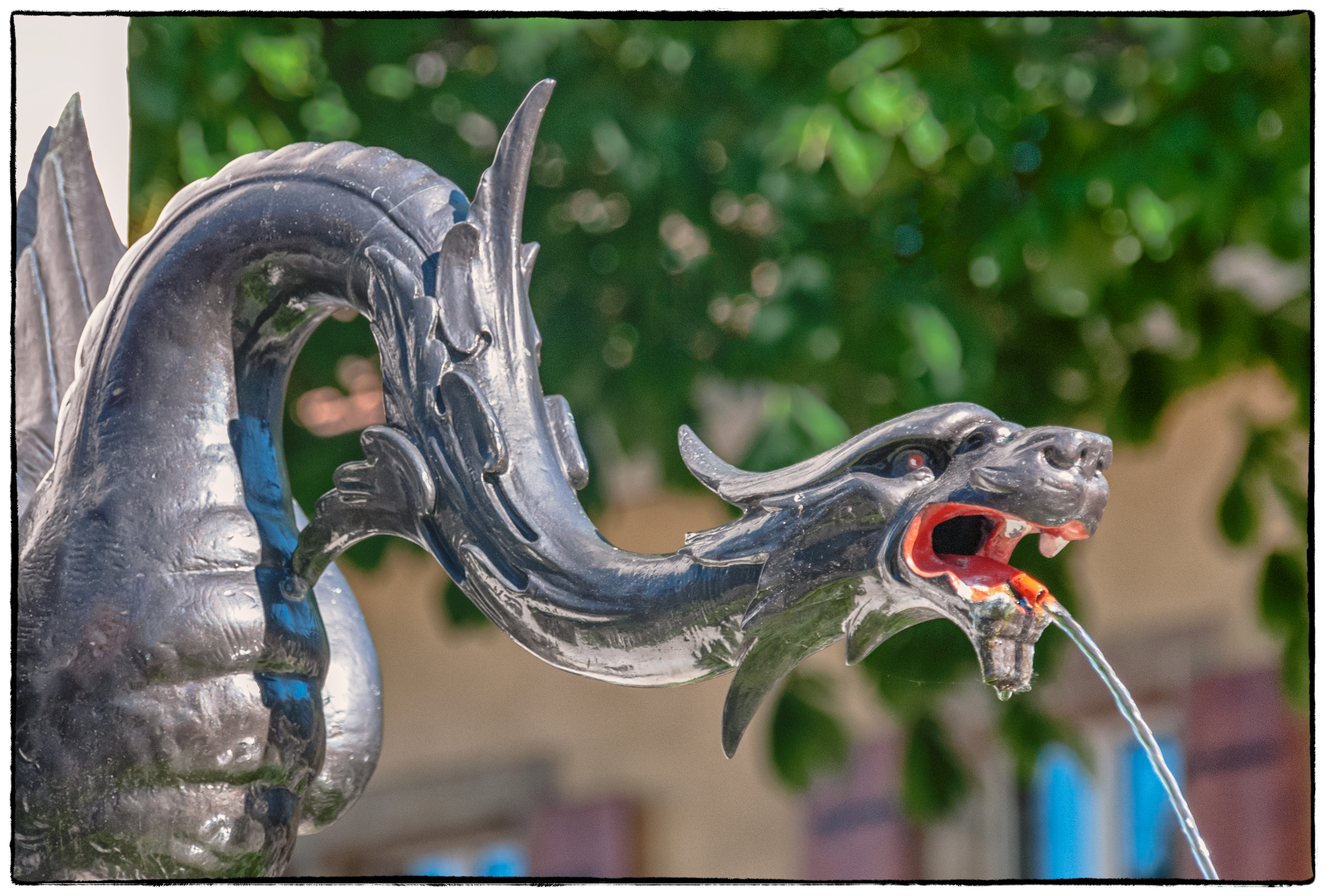
Geneva – Carouge, Basilisk Fountain

Apparently this fountain shows the Sardinian origins of Carouge. It depicts a particular kind of dragon: a “scultone” or “ascultone”, which appears in legends in Sardinia, Italy. It had the power to kill human beings with its gaze and was a type of basilisk, lived in the bush and was immortal.

According to the Myths and Magic… website:

It was said the powerful flight of the scultone had the power to open the ‘Crack of Golgo’ a sinkhole to be found on a natural plateau near the country church of San Pietro, in Supramonte Baunei. It is considered the deepest chasm in Europe. To get rid of the scultone, the people called on Peter the Apostle, who dispatched the dragon with ease. Since the gaze of scultone had the power to kill, Peter made the dragon look into a mirror and upon seeing it’s own reflection, the scultone was neutralised.

This one was part of a fountain on the Place du Temple.

Taken with my Son-in-Law’s Nikon, D80 and Sigma 18-200mm f3.5-f6.3 lens.