August Film Camera – Olympus OM2-n MD

Much has been written (I’ve included links to four pieces below. I particularly like the Mike Eckman article for its honest take on the camera; and the Photography in Malaysia article for its wealth of technical detail) on the Olympus OM cameras including on the OM2-n. Mine also supports a motor drive, hence the designation OM2-n MD.

It’s small and light weight for a camera of its time Compared to modern cameras it feels solid and well built but a little heavy compared to modern cameras.

On top of the camera there’s a lever for off, manual and auto. On the rear there’s a red battery check light, which when you move the lever to the very top remains steady when the battery is fresh, and blinks when it’s getting low.

There’s an exposure compensation (two stops over and under) dial on top (where the shutter dial is usually placed). The rewind lever and the self timer are on the front of the body – to the right.

There’s a flash synch (F,P,X) socket on the left of the lens mount. Most of the pictures I’ve seen of this camera show it without a flash shoe. Mine has one, so I assume it was an optional accessory. Mine bears the words “Shoe 4“. The third article below (i.e. the one from “Photography in Malaysia” provides the following information:

Shoe 4 should be the correct shoe type for all OM-1n and OM2n bodies. It permits manual and normal auto flash control But in the case of OM2n bodies, it will perform TTL flash exposure control; further, it will automatically sets X-sync at the shoe, and via a third contact to provide viewfinder flash ready/sufficient flash LED. Is it possible to use Accessory Shoe Type 1 or “Fix” type shoe on OM-1n bodies ? Yes. Because the Shoe 1 has only one pin and thus it is not possible to use those two pins accessory shoe(s) with earlier OM1 or M1 bodies which has only one socket. In the case of the original OM2 model which has two inputs, Accessory Shoe 2 should be the right type to use with older Quick AUTO 310 TTL flash.

The viewfinder is large and bright and has a split image focusing aid. The viewfinder display changes depending on the mode selected: Manual shows only + and -, automatic shows shutter speeds from 1-1/1000 second.

The shutter seems to be quieter than I’d normally expect from an SLR from that period. It’s electronic and will only fire with a battery.

The back is interchangeable as is the focusing screen.

There’s no shutter dial on top of the camera. Everything is on the lens: aperture, shutter, depth of field. I guess the idea was to have all of the controls in one place. This is convenient but since the lens itself is quite small it means that it can be hard to locate the right dial when you want it. I imagine you’d probably get used to it though.
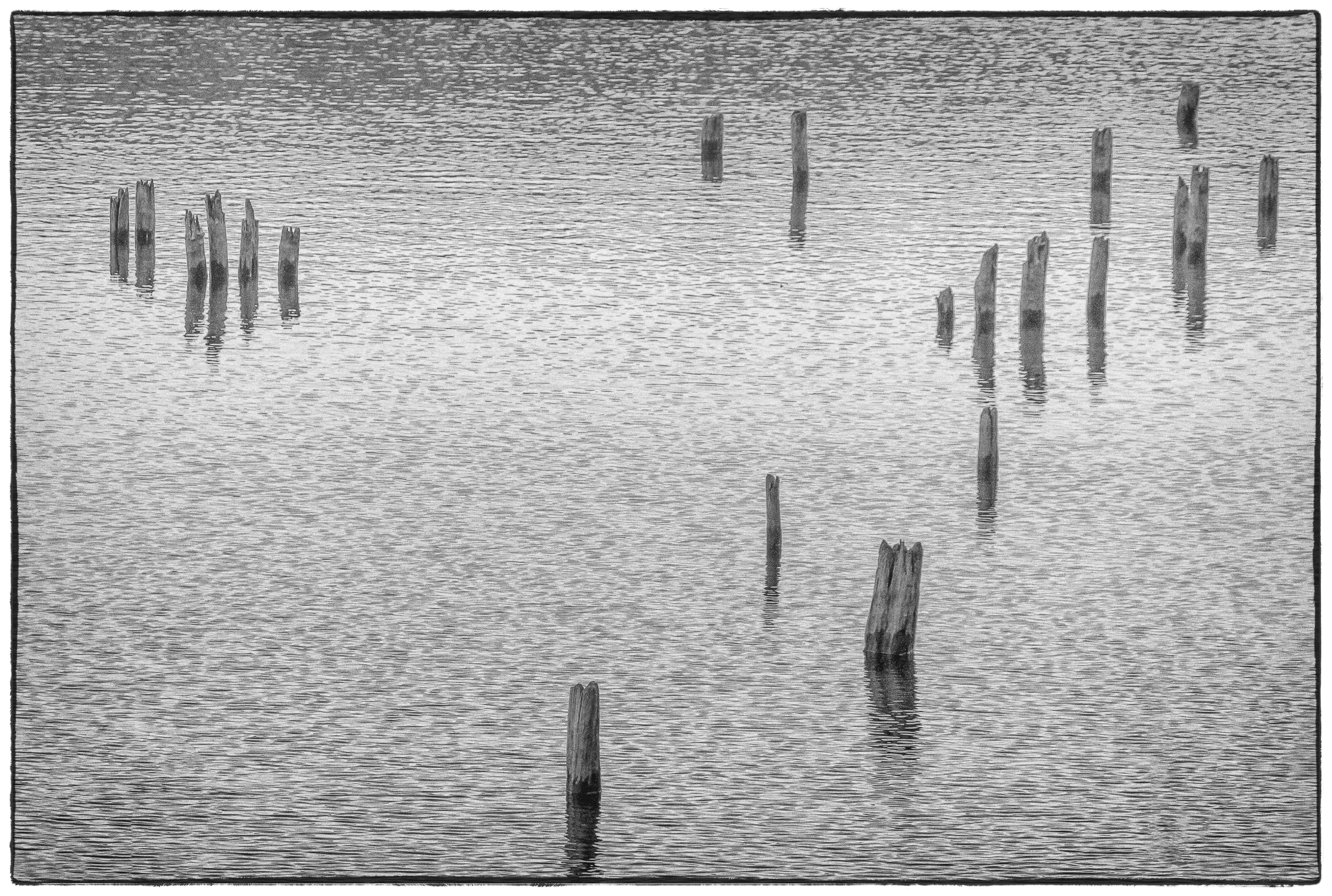

Stillwater Pond – Wood piles

It’s possible to walk to this pond from where I live, but I usually approach it from the other side, near the Fahnestock Park Offices on Route 301 (near Pelton Pond).

According to the Historic Putnam Valley Website:

About 1935 – A CCC (Civilian Conservation Corps) camp was established in what is now Fahenstock Park; the men from the camp constructed Stillwater Pond, Canopus Lake, their dams and other projects in the area.

Apart from the hiking, Stillwater Pond seems to be best known for its fishing. According to Hook and Bullet:

Stillwater Pond is a lake located just 6.7 miles from Mahopac, in Putnam County, in the state of New York, United States, near Dennytown, NY. Fishermen will find a variety of fish including rock bass, bream, bluegill, pumpkinseed sunfish, largemouth bass, crappie, brown trout, rainbow trout and perch here. Whether you’re spinning, fly fishing or baitcasting your chances of getting a bite here are good. So grab your favorite fly fishing rod and reel, and head out to Stillwater Pond. For Fishing License purchase, fishing rules, and fishing regulations please visit New York Fish & Wildlife. Please remember to check with the local Fish and Wildlife department to ensure the stream is open to the public. Now get out there and fish! Check out our Fishing Times chart to determine when the fish will be most active.

Taken with a Sony Alpha 500 and Tamron A18 AF 18-250mm f3.5-6.3 (I think).

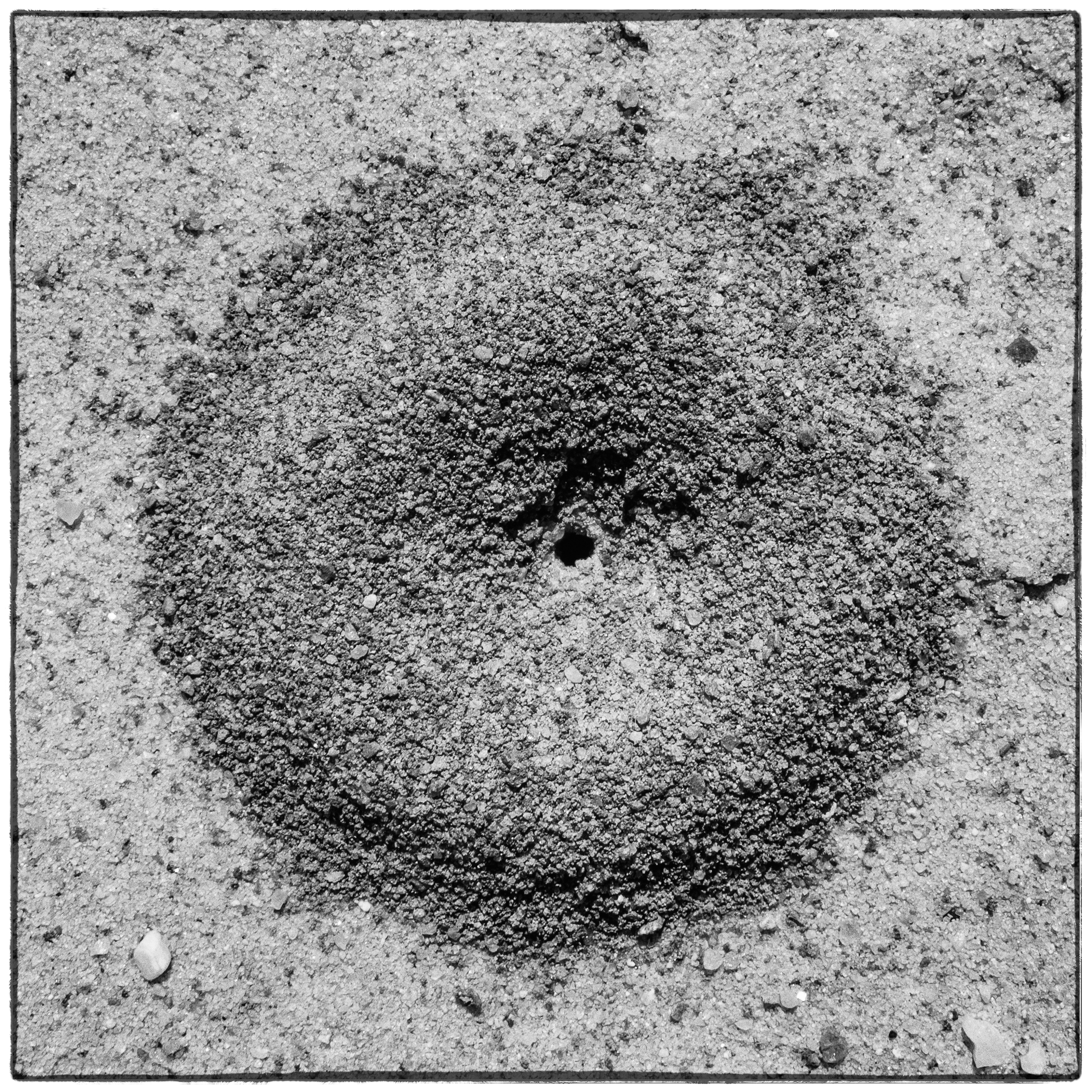
Volcano on the sand

I thought at first that these small volcano-like mounds were made by some kind of animal, maybe a worm. However, I’m beginning to think otherwise.

I came across this article on Exploring the Sand on the Coastal Care site. It describes something very similar to what I found (there are even photographs and illustrations, which look at lot like the picture above):

The movement of the tides up and down the beach every half day or so is a highly visible process carefully watched by fishers, beach buggy enthusiasts and joggers alike. While all these obvious changes are occurring on the beach, important but much less visible things are happening beneath the surface. As the tide goes out, air replaces water between the sand grains. As the tide comes up, water replaces air. The beach is a giant bellows, alternately taking in and expelling air. As the air passing through the sand, a great variety of features form within the sand as well as on the surface of the beach.

You can watch for yourself as air is forced out of the beach. The best time and place to see this is at mid to upper incoming tide levels on the upper beach near the high tide line. If conditions are right, streams of bubbles can be seen through the thin water film of the uppermost wave swash, especially as the swash begins its return to the sea.

When the tide has left the bubble area high and dry, a careful look (on hands and knees) will reveal that some of the nail holes resemble tiny volcanic cones. With a magnifying glass and imagination, we call these features volcanoes. The uppermost part of the hole flares out and is rimmed by a tiny circular mound of sand (Fig. 5.5). The flow of air through the holes was strong enough to remove some sand at the surface and pile it around the rim. Again, if you are watching the swash zone at the right time you can see the tiny eruptions from the holes that expel water and the sand that produces the rim.

Taken with a Sony RX-100 M3

On White Pond

Although White Pond is quite close to our house, I wasn’t aware of its existence until yesterday.

The walk starts by a small jetty (see above). As we passed by someone was fishing.

Before the trail enters the woods there are some great views of the pond.

After a while the trail goes away from the lake and into the woods. Where it once had been flat and clear it now becomes rocky, with abundant roots. This is bad news for me as I have a history of tripping over roots and rocks. In one case I managed to split open my nose and break my glasses. I had to make sure to lift my feet higher than I normally do to avoid them. Because of the recent rain the rocks were also rather slippery. If that wasn’t enough it’s the time of year when acorns start to fall. There was a constant “rain” of acorns during our walk. I kept thinking that one of them would fall on my head, but luckily none did.

The trail doesn’t seem to be well maintained. A lot of trees had fallen across it and they haven’t been cleared away. Some you could go around, some you just had to climb over.

The inevitable stone walls that you find everywhere in the woods around here.

The equally inevitable boulders.

The trail winds around the pond and ends on a road. After I’d finished walking I went along the road. I don’t think I’d recommend walking on it, particularly if you have a dog or small children.

We didn’t actually get to the end of the trail. We came across one large downed tree too many. It was too big to climb over, and I couldn’t any easy way around it. We’d walked for about 45 minutes and it seemed as good a time as any to turn around and retrace out steps.

Taken with a Sony RX-100 M3