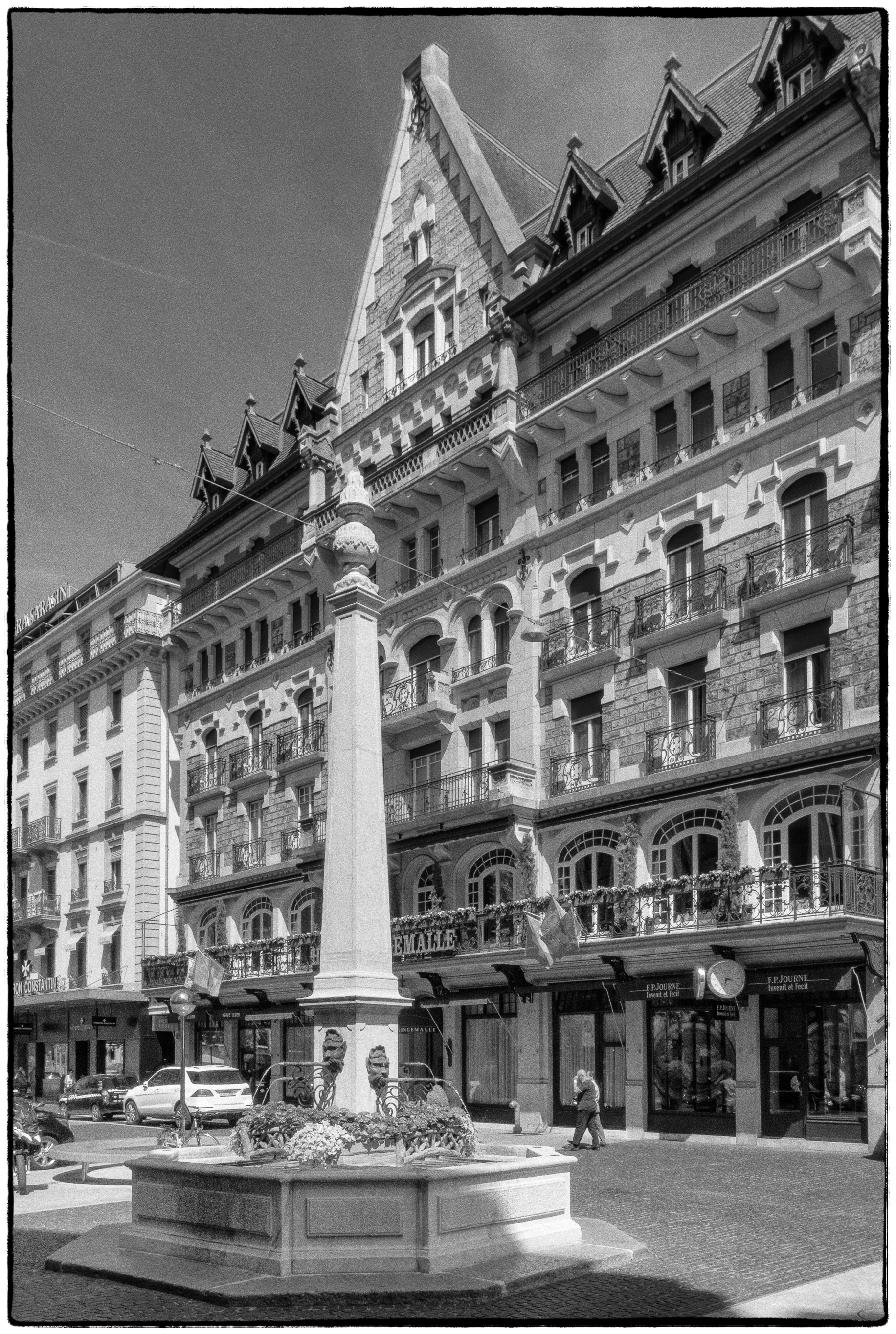
As I walked around the Place de Longemalle I noticed a couple of statues that hadn’t been there the last time I’d visited. They stand outside the Opera Gallery and a sign indicates that they are the work of Andy Denzler. According to Wikipedia:
Andy Denzler trained at the Kunstgewerbeschule and the F&F Schule für Gestaltung in Zurich, both schools of applied arts, as well as at the University of California, Los Angeles, and the Art Center College of Design, Pasadena. In 2006 he graduated as Master of Fine Arts from London’s Chelsea College of Art and Design. Andy Denzler lives in Zurich.
Denzler’s works have been exhibited in one person shows and group shows in Europe and America, since 2010 also in Russia. In 2007, he was included in the exhibition “Kindheit” (Childhood) at the Museum Rohnerhaus in Lauterach, Austria. Works of his are owned, among others, by the Museum of Modern Art, Moscow, the White House in Washington DC, the Museum Würth in Schwäbisch Hall, the Burger Collection in Hong Kong, the White Cube Collection in London and the KunstWerk – Sammlung Klein in Eberdingen/Stuttgart.
Andy Denzler’s works move between abstraction and reality. With the classic means of oil painting, the artist endeavors to fathom the borderlines between fiction and reality. He presents his own perception of the world in his pictures. They are snap-shots of events that take place, blurred, distorted movements, Freeze Frames that stylistically move between Photorealism and Abstract Expressionism. In his paintings Denzler frequently alludes to other media. Titles and subject matter refer to films, as for instance in One Flew Over the Cuckoo’s Nest or Viktoria in The Birds. His “Motion Paintings” are divided into four groups of works: “Portraits”, “History Paintings”, “Figures & Landscapes” and “Urban Figures”. Andy Denzler translates them into painting, sculpture and drawing.
The bronze statues date to 2016. The one above is called “Liquid Walking Woman” and the one below, “Selfie”
Talking Beautiful Stuff provides a nice description in a post entitled Its Her Day:
I stroll through down-town Geneva. It is hot. Very hot. Every-language tourists swarm the luxury shrines to chocolate and watches. A stunning new bronze sculpture in Place de Longemalle stops me in my tracks. It is a young woman in hoody, cut-off denim shorts and trainers walking with confidence. She holds a smartphone. Like her living counterparts, she seems unaware of her allure or the conveniences brought by smartphone culture. She is constructed of horizontal segments re-stacked. The texture contrasts effectively with the smooth skin of the presumed model. Somehow, this sculpture captures the young woman of today. It is very beautiful and very gratifying.
I look around for the plaque that names the genius behind this work. Instead, I spot the same young woman only forty metres away. She has both feet firmly planted and her smartphone held up towards her other self striding to meet her. She has that small-screen look of concentration. Is she photographing her twin, taking a selfie, recording the street scene or checking her make-up? I am captivated by these works individually and as a pair. Finding them makes my day
…
I did not grow up in the internet era nor even with a mobile phone. Denzler’s subject cannot possibly know existence without a smartphone. It is also her camera, her street map, her address book, her pen and paper, her mirror, her compass, her library, her photo album, her stereo, her shopping mall, her magazines, her cinema and much more besides. Her friends and friends’ friends, real and virtual, are connected, categorized and communicated with by Facebook, Twitter, Snapchat, Whatsapp and Instagram. As for all of my generation, what mobile technologies bring to humanity is both fascinating and intimidating. Were I to find myself in conversation with Denzler’s young woman, I’d be interested to know whether she could conceive of life before smartphones. And if I said something stupid like “Well, in my day, we didn’t have such technology.” I am certain she would simply look up from the screen for a second or two, look my squarely in the eye and say politely “But it’s not your day!”