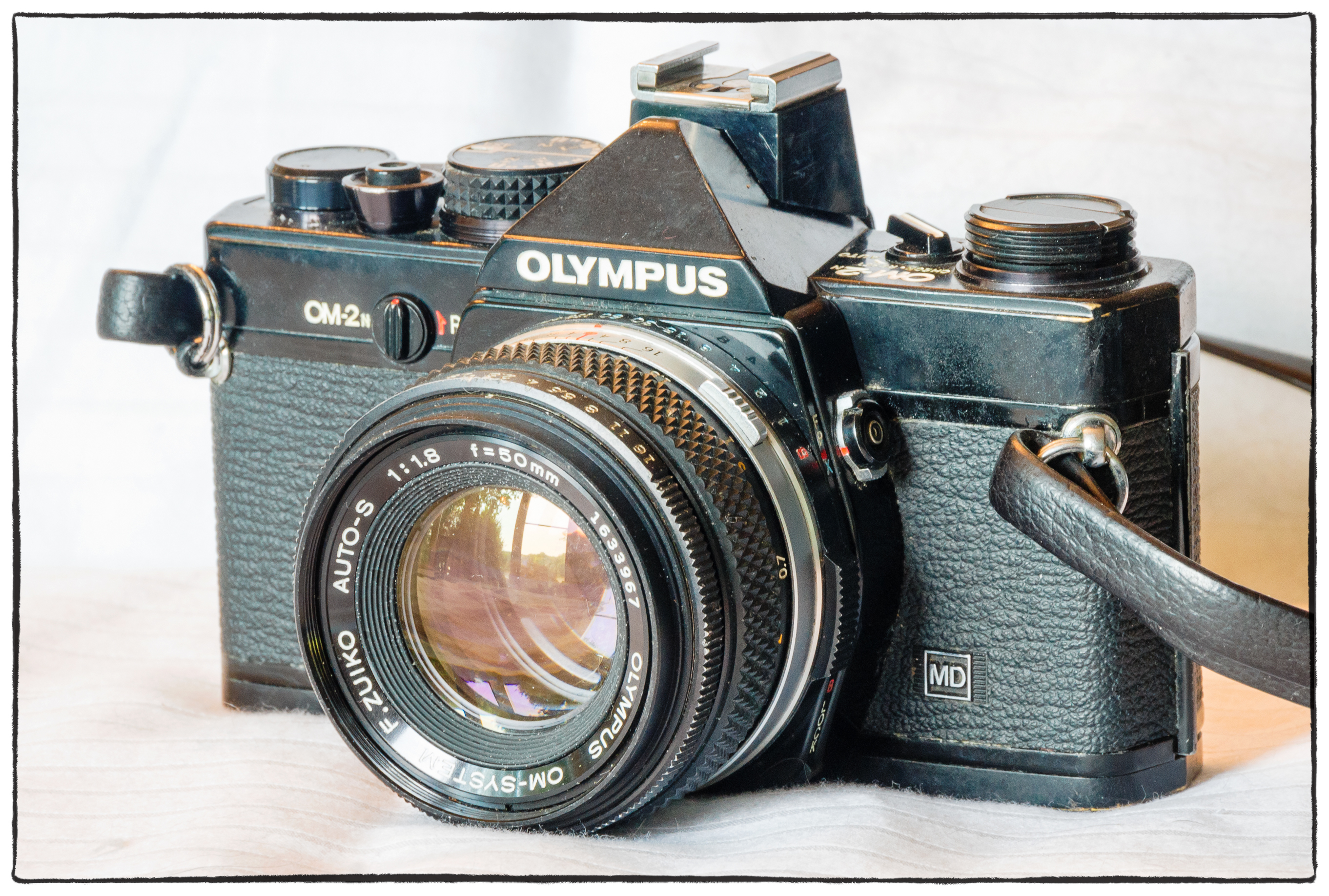
Much has been written (I’ve included links to four pieces below. I particularly like the Mike Eckman article for its honest take on the camera; and the Photography in Malaysia article for its wealth of technical detail) on the Olympus OM cameras including on the OM2-n. Mine also supports a motor drive, hence the designation OM2-n MD.
It’s small and light weight for a camera of its time Compared to modern cameras it feels solid and well built but a little heavy compared to modern cameras.
On top of the camera there’s a lever for off, manual and auto. On the rear there’s a red battery check light, which when you move the lever to the very top remains steady when the battery is fresh, and blinks when it’s getting low.
There’s an exposure compensation (two stops over and under) dial on top (where the shutter dial is usually placed). The rewind lever and the self timer are on the front of the body – to the right.
There’s a flash synch (F,P,X) socket on the left of the lens mount. Most of the pictures I’ve seen of this camera show it without a flash shoe. Mine has one, so I assume it was an optional accessory. Mine bears the words “Shoe 4“. The third article below (i.e. the one from “Photography in Malaysia” provides the following information:
Shoe 4 should be the correct shoe type for all OM-1n and OM2n bodies. It permits manual and normal auto flash control But in the case of OM2n bodies, it will perform TTL flash exposure control; further, it will automatically sets X-sync at the shoe, and via a third contact to provide viewfinder flash ready/sufficient flash LED. Is it possible to use Accessory Shoe Type 1 or “Fix” type shoe on OM-1n bodies ? Yes. Because the Shoe 1 has only one pin and thus it is not possible to use those two pins accessory shoe(s) with earlier OM1 or M1 bodies which has only one socket. In the case of the original OM2 model which has two inputs, Accessory Shoe 2 should be the right type to use with older Quick AUTO 310 TTL flash.
The viewfinder is large and bright and has a split image focusing aid. The viewfinder display changes depending on the mode selected: Manual shows only + and -, automatic shows shutter speeds from 1-1/1000 second.
The shutter seems to be quieter than I’d normally expect from an SLR from that period. It’s electronic and will only fire with a battery.
The back is interchangeable as is the focusing screen.
There’s no shutter dial on top of the camera. Everything is on the lens: aperture, shutter, depth of field. I guess the idea was to have all of the controls in one place. This is convenient but since the lens itself is quite small it means that it can be hard to locate the right dial when you want it. I imagine you’d probably get used to it though.