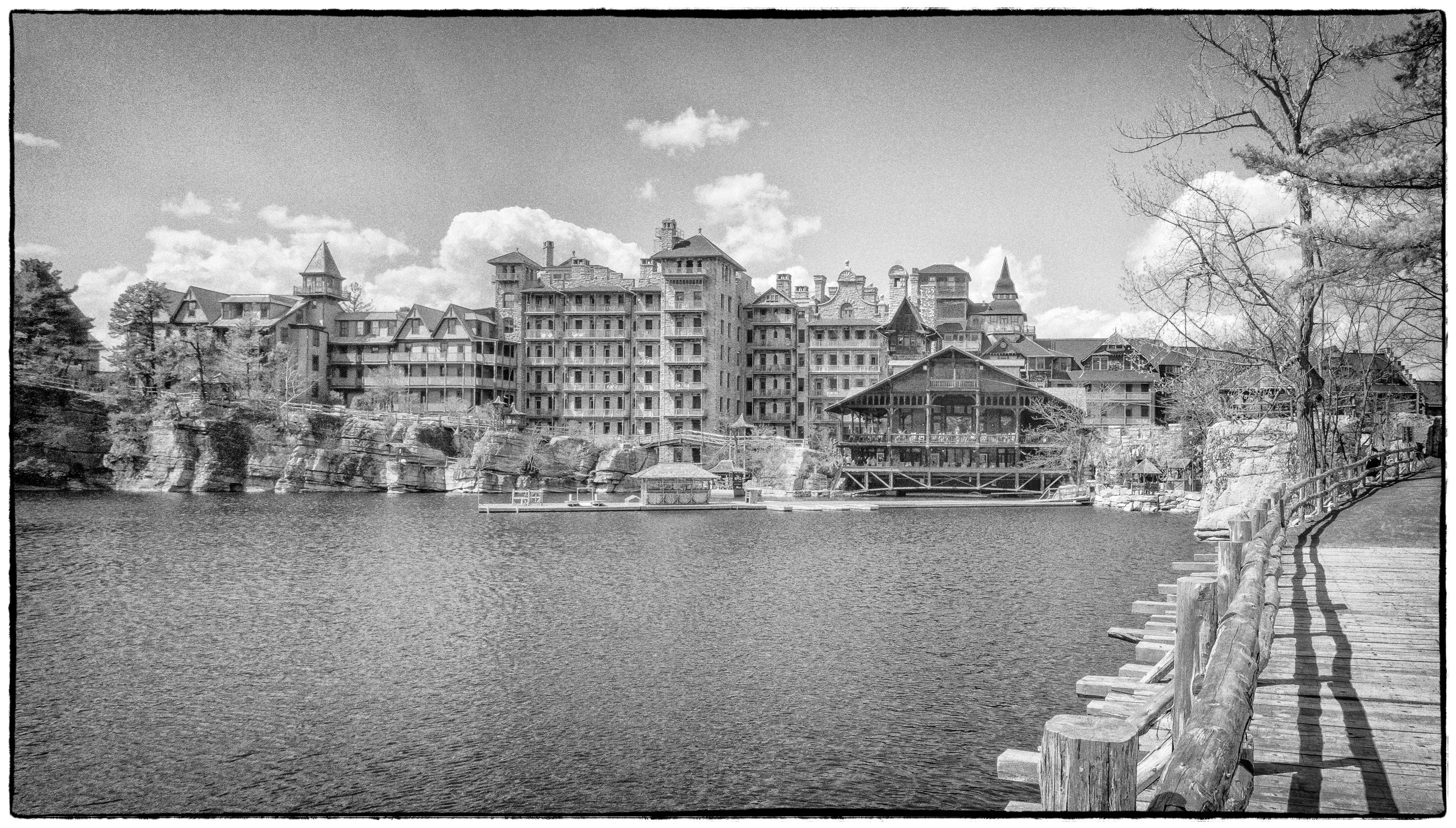
We went for Easter Lunch at the Mohonk Mountain House. It’s about an hour’s drive from our Lake House – just outside New Paltz, itself a rather quaint university town.
The meal was a huge buffet, quite pricey but they you’ve got to admit that the surroundings are quite special. I doubt there’s anything quite like it around here. We stayed for quite a while, sitting on rocking chairs on the terrace overlooking the lake, walking in the grounds etc. Once upon a time the Catskills bristled with resort hotels, but they’ve for the most part disappeared. This is probably one of the few that remain. I posted a picture to Facebook and someone commented that it looks as if it shouldn’t be in New York State – that it should be in another country. I’d agree.
For many years I worked for the United Nations Children’s Fund (UNICEF). Sometime in the 1980’s UNICEF held an important strategy meeting at the Mohonk Mountain House. Senior staff from all of the world attended (at that time I was too junior and didn’t get to go). The meeting came to be known as “The Mohonk Meeting”. Subsequently the organization decided to hold similar meetings, but at the regional level (e.g. in Bangkok for the East Asia and Pacific Region; in Nairobi for the Eastern Africa Region etc.). For some reason these meetings were referred to as “Regional Mohonks”. I’ve often wondered what future historical researchers will think when they come to references to a “Regional Mohonk” in Kathmandu, or somewhere.
I enjoyed being finally able to get there. I’d like to go again and spend more time hiking around the extensive grounds. Unfortunately, they don’t allow dogs. In the days of the famous “Mohonk Meeting” I believe they didn’t allow alcohol either (they do now) because the owners were Quakers. I believe the same family still owns the hotel though. According to Wikipedia:
The historic resort is located on the shore of Lake Mohonk, which is half of a mile (800 m) long and 60 feet (18 m) deep. The main structure, which was designated a National Historic Landmark in 1986, was built by Quaker twin brothers Albert and Alfred Smiley between 1869 and 1910. It has 259 guest rooms, including 28 tower rooms, an indoor pool and spa, and an outdoor ice-skating rink for winter use. The picturesque setting of the resort on the lake was featured in a print by Currier & Ives.
The property consists of 1,325 acres (536 ha), and much of it is landscaped with meadows and gardens. It adjoins the Mohonk Preserve, which is crisscrossed by 85 miles (140 km) of hiking trails and carriage roads. The Smileys conveyed the majority of their property to the preserve, and have received recognition for the stewardship of their land and their early environmental awareness.
The property has been owned and operated by descendants of the Smiley brothers since 1869. The Smiley brothers envisioned a peaceful retreat where people could enjoy the beauty of nature in a truly spectacular setting. From its earliest days, the resort has maintained values of stewardship, reflection, and renewal.
The house was given a National Historic Landmark designation in 1986, and a United Nations Environment Programme Award in 1994 in honor of “125 years of stewardship”. According to the National Trust for Historic Preservation, “Through its buildings and roads, its land, and its spirit, Mohonk exemplifies America’s history and culture. Mohonk has since managed to maintain its 19th century character into the 21st century.” In the 21st century, the resort also retains an emphasis on eco-friendly, environmentally green practices.