Blue and White on Snow

In other posts I’ve mentioned that my wife collects blue and white china. The other day we had a light snowfall, which melted fairly quickly, but which while it lasted left definite traces on the ground and the trees.

My wife liked the way this group of blue and white china looked against the snow covered branches outside and enlisted me to take a picture (her attempts with her iphone had not turned out too well).

So here it is.

Taken with a Sony RX-100 M3.

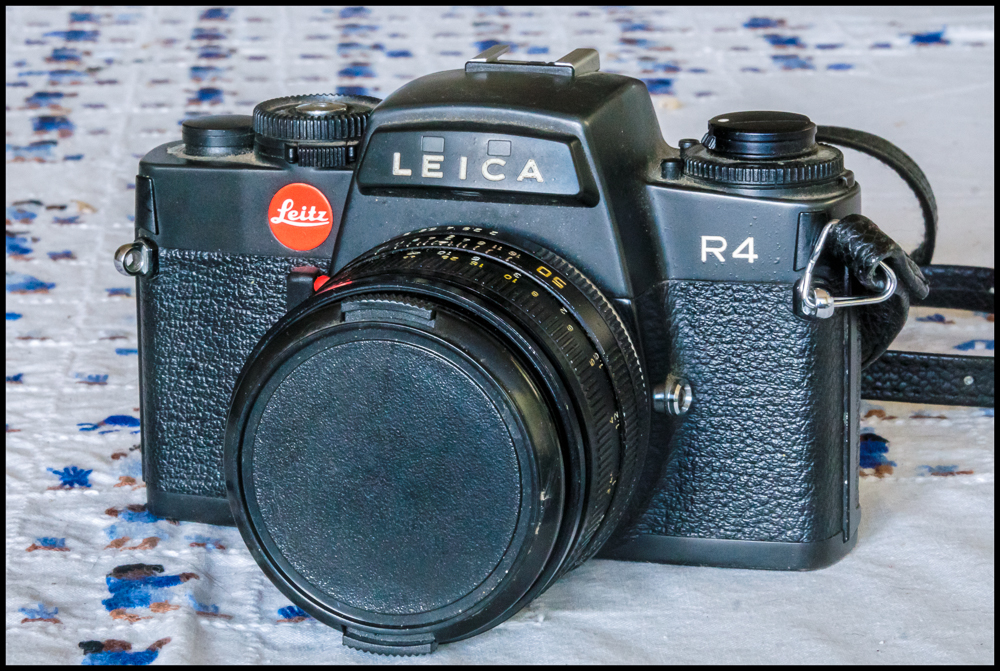
Considering a Leica R4

For some reason I got it into my head that I’d like a Leitz 50mm F2 Summicron R. Possibly to use with a Leica body, or possibly to use with an adapter on my Sony NEX 5n. I’d read (and heard) so much about this lens that I fancied trying it. I quickly realized that the rangefinder versions cost much more than I was willing to pay, but that the SLR R-mount lenses were much less costly and that some of the SLR bodies (e.g. the R4) were not that expensive either. Was a Leica R4 with 50mm f2 Summicron R the way to go?

This was as far as I had gotten, however, when a new friend (knowing my interest in old cameras) showed me some of his. One of them was an R4 with 50mm f2 Summicron (or at least it think it was. The lens faceplate was missing, but it certainly looked like the pictures Id seen).

He kindly let me borrow it for a while to try it out. I was thinking I’d do the following:

1. Just generally try it out without film to see how I liked the handling.
2. Put a roll of film through it.
3. Get an adapter so I could try out the lens on my Nex.

I had the sense that he needed the camera back fairly soon so I quickly ruled out option 3 and I started with option 1. I quickly came to the conclusion that I didn’t like the camera all that much. Admittedly it’s solid and very well made (as you’d expect from a Leica), but it’s also very heavy. I also found the controls to be “fiddly”. Trying to use the camera in my preferred aperture priority mode also turned out to be awkward, largely because the lens was double cam (i.e. designed for the SL series of SLRs) and would only support aperture priority in stopped-down mode: a fairly tortured procedure involving pulling in the depth of field preview level while at the same time half pressing the shutter release and turning the aperture ring.

I’d also read that some early versions of the R4 (of which this was one) had bad electronics that might or might not have been fixed.

Doing more research on the internet I also discovered that the R4 was not particularly liked (for some of the reasons I’ve outlined above).

I returned the camera with my thanks. I’d certainly learned a lot.

Where do I go from here. I’m thinking that I might proceed as follows: 1) as finances allow get my hands on a Summicron R and an adapter to allow its use on Sony E-mount cameras; 2) Still later consider acquiring an R-mount body, possibly a SL2, which seems to get good reviews.

American Witness. The Art and Life of Robert Frank

In earlier posts I’ve noted my difficulties with Robert Frank.

Initially I had some problems with “The Americans“. It seemed to me that it deliberately painted a negative picture of the USA in the 1950s.
Then, after further study I decided that I was wrong and have since become a fan.

So, I thought, the problem must be with Frank, himself. It seemed to me that he was one of these self-absorbed, very “artsy” types who thought being unpleasant was something that they should be allowed because they were special. He was, after all, a part of the beat generation, most of whom displayed these characteristics.

I couldn’t see what was so special about Frank. He’s certainly a first rate photographer, and “The Americans” is possibly the best photobook ever made. But, after that it seemed to me that he didn’t achieve much else. He made movies. I watched one of them and didn’t much care for it. And he eventually returned to still photography but without achieving his earlier fame.

So why is he always placed high on a pedestal, almost god-like. What makes him so much better than other famous photographers e.g. Paul Strand, Edward Weston, Walker Evans etc? I still don’t have an answer to that question.

Then I came across this documentary: Leaving Home, Coming Home: A Portrait of Robert Frank (2005), which made Frank more human. At times he could be a bit “curmudgeonly”, but he wasn’t the self-obsessed artist that I thought he would be.

So I think I’ve finally come to terms with Robert Frank: a great photographer who produced one of the greatest photographic works of our time. Does he deserve to be up on the pedestal? I’m not convinced that he does. But he didn’t put himself on the pedestal. His acolytes did so I can hardly blame him can I?

To me Frank is definitely high up in the pantheon of great photographers, but he’s not the only one up there and there may be some who are higher.

I’ve read the book twice and can heartily recommend it.