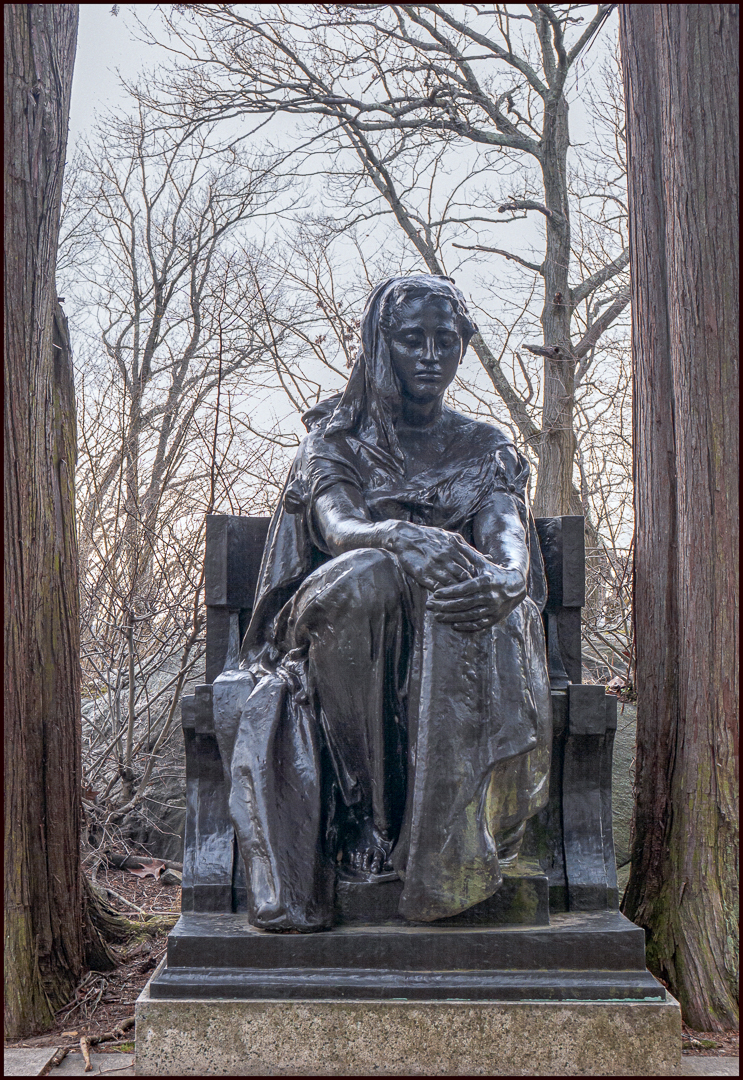
I found the textures and tones to be interesting.
Taken with a Panasonic Lumix GF-1 and Lumix G Vario 45-150mm f4-5.6
Photographs and thoughts on photography and camera collecting

I found the textures and tones to be interesting.
Taken with a Panasonic Lumix GF-1 and Lumix G Vario 45-150mm f4-5.6

Many travelers come to Sleepy Hollow in search of its best-known spirit—the Headless Horseman, made famous by Washington Irving’s “The Legend of Sleepy Hollow.” However, these ghost seekers may not be aware of a second local legend, which has haunted the Sleepy Hollow Cemetery for over 100 years: the Bronze Lady.
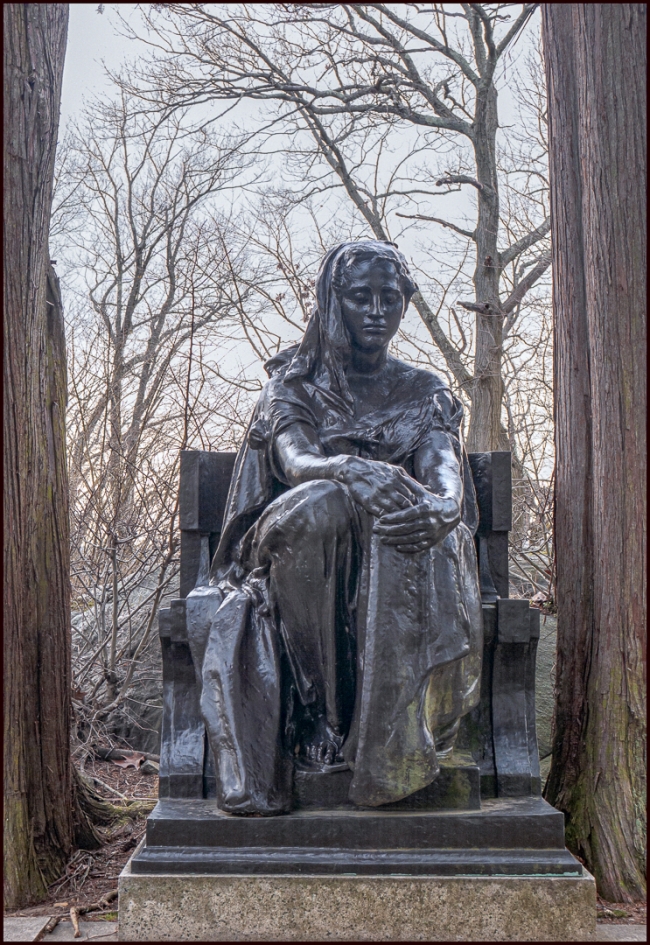
Larger than life and cast in bronze, the towering figure watches over the mausoleum of Civil War General Samuel Thomas. Though her rather sleepy visage appears more sad than threatening, legend says that at night she comes to life and wanders the cemetery grounds, terrifying anyone who may have entered on a dare.
According to lore, as you get closer to the Bronze Lady, you’ll hear her weeping. If you knock on the door to the general’s mausoleum (once, or three times, depending on whose instructions you follow), you’ll have bad dreams that night.
Finally, if you dare to approach and sit in the Bronze Lady’s lap, she’ll allegedly cry tears of blood. If you further insult the statue—say, by hitting it in the face—you’ll be cursed for life. Thrill-seeking visitors have been known to run screaming from the cemetery after a supposed encounter with the Bronze Lady.
The statue was commissioned by General Thomas’ widow upon his death in 1903. According to The New York Times, the statue’s name is actually “Recuillment, or Grief.” A prominent sculptor of the time, Andrew O’Connor, Jr., created the Lady. Jesse Phoebe Brown, O’Connor’s muse and mistress, modeled for the statue. You can see her likeness in a number of other sculptures by O’Connor, including this one.
Though the Bronze Lady is one of the more popular monuments in Sleepy Hollow’s Cemetery, the widow who commissioned it was not so happy with the finished product. She told O’Connor she had hoped for something more “gay”—a rather odd request for a statue meant for a mausoleum. So, O’Connor cast another, happier head. But as soon as Mrs. Thomas told him she liked it, he smashed it on the floor, telling her: “I just made this to show you that I could do it. I should never let such a monstrosity out of my studio.’’ (The Lineup).
Taken with a Panasonic Lumix GF-1 and Lumix G Vario 45-150mm f4-5.6

Also known as a stink bug, presumably because of the bad smell they produce if you crush one. I actually find them quite hard to crush, they’re so well armored. And the odd one that I seen crushed didn’t seem to have a bad smell at all. Mind you I have a notoriously bad sense of smell.
This one was wandering around in our kitchen sink. Well maybe wandering is too strong a word. It would actually move an inch or two and then stand still for a long period of time.
Since it wasn’t moving much this seemed to be a good opportunity to bring out the macro lens. My first few attempts were terrible: blurry, out of focus, badly exposed. Then it occurred to me to try using the small built in flash on the A6000. This resulted in the shot above. I thought the flash would be very constrasty, but I guess the light bounced off the white side walls of the sink and to me produced a pleasing result.
Taken with a Sony A6000 and 7artisans 60mm f2.8 macro.

It was perhaps ironic that after the pictures of the Trump National Golf Course in the preceding post, the next picture I took was of this US Flag. It was lying forgotten, torn, tattered and partly covered by dead leaves on the side of the road. Might be symbolic of something, but I’ve no idea what.
Taken with a Panasonic Lumix GF-1 and Lumix G Vario 45-150mm f4-5.6

The Trump National Golf Club is just a short walk from the House.
Trump National Golf Club Westchester is a private golf club in Briarcliff Manor, New York. The 140-acre (57 ha) course has eighteen holes, with a 75,000-square-foot (7,000 m2) clubhouse. Founded in 1922 as Briarcliff Country Club, it later operated as Briar Hills Country Club and Briar Hall Golf and Country Club. Donald Trump, later 45th president of the United States, purchased the property in 1996 and renamed the club after its county, Westchester, in a similar manner to his other golf properties. He had the clubhouse and course rebuilt for its 2002 reopening; the course was designed by Jim Fazio. Donald Trump served as president over Trump National Golf Club LLC (managing the Westchester club) from August 2000 until January 19, 2017, the day before his inauguration.
…
The club had its origins around 1895, with Briarcliff founder Walter W. Law’s private nine-hole course on his estate, which became available to Briarcliff Lodge guests, and was then known as the Briarcliff Golf Club. In 1922, Devereux Emmet designed a course across the street with eighteen holes, and thus Briarcliff Country Club was founded that year. The name was changed in 1927 to avoid confusion, to Briar Hills Country Club. Briar Hills opened in May 1929 with a new clubhouse; construction began in May 1928 and utilized local stones for the building’s exterior. The interior was noted for its design and spaciousness. In 1936, A. W. Tillinghast redesigned the course. In 1948, Henry Law’s son Theodore sold the club to local businessmen who renamed it Briar Hall Golf and Country Club. The 1964 Metropolitan Open was hosted at Briar Hall; Jack Patroni won the championship. In 1980, ownership of the club changed hands again.
Henry Law, a son of village founder Walter W. Law, was among Briar Hill’s founders. Among the club’s directors were Henry Law and his son Theodore Gilman Law; Gene Sarazen was the club’s golf professional in 1923–24, followed by 1952 PGA Champion Jim Turnesa.
…
At the time of Briar Hall’s 1996 sale, the club had an 18-hole, 6,313 yards (5,773 m) golf course and 78,782 square feet (7,319 m2) clubhouse, seven tennis courts, an in-ground swimming pool, pro shop, maintenance building, and pool house.Briar Hall had been taken over by the Marine Midland Bank, which then sold the property to Trump (Wikipedia)

Taken with a Panasonic Lumix GF-1 and Lumix G Vario 45-150mm f4-5.6