I’m a huge fan of Henri Cartier-Bresson. So it’s somewhat surprising that until recently I had only one, very small, very thin and not very thorough book on or by him.
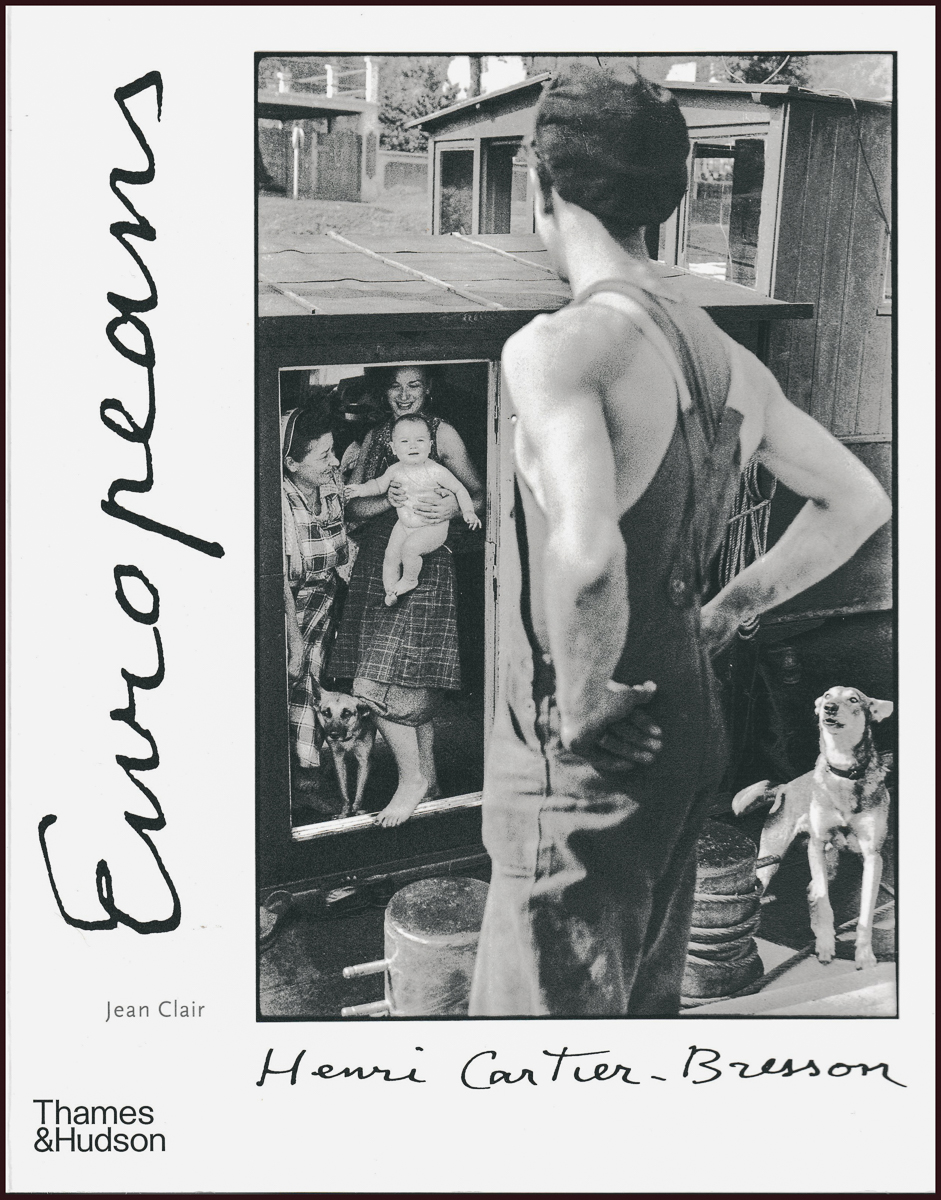
So when I was compiling my Christmas Amazon wishlist (the best way for my family to buy me gifts that I actually want) I included a couple of books about him. This is the first. It’s called “Europeans” and in his introduction, Jean Clair states:
In 1955 a collection of photographs called Les Européens was published. It was conceived and designed by Tériade, with a jacket by Jen Miró. Henri Cartier-Bresson had worked on it for five years, a short period if one considers that the celebrated photographs in Images à la Sauvette (1952, published in English as The Decisive Moment) were selected from work spanning twenty years. The book offered a closely woven portrait of Europe after the war: accumulated ruins and the marks of hunger and woe on people’s faces still appearing very clearly.
After that it was all downhill for the introduction as far as I was concerned. I didn’t know who Mr. Clair was so I looked him up. He’s described as follows:
Jean Clair is the pen name of Gérard Régnier (born 20 October 1940 in Paris, France). Clair is an essayist, a polemicist, an art historian, an art conservator, and a member of the Académie française since May, 2008. He was, for many years, the director of the Picasso Museum in Paris. Among the milestones of his long and productive career is a comprehensive catalog of the works of Balthus. He was also the director of the Venice Biennale in 1995.
I suppose I shouldn’t have been surprised by what followed in the introduction: lots of big, arcane words and tortured sentences. The following is fairly typical:
Now, as a wizard of speed, he needed a certain lightness of touch, something airy, mercurial. Hermes, god of commerce and thieves, could well be the god of photographers. With quicksilver as the escutcheon of his equipment, this disciple of hermetic knowledge, borrowing the the powers of the god with winged hat and shoes, sets out to purloin the the fulgurating moment at the crossroads of appearances and to conserve something of Mercury’s spark.
Maybe it’s just me, but I don’t relate well to this kind of “criticspeak”. When I was in university many years ago I had to read a book by Messrs. René Wellek and Austin Warren. I can’t remember the title (I’ve probably blotted it out) but it was something to do with principles of literary criticism. Their best know work seems to be Theory of Literature, but that title doesn’t ring any bells. Anyway I read that book from cover to cover and after I finished it I found that I couldn’t remember a single thing. Still, I remember thinking that the book must have been important or why would they have made us read it. So I read it again with the same result. Maybe now I’m older I should read it again. Who knows – third time lucky.
But on to the pictures. They are of course remarkable, for the most part. We’re so used to seeing Cartier-Bresson’s masterpieces that it’s easy to forget that not all of his pictures fall into that class. Of the 200 or so pictures I only really liked about 43.
Unfortunately, it’s not immediately obvious how the photographs are organized. There’s no table of contents and at first I thought that the pictures were randomly organized. However, after a bit of study I realized that they are in fact organized by country, but that the order of the countries is not alphabetical. Rather it goes as follows (with the number of photographs for each country in parentheses): France (36); Portugal (7); Spain (18); Italy (20); Switzerland (5); Yugoslavia (5); Greece (6); Turkey (5); Romania (4); Hungary (3); Austria (3); Germany (16); Belgium (1); Netherlands (3); Poland (6); USSR (17); Sweden (3); Denmark (1); UK (13); Ireland (10).
Still despite the minor criticisms I really enjoyed the book.
Now on to the second book: Henri Cartier-Bresson. The Modern Century , but first I have to figure out how to read it comfortably. It’s longer, bigger and heavier that the above book.