Rock cairn

Taken at one of the beaches on our lake. One of the interesting things about this cairn is that it wasn’t always there. In fact even though I visit this beach every few days while walking the dog I’ve never seen it before. At first I thought that maybe I’d missed it, but I have some other pictures taken from a similar viewpoint and it’s definitely not there. I can only assume that someone has recently piled up these rocks.

It was a windy day and I liked the way that the water was rushing around the rocks.

Philipstown Depot Theatre

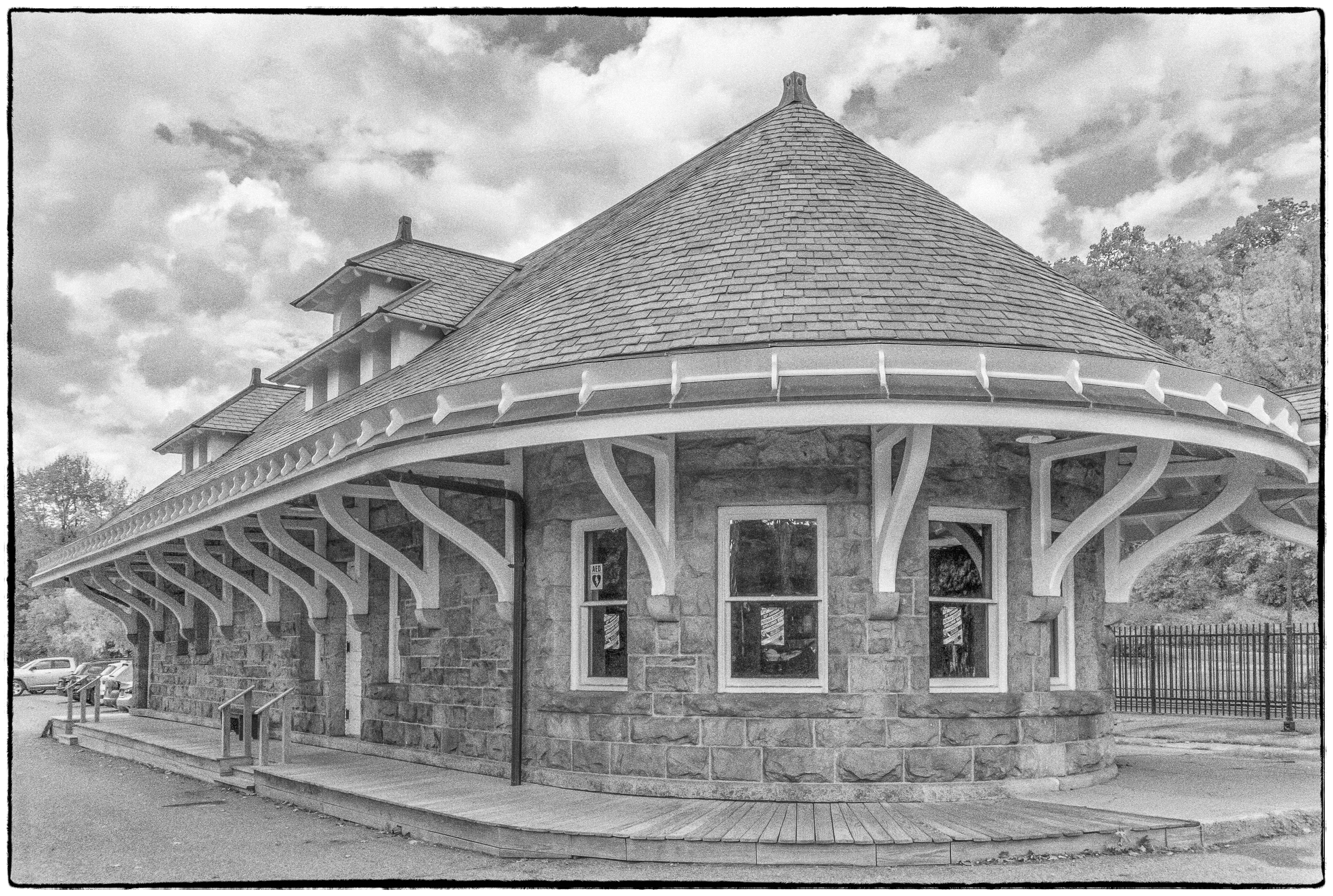
We recently went to the Philipstown Depot Theatre, which is housed in the former Garrison railway station.

The i Ride the Harlem Line site describes the station as follows:

If you’re looking for attractive views along the Hudson, Garrison might be the station for you. Garrison station is located along the waterfront, and from there are lovely views of West Point on the river’s opposite bank. Due to the proximity to West Point you may think that the name derives from some military installation, however the name is a reference to the Garrison family. The first Garrisons arrived in the area in 1786, but it wasn’t until 1803 that Harry Garrison purchased waterfront property that the area became known as Garrison’s Landing. The name caught on, largely because of the ferry to West Point, established by the Garrisons in 1829. When the railroad arrived, and a station established, the name became permanent – though over the years it has morphed from “Garrison’s” to just “Garrison.”

Today’s train station is located just shy of 50 miles from Grand Central, in the un-electrified territory of the Hudson Line. The old stone station, just north of Metro-North’s station, still stands and is in use by the Philipstown Depot Theatre. Completed in 1893, the station was built by William H. LaDue, who was also responsible for the construction of several other stations in the area. Right next to the old station is the entrance to a tunnel leading under the tracks, built in 1929. The newer platform, used by Metro-North, consists of two side platforms, connected by an overpass. Thus Garrison is one of very few Metro-North stations to have both a tunnel and an overpass.

In railroad lore, Garrison may unfortunately be remembered for the terrible train crash that occurred on October 24, 1897. A nine-car train, containing six sleeper cars, left Albany at 3:43 AM and derailed just south of Garrison station at around 5:46 AM. The engine and several train cars were thrown into the river, and eighteen of the nineteen people that perished drowned in the Hudson. Among the casualties was the engineer, at 35-year veteran of the New York Central, and the fireman, who had been working for the railroad for seven years.

Source: Tuesday Tour of the Hudson Line: Garrison.

I’ve been to this building before, and have always assumed that because of its size (it’s quite small) it was only the ticket office and that the theater was located elsewhere. That’s not the case, however as we discovered when we went to see our friend Paul (see Paul and Family and 
Quoth the Raven, ‘Nevermore’) direct, and perform in, a one act play – one of a number featuring in a local competition. We discovered an 80 seat theatre and a small refreshments area in this small building. We enjoyed the performances and Paul’s play was one of three chosen to go through to the next phase of the competition.


A pair of pigeons

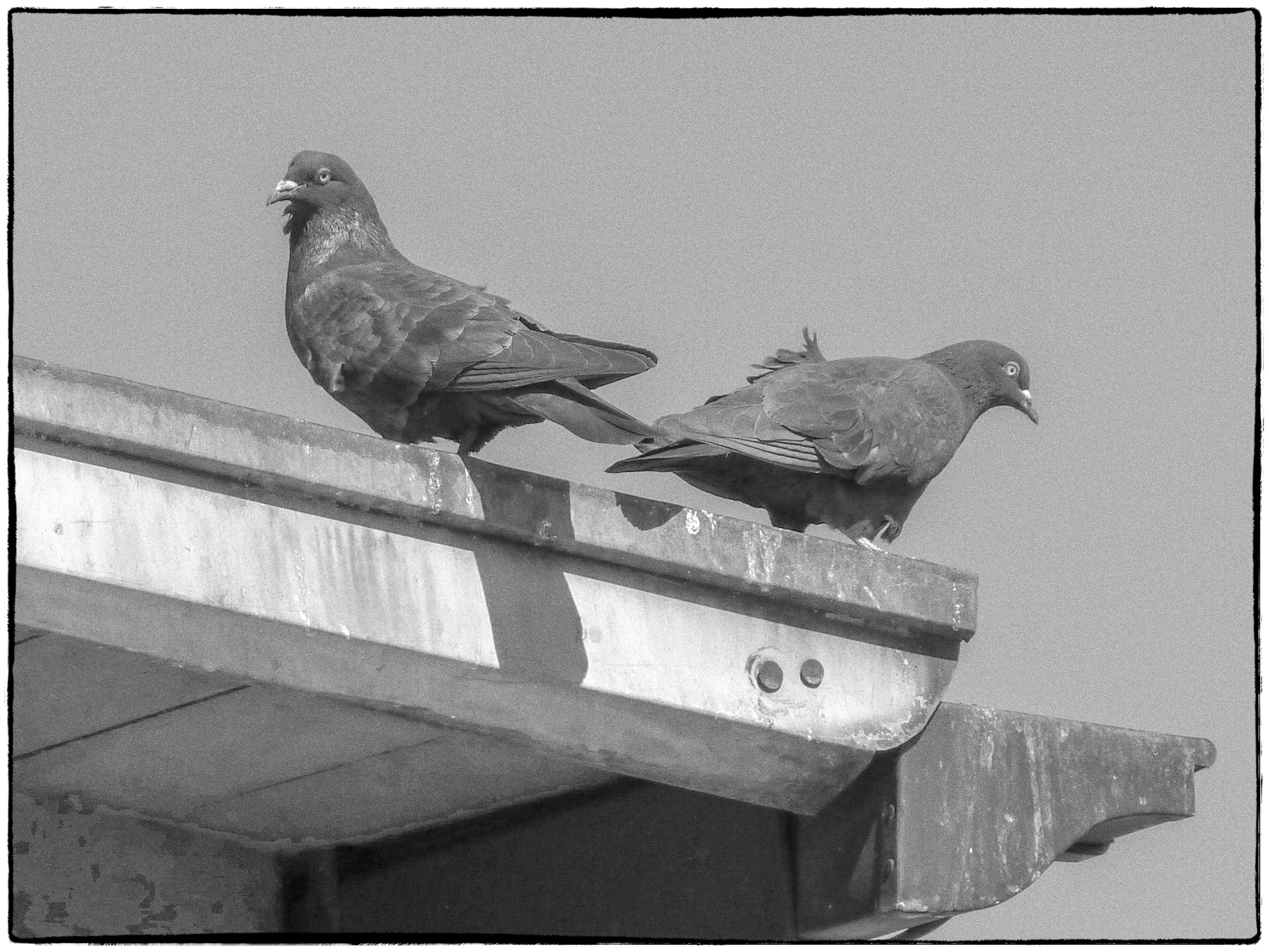
I have a very clear memory of taking this picture. We were in Copenhagen visiting our older daughter and her family. I’d gone with my grandson to his piano lesson. We’d been driven there, but were expected to make our own way home. I recall that we were taking the train so we walked to the nearest station and while we were waiting for the train to arrive I spotted these two pigeons on the roof.

It was taken in May, 2011 with a Panasonic Lumix ZS3 – a compact 10 megapixel point and shoot camera. Yes the images were noisy and the focus tended to lag. In poor light it was next to useless. But it was very small and light and had an excellent 12x zoom. It took more than adequate pictures in good light. I have many pictures that I would never have gotten at all otherwise because: 1) I probably wouldn’t have had a camera with me; and 2) even if I did have a camera a shorter focal length lens would not have allowed me to get the picture.

Sir Arthur Conan Doyle and photography

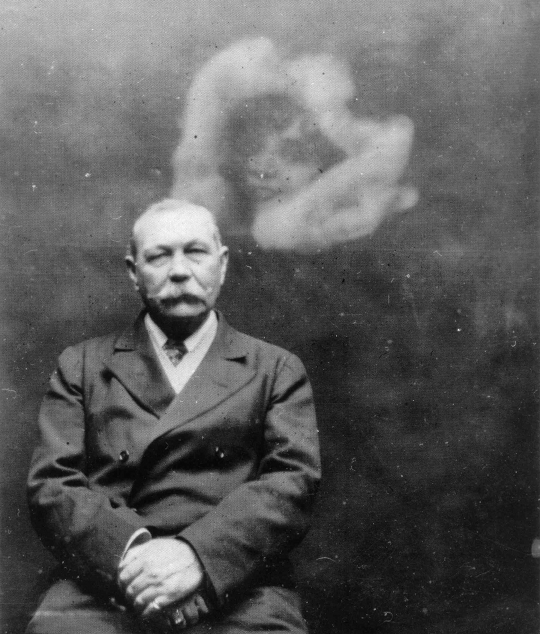
Spirit photograph of Arthur Conan Doyle taken by the ‘spirit photographer’ Ada Deane in 1922, the same year in which Conan Doyle’s The Coming of the Fairies was published via The Public Domain Review

In the winter of 1920, readers of the popular British magazine the Strand found a curious headline on the cover of their Christmas issues. “FAIRIES PHOTOGRAPHED,” it said. “AN EPOCH-MAKING EVENT DESCRIBED BY A. CONAN DOYLE.” The Strand’s readership was well acquainted with Sir Arthur Conan Doyle; most of his wildly popular Sherlock Holmes stories had appeared for the first time in its pages. The great man’s claim that fairies –real fairies – had been photographed in the north of England by two young girls wa

Source: Sir Arthur and the Fairies | The Public Domain Review

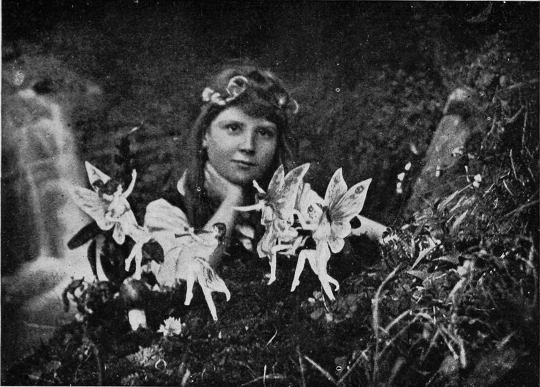
The first fairy photograph, featured in Conan Doyle’s The Coming of the Fairies (1922) Via The Public Domain Review

The fairy pictures seem to me to be obvious fakes, but perhaps when photography was young this was not quite so obvious. Maybe in those days people we more willing to accept the veracity of photographs than they are today when we all know how easy it is to manipulate a photograph. Although he doesn’t seem to have been a very active photographer himself, Doyle had 13 articles on photography published by the British Journal of Photography. He also wrote a book called “The Case for Spirit Photography”.

And now to the real reason for this post. I’m feeling quite pleased with myself at the moment. Of course I’ve seen Sherlock Holmes movies and the various TV series. And I have a vague memory of having to read some Holmes in High School (as I recall I didn’t enjoy it much at the time). I can’t remember ever reading Sherlock Holmes just for the fun of it. So I’ve just worked myself through the complete Sherlock Holmes: 4 novels and 56 short stories. Phew!! For the most part I enjoyed the experience even though some of the stories were fairly ordinary.