
My wife and one of the grandchildren in our lake. I hope it conveys some of the love I feel for my family.
Photographs and thoughts on photography and camera collecting

My wife and one of the grandchildren in our lake. I hope it conveys some of the love I feel for my family.

My father grew up on a farm and although he never really wanted to be a farmer (if he had he would have stayed there) he retained an interest in “things agricultural” for the rest of his life. One manifestation of this was his inability to ignore any traction engine rally taking place in the vicinity. What’s a traction engine you may ask? You can find some pictures of these magnificent beasts in this Wikipedia article, which describes them as follows (note the sentence in bold below. This type of fair is what I mean by a “traction engine rally”):
A traction engine is a self-propelled steam engine used to move heavy loads on roads, plough ground or to provide power at a chosen location. The name derives from the Latin tractus, meaning ‘drawn’, since the prime function of any traction engine is to draw a load behind it. They are sometimes called road locomotives to distinguish them from railway locomotives – that is, steam engines that run on rails.
Traction engines tend to be large, robust and powerful, but heavy, slow, and difficult to manoeuvre. Nevertheless, they revolutionized agriculture and road haulage at a time when the only alternative prime mover was the draught horse.
They became popular in industrialised countries from around 1850, when the first self-propelled portable steam engines for agricultural use were developed. Production continued well into the early part of the 20th century, when competition from internal combustion engine–powered tractors saw them fall out of favour, although some continued in commercial use in the United Kingdom well into the 1950s and later. All types of traction engines have now been superseded, in commercial use. However, several thousand examples have been preserved worldwide, many in working order. Steam fairs are held throughout the year in the United Kingdom, and in other countries, where visitors can experience working traction engines at close hand.
In many ways the traction engine was the precursor to these old (but not as old as the traction engines) tractors. So when, in September 2013, I read an announcement of this old tractor show at Tilly Foster Farm I felt a sense of excitement. The sense of excitement continued tinged with a certain awe that I always feel when encountering old technology. However, it was also tempered with a little sadness. I had always accompanied my father on his traction engine excursions and would never be able to do so again.
Did I try to convey this excitement, awe and sadness in the photographs? I don’t recall that I did. Should I have tried to do so? Maybe, although as I write this I’m unsure how I would have made the photographs different in order to do so. I guess I still have difficulty getting a photograph to convey emotions.

In a recent post: Soul/Creativity on his Photos and Stuff blog, Andrew Molitor provides the following quote (which he attributes to Ansel Adams):
The final image you achieve will, to quote Alfred Stieglitz, reveal what you saw and felt. If it were not for this element of felt, the term creative photography would have no meaning.
For many years I had difficulty with the first part of this quote: revealing what I saw. My failure to do this almost led me to abandon photography. I didn’t develop or print my own film so my options were limited. This changed (although it took me a while to realize it) with the advent of digital photography and now, with a little help from Lightroom and even less from Photoshop I’m able to get an image, which is much closer to what I thought I would get when I pressed the shutter button.
The second part of the quote suggests that I should also try to reveal what I felt when I took the picture. I hadn’t thought much about this aspect. My first reaction was to think that I didn’t really feel much at all. But then it occurred to me that I’m not, I hope, some kind of psychopath who doesn’t feel anything at all. I must be feeling something. I just have to try harder to articulate what it is.
Unfortunately, I often look back on old photographs and rework them. This particular picture was taken in 2013 so my memory of what I felt at the time is a bit vague. I imagine, however, that it was something along the lines of “Aw how cute! The little one is trying to hide behind the other one”. Ok, maybe not the deepest, or most thought provoking feeling, but that’s probably it.
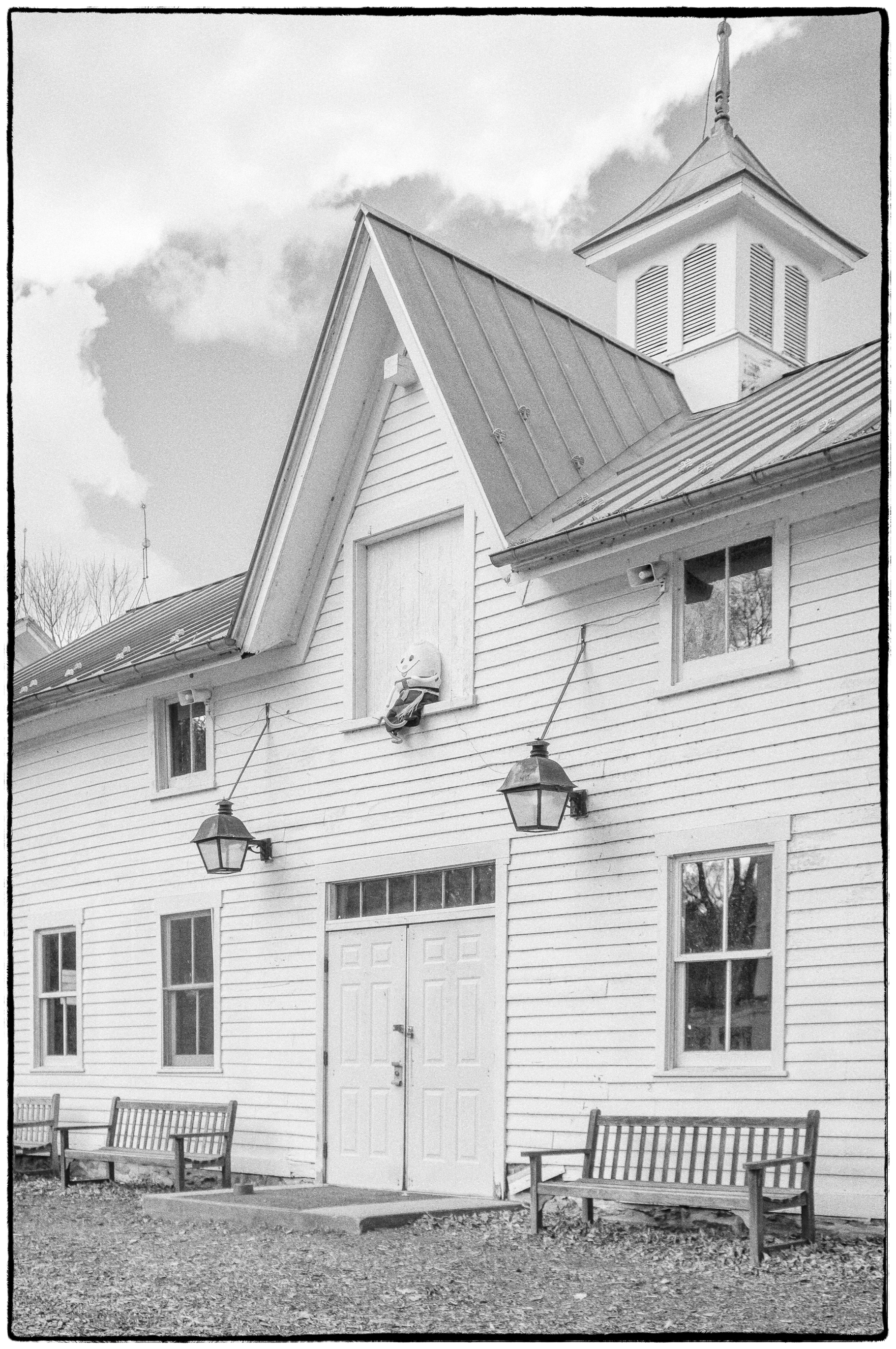
I like old buildings. They evoke in me a feeling of nostalgia for earlier times. So this one definitely caught my attention. As I looked more closely a sense of amusement started to take over. At first I didn’t see it, but after a while I noticed the rather incongruous ‘Humpty Dumpty‘ sitting in the upper area between the two lamps. What on earth is that doing there? True – this was shortly before Hallowe’en, but I’ve never thought that old humpty was particularly associated with that event. Should we be singing “Humpty Dumpty sat on a barn. Humpty Dumpty had a great….”
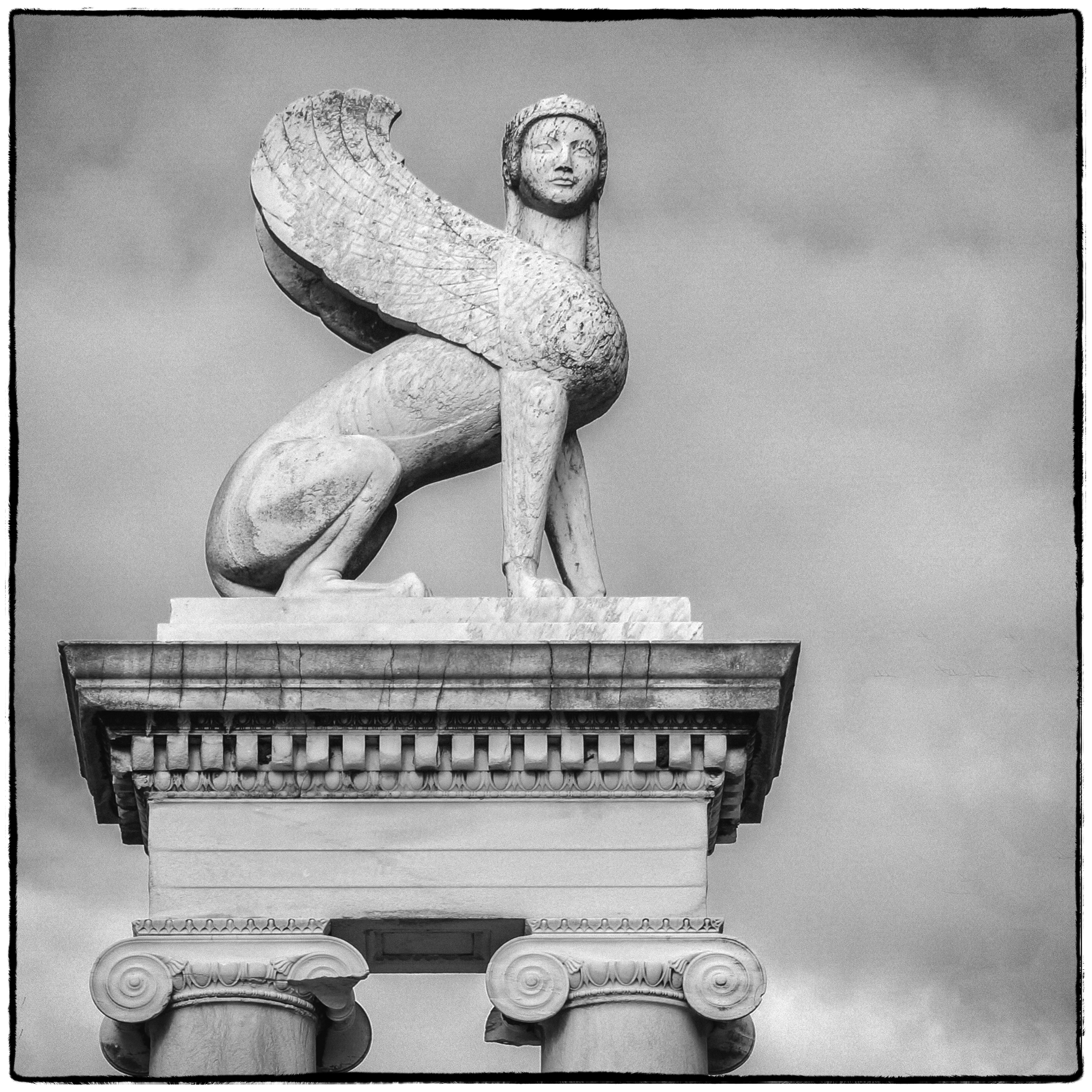
We just had some visitors so as we usually do we prepared a fairly extensive meal and afterwards took them to a nearby attraction: Chuang Yen Monastery. They’ve decided to reciprocate by inviting us later this month to a meal at their home in Hastings-on-Hudson followed by a visit to Untermyr Gardens in Yonkers, NY.
I’ve been to the park before (see Untermyr Park, Yonkers, NY). The picture above is from that visit in January, 2012. The sphinx is one of two sitting on top of very impressive tall double columns. The date tells all: it was the middle of Winter and the park was quite bare and of course none of the flowers were blooming. I’m looking forward to returning when things are in bloom. After the visit I also realized that there was an entire section of the park (closer to the Hudson and the Old Croton Aqueduct) that I missed during that visit (It was cold and I didn’t hang around long enough to explore thoroughly). I’m hoping to find and check out that area too. Should be fun!