
These players were performing at the large Elephant’s Trunk Flea Market in New Milford, Ct.
Taken with a Pentax ZX-L, SMC Pentax-F 35-70mm f3.5-4.5 and Tri-X 400.
Photographs and thoughts on photography and camera collecting

These players were performing at the large Elephant’s Trunk Flea Market in New Milford, Ct.
Taken with a Pentax ZX-L, SMC Pentax-F 35-70mm f3.5-4.5 and Tri-X 400.
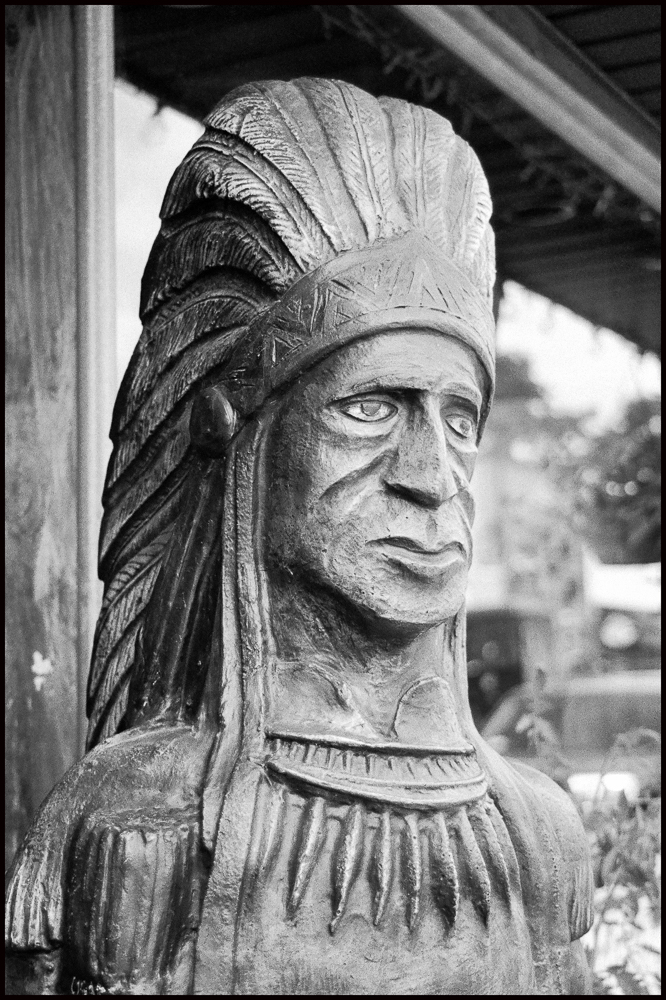
This wooden figure stands outside Smalley’s Inn in Carmel, NY.
According to Wikipedia:
The cigar store Indian or wooden Indian is an advertisement figure, in the likeness of a Native American, used to represent tobacconists. The figures are often three-dimensional wooden sculptures several feet tall – up to life-sized. They are still occasionally used for their original advertising purpose, but are more often seen as decorations or advertising collectibles, with some pieces selling for hundreds of thousands of dollars. People within the Native American community often view such likenesses as a caricature or as depictions that perpetuate stereotypes, drawing an analogy to the African-American lawn jockey.
Because of the general illiteracy of the populace, early store owners used descriptive emblems or figures to advertise their shops’ wares; for example, barber poles advertise barber shops, show globes advertised apothecaries and the three gold balls represent pawn shops. American Indians and tobacco had always been associated because American Indians introduced tobacco to Europeans, and the depiction of native people on smoke-shop signs was almost inevitable. As early as the 17th century, European tobacconists used figures of American Indians to advertise their shops.
Because European carvers had never seen a Native American, these early cigar-store “Indians” looked more like black slaves with feathered headdresses and other fanciful, exotic features. These carvings were called “Black Boys” or “Virginians” in the trade. Eventually, the European cigar-store figure began to take on a more “authentic” yet highly stylized native visage, and by the time the smoke-shop figure arrived in the Americas in the late 18th century, it had become thoroughly “Indian.”
Taken with a Pentax ZX-L, SMC Pentax-F 35-70mm f3.5-4.5 and Tri-X 400.

Above:Marker in a Patterson, NY cemetery.
I’m pleased to say that, unlike the last two Pentax SLRs I acquired (which were dead on arrival) this one worked perfectly. Film loading and unloading was easy. Although uninspired pictures they were all well exposed (if a little contrasty possibly because of the combination of Tr-X 400 and the bright mid day light) and well focused. The camera was so light I could have easily have carried it around all day. I particularly liked the use of a switch around the shutter release to adjust aperture, shutter speed etc.
I tend to frame quite tightly and the only quibble I have is that in some of the pictures the framing was off. This has happened to me with other cameras. I have to remember to frame more broadly in future.


Taken with a Pentax ZX-L, SMC Pentax-F 35-70mm f3.5-4.5 and Tri-X 400.
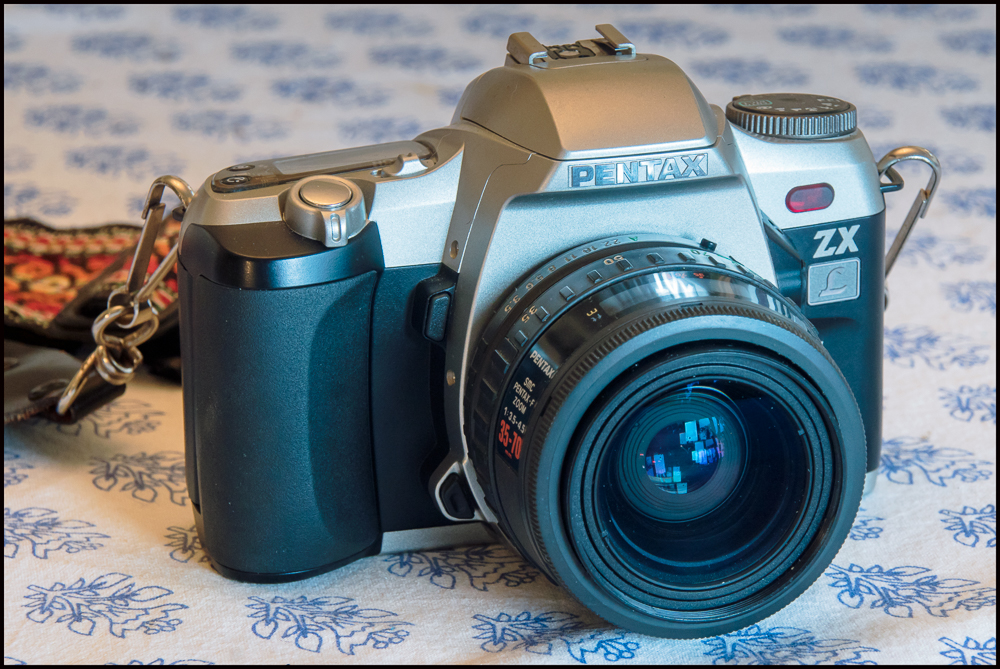
In an earlier post (See: A couple of Pentax autofocus SLRs). In that post I noted that I had purchased two Pentax autofocus SLRs and that neither of them had worked. I also said: “So if there’s a message here it’s probably that it’s wise to avoid Pentax ZX series cameras, attractive though they may be”.
Famous last words. I decided that I wouldn’t let my frustration with the last two get in the way of trying out what appeared to be an interesting line of cameras, and one that I hadn’t yet tested. And in any case they’re so inexpensive that the degree of risk was small so I got another one.
Feature rich and small and light the ZX-L easy and fun to use. It has the pretty much all the features that anyone would need, but is so easy to use that nothing impedes the user experience.
The camera has a quality feel: solid and well made even if it is mostly made of plastic. It’s easy to hold and is not tiring to use. It has dedicated controls for most functions.
Turn the ring around the mode dial to select the shooting mode.
The camera has a KAF2, with a manual aperture coupling which makes it compatible with K and M series lenses as well as later autofocus lenses. FA J and DA lenses also work because of the on-body aperture control. I’m not a user of Pentax DSLRs, but I’ve read that the control layout is similar.
I’ve read that the flash system is very flexible, but since I barely use flash this is unlikely to be an issue for me. There is also a built in flash.
The camera features three-point autofocus, which generally works well but which, under certain conditions (I’m not exactly sure that there was a clear pattern as to which) seemed to hunt a little. You can’t choose a specific AF point, but that’s fine with me as I generally use a central spot anyway and this is available via a dedicated switch. Although I haven’t used the camera with manual focus lenses I’ve read that in this case a “green diamond” will light up in the viewfinder (accompanied by a beep) to confirm focus.
It has a multiple exposure mode, which it’s unlikely I’ll ever use
Some features I liked: a backlit, illuminated LCD which comes on automatically when conditions get dark; depth of field preview; AE lock; 1/4000 second shutter speed; good, if a little small viewfinder display; toggle switch around the shutter release to change aperture, shutter speed etc.
The camera also has a number or custom functions:
Auto bracketing range in EV:1/2 EV; 1/3 EV; 2/3 EV; 1 EV.
Reset to single fram after autobracket: Yes/No.
Shutter release delay time with remote controller: 3 sec; immediate.
Autofocus-activation with the remote control: Off; On.
Meter method w/ AE lock: Spot; Multi-segment.
AE lock when subject in focus: Off; On.
Autofocus method in Action mode: Continuous; Focus Lock.
LCD illumination mode: Shutter release half down, in the dark; when preview button is pressed; Not illuminated.
Power On illumination pattern: Regular; Irregular; No illumination.
Leader In/Out on rewind: In;Out.
Wireless flash affect on built-in flash: Master mode (flash is fired); Controlled (flash not fired).
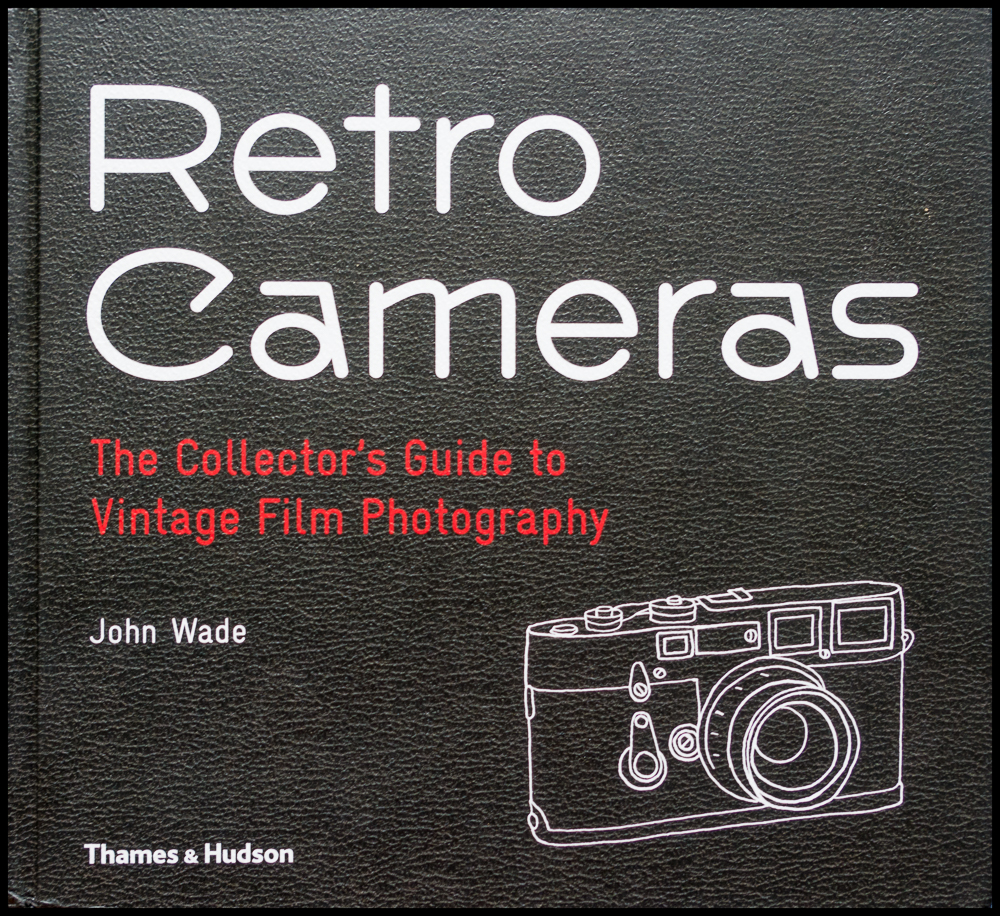
If so then this might be a book for you. It tells the story behind 100 vintage film cameras.
An introduction touches on issues of value and rarity and then goes on to explain the purpose and structure of the book:
After discussing some of the often forgotten basics, each section deals with a type of camera and how to use it, aiming at the photographer contemplating using a manual or semi-automatic film camera for the first time. The cameras listed are all practical propositions for a retro photographer with a reasonable budget. Each one has been carefully chosen as a typical example of a camera from its era. A comprehensive glossary at the end of the book gives definitions of terms that might be unfamiliar to photographers in the digital age.
This is followed by a section on each type of camera:
The book concludes with a section on retro accessories (exposure meters; rangefinders; flashguns, tripods, filters, close-up attachments, focal-length adapters, stereo accessories.
The book is nicely made with a good, solid cover and glossy pages. It’s also lavishly illustrated.
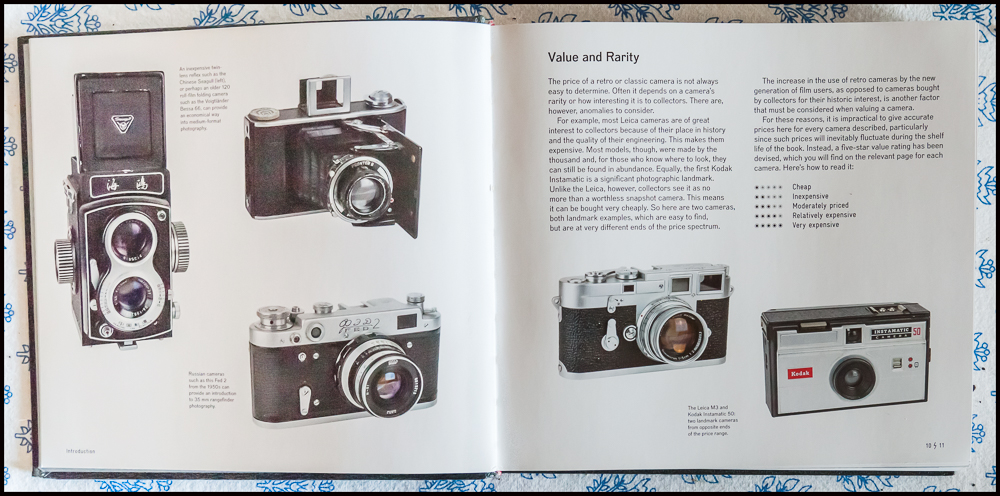
While the selection seems a little idiosyncratic I doubt that you’ll ever one that all retro camera aficionados will agree on.
There’s a useful review of the book on Cameralabs. It concludes as follows:
There’s no shortage of camera history books around, but few that look this good. Of those that do, Retro Cameras stands out for Wade’s curation, compiling a compelling collection of well-known and unusual models with great-looking product photography throughout and just the right amount of text to inform without becoming a dry reference volume. Recommended whether you’re a collector, historian, camera geek or lover of a good coffee table book. Suffice it to say, it’s a great gift for photographers who love older cameras.
I couldn’t agree more.