
Seen on one of the structures in a nearby playground. I assume it’s some kind of device that children would play with. I have no idea what it’s called. I just liked the colors and the repeating pattern.
Taken with a Vivitar 35ES.
Photographs and thoughts on photography and camera collecting

Seen on one of the structures in a nearby playground. I assume it’s some kind of device that children would play with. I have no idea what it’s called. I just liked the colors and the repeating pattern.
Taken with a Vivitar 35ES.
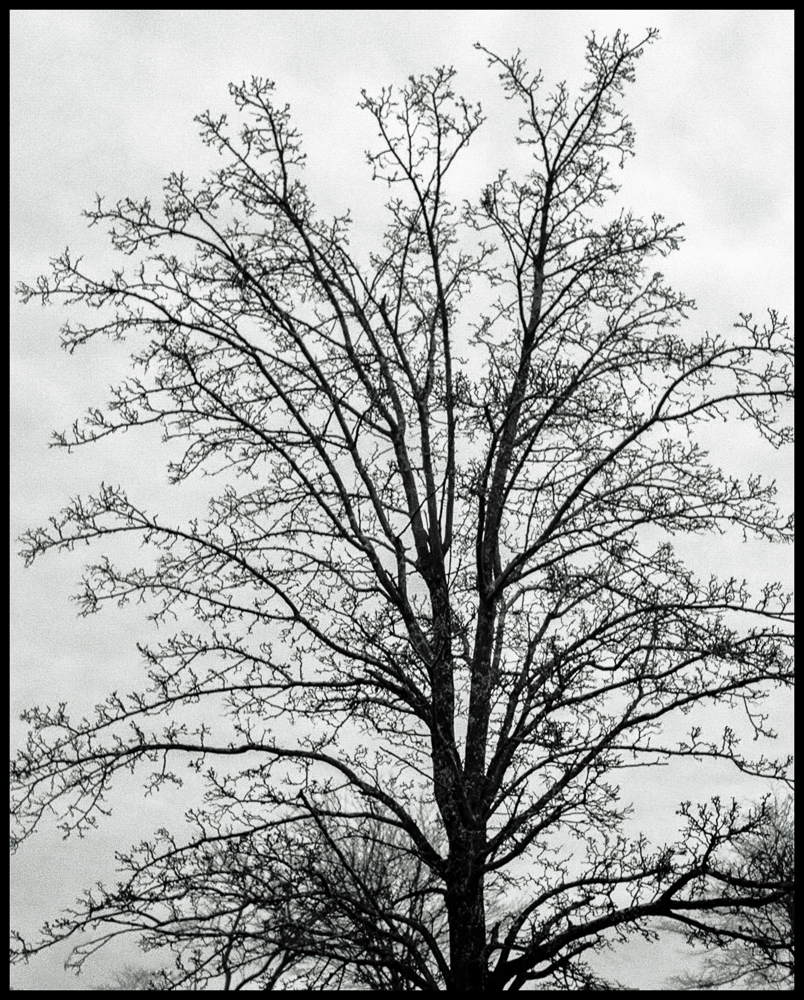
I liked the shape of the bare branches against the sky and decided that I silhouette would work well.
Taken with a Vivitar 35ES.
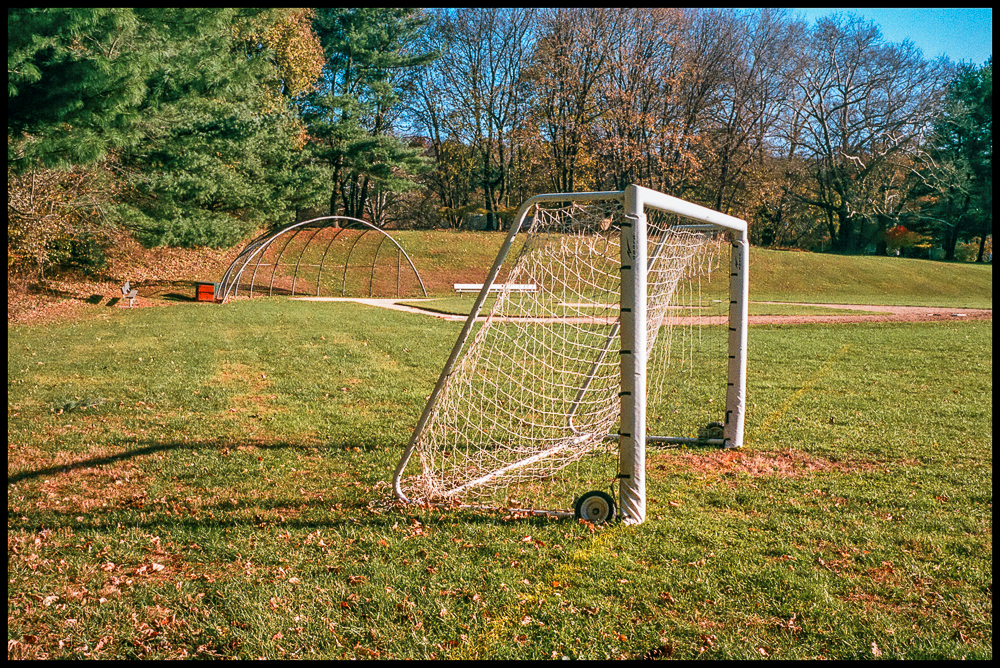
This was the first exposure I made using the Vivitar 35ES. I’d taken the dog for a walk in our neighborhood and we reached a small park with playing fields and a small playground for children.
It was late in the day and the light was appealing and, in addition to the colors, I liked the composition with the goal posts in the foreground and the other structure to the rear. I believe this has something to do with baseball, but I don’t know enough about baseball to know what it’s called.
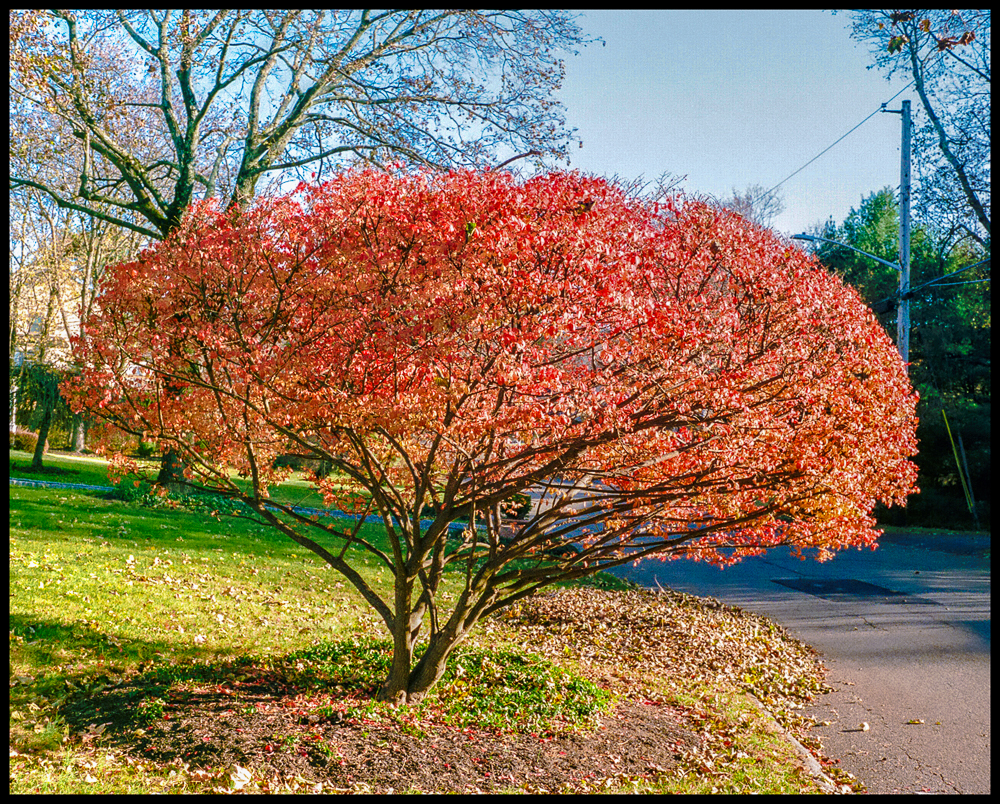
This is my October 2017 film camera. It’s taken me a very long time to complete this roll of film. As you can see from the picture above I started to use it towards the end of November, 2017 (today is 6 February 2018)! There a number of reasons for this. First my wife had a serious car accident December 1. Our car was totaled, but thankfully my wife received only bumps and bruises – painful, but not life threatening. However, she needed to be tended for a while so I wasn’t able to get out much. Just as she was starting to recover the weather got really cold and I didn’t feel like going out. Then one day while making a fire I managed to drop a fairly heavy log onto my sock-covered foot. That slowed me down for a while.
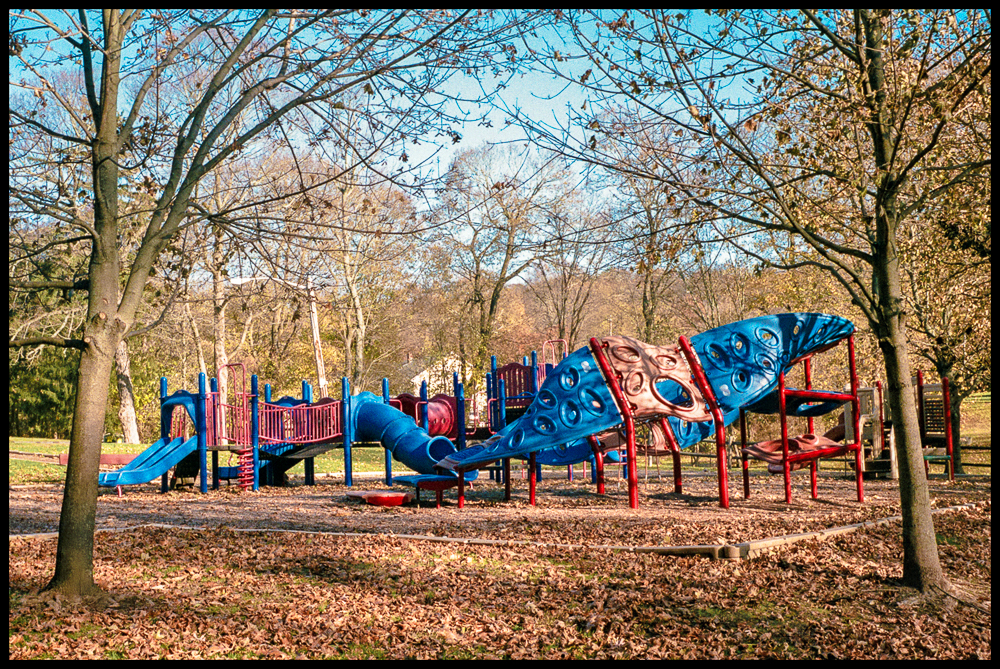
It’s still cold, snowy and icy so I’m still not getting out that much, but I’m hoping to do so more in the near future.
Generally I think the camera performed very well. I, however, made a number of “rookie” mistakes. I missed one frame because I forgot to remove the lens cap (I guess I haven’t used a rangefinder camera in a while). Then on a couple of occasions I rested my finger on the top of the camera in such a way that it prevented the film from advancing correctly and caused a few inadvertent double exposures (at least one of which was quite interesting). At first I didn’t realize what was going on. I heard a strange grading noise, but didn’t make the connection with the location of my finger.
As mentioned in the earlier post the viewfinder is surprisingly bright and the rangefinder patch fairly clear. This is not always the case with compact rangefinder cameras of this vintage. Often the viewfinders are dim and cloudy.
The lens is every bit as good as internet reviewers say it is. Exposure was as anticipated.

So the camera did everything asked of it. Unfortunately, I didn’t altogether enjoy the experience. My first serious film camera was a Minolta Hi-Matic 7sii. It was a gift from my wife early in our relationship and I have a very strong emotional attachment to it. When I started collecting cameras I thought I would build a collection of similar compact cameras. I now have a number of them.
I suspect, however, that my aging eyes are no longer up to cameras like this. Even though the viewfinder is bright and the rangefinder patch was pretty clear, I had difficulty using the rangefinder – more difficulty than I’ve had with vintage SLRs.
Moreover, I’m not convinced that rangefinders are the best option for my type of photography either. I think of rangefinders being best suited to genres like street photography where you need something small, light, unobtrusive and where you can see things moving into the frame (think Henri Cartier-Bresson). Unfortunately that’s not my type of photography. I tend to take pictures of things that don’t move: old buildings, old objects, still life, landscapes etc. It’s only taken me nearly 40 years to figure this out.
I’m not going to give up on rangefinders yet though. I’d like to try a rangefinder with a larger viewfinder (e.g. I have a Canon P; A Voigtlander Bessa R2 and some others). If that fails then I can see an autofocus SLR in my future.

A few days before Christmas my wife was going to lunch with a friend in Pleasantville, NY. I needed to get out of the house so I decided to go along with her. I knew that there was a small bookstore in Pleasantville and I thought that I would “check it out” and then grab a bite to eat.
I set off walking in the direction of the bookstore when I spotted this photo store: Photoworks. I’d noticed it before, but it always seemed to be closed when I went by. Assuming that it was largely devoted to photofinishing, scanning etc. I was about to walk by when, looking through the window, I noticed a glass case inside – full of vintage cameras. I went in and asked the women if the cameras were for sale or just for display. She called her husband, George who emerged from the back somewhere and we had a long conversation about vintage cameras. Inside the case were two Nikon Fs (see above). I’d wanted one of these for a while, the price was right and the prospect of actually having a human being I could bring the camera back to in case of problems was appealing. I told him I would consult with my wife and return later.

I continued on to the bookstore: The Village Bookstore, a very pleasant establishment, small but well stocked and with a nice atmosphere. Among the shelves I came across (and purchased) this recently published biography of Robert Frank: American Witness. The Art and Life of Robert Frank.
Time to start looking for somewhere to eat. Then I spotted this building. On the front it said “The Gordon Parks Foundation“, so I went inside to take a look. I didn’t even realize that such an institution existed in Pleasantville. Inside they had a small selection of books by/on Gordon Parks but the bulk of the space was taken up by an exhibition: Element: Gordon Parks and Kendric Lamar. According to the Foundation’s website:
The Gordon Parks Foundation announced the opening of ELEMENT – a new exhibition on view at the Foundation’s exhibition space from December 1—February 10 showcasing Gordon Parks photographs that inspired rapper Kendrick Lamar’s music video ELEMENT from his album, DAMN. Lamar, known for using powerful images in his music videos, directly references and revives a number of Parks’ images that explore the lives of Black Americans, including the 1963 photo Boy With Junebug, Untitled, the 1956 photo from Parks’ “Segregation Stories” series, Ethel Sharrieff, a 1963 photo from his “The White Man’s Day Is Almost Over” photo essay about Black Muslims, as well as photos form Parks’ 1948 “Harlem Gang Leader” series.
“Gordon Parks’ work is continuing to have a great impact on young people – and particularly on artists like Kendrick who, use the power of imagery to examine issues related to social justice and race in our country,” said Peter W. Kunhardt, Jr., Executive Director of The Gordon Parks Foundation. “With ELEMENT the music video, Kendrick has helped to call attention to one of the most important artists of our time.”
Long-time friend and supporter of The Gordon Parks Foundation, Kasseem Dean (aka, Swizz Beatz) noted, “I’m so inspired that my friend Kendrick Lamar chose the iconic imagery of the legendary Gordon Parks in his video for ELEMENT. It’s a prime example of how contemporary change makers – artists, musicians, filmmakers, designers – can borrow from the greats of the past who were also working towards social change.”
At the foundation of ELEMENT. are Parks’ photo essays exploring issues related to poverty and social justice which established him as one of the most significant story tellers of American society. “Harlem Gang Leader,” the photo essay published in LIFE magazine, is credited with introducing Parks to America. The photos explored the world of Leonard “Red” Jackson, the leader of a gang in Harlem. Soon after, Parks was offered a position as staff photographer for the magazine, making him the first, and for a long time the only, African American photographer at the magazine. Also published in LIFE, Parks documented the daily life of an extended African American family living under Jim Crow segregation in the rural South entitled “The Restraints: Open and Hidden.”
The Guardian has also published an interesting article on this exhibition: The story behind Kendrick Lamar’s Gordon Parks exhibition

After that I decided that I didn’t have enough time to eat before meeting my wife so I adjourned to a nearby bar
Foley’s Club Lounge for a couple of beers.
According to Mount Pleasant by George Waterbury, Claudine Waterbury, Bert Ruiz:
Harry Foley was a Pleasantville High School Basketball legend. He was also a Niagara University Hall of Fame and Westchester County Hall of Fame athlete. He bought Gorman’s Club Lounge on Bedford Road in 1950 and maintained the establishment until the 1970s. Foley’s Club Lounge has been a traditional watering hole for generations of Pace University students for nearly a half century.

When my wife finished her lunch we met up and I asked her if she’d like to buy me a Christmas present. She said yes so it was off back to the photo store to pick up the Nikon F with Photomic Ftn finder.
All in all a photographically speaking an interesting day, if rather unexpected.